
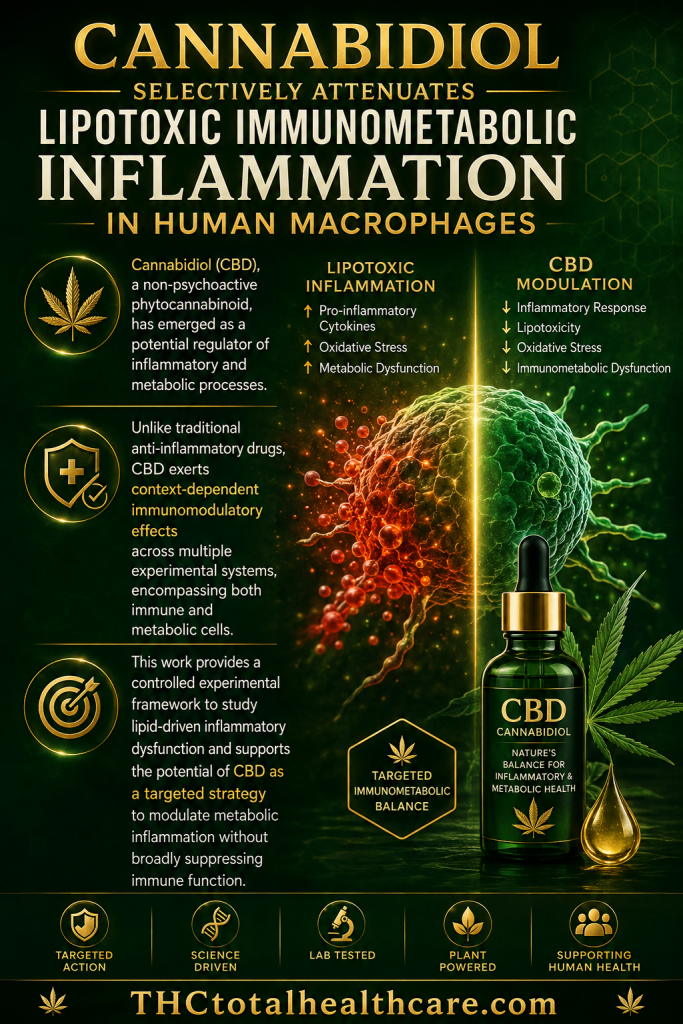
Lipotoxic inflammation caused by excess fatty acids can drive metabolic disease by altering immune-cell function. In human macrophages, cannabidiol (CBD) selectively reduced inflammatory and immunometabolic responses triggered by lipotoxic stress without broadly suppressing normal immune activity. The researchers concluded that CBD may have therapeutic potential for metabolic disorders characterized by chronic lipid-driven inflammation.
“The role of saturated fatty acid-induced immunometabolic stress in macrophage dysfunction during metabolic disease remains incompletely understood, particularly the interplay between inflammatory signaling and intracellular lipid handling.
We employed a tightly controlled palmitic acid (PA)-based lipotoxicity model in PMA-differentiated U937-derived human macrophage-like cells to investigate how lipid excess reshapes inflammatory responses and to evaluate the modulatory effects of cannabidiol (CBD).
PA exposure induced a metabolically stressed yet viable macrophage phenotype, characterized by a broad cytokine remodeling profile. This included induction of classical proinflammatory cytokines such as interleukin (IL)-6, together with activation of inflammasome-associated cytokines IL-1β and IL-18 and additional immunoregulatory mediators, while tumor necrosis factor alpha (TNF-α) contributed to the overall inflammatory profile in a multivariate analysis. These changes were accompanied by a significant, time-dependent storage of intracellular triglycerides (TG) consistent with lipid overload and altered lipid handling.
CBD co-treatment did not compromise cell viability but selectively attenuated PA-induced inflammatory response in a cytokine-dependent manner, with the most significant reduction observed at higher concentrations. In parallel, CBD significantly reduced intracellular TG accumulation under lipotoxic conditions.
Collectively, these findings define a lipotoxicity-associated macrophage phenotype driven by saturated fatty acids and identify CBD as a context-dependent modulator of immunometabolic inflammation.
This work provides a controlled experimental framework to study lipid-driven inflammatory dysfunction and supports the potential of CBD as a targeted strategy to modulate metabolic inflammation without broadly suppressing immune function.”
https://pubmed.ncbi.nlm.nih.gov/42534637
“Cannabidiol (CBD), a non-psychoactive phytocannabinoid, has emerged as a potential regulator of inflammatory and metabolic processes. Unlike traditional anti-inflammatory drugs, CBD exerts context-dependent immunomodulatory effects across multiple experimental systems, encompassing both immune and metabolic cells.”
“Overall, this work supports CBD as a context-dependent modulator of immunometabolism response in PMA-differentiated U937-derived macrophages and provides a controlled experimental framework for studying lipid-driven inflammatory dysfunction in U937-derived macrophages.”
https://www.frontiersin.org/journals/immunology/articles/10.3389/fimmu.2026.1873494/full