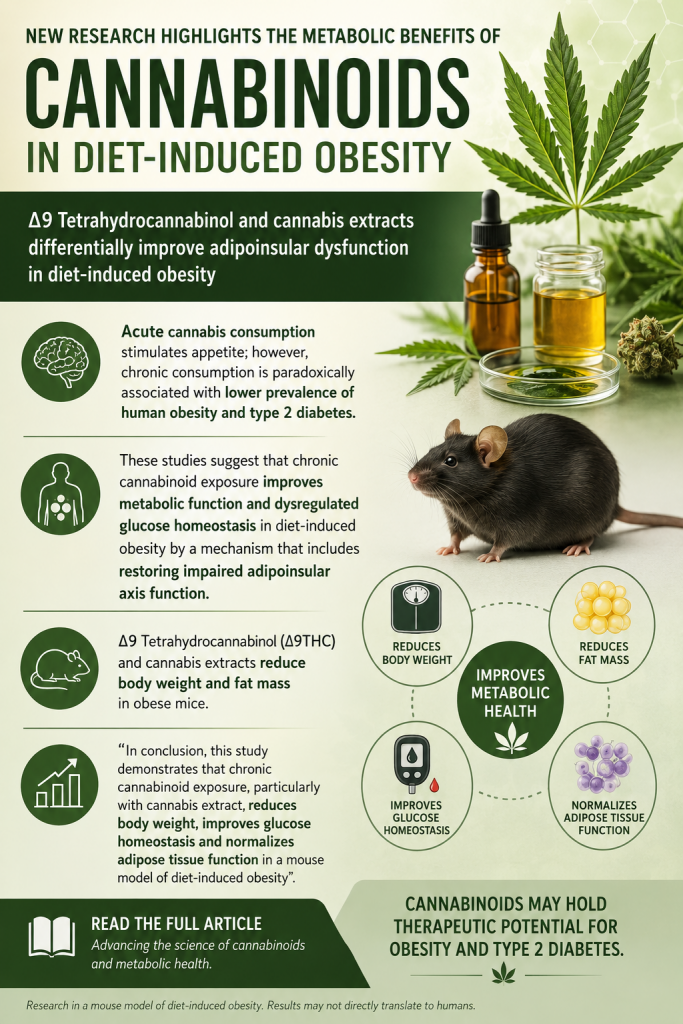
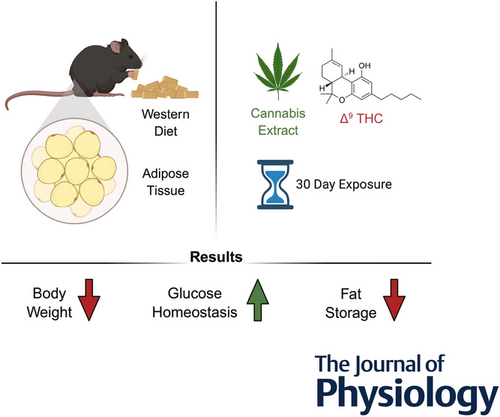
Δ9 Tetrahydrocannabinol and cannabis extracts differentially improve adipoinsular dysfunction in diet-induced obesity

THC and cannabis extracts may have important effects on obesity-related metabolic dysfunction. In this study, both THC and cannabis extracts reduced body weight and fat mass in diet-induced obese mice while improving abnormalities in adipose-tissue signaling. Cannabis extracts produced the strongest metabolic effects, more effectively normalizing adipokine expression and restoring glucose clearance to levels seen in lean mice, an effect not achieved by THC alone. The findings suggest that chronic cannabinoid exposure—particularly whole cannabis extracts—can improve glucose homeostasis, adipose function, and metabolic regulation in obesity.

“Diet-induced obesity (DIO) is associated with dysregulated adipoinsular axis and endocannabinoid system (eCBS) function. Acute cannabis consumption stimulates appetite; however, chronic consumption is paradoxically associated with lower prevalence of human obesity and type 2 diabetes.

We investigated the impact of chronic exposure to Δ9 tetrahydrocannabinol (THC) and cannabis extracts on DIO and glucose homeostasis in mice.

Male mice were fed a high-fat/sucrose diet or a low-fat/no-sucrose diet for 60 days. At day 30, mice were administered THC (5 mg/kg) or cannabis extracts matched for THC content daily for 30 days. We assessed adipocyte biology, glucose tolerance, insulin sensitivity, eCBS expression, body weight, food intake and motor activity. Roles for the eCBS in cannabis-induced changes in metabolic processes, including cellular bioenergetics, were analysed in 3T3-L1 adipocytes.

THC and extracts reduced body weight and fat mass in DIO mice, and reversed DIO-associated changes in expression of adipokines that regulate the adipoinsular axis. Extracts normalized expression of adipokines more effectively than THC. Notably, extracts – but not THC – normalized glucose clearance in DIO mice to levels found in lean mice. In addition, THC and extracts promoted anti-adipogenic effects and changes in energy metabolism in 3T3-L1 cells in a concentration-dependent manner.

These studies suggest that chronic cannabinoid exposure improves metabolic function and dysregulated glucose homeostasis in DIO by a mechanism that includes restoring impaired adipoinsular axis function.

KEY POINTS: Δ9 Tetrahydrocannabinol (Δ9THC) and cannabis extracts reduce body weight and fat mass in obese mice. Cannabis extracts, but not Δ9THC alone, improve glucose homeostasis in obese mice. Extracts more effectively normalize expression of components of the adipoinsular axis in obese mice. Δ9THC and extracts promote anti-adipogenic effects in 3T3-L1 cells. Δ9THC and extracts alter cellular bioenergetics in 3T3-L1 cells.”

https://pubmed.ncbi.nlm.nih.gov/42113966

“In conclusion, this study demonstrates that chronic cannabinoid exposure, particularly with cannabis extract, reduces body weight, improves glucose homeostasis and normalizes adipose tissue function in a mouse model of DIO. Our findings highlight the potential therapeutic value of cannabinoids in managing obesity and related metabolic disorders, though further research is needed to fully understand the underlying mechanisms and translate these findings into clinical applications.”

https://physoc.onlinelibrary.wiley.com/doi/10.1113/JP290431
Cannabinoids for Dermatological Applications: Mechanistic Insights, Clinical Evidence, and Emerging Nanotechnology-Enabled Delivery Strategies

Cannabinoids are being explored across a growing range of dermatological conditions because of their anti-inflammatory, antioxidant, antimicrobial, and pain-modulating effects. This review examines the evidence for cannabinoid-based approaches in acne, eczema, psoriasis, pruritus, wound healing, and other skin disorders, while also highlighting emerging nanotechnology designed to improve topical delivery and skin penetration. The findings show that cannabinoids can act on multiple biological pathways relevant to skin health and that advanced delivery systems may make these compounds more effective and practical for dermatological treatment.

“Cannabinoids (CBs) derived from Cannabis sativa have attracted growing interest for dermatological applications due to their anti-inflammatory, antiproliferative, antimicrobial, antifibrotic, and antipruritic properties. However, their clinical translation is significantly limited by physicochemical and pharmacokinetic challenges, including poor aqueous solubility, lipophilicity, instability, variable skin penetration, and inconsistent bioavailability.

At the molecular level, CBs modulate keratinocyte proliferation, sebocyte activity, fibroblast function, melanocyte balance, and immune signalling through CB1/CB2 receptors, TRP channels, and PPARγ pathways.

Evidence supports their potential in the treatment of psoriasis, atopic dermatitis, acne, allergic contact dermatitis, pruritus, scleroderma, and skin cancers. Clinical evidence remains preliminary: topical and oral formulations have demonstrated anti-inflammatory, antiproliferative, antibacterial, and antifibrotic effects, with improvements in pruritus, lesion severity, and quality of life in early-phase studies. However, most trials are small, uncontrolled, and lack placebo comparators, limiting generalisability.

To overcome formulation barriers and enhance dermal delivery, advanced pharmaceutical strategies such as liposomes, nanoemulsions, polymeric nanoparticles, micelles, and transdermal systems have been investigated to improve stability, controlled release, and targeted skin deposition while minimising systemic exposure.

This review integrates mechanistic insights, clinical evidence, and emerging nanotechnology-enabled delivery approaches, emphasising rational formulation design and translational considerations necessary for advancing CBs toward standardised and clinically reliable dermatological therapeutics.”

https://pubmed.ncbi.nlm.nih.gov/42076122

“In summary, cannabinoids represent a biologically plausible yet clinically evolving therapeutic class in dermatology. Advancing their role in patient care will depend on coordinated progress in mechanistic understanding, pharmaceutical design, and structured clinical validation.”

https://www.mdpi.com/1999-4923/18/4/469

Cannabinoid-Driven Rewiring of GPCR and Ion Channel Signaling in Lung Cancer

Cannabinoids may influence lung cancer through far more than the classical CB1 and CB2 receptors. This review examines how cannabinoid exposure can rewire GPCR and ion-channel signaling networks that regulate cancer-cell growth, survival, migration, calcium signaling, and treatment response. The evidence suggests that cannabinoids can disrupt multiple interconnected pathways involved in lung cancer progression, highlighting a broader anticancer mechanism than receptor activation alone. The review supports cannabinoid signaling networks as promising targets for future lung cancer therapies.

“Lung cancer remains the leading cause of cancer-related mortality worldwide, with non-small cell lung cancer accounting for the majority of cases and exhibiting persistent challenges related to therapy resistance and metastatic progression. Increasing evidence indicates that dysregulated G protein-coupled receptor signaling and ion channel activity function cooperatively as master regulators of tumor cell proliferation, migration, survival, and therapeutic response.

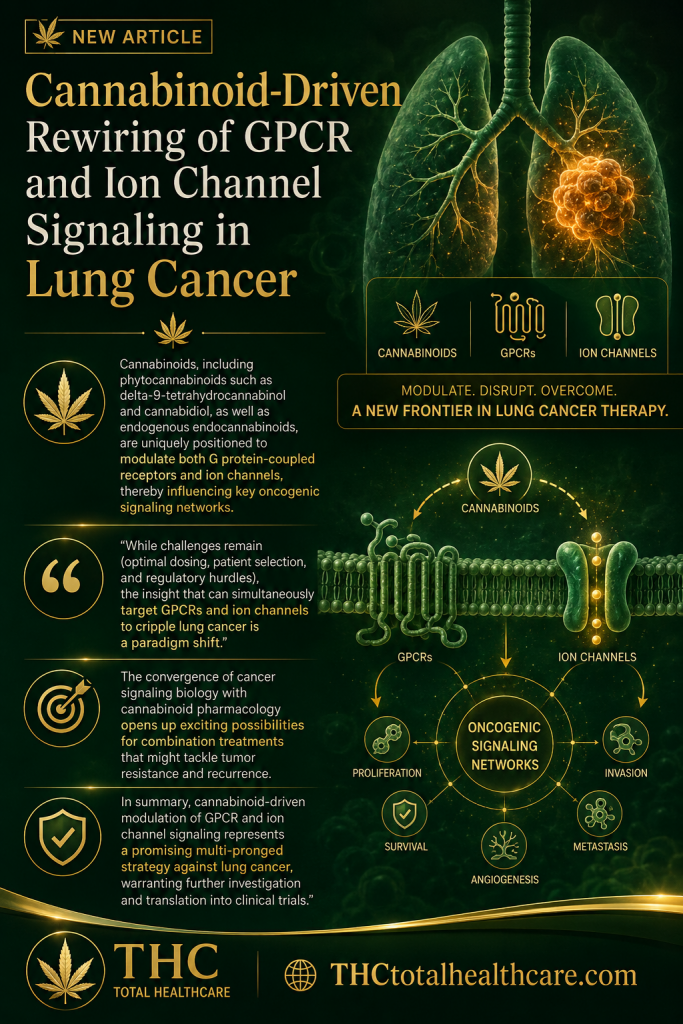
Cannabinoids, including phytocannabinoids such as delta-9-tetrahydrocannabinol and cannabidiol, as well as endogenous endocannabinoids, are uniquely positioned to modulate both G protein-coupled receptors and ion channels, thereby influencing key oncogenic signaling networks.

This review synthesizes current knowledge on the role of major ion channel families, including transient receptor potential channels, potassium channels, and sodium channels, and principal G protein-coupled receptor pathways involved in lung cancer progression. We further discuss how cannabinoids reprogram these interconnected signaling systems through canonical cannabinoid receptors, non-classical targets such as G protein-coupled receptor 55 and adenosine receptors, and direct modulation of ion channel activity.

Special attention is given to G protein-coupled receptor-ion channel coupling within membrane microdomains and to the capacity of cannabinoids to act as biased ligands, redirecting downstream pathways, such as the phosphoinositide 3-kinase-protein kinase B-mechanistic target of rapamycin and epidermal growth factor receptor signaling, toward apoptosis and reduced metastatic potential. Emerging strategies, including cannabinoid-based combination therapies, selective receptor biasing, and targeted delivery systems, are also highlighted.

Altogether, cannabinoid-driven rewiring of G protein-coupled receptor and ion channel signaling represents a promising mechanistic framework for developing innovative therapeutic approaches against lung cancer.”

https://pubmed.ncbi.nlm.nih.gov/42072396

“While challenges remain (optimal dosing, patient selection, and regulatory hurdles), the insight that can simultaneously target GPCRs and ion channels to cripple lung cancer is a paradigm shift. The convergence of cancer signaling biology with cannabinoid pharmacology opens up exciting possibilities for combination treatments that might tackle tumor resistance and recurrence. In summary, cannabinoid-driven modulation of GPCR and ion channel signaling represents a promising multi-pronged strategy against lung cancer, warranting further investigation and translation into clinical trials.”

https://www.mdpi.com/2227-9059/14/4/856

Cannabinoid receptors orchestrate distinct anti-tumour pathways in gastric cancer via and beyond specialized pro-resolving mediators

Cannabinoid receptor signaling showed potent antitumor activity in gastric cancer cells through multiple complementary mechanisms. Activation of CB1 and CB2 reduced cancer-cell proliferation and viability, induced apoptosis, impaired migration and epithelial-to-mesenchymal transition, and suppressed angiogenic activity. CB2 activation also reduced cancer stemness, while both receptors promoted production of the pro-resolving mediators Resolvin D1 and Lipoxin B4, which contributed to the anti-angiogenic effects. The findings identify a dual SPM-dependent and SPM-independent pathway through which cannabinoid receptors can restrain gastric cancer progression.

“Endocannabinoids (ECS) and specialized pro-resolving mediators (SPMs) are both lipid-based compounds, but differ significantly in origin, mechanisms, and functions. Their mechanistic interaction in cancer remains undefined, particularly in gastric cancer (GC). Several interconnections have been described between these two “bioactive lipids” involved in inflammation resolution, homeostatic and anti-tumour functions.

Cannabinoid signalling can modulate SPM biosynthesis in immune cells, thus we investigated whether this crosstalk operates in GC cells, and whether SPMs mediate part of the anti-tumour activity of cannabinoid receptors.

Using synthetic and selective agonists for the cannabinoid G-protein-coupled receptors CB1 and CB2 (ACEA and JWH133, respectively), we found that receptor activation in GC cells (AGS and MKN45) sustains the synthesis of two SPMs, Resolvin D1 and Lipoxin B4, which in turn suppresses the angiogenic potential of GC cells. These CB1/CB2-driven activities required a SRC/MAPK signalling. At physiological concentrations, these SPMs further enhanced the binding affinity of ACEA and JWH133 for CB1 and CB2, indicating a functional crosstalk between the two systems.

Beyond angiogenesis, CB1/2 stimulation reduced cell proliferation and viability, induced apoptosis, impaired the migration and the epithelial-to-mesenchymal program in GC cells. Only CB2 activation reduced the stemness properties of GC cells. Interestingly, while the anti-angiogenic properties of CB1 and CB2 required SPM production, their other anti-tumour actions were independent of the pro-resolving pathway.

Our results extend the current knowledge of the endocannabinoid system by defining a new dual mechanism, SPM-dependent and SPM-independent, that restrains GC progression and identify the ECS-SPM axis as a potential target for therapeutic intervention.”

https://pubmed.ncbi.nlm.nih.gov/41775095

“CB1 and CB2 activation sustain potent anti-tumour effects in gastric cancer (GC).”

“In conclusion, this work demonstrates that cannabinoid receptor activation restrains gastric cancer cell proliferation, migration, stemness, and angiogenesis through both SPM-dependent and SPM-independent mechanisms. By linking ECS activation to pro-resolving lipid metabolism via SRC-ERK signalling, our data position CB1 and CB2 as regulators of tumour control rather than progression. These findings open the way for preclinical in vivo studies aimed at exploiting cannabinoid-SPM crosstalk as a novel therapeutic axis in gastric cancer.”

https://www.sciencedirect.com/science/article/pii/S0753332226002192?via%3Dihub

Antiproliferative Effects of Cannabinoids and Cisplatin in Cervical Cancer Cells

Cannabinoids are being investigated as potential partners for conventional chemotherapy in cervical cancer. In this study, cannabinoid treatment reduced the proliferation of cervical cancer cells, while combination with cisplatin produced additional antiproliferative effects. The findings suggest that cannabinoids can directly interfere with cervical cancer cell growth and may also enhance responses to an established chemotherapy agent. This adds to growing evidence that cannabinoid-based compounds could have value as adjuncts in cancer treatment.

“Introduction: Cervical cancer remains a leading cause of cancer-related mortality among women globally, particularly in low- and middle-income countries. Cisplatin, a standard chemotherapeutic agent, is limited by severe toxicities and chemoresistance. This study aimed to assess the effects of cisplatin in combination with phytocannabinoids, Δ9-tetrahydrocannabinol (THC) and cannabidiol (CBD) on cell proliferation, morphology, cell cycle progression, cell death, and DNA damage.

Methods: Synergistic interactions between THC, CBD, and cisplatin were assessed in HeLa, SiHa, and MCF-12A cells using the checkerboard assay and SRB assay. Cell morphology, cell cycle progression, apoptosis induction, autophagic activity, and DNA repair gene expression were evaluated using various techniques.

Results: The THC-CBD-cisplatin combination exhibited the strongest apoptotic response in cancer cells (HeLa 53%, SiHa 58%), while minimally affecting MCF-12A cells (32%). Cannabinoid co-treatment amplified the antiproliferative and pro-apoptotic effects of cisplatin in HeLa and SiHa cells. The triple combination induced a G2/M arrest in HeLa cells and sub-G1 accumulation in SiHa cells. Autophagic activity, indicated by LC3B puncta formation, increased in HeLa and SiHa cells following THC and CBD exposure. DNA repair genes XRCC1 and RAD51 were downregulated by the cannabinoid-cisplatin combination.

Conclusion: These findings demonstrate that combining THC and CBD with cisplatin results in enhanced and mechanistically diverse anticancer effects, with a higher degree of selectivity for cervical cancer cells compared to non-cancerous MCF-12A cells by inducing apoptosis and autophagy while inhibiting DNA repair capacity. This study highlights the potential of cannabinoid-based combination therapies as a promising approach for cervical cancer treatment.”

https://pubmed.ncbi.nlm.nih.gov/42055476

“Cannabinoids, a diverse group of bioactive compounds from the cannabis plant, have been shown to inhibit cancer cell proliferation through mechanisms such as inducing apoptosis, arresting the cell cycle, and inhibiting angiogenesis.”

“This study demonstrates that the combination of cannabinoids, specifically THC and CBD, with cisplatin results in enhanced, selective, and mechanistically diverse anticancer effects in cervical cancer cells. The combined treatment induces apoptosis and autophagy while inhibiting DNA repair capacity, leading to significant cytotoxicity against cancer cells and minimizing damage to normal cells. These findings underscore the potential of cannabinoid-based combination therapies as a promising and safer approach for cervical cancer treatment.”

https://onlinelibrary.wiley.com/doi/10.1002/cnr2.70561

Evaluation of Dronabinol to Decrease Opioid Use for Cancer-Induced Bone Pain

Cancer-induced bone pain can be severe and often requires substantial opioid treatment, making opioid-sparing strategies especially valuable. In this study, dronabinol was evaluated as an adjunct for patients with cancer-related bone pain and was associated with reduced opioid requirements while maintaining pain control. The findings suggest that THC-based therapy may help lessen reliance on opioids in cancer pain management and support a broader role for cannabinoids as adjuncts in supportive oncology care.

“Background: Bone metastases (BM) from breast cancer cause significant cancer-induced bone pain (CIBP). Management of CIBP is primarily with opioids, which have notable side effects. In preclinical models, cannabinoid receptor (CB)2 and CB1 agonists were shown to decrease CIBP and bone degradation. We hypothesized that the addition of CB2/CB1 agonists would decrease opioid requirements in patients with BM.

Methods: We conducted a single-arm study among breast cancer patients with BM on opioid therapy. Patients were treated with 10 mg dronabinol BID for 8 weeks. Our primary objective was to determine the proportion who decreased their opioid use by ≥ 20%. Participants completed the Brief Pain Inventory and the European Organization for Research and Treatment of Cancer quality of life questionnaires before and after treatment. Pre- and post-treatment blood and urine were collected for analysis of biomarkers of bone remodeling.

Results: We enrolled 14 evaluable patients, and 4 decreased opioid use by ≥ 20%, meeting the primary endpoint. Patients reported significant improvements in pain severity, interference scores, quality of life, and insomnia. There was one grade 3 adverse event (dizziness) related to the study drug. A significant decrease was noted in serum C-terminal telopeptide levels with therapy.

Conclusion: Our pilot study shows that the addition of dronabinol resulted in decreased opioid requirements for CIBP. Patient-reported outcomes also demonstrated improved pain and QOL with addition of dronabinol. Our results are promising and warrant further investigation into novel analgesics for CIBP to decrease opioid use.”

https://pubmed.ncbi.nlm.nih.gov/42050177

https://academic.oup.com/oncolo/advance-article/doi/10.1093/oncolo/oyag163/8664403

“Dronabinol, sold under the brand names Marinol and Syndros, is the generic name for the molecule of (−)-trans-Δ9-tetrahydrocannabinol (THC) in the pharmaceutical context. It has indications as an appetite stimulant and antiemetic and is approved by the US Food and Drug Administration (FDA) as safe and effective for HIV/AIDS-induced anorexia and chemotherapy-induced nausea and vomiting.”

Associations of Low-Level Prenatal Alcohol and Cannabis Exposure With Adolescent Cognitive Trajectories

Questions about prenatal cannabis exposure often center on whether even low levels of exposure are associated with lasting cognitive effects later in childhood. This longitudinal study followed adolescent cognitive development and found that low-level prenatal cannabis exposure was not associated with broad declines in cognitive trajectories across adolescence. The results help add longer-term developmental evidence to a field often dominated by short-term or heavily confounded findings and provide important context for understanding the effects of lower-level prenatal exposure.

“Background: No studies have examined the differential and combined effects of prenatal alcohol and cannabis exposure (PAE/PCE) on longitudinal trajectories of adolescent cognitive development. Further, previous alcohol research is mixed, with some evidence for negative PAE effects on cognition and other studies reporting null or positive associations. This study examined associations between PAE, PCE, and growth trajectories of adolescent cognition in a large, diverse sample.

Methods: N = 11,029 adolescents from the Adolescent Brain Cognitive Development℠ Study completed the NIH Toolbox cognitive battery at baseline (Mage = 9.95), two-year follow-up (Mage = 11.95), and four-year follow-up (Mage = 14.07). Retrospective parent report of PAE and PCE was assessed at baseline. Univariate growth trajectories were estimated for cognitive measures: Pattern Comparison, Picture Sequence Memory, Oral Reading, Flanker Task, and Picture Vocabulary. Cross-product terms for PAE and PCE tested combined use.

Results: Most mothers reported no prenatal alcohol (n = 8257; 74%) or cannabis (n = 10,812; 94%) use. Overall, use was low: across pregnancy, women reporting any alcohol use averaged 33.31 drinks, and those reporting any cannabis use averaged 33.00 use occasions. Before including covariates, there were negative main effects of PCE and positive main effects of PAE on intercepts for all five cognitive domains. There was little evidence for PCE/PAE effects on slopes for cognition. After adding covariates, no negative effects of PCE remained. Small positive PAE effects on intercepts for multiple domains persisted. Cross-product terms for combined exposure were not significant.

Conclusions: Little evidence emerged for negative effects of low PAE, PCE, or combined exposure on adolescents’ cognitive development after accounting for sociodemographic factors. Light drinking in families with social features positively associated with cognitive ability may result in few negative consequences. This study is the first to demonstrate weak evidence for adverse differential and combined low-level PAE and PCE effects on the development of adolescent cognition.”

https://pubmed.ncbi.nlm.nih.gov/41947378

“Little evidence emerged for negative effects of low level prenatal alcohol, cannabis, or combined exposure on adolescents’ cognitive development after accounting for sociodemographic factors.”

https://onlinelibrary.wiley.com/doi/10.1111/acer.70297

Cannabis Use and the Risk of Incident Venous Thromboembolism Among People With HIV: A Longitudinal Cohort Study in the United States

People living with HIV already face an elevated risk of venous thromboembolism, making it important to understand whether cannabis use adds to that risk. In this longitudinal U.S. cohort study, cannabis use was not associated with an increased incidence of venous thromboembolism among people with HIV. The findings provide reassuring real-world evidence that cannabis use did not appear to add measurable clotting risk in this population and help clarify an important cardiovascular safety question in HIV care.

“People with HIV (PWH) are at an increased risk of venous thromboembolism (VTE), and cannabis use is common in this population. However, evidence of cannabis impact on VTE risk has been conflicting and not well evaluated in PWH.

Using data from five Centers for AIDS Research Network of Integrated Clinical Systems sites (2009-2020), we assessed the association between cannabis use and VTE risk.

Among 13,646 PWH, 30% reported current cannabis use. In adjusted Cox models, neither former (adjusted hazard ratio [aHR] 0.78, 95% confidence interval (CI) 0.57-1.07) nor current (aHR 0.74, 95% CI 0.51-1.06) cannabis use showed a significant increase in VTE incidence compared with never use. Additionally, no dose-dependent relationship was observed between cannabis use frequency and VTE.

Among PWH, cannabis use does not appear to be associated with an elevated risk of VTE.

Further research is needed to elucidate the relationship between cannabis and VTE risk in this population.”

https://pubmed.ncbi.nlm.nih.gov/42017672

https://journals.lww.com/janac/abstract/9900/cannabis_use_and_the_risk_of_incident_venous.255.aspx

The greater the pleiotropic effects, the greater the benefits – cannabis as a “biopsychosocial” drug: a mixed-methods study on chronic non-cancer pain

Chronic non-cancer pain affects far more than physical sensation, often disrupting sleep, mood, daily function, and social well-being. In this mixed-methods study, patients using cannabis reported benefits across multiple dimensions of pain, including symptom relief, improved sleep, better emotional well-being, and enhanced day-to-day functioning. The findings support the idea that cannabis may work as a biopsychosocial treatment, with its broader “pleiotropic” effects providing value across several interconnected aspects of chronic pain rather than targeting pain intensity alone.

“Background: Against the background of widely inconsistent data from randomized controlled trials (RCT), the use of cannabis-based medicines (CBM) from the perspective of patients with chronic non-cancer pain (CNCP) was described.

Methods: Based on a purposive/convenient sampling, patients were recruited from the Pain Clinic of Hannover Medical School who had been using CBM prescribed by a doctor for at least 6 months. The patients discussed their experiences with CBM in semi-structured individual interviews. The interview transcripts were coded and analyzed using a modified grounded theory approach with the help of MAXQDA®. In addition, the Treatment Satisfaction Questionnaire with Medication (TSQM) was used.

Results: Theoretical saturation was reached after 32 interviews. Open and selective coding revealed the overarching phenomenon of “subjective pain experience under CBM therapy”, with one of the main themes being the “effect of CBM”. This revealed the categories “effect on pain” and “psychological” and “somatic effect”. The most important concepts were “pain intensity”, “pain management”, “stress management”, “musculoskeletal system”, and “sleep quality.” Constructing a theoretical framework 4 groups of responses to CBM treatment were identified. The focus is either on (I) pain reduction, (II) pain coping, (III) reduced stress or (IV) multidimensional aspects. When this classification was applied to topic of quality of life (QOL), the greatest effectiveness and highest overall satisfaction were found in group (IV). Mixed methods showed a continuous increase in the perceived effectiveness of CBM on pain-centered complaints from group (I) to (IV).

Conclusions: In line with the biopsychosocial understanding of chronic pain, it appears that those CNCP patients who benefit most from CBM are those who show the most far-reaching effects on both a physical and psychological level. The pleiotropic effects of CBM may be responsible for this. Based on these results, interdisciplinary prospective research appears sensible and necessary to further and systematically investigate this clinically relevant topic.”

https://pubmed.ncbi.nlm.nih.gov/42015327

https://link.springer.com/article/10.1186/s42238-026-00440-w

Analgesic Effect of Cannabinoids for Fibromyalgia: A Systematic Review and Meta-Analysis

Cannabinoids are showing meaningful analgesic potential in fibromyalgia, a condition often marked by widespread pain, sleep disturbance, fatigue, and reduced quality of life. This systematic review and meta-analysis found that cannabinoid-based treatments were associated with significant reductions in pain intensity, supporting their role as a therapeutic option for fibromyalgia symptom management. The findings add higher-level evidence that cannabis-based medicines can provide measurable pain relief in a condition where conventional treatments are often incomplete.

“Background: Fibromyalgia is a kind of complex chronic pain syndrome that exerts a profound impact on patients’ lives. Current pharmacological treatments for fibromyalgia often yield suboptimal results. Cannabinoids have emerged as a potential therapeutic alternative to these treatments.

Objectives: Our study aimed to assess the analgesic efficacy of cannabinoids in treating fibromyalgia.

Study design: A systematic review and meta-analysis.

Methods: We conducted a comprehensive literature search using PubMed (MEDLINE), EMBASE, ISI Web of Knowledge, Cochrane Library, and Clinicaltrials.gov to analyze randomized controlled trials and observational studies that investigated the analgesic efficacy of cannabinoids in individuals diagnosed with fibromyalgia. The primary outcome was the effect of cannabinoids on pain intensity, quantified by the standardized mean difference (SMD) in pain levels before and after the treatment. We registered our review protocol in PROSPERO (CRD42024495525). The quality of the evidence was evaluated using the Grade of Recommendations Assessment, Development, and Evaluation (GRADE) method.

Results: Twelve clinical studies, consisting of 2 randomized controlled trials and 10 observational studies, (14 comparisons, 1,248 patients) were selected. Cannabinoids reduced pain intensity with statistical significance (SMD = -1.41, 95% CI = -1.98 to -0.84, P < 0.001), which was associated with a low GRADE rating. Both short-term (< 3 months, SMD = -1.37, 95% CI = -2.32 to -0.43, P = 0.004) and longer-term (≥ 3 months, SMD = -1.43, 95% CI = -2.22 to -0.65, P < 0.001) follow-ups showed statistically significant pain score reduction. Patients also experienced statistically significant improvements in sleep quality, anxiety, depression and quality of life (P-values < 0.05). Common adverse effects included dizziness, dry mouth, and drowsiness, while serious adverse effects were rare.

Limitations: Our analyses revealed that the results demonstrated considerable heterogeneity, which was attributed to variations in study designs, interventions, and outcome measurements across the included studies. These factors could potentially influence the validity of the findings. Thus, the results should be interpreted with these variations in mind.

Conclusion: Cannabinoids may provide analgesic benefits for patients with fibromyalgia. Cannabinoid use was also associated with improvements in sleep, anxiety, depression and quality of life. However, the findings should be interpreted with caution due to the quality of the evidence, heterogeneity, and small amount of available data from randomized controlled trials.”

https://pubmed.ncbi.nlm.nih.gov/42013320