Epoxidized and Maleinized Hemp Oil to Develop Fully Bio-Based Epoxy Resin Based on Anhydride Hardeners

Hemp oil is being explored as a renewable chemical feedstock for producing more sustainable plastics and resins.

In this study, researchers modified hemp oil through epoxidation and maleinization to develop a fully bio-based epoxy resin system using anhydride hardeners.

The findings show how hemp-derived oils could help replace some petroleum-based ingredients in advanced polymer materials while supporting the development of more sustainable manufacturing technologies.

“The present work aims to develop thermosetting resins using epoxidized hemp oil (EHO) as a bio-based epoxy matrix and a mixture of methyl nadic anhydride (MNA) and maleinized hemp oil (MHO) in different ratios as hardeners.

The results show that the mixture with only MNA as a hardener is characterized by high stiffness and brittleness. In addition, this material is characterized by a high curing time of around 170 min. On the other hand, as the MHO content in the resin increases, the mechanical strength properties decrease and the ductile properties increase.

Therefore, it can be stated that the presence of MHO confers flexible properties to the mixtures. In this case, it was determined that the thermosetting resin with balanced properties and high bio-based content contains 25% MHO and 75% MNA. Specifically, this mixture obtained a 180% higher impact energy absorption and a 195% lower Young’s modulus than the sample with 100% MNA.

Also, it has been observed that this mixture has significantly shorter times than the mixture containing 100% MNA (around 78 min), which is of great concern at an industrial level. Therefore, thermosetting resins with different mechanical and thermal properties can be obtained by varying the MHO and MNA content.”

https://pubmed.ncbi.nlm.nih.gov/36987185

“After compiling all the data obtained, it can be concluded that maleinized hemp oil (MHO) is an excellent crosslinking agent next to methyl nadic anhydride (MNA), which is of petrochemical origin, for epoxidized hemp oil (EHO).

After performing the mechanical tests, it was observed that the sample containing 100% MNA (100MNA) presented with high rigidity and brittleness, whereas, with the addition of MHO in different amounts, it was observed that the material showed greater ductility and flexibility.”

https://www.mdpi.com/2073-4360/15/6/1404

Development of Polylactic Acid Thermoplastic Starch Formulations Using Maleinized Hemp Oil as Biobased Plasticizer

Hemp oil is being investigated as a renewable ingredient for improving the performance of bio-based plastics.

In this study, researchers used maleinized hemp oil as a biobased plasticizer in blends of polylactic acid and thermoplastic starch, examining how it affected flexibility, compatibility and material properties.

The findings show how chemically modified hemp oil could help improve biodegradable polymer formulations while reducing reliance on conventional petroleum-derived plasticizers.

“In this study, hemp seed oil was reacted with maleic anhydride in an ene reaction to obtain maleinized hemp seed oil (MHO).

The use of MHO as a plasticizer and compatibilizer has been studied for polylactic acid (PLA) and thermoplastic starch (TPS) blends (80/20, respectively). By mechanical, thermal and morphological characterizations, the addition of MHO provides a dual effect, acting as plasticizer and compatibilizer between these two partially miscible biopolymers.

The addition of MHO up to 7.5 phr (parts by weight of MHO per hundred parts of PLA and TPS) revealed a noticeable increase in the ductile properties, reaching an elongation at break 155% higher than the PLA/TPS blend. Furthermore, contrary to what has been observed with maleinized oils such as linseed oil, the thermal properties do not decrease significantly as a result of the plasticizing effect, due to the compatibilizing behavior of the MHO and the natural antioxidants present in the oil.

Finally, a disintegration test was carried out in aerobic conditions at 58 °C, for 24 days, to demonstrate that the incorporation of the MHO, although causing a slight delay, does not impair the biodegradability of the blend, obtaining total degradation in 24 days.”

https://pubmed.ncbi.nlm.nih.gov/33922939

“MHO is shown to be a potential plasticizer and compatibilizer of organic origin, to be used in different polymeric blends without affecting their biodegradability.”

https://www.mdpi.com/2073-4360/13/9/1392


The seed of industrial hemp (Cannabis sativa L.): Nutritional Quality and Potential Functionality for Human Health and Nutrition

Hemp seed is increasingly recognized as more than a source of plant protein and healthy fats—it also contains a wide range of nutrients and bioactive compounds with potential relevance to human health.

This review examines the nutritional quality of industrial hemp seed, including its proteins, essential fatty acids, vitamins, minerals, fiber and other functional components.

The findings highlight hemp seed as a nutrient-dense food ingredient with potential applications in healthy diets and functional foods.

“Hempseeds, the edible fruits of the Cannabis sativa L. plant, were initially considered a by-product of the hemp technical fibre industry. Nowadays, following the restorationing of the cultivation of C. sativa L. plants containing an amount of delta-9-tetrahydrocannabinol (THC) <0.3% or 0.2% (industrial hemp) there is a growing interest for the hempseeds production due to their high nutritional value and functional features.

The goal of this review is to examine the scientific literature concerning the nutritional and functional properties of hempseeds. Furthermore, we revised the scientific literature regarding the potential use of hempseeds and their derivatives as a dietary supplement for the prevention and treatment of inflammatory and chronic-degenerative diseases on animal models and humans too.

In the first part of the work, we provide information regarding the genetic, biochemical, and legislative aspects of this plant that are, in our opinion essential to understand the difference between “industrial” and “drug-type” hemp. In the final part of the review, the employment of hempseeds by the food industry as livestock feed supplement and as ingredient to enrich or fortify daily foods has also revised.

Overall, this review intends to encourage further and comprehensive investigations about the adoption of hempseeds in the functional foods field.”

https://pubmed.ncbi.nlm.nih.gov/32610691

“Overall, the studies performed on animal models have highlighted that there is some evidence about the protective and beneficial effects of hempseeds dietary supplementation especially on inflammatory and chronic-degenerative diseases such as CVDs and neurodegenerative ones, whereas, from the human studies some benefits for the atopic dermatitis treatment, certain blood parameters, and inflammatory responses modulation were emerged following the hempseed oil dietary intake.”

https://www.mdpi.com/2072-6643/12/7/1935

Hemp seed (Cannabis sativa L.) enriched pasta: Physicochemical properties and quality evaluation

Hemp seed is increasingly being incorporated into everyday foods as a way to improve nutritional value while creating new plant-based products.

In this study, researchers added hemp seed ingredients to pasta and evaluated how the enrichment affected its nutritional composition, texture, cooking characteristics and overall quality.

The findings show how hemp seed can be used to enhance conventional foods while maintaining properties important for consumer acceptance.

“Hemp seed (Cannabis sativa L.) contain large amounts of nutrients, e.g. protein, dietary fiber, minerals, and unsaturated fatty acids, which make them a good fortifying component in food production.

The aim of the present study was to determine the effect of hemp addition on the physicochemical properties, cooking quality, texture parameters and sensory properties of durum wheat pasta. The samples were fortified with 5-40% of commercially available hemp flour or 2.5-10% of hemp cake obtained from hemp seed oil pressing.

Our study showed that the addition of hemp seed raw materials led to an increase in the protein, total dietary fiber (TDF), ash and fat content in the pasta samples.

Due to its lower granulation and higher nutritional value, hemp flour was found to be a better raw material for the fortification of pasta than hemp cake. Pasta enriched with hemp flour at the level of 30-40% contains 19.53-28.87% d.m. of protein and 17.02-21.49% d.m. of TDF and according to the EU, a definition can be described as a high-protein and high-fiber products.

All enriched pasta samples were also characterized by safe Δ-9-tetrahydrocannabinol (THC) and cannabidiol (CBD) content, and their sensory properties were accepted by consumers.”

https://pubmed.ncbi.nlm.nih.gov/33735229

“Consumers are looking for new plant-based raw materials that could be a good source of protein. One of the high-protein raw materials, which is increasingly becoming part of a healthy balanced human diet is hemp (Cannabis sativa L.).”

“Hemp seeds are a rich source of nutrients.”

“The results of the research indicate the possibility of using hemp components to improve the nutritional value of pasta while maintaining its safety.

Both hemp raw materials allow enriching pasta with protein, dietary fiber, mainly its insoluble fraction and minerals.

Pasta with 30% addition of hemp flour can be described as a high-protein and high-fiber product and at the same time characterized by satisfactory organoleptic properties and good cooking qualities.”

https://journals.plos.org/plosone/article?id=10.1371/journal.pone.0248790

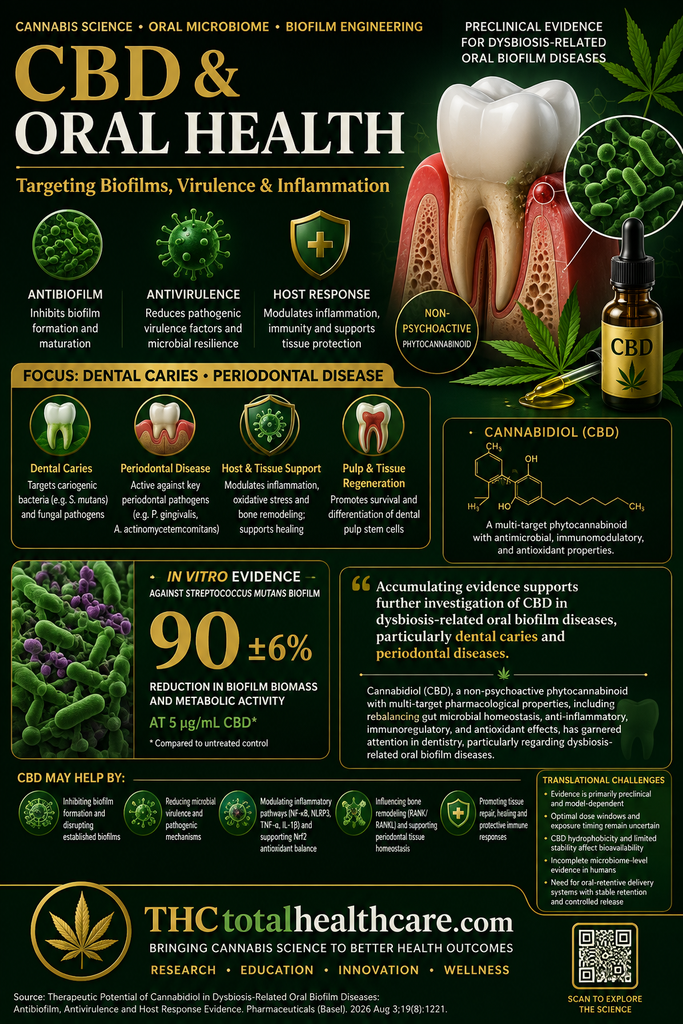
Cannabidiol (CBD) Inhibits Streptococcus oralis Growth and Biofilm Formation, While Maintaining Human Gingival Epithelial Cell Viability: An In Vitro Study

Dental biofilms can contribute to persistent oral infections and are often difficult to control with conventional antimicrobial approaches. Researchers are now exploring cannabidiol (CBD) as a potential oral antimicrobial, with laboratory findings showing activity against Streptococcus oralis, reduced biofilm formation, and maintained viability of human gingival epithelial cells at the concentrations tested.

Background: The oral ecosystem harbors multiple microorganisms, including Streptococcus oralis (S. oralis), which contributes to biofilm formation and microbial virulence. To eliminate oral biofilms, mechanical intervention is combined with antimicrobial agents such as chlorhexidine, but these have limited effects. Such intervention could benefit natural antimicrobial compounds, including cannabidiol (CBD).

Aim: This study aims to evaluate the effect of CBD on reducing S. oralis growth and decreasing its biofilm-forming capacity, as well as its interaction with human gingival epithelial cells, to explore its potential application as an oral antimicrobial agent.

Methodology: S. oralis was cultured in the presence of different concentrations of CBD. Bacterial growth was evaluated at different time points postexposure to CBD. Bacterial biofilm formation was investigated after 3 days of exposure to CBD using histological and quantitative analyses. The interaction between CBD and gingival epithelial cells was assessed using cell morphology, cell adhesion, and cell viability/proliferation assays.

Results: CBD inhibited planktonic growth of S. oralis in a concentration-dependent manner with a minimum inhibitory concentration (MIC) of 6.25 μg/mL and a minimum bactericidal concentration (MBC) of 25 μg/mL. CBD also significantly (p < 0.01) decreased S. oralis biofilm by disrupting its architecture. The effect on the bacterial growth and its capacity to form biofilms was observed even with a low concentration (3.12 μg/mL) of CBD. Given that antimicrobial molecules should be effective against biofilm-associated bacteria while maintaining compatibility with host tissues, this study showed that concentrations (3.12, 6.25, and 12.5 μg/mL) of CBD we tested have anti-S. oralis effect maintained human gingival epithelial cell viability.

Conclusion: CBD exhibited a significant antimicrobial effect against S. oralis. Although the bactericidal concentration was higher than the range tested in gingival epithelial cells, low and intermediate CBD concentrations inhibited S. oralis growth and biofilm formation while maintaining cell viability after 24 h of exposure. These findings provide preliminary evidence supporting further investigation of the antimicrobial and antibiofilm properties of CBD in oral health contexts.”

https://pubmed.ncbi.nlm.nih.gov/42597385

“This study demonstrated the effectiveness of CBD at different concentrations in inhibiting the growth of S. oralis at both early and late exposure periods.

Overall, this study provides preliminary evidence supporting further investigation of CBD as a potential antimicrobial molecule against S. oralis.”

https://onlinelibrary.wiley.com/doi/10.1155/ijod/4609857

A matter of formulation: Efficacy and tolerability of nabiximols and cannabis decoction for the treatment of multiple sclerosis-related spasticity

Cannabinoid medicines are used to help manage multiple sclerosis-related spasticity, but formulation can influence both effectiveness and tolerability. In this study, both nabiximols and cannabis decoction were effective for MS-related spasticity, while cannabis decoction may represent a viable option for patients who do not respond to or tolerate nabiximols.

Background: Spasticity is one of the most disabling symptoms in multiple sclerosis (MS) and is often inadequately controlled by standard treatments. Nabiximols is an approved cannabinoid therapy for MS-related spasticity, while cannabis decoctions may offer alternative efficacy and tolerability profiles.

Methods: This retrospective single-centre study evaluated the efficacy and tolerability of nabiximols and cannabis decoction for MS-related spasticity, spasms, and pain, in particular in patients who switched from nabiximols to decoction. Patients initiating nabiximols between 2013 and 2024 were included. Modified Ashworth Scale (mAS), Numerical Rating Scale (NRS) for spasticity and pain, and Penn Spasm Frequency Scale (PSFS) were assessed at baseline and follow-up. Efficacy was analysed using within-group and mixed-model approaches, and Cox regression evaluated discontinuation risk.

Results: Sixty-three patients were included; 39 (61.9%) discontinued nabiximols and 14 switched to cannabis decoction. Both treatments significantly improved spasticity, spasms, and pain. In switchers, cannabis decoction led to significant improvements across all outcomes. Nabiximols showed a higher, though not statistically significant, discontinuation rate, with adverse effects reported in 27.0% versus 14.3% for cannabis decoction. Longer disease duration was associated with discontinuation due to inefficacy, while tetraspasticity predicted switching to cannabis decoction.

Conclusions: Both nabiximols and cannabis decoction are effective for MS-related spasticity. Cannabis decoction may represent a viable option for patients who do not respond to or tolerate nabiximols. Differences in cannabinoid composition and pharmacokinetics may explain variations in outcomes. Prospective studies are needed to confirm these findings and optimize treatment strategies.”

https://pubmed.ncbi.nlm.nih.gov/42594706

https://www.msard-journal.com/article/S2211-0348(26)00463-3/abstract

Biocompatible Cyclodextrin-Cannabinoid Agar-Xanthan Gum Hydrogels for Controlled Delivery and Antimicrobial Soft-Tissue Biomedical Applications

Researchers developed biocompatible hydrogels containing CBD and CBN designed for controlled cannabinoid delivery to soft tissue. The formulations provided sustained release for up to 72 hours, showed selective antibacterial activity against Staphylococcus aureus, and remained noncytotoxic to human skin fibroblasts, supporting their potential use in localized drug delivery and tissue-engineering applications

“Agar/xanthan hydrogels incorporating hydroxypropyl-β-cyclodextrin (HP-β-CD) inclusion complexes of nonpsychoactive cannabinoids (cannabidiol, CBD; cannabinol, CBN) were developed as multifunctional biomaterials for controlled delivery and antimicrobial soft-tissue biomedical applications.

Physicochemical characterization showed improved thermal stability, tunable hydrophilicity, and a porous network suitable for loading and release. In vitro release studies demonstrated sustained cannabinoid delivery over 72 h, following first-order and Fu-Kao kinetic models.

The hydrogels exhibited selective antimicrobial activity against Staphylococcus aureus, while remaining inactive toward Escherichia coli. Cytocompatibility assays with human skin fibroblasts confirmed noncytotoxic behavior over 7 days for all hydrogel formulations tested.

These results highlight that cyclodextrin-cannabinoid-loaded agar/xanthan hydrogels are promising biocompatible platforms for controlled delivery with antimicrobial activity, suitable for tissue engineering applications.”

https://pubmed.ncbi.nlm.nih.gov/42597876

“All these results demonstrate that combining agar/xanthan hydrogels with HPβ-CD–cannabinoid inclusion complexes yields multifunctional, biocompatible materials with controlled release and selective antibacterial activity, making them promising candidates for soft-tissue local controlled-release applications.”

https://pubs.acs.org/acsodf/article/11/31/46955/5232225/Biocompatible-Cyclodextrin-Cannabinoid-Agar

Flexible Bionanocomposites from Epoxidized Hemp Seed Oil Thermosetting Resin Reinforced with Halloysite Nanotubes

Hemp seed oil may have value far beyond food and nutrition. Researchers converted the oil into a flexible, transparent thermosetting material and reinforced it with halloysite nanotubes, producing bionanocomposites with improved thermal stability, stiffness, strength, ductility, and toughness. The sustainable material could provide an alternative to petroleum-based polymers for applications such as packaging

“Hemp seed (Cannabis sativa L.) oil comprises a variety of beneficial unsaturated triglycerides with well-documented nutritional and health benefits. However, it can become rancid over a relatively short time period, leading to increased industrial costs and waste of a valuable product.

The development of sustainable polymers is presented as a strategy, where both the presence of unsaturation and peroxide content could be effectively used to alleviate both the waste and financial burden.

After the reaction with peroxyacetic acid, the incorporation of halloysite nanotubes (HNTs), and the subsequent thermal curing, without the need for organic solvents or interfacial modifiers, flexible transparent materials with a low glass-transition temperature were developed.

The improvement in the thermal stability and both the static and dynamic mechanical properties of the bionanocomposites were significantly enhanced with the well-dispersed HNT filler. At an optimum concentration of 0.5 wt % HNTs, a simultaneous increase in stiffness, strength, ductility, and toughness was observed in comparison to the unfilled cured resin.

These sustainable food-waste-derived bionanocomposites may provide an interesting alternative to petroleum-based materials, particularly for low-load-bearing applications, such as packaging.”

https://pubmed.ncbi.nlm.nih.gov/28240903

https://pubs.acs.org/jpcbfk/article-abstract/121/11/2454/1103644/Flexible-Bionanocomposites-from-Epoxidized-Hemp?redirectedFrom=fulltext

From Hemp Waste to Bioactive Nanofiber Composites: Deep Eutectic Solvents and Electrospinning in Upcycling Endeavors

Hemp agricultural waste could become a useful raw material for advanced sustainable products rather than simply being discarded. Researchers transformed hemp waste into electrospun composite nanofibers with improved mechanical strength along with antioxidant and antibacterial properties, demonstrating a promising way to turn cannabis-industry waste into bioactive materials.

“Natural fibers have attracted increasing interest as an alternative to produce environmentally friendly and sustainable materials.

Particularly, hemp fibers have been widely used in various industrial applications due to their extremely unique properties. However, hemp can generate a large amount of agro-waste, and it results in an attractive source of biopolymers for the development of low-cost materials as an alternative to the raw materials and conventional petroleum-based plastics.

In addition, deep eutectic solvents (DESs), a new type of truly green solvents, have been shown to remove gums, lignin, and other non-cellulosic components from hemp fibers. Reusing these components dissolved into the DESs to fabricate new materials directly by electrospinning is a very attractive but still unexplored endeavor.

Thus, this innovative research to venture new upcycling pathways is focused on the fabrication of composite nanofibers by electrospinning of a gel-based blend of Poly(vinyl alcohol) (PVA) and hemp agro-waste (HW) dissolved into choline chloride (ChCl):Glycerol (1:2) and ChCl:Urea (1:2) DES mixtures.

The results obtained revealed that the produced nanofibers displayed uniform appearance with diameters ranging from 257.7 ± 65.6 nm to 380.8 ± 134.0 nm. In addition, the mechanical properties of the electrospun composite nanofibers produced from the gel-based blends of HW dissolved in DESs and PVA (HW-DESs_PVA) were found to be superior, resulting in an enhanced tensile strength and Young’s modulus.

Furthermore, the incorporation of HW into the nanofibers was able to provide bioactive antioxidant and antibacterial properties.

Overall, this study demonstrated a promising, more sustainable, and eco-friendly way to produce electrospun composite nanofibers using HW in a circular economy perspective.”

https://pubmed.ncbi.nlm.nih.gov/38275839

https://www.mdpi.com/2310-2861/10/1/1

Marijuana Use for Symptom Control in Inflammatory Bowel Disease: Patients’ Perceptions and Patterns of Use

Many people with inflammatory bowel disease use cannabis to manage symptoms that remain difficult to control. In this survey of 108 patients with IBD, frequent marijuana use was associated with reported relief of nausea and vomiting, joint pain, and insomnia, while 87.6% of participants said it improved their quality of life and 59.3% believed it reduced their opioid use.

Introduction: Many patients with inflammatory bowel disease (IBD) use marijuana for disease-related symptoms. Data regarding reasons for usage, impact, and perceptions on its effects is lacking. Our study aimed to understand patterns of marijuana use, underlying symptom response, and beliefs about marijuana in patients with IBD.

Methods: An anonymous REDCap survey comprised of 39 questions on demographics, disease features, patterns of marijuana use, symptoms, quality of life, and true/false statements about marijuana was administered to 108 participants recruited from University of Florida (UF) IBD clinic.

Results: Participants were 47.2% male and 51.9% female. While a significant percentage of subjects reported co-morbid depression/anxiety (61.1%), the percentages for PTSD and ADHD are both 19.4%. Patient characteristics are compared among three reasons of marijuana use (Recreational, Medical and Combination). There was a notable shift in reasons for use with both age (p = 0.0074) and duration of IBD diagnosis (p = 0.006): recreational use is more common among younger patients and those with a shorter duration of IBD diagnosis, medical use becomes predominant in middle-aged patients and those with an intermediate duration of diagnosis, and combination use increases among older patients and those with the longest duration of IBD diagnosis. Comparisons are also conducted based on the frequency of marijuana usage. Associations were found between marijuana use frequency and symptom relief. Daily or near-daily marijuana use was associated with self-reported relief of nausea/vomiting (82.1%; p = 0.003), arthralgias (81%; p = 0.013), and insomnia (80%; p = 0.02). Additionally, marijuana use was linked to an improved ability to live independently (p = 0.0075) and current employment (p = 0.04). Patients with a history of bowel surgery were more likely to report marijuana use lasting longer than 5 years (OR 21.94, CI [2.91, 250.18], p = 0.0059) and using marijuana at least once weekly (OR 11.13, CI [1.78, 97.69], p = 0.0163). Notably, 59.3% of respondents believed marijuana use had reduced their opioid consumption. Marijuana users with a history of IBD-related hospitalization had higher odds of reporting depression/anxiety (OR 14.3, CI [2.34, 143.2], p = 0.009) and diarrhea symptoms (OR 13.3, CI [2.2, 128.9], p = 0.01). When asked how marijuana use affected their ability to live independently, 61.3% of participants reported “improved.” Similarly, 87.6% respondents reported improvement in their quality of life with marijuana use.

Conclusions: Marijuana can be helpful for symptom control, reducing reliance on opioid pharmaceuticals, and may improve quality of life in patients with IBD. Participants demonstrated good insight regarding the role of marijuana in the management of their disease.”

https://pubmed.ncbi.nlm.nih.gov/42592634

“Inflammatory bowel disease is an autoimmune condition causing inflammation in the small intestines and colon. It can often lead to chronic pain, hospitalization, surgery, and poor quality of life. Data regarding marijuana use among patients with inflammatory bowel disease is lacking. We conducted an anonymous survey of 108 participants with inflammatory bowel disease who use marijuana. Most participants reported improvement in symptoms, decreased opioid usage, and accurate perceptions on marijuana effects in their disease process.”

https://karger.com/mca/article/9/1/211/951948/Marijuana-Use-for-Symptom-Control-in-Inflammatory