A frequent polymorphism in the coding exon of the human cannabinoid receptor (CNR1) gene.

“The central cannabinoid receptor (CB1) mediates the pharmacological activities of cannabis, the endogenous agonist anandamide and several synthetic agonists.

The cloning of the human cannabinoid receptor (CNR1) gene facilitates molecular genetic studies in disorders like Gilles de la Tourette syndrome (GTS), obsessive compulsive disorder (OCD), Parkinsons disease, Alzheimers disease or other neuro psychiatric or neurological diseases, which may be predisposed or influenced by mutations or variants in the CNR1 gene.

We detected a frequent silent mutation (1359G–>A) in codon 453 (Thr) of the CNR1 gene that turned out to be a common polymorphism in the German population. Allele frequencies of this polymorphism are 0.76 and 0.24, respectively.

We developed a simple and rapid polymerase chain reaction (PCR)-based assay by artificial creation of a Msp I restriction site in amplified wild-type DNA (G-allele), which is destroyed by the silent mutation (A-allele).

The intragenic CNR1 polymorphism 1359(G/A) should be useful for association studies in neuro psychiatric disorders which may be related to anandamide metabolism disturbances.”
http://www.ncbi.nlm.nih.gov/pubmed/10441206

Type-2 Cannabinoid Receptors in Neurodegeneration.

“Based on its wide expression in immune cells, type 2 cannabinoid (CB2) receptors were traditionally thought to act as “peripheral receptors” with an almost exclusively immunomodulatory function. However, their recent identification in mammalian brain areas, as well as in distinct neuronal cells, has opened the way to a re-consideration of CB2 signaling in the context of brain pathophysiology, synaptic plasticity and neuroprotection. To date, accumulated evidence from several independent preclinical studies has offered new perspectives on the possible involvement of CB2signaling in brain and spinal cord traumatic injury, as well as in the most relevant neurodegenerative disorders like Alzheimer’s disease, Parkinson’s disease and Huntington’s chorea. Here, we will review available information on CB2 in these disease conditions, along with data that support also its therapeutic potential to treat them.”

http://www.ncbi.nlm.nih.gov/pubmed/27450295

Cannabinoid receptor agonist WIN55,212-2 and fatty acid amide hydrolase inhibitor URB597 may protect against cognitive impairment in rats of chronic cerebral hypoperfusion via PI3K/AKT signaling.

“The present study further investigated the protective effects of cannabinoid receptor agonist WIN55,212-2 (WIN) and fatty acid amide hydrolase (FAAH) inhibitor URB597 (URB) on chronic cerebral hypoperfusion (CCH)-induced cognitive impairment in rats.

These findings suggest that WIN and URB are promising agents for therapeutic management of CCH.”

http://www.ncbi.nlm.nih.gov/pubmed/27424778

“Chronic cerebral hypoperfusion (CCH) is one of the causes of vascular dementia (VaD) and is also an etiological factor for Alzheimer’s disease (AD).”  http://journal.frontiersin.org/article/10.3389/fnagi.2014.00010/full

Agitation in Alzheimer Disease as a Qualifying Condition for Medical Marijuana in the United States.

“Of the 24 states and localities where medical marijuana is legal, dementia is a qualifying condition in 10 (41.7%), primarily for agitation of Alzheimer disease.

Dementia is somewhat commonly listed as a potential qualifying condition for medical marijuana.

Currently, few applicants for medical marijuana list dementia as the reason for seeking certification. However, given increasingly open attitudes toward recreational and medical marijuana use, providers should be aware that dementia is a potential indication for licensing, despite lack of evidence for its efficacy.”

http://www.ncbi.nlm.nih.gov/pubmed/27389672

Microglia activation states and cannabinoid system: Therapeutic implications.

“Microglial cells are recognized as the brain’s intrinsic immune cells, mediating actions that range from the protection against harmful conditions that modify CNS homeostasis, to the control of proliferation and differentiation of neurons and their synaptic pruning. To perform these functions, microglia adopts different activation states, the so-called phenotypes that depending on the local environment involve them in neuroinflammation, tissue repair and even the resolution of the inflammatory process.

There is accumulating evidence indicating that cannabinoids (CBs) might serve as a promising tool to modify the outcome of inflammation, especially by influencing microglial activity.

Microglia has a functional endocannabinoid (eCB) signaling system, composed of cannabinoid receptors and the complete machinery for the synthesis and degradation of eCBs.

The expression of cannabinoid receptors – mainly CB2 – and the production of eCBs have been related to the activation profile of these cells and therefore, the microglial phenotype, emerging as one of the mechanisms by which microglia becomes alternatively activated.

Here, we will discuss recent studies that provide new insights into the role of CBs and their endogenous counterparts in defining the profile of microglia activation.

These actions make CBs a promising therapeutic tool to avoid the detrimental effects of inflammation and possibly paving the way to target microglia in order to generate a reparative milieu in neurodegenerative diseases.”

http://www.ncbi.nlm.nih.gov/pubmed/27373505

Endocannabionoid System in Neurological Disorders.

“Several studies support the evidence that the endocannabinoid system and cannabimimetic drugs might have therapeutic potential in numerous pathologies. These pathologies range from neurological disorders, atherosclerosis, stroke, cancer to obesity/metabolic syndrome and others.

In this paper we review the endocannabinoid system signaling and its alteration in neurodegenerative disorders like multiple sclerosis, Alzheimer’s disease, Parkinson’s disease and Huntington’s disease and discuss the main findings about the use of cannabinoids in the therapy of these pathologies.

Despite different etiologies, neurodegenerative disorders exhibit similar mechanisms like neuro-inflammation, excitotoxicity, deregulation of intercellular communication, mitochondrial dysfunction and disruption of brain tissue homeostasis.

Current treatments ameliorate the symptoms but are not curative.

Interfering with the endocannabinoid signaling might be a valid therapeutic option in neuro-degeneration.

To this aim, pharmacological intervention to modulate the endocannabinoid system and the use of natural and synthetic cannabimimetic drugs have been assessed. CB1 and CB2 receptor signaling contributes to the control of Ca2+ homeostasis, trophic support, mitochondrial activity, and inflammatory conditions.

Several studies and patents suggest that the endocannabinoid system has neuro-protective properties and might be a target in neurodegenerative diseases.”

http://www.ncbi.nlm.nih.gov/pubmed/27364363

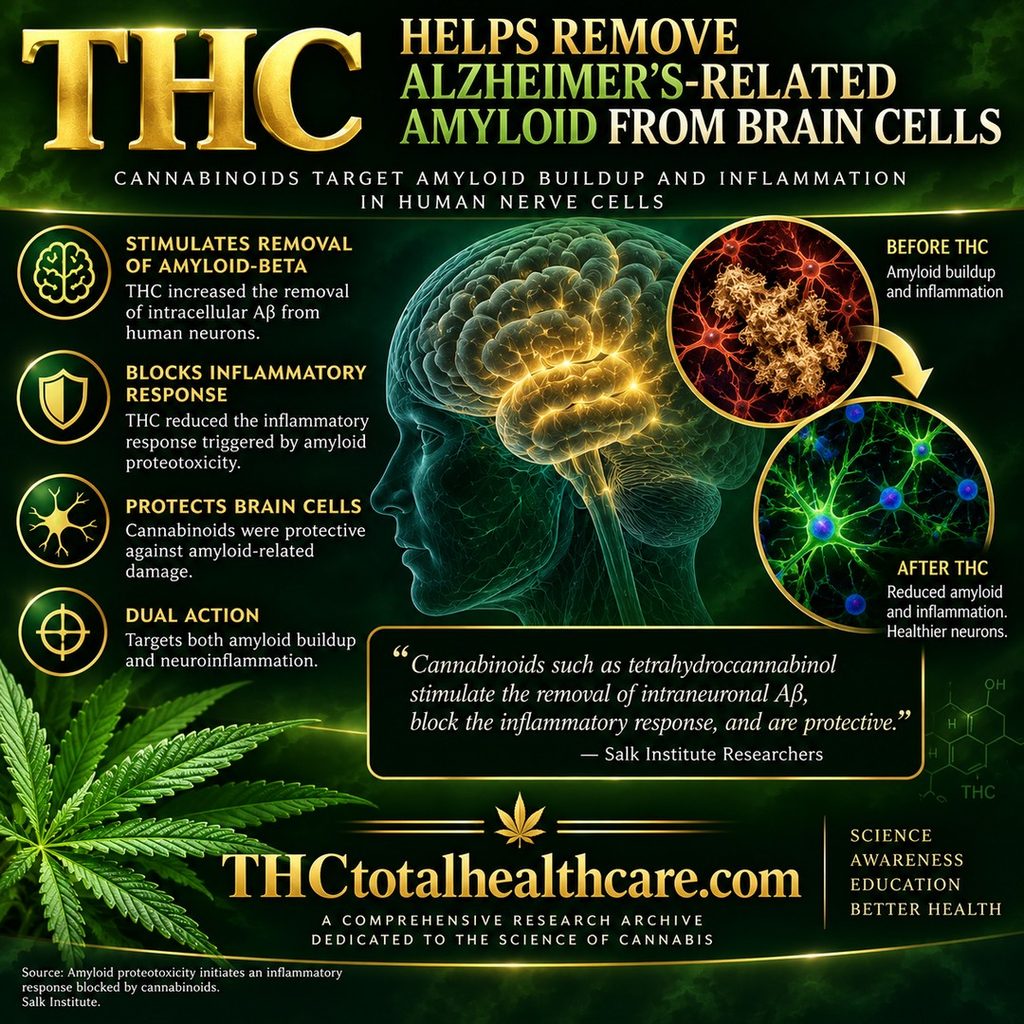
Marijuana fights Alzheimer’s disease, Salk Institute scientists discover

Cannabinoids remove plaque-forming Alzheimer's proteins from brain cells

“Salk Institute scientists have discovered that a main compound found in marijuana can fight a toxic protein associated with Alzheimer’s disease. According to the scientists, at this time, there are no drugs that significantly inhibit cell death associated with Alzheimer’s disease (AD), Parkinson’s or Huntington’s diseases. However, the most recent data about Alzheimer’s and marijuana suggests that there is a therapeutic potential of cannabinoids (the chemical compounds secreted by cannabis flowers) for the treatment of AD. Cannabinoids are able to remove plaque-forming Alzheimer’s proteins from brain cells, reports the Medical Express on June 29.”  http://www.examiner.com/article/marijuana-fights-alzheimer-s-disease-salk-institute-scientists-discover

“Cannabinoids remove plaque-forming Alzheimer’s proteins from brain cells”  http://medicalxpress.com/news/2016-06-cannabinoids-plaque-forming-alzheimer-proteins-brain.html

“Cannabinoids remove toxic proteins associated with Alzheimer’s disease from the brain” http://www.irishexaminer.com/examviral/science-world/cannabinoids-remove-toxic-proteins-associated-with-alzheimers-disease-from-the-brain-407788.html

“Marijuana Compound Helps Remove Alzheimer’s Disease Protein From Brain” -brain.” http://www.scienceworldreport.com/articles/42990/20160630/marijuana-compound-helps-remove-alzheimers-disease-protein-from-brain.htm

“Marijuana compound removes toxic Alzheimer’s protein from the brain”  http://www.sciencealert.com/marijuana-compound-removes-toxic-alzheimer-s-protein-from-the-brain

“Cannabinoids remove plaque-forming Alzheimer’s proteins from brain cells”  https://www.sciencedaily.com/releases/2016/06/160629095609.htm

“Cannabinoids Remove Plaque-forming Alzheimer’s Proteins from Brain Cells”  https://www.laboratoryequipment.com/news/2016/06/cannabinoids-remove-plaque-forming-alzheimers-proteins-brain-cells

“MARIJUANA COMPOUND REMOVES ALZHEIMER’S PLAQUE FROM BRAIN CELLS, STUDY FINDS” http://www.popsci.com/marijuana-compound-removes-alzheimers-plaque-from-brain-cells-study

“Cannabinoids remove plaque-forming Alzheimer’s proteins from brain cells. Preliminary lab studies at the Salk Institute find THC reduces beta amyloid proteins in human neurons.” http://www.salk.edu/news-release/cannabinoids-remove-plaque-forming-alzheimers-proteins-from-brain-cells/


Amyloid proteotoxicity initiates an inflammatory response blocked by cannabinoids

Researchers found that THC and other cannabinoids helped remove beta-amyloid from human nerve cells while also reducing the inflammatory response linked to amyloid buildup. The study reported that THC stimulated the removal of intracellular amyloid-beta and protected the cells from amyloid-related damage. Because beta-amyloid accumulation is a hallmark of Alzheimer’s disease, the findings point to a possible role for cannabinoids in targeting both amyloid buildup and inflammation.

“The beta amyloid (Aβ) and other aggregating proteins in the brain increase with age and are frequently found within neurons. The mechanistic relationship between intracellular amyloid, aging and neurodegeneration is not, however, well understood.

We use a proteotoxicity model based upon the inducible expression of Aβ in a human central nervous system nerve cell line to characterize a distinct form of nerve cell death caused by intracellular Aβ.

It is shown that intracellular Aβ initiates a toxic inflammatory response leading to the cell’s demise. Aβ induces the expression of multiple proinflammatory genes and an increase in both arachidonic acid and eicosanoids, including prostaglandins that are neuroprotective and leukotrienes that potentiate death.

Cannabinoids such as tetrahydrocannabinol stimulate the removal of intraneuronal Aβ, block the inflammatory response, and are protective.

Altogether these data show that there is a complex and likely autocatalytic inflammatory response within nerve cells caused by the accumulation of intracellular Aβ, and that this early form of proteotoxicity can be blocked by the activation of cannabinoid receptors.”

http://www.nature.com/articles/npjamd201612

“Cannabinoids remove plaque-forming Alzheimer’s proteins from brain cells. Preliminary lab studies at the Salk Institute find THC reduces beta amyloid proteins in human neurons.” http://www.salk.edu/news-release/cannabinoids-remove-plaque-forming-alzheimers-proteins-from-brain-cells/

Need this THC study explained? thcXplained.com

CB2 Cannabinoid Receptor As Potential Target against Alzheimer’s Disease.

“The CB2 receptor is one of the components of the endogenous cannabinoid system, a complex network of signaling molecules and receptors involved in the homeostatic control of several physiological functions. Accumulated evidence suggests a role for CB2 receptors in Alzheimer’s disease (AD) and indicates their potential as a therapeutic target against this neurodegenerative disease.

Levels of CB2 receptors are significantly increased in post-mortem AD brains, mainly in microglia surrounding senile plaques, and their expression levels correlate with the amounts of Aβ42 and β-amyloid plaque deposition.

Moreover, several studies on animal models of AD have demonstrated that specific CB2 receptor agonists, which are devoid of psychoactive effects, reduce AD-like pathology, resulting in attenuation of the inflammation associated with the disease but also modulating Aβ and tau aberrant processing, among other effects.

CB2 receptor activation also improves cognitive impairment in animal models of AD.

This review discusses available data regarding the role of CB2 receptors in AD and the potential usefulness of specific agonists of these receptors against AD.”

http://www.ncbi.nlm.nih.gov/pubmed/27303261

Stimulation of brain glucose uptake by cannabinoid CB2 receptors and its therapeutic potential in Alzheimer’s disease

Cover image

“Brain disorders, including Alzheimer’s disease (AD), often involve specific early alterations in the metabolism of glucose in the brain.

The idea of alleviating symptoms of dementia by boosting cerebral energy metabolism has been toyed with for decades, yet safe pharmacological agents with well characterized mechanism of action are still lacking.

In this sense, we have investigated here the local cerebral glucoregulatory potential of the endocannabinoid system in rodents.

Cannabinoid CB2 receptors (CB2Rs) are emerging as important therapeutic targets in brain disorders that typically involve neurometabolic alterations.

Together, these results reveal a novel general glucoregulatory role for CB2Rs in the brain, raising therapeutic interest in CB2R agonists as nootropic agents.

In conclusion, the present results provide the first direct pharmacological evidence in vitroand in vivo of a role of CB2R in central glucoregulation.

Additionally, we found that glucoregulation by endogenous CB2R signalling is negatively affected by β-amyloidosis, thought to be the first pathological step in AD.

Therefore, it would be interesting to perform further studies to define how CB2R mediated glucoregulation contributes to the recently discovered therapeutic potential of CB2R agonists in animal models of AD”

http://www.sciencedirect.com/science/article/pii/S0028390816300879