“We observe significant improvement of symptoms of FM in patients using cannabis… knowledge of the endocannabinoid system and the role of the stress system in the pathopysiology of FM suggest a new approach to the suffering of these patients… results together with previous evidence seem to confirm the beneficial effects of cannabinoids on FM symptoms.”
“The hemp plant Cannabis sativa produces unique compounds known as cannabinoids, of which Δ9-tetrahydrocannabinol (THC) is the most important… The present study was undertaken to investigate the antitumoral action of cannabinoids in pancreatic cancer and the molecular mechanisms involved in that effect… Cannabinoids induce apoptosis of pancreatic tumor cells via endoplasmic reticulum stress-related genes…These findings may contribute to set the basis for a new therapeutic approach for the treatment of pancreatic cancer.”
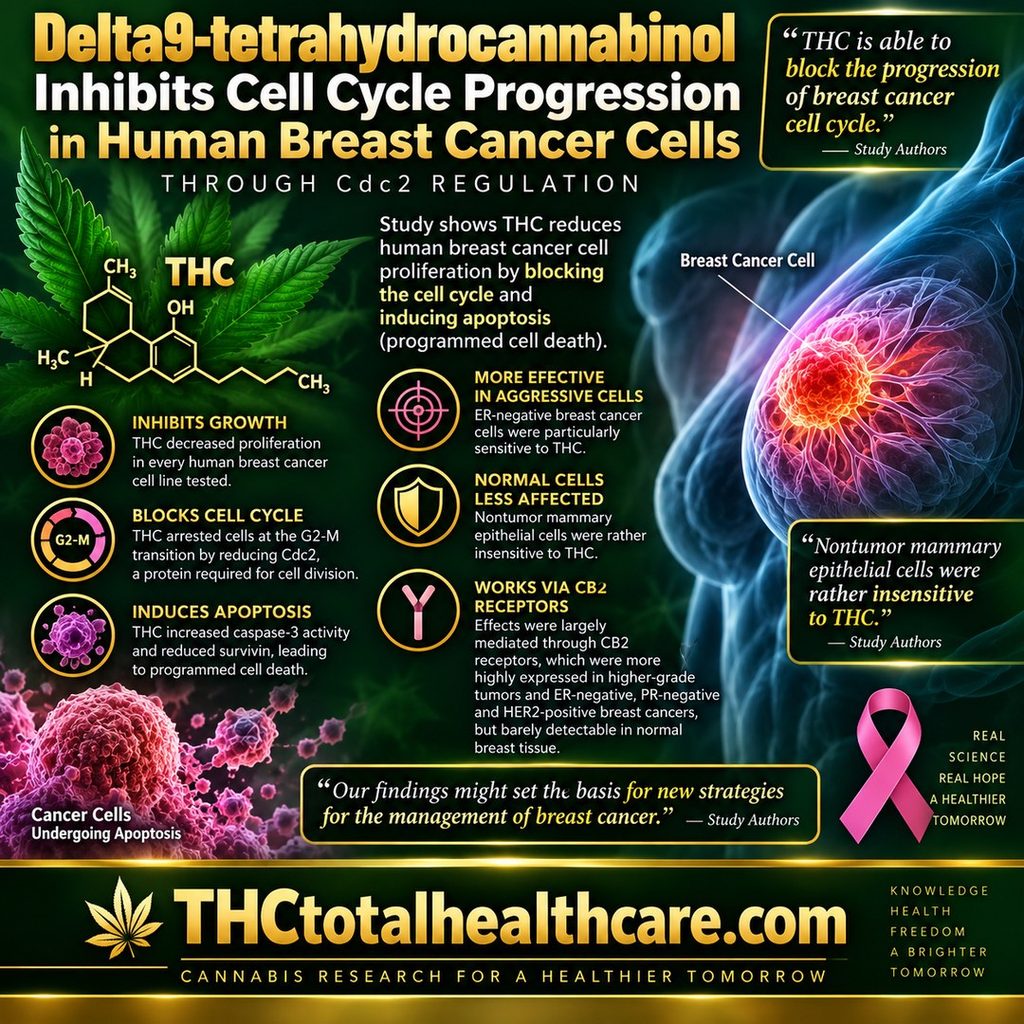
Researchers found that Δ9-tetrahydrocannabinol (THC) reduced the growth of multiple human breast cancer cell lines by stopping cells from progressing through the cell cycle and by triggering apoptosis, or programmed cell death. THC blocked the cells at the G2-M stage by reducing Cdc2, a protein needed for cell division, and breast cancer cells engineered to produce more Cdc2 became more resistant to THC.
The study also found that aggressive ER-negative breast cancer cells were particularly sensitive to THC, while normal human mammary epithelial cells were much less affected. THC’s effects were largely associated with CB2 cannabinoid receptors, which were more highly expressed in higher-grade tumors and in ER-negative, PR-negative and HER2-positive breast tumors, while CB2 expression was barely detectable in normal breast tissue.
The researchers concluded that these findings could help form the basis for new cannabinoid-based strategies for managing breast cancer.
“It has been proposed that cannabinoids are involved in the control of cell fate. Thus, these compounds can modulate proliferation, differentiation, and survival in different manners depending on the cell type and its physiopathologic context. However, little is known about the effect of cannabinoids on the cell cycle, the main process controlling cell fate.
Here, we show that Delta(9)-tetrahydrocannabinol (THC), through activation of CB(2) cannabinoid receptors, reduces human breast cancer cell proliferation by blocking the progression of the cell cycle and by inducing apoptosis. In particular, THC arrests cells in G(2)-M via down-regulation of Cdc2, as suggested by the decreased sensitivity to THC acquired by Cdc2-overexpressing cells.
Of interest, the proliferation pattern of normal human mammary epithelial cells was much less affected by THC. We also analyzed by real-time quantitative PCR the expression of CB(1) and CB(2) cannabinoid receptors in a series of human breast tumor and nontumor samples. We found a correlation between CB(2) expression and histologic grade of the tumors. There was also an association between CB(2) expression and other markers of prognostic and predictive value, such as estrogen receptor, progesterone receptor, and ERBB2/HER-2 oncogene. Importantly, no significant CB(2) expression was detected in nontumor breast tissue.
Taken together, these data might set the bases for a cannabinoid therapy for the management of breast cancer.”
“We therefore investigated the role of the CB-Rs (CannaBinoid-Receptors) in mediating apoptosis in 3 leukemic cell lines… We have shown that THC is a potent inducer of apoptosis… THC-induced cell death…”
“The active ingredient in marijuana cuts tumor growth in common lung cancer in half and significantly reduces the ability of the cancer to spread, say researchers at Harvard University who tested the chemical in both lab and mouse studies.”
“Cannabinoids exert antiproliferative properties in a variety of malignant tumors, including pancreatic ductal adenocarcinoma … Cannabinoids can induce apoptosis (programmed cell death) in cancer cells…Furthermore, they have been shown to decrease invasiveness of cancer cells.”
“Delta9-Tetrahydrocannabinol, the main active component of marijuana… Here, we show that intratumoral administration of Delta9-tetrahydrocannabinol… induced a considerable regression of malignant gliomas… Cannabinoid treatment did not produce any substantial neurotoxic effect… cannabinoids signal apoptosis (cell death/suicide) by a pathway involving cannabinoid receptors… These results may provide the basis for a new therapeutic approach for the treatment of malignant gliomas.”
”Remarkably, cannabinoids kill glioma cells selectively and can protect non-transformed glial cells from death…”
The study by Manuel Guzmán of Madrid Spain found that cannabinoids, the active components of marijuana, inhibit tumor growth in laboratory animals. They do so by modulating key cell-signalling pathways, thereby inducing direct growth arrest and death of tumor cells, as well as by inhibiting the growth of blood vessels that supply the tumor.
“Hepatocellular carcinoma (HCC) is the third cause of cancer-related death worldwide… few therapeutic options are available… we investigated the effects of cannabinoids–a novel family of potential anticancer agents–on the growth of HCC. We found that Δ(9)-tetrahydrocannabinol (Δ(9)-THC, the main active component of Cannabis sativa)… reduced the viability of the human HCC cell lines…cannabinoids were also able to inhibit tumor growth… Our findings may contribute to the design of new therapeutic strategies for the management of HCC.”
“… the EndoCannabinoid System has been implicated in a growing number of physiological functions of the nervous system and various peripheral organs, and its modulation turned out to hold tremendous therapeutic promise in a wide range of disparate diseases and pathological conditions, ranging from mood and anxiety disorders, movement disorders, neuropathic pain, multiple sclerosis, and spinal cord injury to cancer, glaucoma, osteoporosis, atherosclerosis, myocardial infarction, stroke, hypertension, and obesity/ metabolic syndrome to name just a few…”