“Both adenosine A1 and cannabinoid CB1 receptors trigger similar transduction pathways and protect against neurotoxic insults at the hippocampus, but their combined neuroprotective potential has not been investigated.
We set forth to assess the combined action of A1 and CB1 receptors against glutamate NMDA receptor-mediated excitotoxicity at the hippocampus…
The results suggest that both CB1 and A1 receptors produce additive cumulative neuroprotection against NMDA-induced excitotoxicity in the hippocampus.”
“Intrapartum-related events are the third leading cause of childhood mortality worldwide and result in one million neurodisabled survivors each year. Infants exposed to a perinatal insult typically present with neonatal encephalopathy (NE).
The contribution of pure hypoxia-ischaemia (HI) to NE has been debated; over the last decade, the sensitising effect of inflammation in the aetiology of NE and neurodisability is recognised.
Therapeutic hypothermia is standard care for NE in high-income countries; however, its benefit in encephalopathic babies with sepsis or in those born following chorioamnionitis is unclear.
It is now recognised that the phases of brain injury extend into a tertiary phase, which lasts for weeks to years after the initial insult and opens up new possibilities for therapy.
There has been a recent focus on understanding endogenous neuroprotection and how to boost it or to supplement its effectors therapeutically once damage to the brain has occurred as in NE.
In this review, we focus on strategies that can augment the body’s own endogenous neuroprotection.
We discuss in particular remote ischaemic postconditioning whereby endogenous brain tolerance can be activated through hypoxia/reperfusion stimuli started immediately after the index hypoxic-ischaemic insult.
Therapeutic hypothermia, melatonin, erythropoietin and cannabinoids are examples of ways we can supplement the endogenous response to HI to obtain its full neuroprotective potential.
Achieving the correct balance of interventions at the correct time in relation to the nature and stage of injury will be a significant challenge in the next decade.”
“Microglia accumulation plays detrimental roles in the pathology of germinal matrix hemorrhage (GMH) in the immature preterm brain.
Here, we investigated the effects of a cannabinoid receptor 2 (CB2R) agonist on microglia proliferation and the possible involvement of the mitogen-activated protein kinase (MAPK) family pathway in a collagenase-induced GMH rat model and in thrombin-induced rat microglia cells.
Overall, these findings suggest that activation of the endocannabinoid system might attenuate inflammation-induced secondary brain injury after GMH in rats by reducing microglia accumulation through a mechanism involving ERK dephosphorylation.
Enhancing CB2R activation is a potential treatment to slow down the course of GMH in preterm newborns.”
“A basal tone of the endocannabinoid 2-arachidonoylglycerol (2-AG) enhances late oligodendrocyte progenitor cell (OPC) differentiation. Here, we investigated whether endogenous 2-AG may also promote OPC proliferation in earlier stages…
Our data suggest that proliferation of early OPCs stimulated by PDGF-AA and bFGF depends on the tonic activation of cannabinoid receptors by endogenous 2-AG and provide further evidence on the role of endocannabinoids in oligodendrocyte development, being important for the maintenance and self-renewal of the OPCs.
The results highlight the therapeutic potential of the endocannabinoid signaling in the emerging field of brain repair.”
“Long-term potentiation (LTP) has been most thoroughly studied in the hippocampus, which has a key role in learning and memory. Endocannabinoids are one of the endogenous systems that modulate this kind of synaptic plasticity. The activation of the vanillioid system has also been shown to mediate synaptic plasticity in the hippocampus. In addition, immunohistochemical studies have shown that cannabinoid receptor type 1 (CB1) and vanilloid receptor 1 (TRPV1) are closely located in the hippocampus.
It seems that agonists of the vanilloid system modulate cannabinoid outputs that cause an increase in synaptic plastisity, while in contemporary consumption of two agonist, TRPV1 agonist can change production of endocannabinoid, which in turn result to enhancement of LTP induction. These findings suggest that the two systems may interact or share certain common signaling pathways in the hippocampus.”
“The endocannabinoid (eCB) system helps recovery following traumatic brain injury (TBI).
Treatment with 2-arachidonoylglycerol (2-AG), a cerebral eCB ligand, was found to ameliorate the secondary damage.
Interestingly, the fatty acid amino acid amide (FAAA) N-arachidonoyl-L-serine (AraS) exerts similar eCB dependent neuroprotective. The present study aimed to investigate the effects of the FAAA palmitoyl-serine (PalmS) following TBI.
We suggest that the neuroprotective action of PalmS is mediated by indirect activation of the eCB receptors following TBI. One such mechanism may involve receptor palmitoylation which has been reported to result in structural stabilization of the receptors and to an increase in their activity. Further research is required in order to establish this assumption.”
“Traumatic brain injury (TBI) can cause persistent challenges including problems with learning and memory.
Previous studies suggest that the activation of the cannabinoid 1 receptor after a traumatic brain injury could be beneficial.
We tested the hypothesis that posttraumatic brain injury administration of a cannabinoid 1 receptor agonist can rescue deficits in learning and memory.
Young adult male rats were subjected to a moderately severe controlled cortical impact brain injury, with a subset given postinjury i.p. injections of a cannabinoid receptor agonist.
Utilizing novel object recognition and the morris water task, we found that the brain-injured animals treated with the agonist showed a marked recovery.”
“Excitotoxic neuronal death underlies many neurodegenerative disorders.
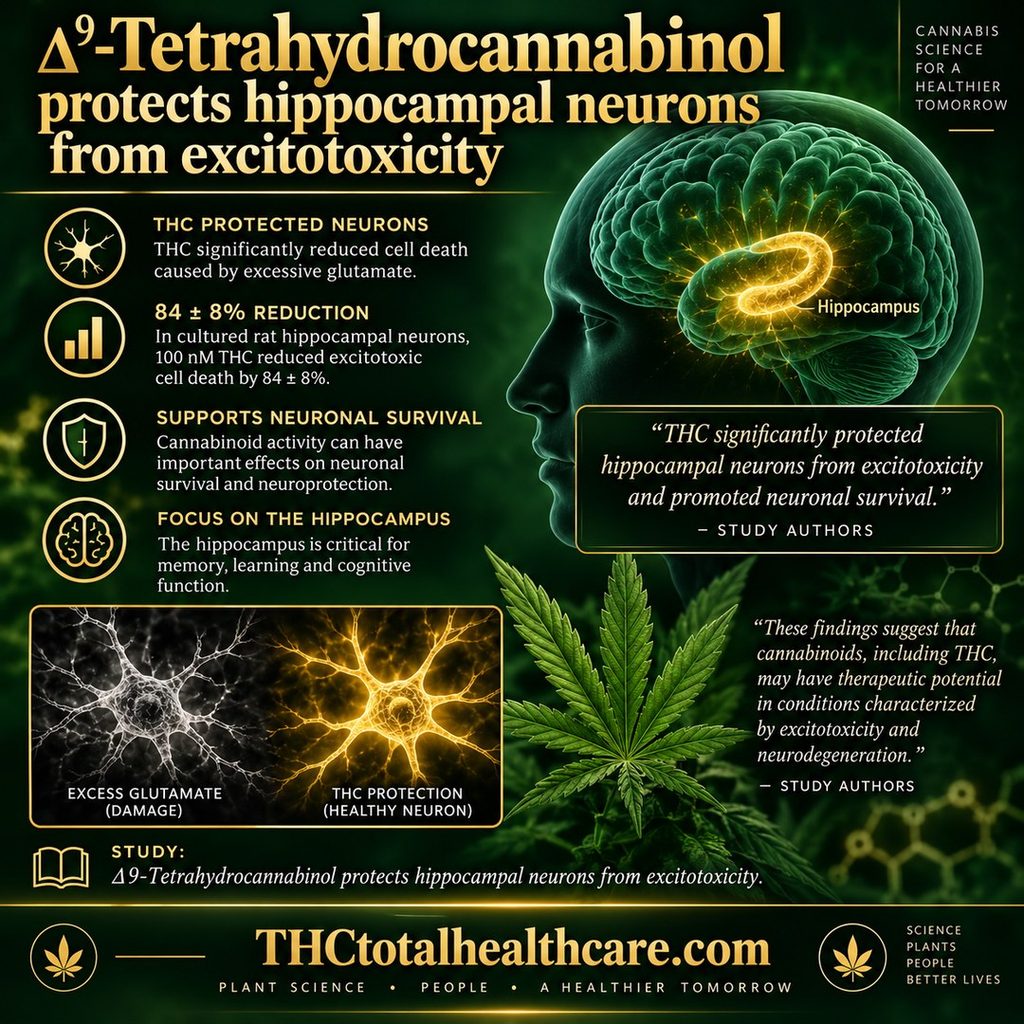
Because cannabinoid receptor agonists act presynaptically to inhibit glutamate release, we examined the effects of Win 55212-2, a full agonist at CB(1) receptors, and Delta(9)-tetrahydrocannabinol (THC), a partial agonist, on the survival of neurons exposed to an excitotoxic pattern of synaptic activity.
Reducing the extracellular Mg(2+) concentration ([Mg(2+)](o)) to 0.1 mM evoked an aberrant pattern of glutamatergic activity that produced synaptically mediated death of rat hippocampal neurons in culture. Neuronal viability was quantified with a multiwell fluorescence plate scanner equipped to detect propidium iodide fluorescence.
Win 55212-2 (100 nM) and THC (100 nM) significantly reduced 0.1 mM [Mg(2+)](o)-induced cell death by 77 +/- 11% and 84 +/- 8%, respectively. Interestingly, the protection afforded by THC was not significantly different from that produced by Win 55212-2, suggesting that attenuation without a complete block of excitatory activity is sufficient for neuroprotection.
The effect of prolonged drug exposure on the neuroprotection afforded by cannabinoid receptor agonists was also studied. When cultures were pretreated for 24 h with Win 55212-2 (100 nM) or THC (100 nM), inhibition of 0.1 mM [Mg(2+)](o)-induced toxicity was significantly reduced to 39 +/- 19% and 45 +/- 13%, respectively. Thus, desensitization of CB(1) receptors diminishes the neuroprotective effects of cannabinoids.
This study demonstrates the importance of agonist efficacy and the duration of treatment on the neuroprotective effects of cannabinoids. It will be important to consider these effects on neuronal survival when evaluating pharmacologic treatments that modulate the endocannabinoid system.”
“We studied the effects of Win 55212-2 and THC on a synaptic model of excitotoxicity. Despite the fact that THC only partially inhibits glutamatergic synaptic transmission, the protection from neurotoxicity produced by THC equaled that of Win 55212-2 in rat hippocampal culture.”
“THC and Win 55212-2 protected neurons from the excitotoxicity induced by an aberrant pattern of glutamatergic synaptic activity. THC produced neuroprotection comparable to that produced by the full agonist Win 55212-2, even though it is a partial agonist at the CB1 receptor and thus attenuates but does not block synaptic transmission.”
“Cannabinoids protect neurons from excitotoxic injury…
Endogenous or exogenous cannabinoids have shown neuroprotective effects…
The main finding reported here is that cannabinoids protect neurons from excitotoxic injury by a mechanism that involves the activation of CB1R and inhibition of NOS and PKA….
By identifying the signaling pathways responsible for cannabinoid effects in animal models of disease and their human counterparts, it may be possible to design more specific and therefore more efficacious cannabinoid-based therapies.”
“Traumatic brain injury (TBI) is associated with significant morbidity (sickness) and mortality (death).
Several studies have demonstrated neuroprotective effects of cannabinoids.
The objective of this study was to establish a relationship between the presence of a positive toxicology screen for tetrahydrocannabinol (THC) and mortality after TBI…
After adjusting for differences between the study cohorts on logistic regression, a THC(+) screen was independently associated with survival after TBI.
A positive THC screen is associated with decreased mortality in adult patients sustaining TBI.”