Δ9-Tetrahydrocannabinol Modulates Hippocampal Neurogenesis in Female Wistar Rats: Interaction with Estradiol

THC may influence the female brain through both neurogenic and anti-inflammatory mechanisms. In ovariectomized female rats, Δ9-THC significantly increased hippocampal cell proliferation, showed evidence of enhanced neurogenesis, and reduced the inflammatory markers COX-2 and TNF-α. The effects also interacted with estradiol, highlighting the importance of hormonal status in determining THC’s actions in the brain.

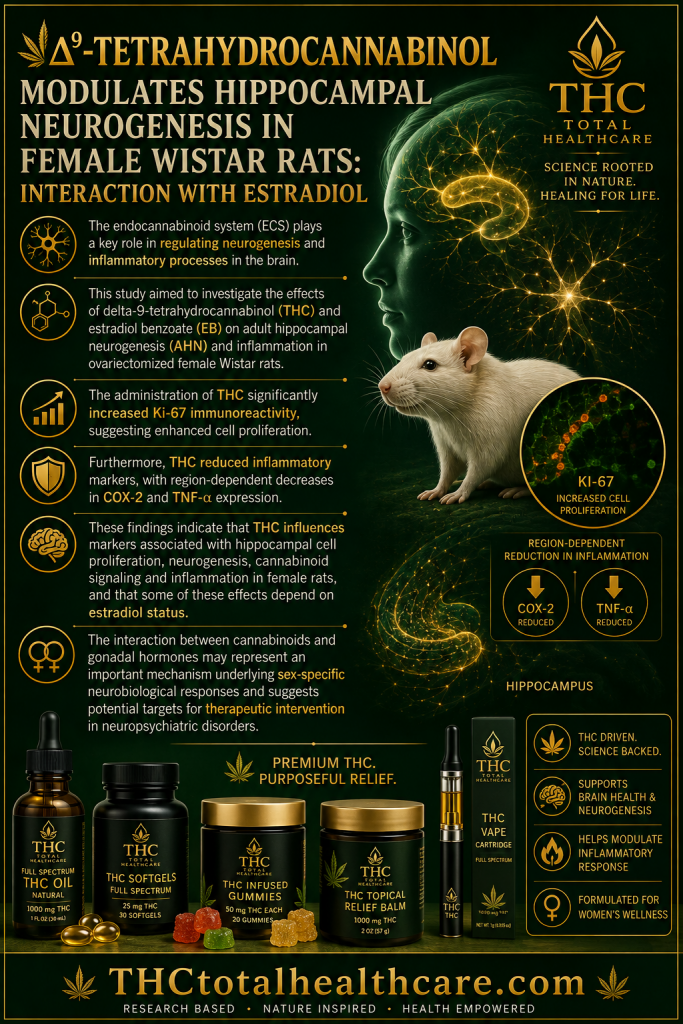
“The endocannabinoid system (ECS) plays a key role in regulating neurogenesis and inflammatory processes in the brain.

The increasing prevalence of Cannabis use among women highlights the importance of understanding sex-specific effects of cannabinoids, particularly in the context of hormonal interactions.

This study aimed to investigate the effects of delta-9-tetrahydrocannabinol (THC) and estradiol benzoate (EB) on adult hippocampal neurogenesis (AHN) and inflammation in ovariectomized female Wistar rats.

Sixteen rats were allocated to four experimental groups receiving THC, EB, both treatments, and vehicle. Immunohistochemical analyses were conducted to evaluate markers of proliferation (Ki-67), neurogenesis (doublecortin and PSA-NCAM), cannabinoid receptor expression (CB1), and inflammation (COX-2 and TNF-α) in the hippocampal formation.

The administration of THC significantly increased Ki-67 immunoreactivity, suggesting enhanced cell proliferation. A trend toward increased doublecortin expression was observed, particularly in EB-treated animals. THC also modulated CB1 receptor expression, with significant increases in the dentate gyrus and hilus following combined THC and EB treatment. Furthermore, THC reduced inflammatory markers, with region-dependent decreases in COX-2 and TNF-α expression.

These findings indicate that THC influences markers associated with hippocampal cell proliferation, neurogenesis, cannabinoid signaling and inflammation in female rats, and that some of these effects depend on estradiol status.

The interaction between cannabinoids and gonadal hormones may represent an important mechanism underlying sex-specific neurobiological responses and suggests potential targets for therapeutic intervention in neuropsychiatric disorders.”

https://pubmed.ncbi.nlm.nih.gov/42570151

https://link.springer.com/article/10.1007/s11064-026-04857-w


Effects of cannabidiol in comparison to hormonal therapy on estrogen decline-induced memory impairments and endocannabinoid system in rats

Declining estrogen levels can contribute to memory impairment and changes in endocannabinoid signaling. In this rat study, cannabidiol (CBD) improved memory deficits associated with estrogen decline and altered components of the endocannabinoid system, with effects that were compared directly with hormonal therapy. The researchers concluded that CBD may represent a potential non-hormonal strategy for addressing cognitive changes associated with estrogen deficiency.

“The aim of this study was to investigate the effects of cannabidiol (CBD) on memory deficits induced by ovariectomy and to directly compare its effects with those of hormone therapy, in order to better understand potential shared mechanisms related to menopause-associated cognitive decline, with a particular focus on the endocannabinoid system.

Three-month-old female Wistar rats were randomly assigned to four experimental groups: SHAM-Veh (Vehicle), OVX-Veh, OVX-E2 (estradiol), and OVX-CBD. Animals underwent either bilateral ovariectomy or sham surgery. Following a three-week recovery period, rats received daily subcutaneous injections of CBD (10 mg/kg), estradiol (10 μg/kg), or vehicle for 21 consecutive days. Behavioral assessments included object recognition and fear-motivated memory tests. Twenty-four hours after the final treatment, animals were euthanized for neurochemical and molecular analyses. Levels of the endocannabinoids anandamide (AEA) and 2-arachidonoylglycerol (2-AG) were measured using high-performance liquid chromatography. Gene expression of cannabinoid receptors CB1 and CB2, as well as enzymes involved in the synthesis and degradation of endocannabinoids (NAPE-PLD, DAGL-A, FAAH, and MGLL), was evaluated in the hippocampus by RT-qPCR.

The results demonstrated that CBD treatment produced memory improvements in the object recognition task comparable to those observed with estradiol. Ovariectomy-induced impairments in fear-motivated memory were completely reversed by both CBD and estradiol treatments. Additionally, CBD reduced the expression of FAAH and MGLL, resulting in increased hippocampal levels of AEA and 2-AG, effects similar to those observed with hormone therapy. Estradiol also increased NAPE-PLD expression, contributing to elevated AEA levels.

Overall, the findings suggest that CBD exerts a protective effect on memory comparable to standard estrogen therapy, supporting its therapeutic potential for menopause-related cognitive impairments.”

https://pubmed.ncbi.nlm.nih.gov/42476954

https://onlinelibrary.wiley.com/doi/10.1111/jne.70234


Endocannabinoid system modulation in bruxism: a neurobiological hypothesis and translational model of ECS-targeted intervention

Bruxism may involve more than mechanical jaw activity, with stress, sleep regulation, pain processing, and motor control all potentially contributing to the condition. This paper proposes that dysfunction of the endocannabinoid system may play a role in bruxism and outlines how cannabinoid receptors and related signaling pathways could become therapeutic targets. The authors conclude that ECS-directed interventions may offer a new translational framework for treating bruxism and warrant further experimental and clinical investigation.

“Bruxism is a multifactorial motor behavior of predominantly central origin, characterized by repetitive masticatory muscle activity and associated with dysregulation of dopaminergic, serotonergic, GABAergic, and glutamatergic pathways involved in motor control, emotional regulation, and stress responsivity.

The endocannabinoid system (ECS) has emerged as a key homeostatic neuromodulator capable of integrating these neurotransmitter systems, thereby influencing pain processing, sleep-wake dynamics, and motor output.

This article develops a neurobiological hypothesis based on a narrative integrative synthesis of clinical, experimental, and translational evidence regarding ECS involvement in the pathophysiology of bruxism.

Findings from randomized clinical trials suggest that topical cannabidiol (CBD) may modulate motor neuron excitability and reduce pain-related outcomes, while case-based and experimental evidence supports the interaction between cannabinoid signaling and neural circuits implicated in motor control and behavioral regulation.

Building on this evidence, we propose a hypothesis-driven translational model in which ECS-mediated neuromodulation may influence central mechanisms underlying bruxism, including motor pattern generation, stress responsivity, and nociceptive processing.

Rather than providing prescriptive therapeutic recommendations, this model is intended as a hypothesis-generating construct that integrates current knowledge on ECS signaling within the broader neurobiology of motor control. Although heterogeneity in study design and outcome measures limits definitive conclusions, the available evidence supports the ECS as a plausible modulatory system in bruxism, with potential implications for future mechanistic and clinical research in centrally mediated motor disorders.”

https://pubmed.ncbi.nlm.nih.gov/42459362

“In summary, the integration of neurobiological knowledge about bruxism with advances in understanding the endocannabinoid system supports the development of a hypothesis-driven translational model in which ECS-mediated neuromodulation may represent a relevant pathway for influencing centrally mediated motor behaviors.”

https://www.frontiersin.org/journals/neuroscience/articles/10.3389/fnins.2026.1854001/full


Prevention of Alzheimer’s Disease Pathology by Cannabinoids: Neuroprotection Mediated by Blockade of Microglial Activation

Alzheimer’s disease involves not only amyloid accumulation but also chronic activation of microglia and damaging neuroinflammation. In this preclinical study, cannabinoids reduced microglial activation, protected neurons from amyloid-related injury, and helped prevent Alzheimer’s-like pathology. The researchers concluded that cannabinoid-mediated suppression of microglial activation may represent a promising neuroprotective strategy for slowing or preventing disease progression.

“Alzheimer’s disease (AD) is characterized by enhanced β-amyloid peptide (βA) deposition along with glial activation in senile plaques, selective neuronal loss, and cognitive deficits.

Cannabinoids are neuroprotective agents against excitotoxicity in vitro and acute brain damage in vivo.

This background prompted us to study the localization, expression, and function of cannabinoid receptors in AD and the possible protective role of cannabinoids after βA treatment, both in vivo and in vitro.

Here, we show that senile plaques in AD patients express cannabinoid receptors CB1 and CB2, together with markers of microglial activation, and that CB1-positive neurons, present in high numbers in control cases, are greatly reduced in areas of microglial activation. In pharmacological experiments, we found that G-protein coupling and CB1 receptor protein expression are markedly decreased in AD brains. Additionally, in AD brains, protein nitration is increased, and, more specifically, CB1 and CB2 proteins show enhanced nitration. Intracerebroventricular administration of the synthetic cannabinoid WIN55,212-2 to rats prevent βA-induced microglial activation, cognitive impairment, and loss of neuronal markers.

Cannabinoids (HU-210, WIN55,212-2, and JWH-133) block βA-induced activation of cultured microglial cells, as judged by mitochondrial activity, cell morphology, and tumor necrosis factor-α release; these effects are independent of the antioxidant action of cannabinoid compounds and are also exerted by a CB2-selective agonist. Moreover, cannabinoids abrogate microglia-mediated neurotoxicity after βA addition to rat cortical cocultures.

Our results indicate that cannabinoid receptors are important in the pathology of AD and that cannabinoids succeed in preventing the neurodegenerative process occurring in the disease.”

“Cannabinoid receptors in AD brain.”

“Cannabinoids, the active components of marijuana and their analogs, exert a wide spectrum of central and peripheral effects by activating specific cannabinoid receptors, two of which have been well characterized to date: CB1 and CB2.”

“Cannabinoids exert neuroprotection under different experimental conditions. Thus, cannabinoid receptor activation protects hippocampal or granule cerebellar neurons from excitotoxicity”

“This background prompted us to study the characteristics and localization of cannabinoid receptors in AD brain, with particular emphasis on any relationship with microglial activation.”

“Cannabinoid treatment prevents βA-induced microglial activation and neurotoxicity in vitro.”

“Cannabinoid treatment prevents βA-induced toxic effects in vivo.”

“Because cannabinoids combine both anti-inflammatory and neuroprotective actions, our findings may set the basis for the use of these compounds as a therapeutic approach for AD.”

https://pmc.ncbi.nlm.nih.gov/articles/PMC6726060

https://www.jneurosci.org/content/25/8/1904.long

Progressive weight loss is attenuated by THC treatment in rats with activity-based anorexia

Anorexia nervosa remains one of the most difficult eating disorders to treat, with few effective medications available to stop the dangerous progression of weight loss. In this preclinical study, researchers tested THC after significant weight loss had already begun—not as a preventive measure—and found that it slowed further weight loss and prolonged survival in rats with activity-based anorexia. Interestingly, the effect was linked not to increased food intake, but to THC reducing excessive activity and therefore lowering energy expenditure. The findings add to growing evidence that the endocannabinoid system may represent a therapeutic target worth further investigation in anorexia nervosa.

“Anorexia nervosa (AN) is a severe psychiatric disorder with limited effective pharmacological treatments.

Given the role of the endocannabinoid system (ECS) in regulating energy balance and its possible involvement in AN pathophysiology, cannabinoid-based interventions may hold therapeutic potential.

Using the preclinical activity-based anorexia (ABA) model, we investigated whether Δ⁹-tetrahydrocannabinol (THC) could attenuate the progression of ABA-induced weight loss.

Female rats were exposed to the ABA paradigm, which combines restricted food access (2 h/day) with unrestricted access to running wheels. After 3 days, when ABA rats had lost 10-12% of their baseline body weight, they received daily injections of either THC or vehicle. Rats were removed from the paradigm after losing 23% of their body weight or on the morning of day 8, whichever occurred first.

THC treatment significantly attenuated weight loss and prolonged survival in the paradigm.

These beneficial effects of THC were mediated by a selective suppression of excessive dark- and light-phase wheel running with no additional effects on food intake.

These findings provide the first evidence that initiating THC treatment after significant weight loss in the ABA paradigm can halt the progression of weight loss through a selective decrease in energy expenditure.

Importantly, treatment was initiated after (rather than before) the emergence of ABA-induced weight loss, thus enhancing the translational relevance of the model and our findings.

Together, these findings suggest that pharmacological activation of the ECS may represent a promising treatment for individuals with AN.”

https://pubmed.ncbi.nlm.nih.gov/42448208

“THC treatment, initiated after ∼12% body weight loss in rats with activity-based anorexia (ABA), reduced further weight loss and prolonged survival.”

“Findings support endocannabinoid-targeted therapies for anorexia nervosa.”

https://www.sciencedirect.com/science/article/abs/pii/S0031938426002313?via%3Dihub


UK Medical Cannabis Registry: A Clinical Outcomes Analysis for Autism Spectrum Disorder

Autistic adults often experience overlapping problems such as anxiety, sleep disturbance, and reduced quality of life, yet treatment options for these associated symptoms can be limited. This UK Medical Cannabis Registry analysis examined patient-reported outcomes following treatment with prescribed cannabis-based medicines in people with autism spectrum disorder. Participants reported improvements across several measures of general health, anxiety, sleep, and quality of life over follow-up, while adverse events were also documented. The findings support further controlled research into cannabis-based medicines for symptoms commonly associated with autism.

Introduction: Autism spectrum disorder (ASD) is a neurodevelopmental disorder associated with distressed behaviors and psychological challenges. This study aims to evaluate the change in health-related quality of life (HRQoL), anxiety, and sleep quality in autistic individuals prescribed cannabis-based medicinal products (CBMPs).

Method: This observational case series analyzed data from the UK Medical Cannabis Registry on autistic adults treated with CBMPs. Demographic and clinical data were collected at baseline, with patient-reported outcome measures assessed up to 18 months. Primary outcomes included changes in anxiety (GAD-7), sleep quality (SQS), and HRQoL (EQ-5D-5L). Secondary outcomes included the incidence of adverse events. Statistical significance was indicated by p < 0.050.

Results: One-hundred and thirty individuals met the inclusion criteria. GAD-7 (p < 0.001) and SQS (p < 0.001) scores improved from baseline to 18 months. EQ-5D-5L index values showed improvement from baseline (0.43 ± 0.30) to 18 months (0.51 ± 0.32, p < 0.001), and PGIC scores increased from 1 month (5.43 ± 1.49) to 18 months (5.65 ± 1.32, p = 0.013). Twenty-five participants (19.23%) reported a total of 232 (178.46%) adverse events, with most being mild (n = 88; 67.69%) or moderate (n = 99; 76.15%).

Conclusion: Treatment with CBMPs was associated with improvements in HRQoL, anxiety, and sleep outcomes in autistic patients over an 18-month period. Given the absence of a control group, these findings represent associations rather than proven treatment effects. Further high-quality randomized controlled trials are needed to confirm the long-term efficacy and safety of CBMPs in ASD.”

https://pubmed.ncbi.nlm.nih.gov/42387975

“The endocannabinoid system (ECS) is a widespread neuromodulatory network that has been linked to the pathophysiology of ASD and is viewed as a potential target for drug development.”

“This observational study suggests that CBMP initiation in autistic adults is associated with improvements in HRQoL, anxiety, and sleep quality over 18 months. There was a favorable safety profile, with 80.77% of patients not reporting any adverse events.”

https://onlinelibrary.wiley.com/doi/10.1002/npr2.70146

Cannabis Oil Prevents Early Hepatic Fibrosis, Inflammation, and Endothelial Dysfunction in a Sucrose-Rich Diet-Induced MASLD Model: Role of Cannabinoid Receptors

Metabolic dysfunction-associated steatotic liver disease (MASLD) can progress from excess liver fat to chronic inflammation, vascular dysfunction, and fibrosis. In this preclinical study, researchers found that cannabis oil prevented several early signs of liver injury in rats fed a sucrose-rich diet, including hepatic fibrosis, inflammation, and endothelial dysfunction. The protective effects were linked in part to cannabinoid receptor signaling, suggesting that compounds within cannabis oil may influence biological pathways involved in the early progression of metabolic liver disease. These findings provide mechanistic evidence for further investigation of cannabinoid-based approaches to preventing or slowing MASLD-related liver damage.

Introduction: Metabolic dysfunction-associated steatotic liver disease (MASLD) is a growing health concern globally, often associated with excessive sugar intake and metabolic dysregulation. In this study, we explored early hepatic alterations induced by a short-term sucrose-rich diet (SRD) and evaluated the preventive effects of a full-spectrum cannabis oil (CO) with a CBD:THC ratio of 2:1.

Methods: Male Wistar rats were assigned to three groups: reference diet, SRD, and SRD plus CO (SRD + CO). CO was administered daily to the SRD + CO group from the onset of SRD exposure and throughout the 3-week experimental period. Liver fibrosis was assessed through hydroxyproline content, total collagen, TGF-β, and CB1R expression. Endothelial dysfunction was evaluated by measuring nitric oxide (NO) levels, endothelial nitric oxide synthase, myeloperoxidase, and VCAM-1 expression. Inflammatory responses were analyzed through hepatic expression of IL-10, TNF-α, PAI-1, MCP-1, F4/80, and CB2R. Transmission electron microscopy was performed on liver tissue to evaluate ultrastructural alterations.

Results: SRD induced significant hepatic fibrosis, endothelial dysfunction, and inflammation. Ultrastructural analysis revealed nuclear alterations, including chromatin condensation, reduced mitochondrial number, intracellular lipid accumulation, increased glycogen deposits, and stromal changes characterized by perisinusoidal and periportal fibrosis with inflammatory cell infiltration. CO administration attenuated these pathological features and was accompanied by modulation of cannabinoid receptor expression.

Conclusion: These findings highlight the preventive effects of CBD- and THC-containing CO against early liver alterations associated with MASLD.”

https://pubmed.ncbi.nlm.nih.gov/42367574

“Phytocannabinoids, such as cannabidiol (CBD) and Δ9-tetrahydrocannabinol (THC), interact with the ECS and various other signaling pathways, providing antioxidant, anti-inflammatory, and antifibrotic properties. Full-spectrum cannabis extracts, which combine phytocannabinoids like CBD and THC, have emerged as therapeutic candidates in preclinical studies for the treatment of liver disorders associated with metabolic dysfunction. Previous studies conducted by our group have demonstrated hepatoprotective and antioxidant effects following the administration of full-spectrum COs in rats fed an SRD for 3 weeks.”

“The present study was designed to evaluate the preventive effects of daily CO administration during the early stages of SRD-induced MASLD.”

“Daily CO administration prevented these alterations and the SRD-induced increase in cannabinoid receptor protein levels.”

“These findings position ECS modulation – particularly through phytocannabinoid combinations – as a promising multi-target strategy capable of mitigating the earliest pathogenesis processes underlying MASLD.”

https://karger.com/mca/article/9/1/163/950066/Cannabis-Oil-Prevents-Early-Hepatic-Fibrosis

Modulation of Respiratory Diseases by the Endocannabinoid System: A Therapeutic Perspective

The endocannabinoid system is increasingly being studied as a regulator of inflammation, immune activity, airway tone, and tissue repair within the lungs. This review examines how cannabinoid receptors, endocannabinoids, and related signaling pathways may influence respiratory diseases including asthma, COPD, pulmonary fibrosis, acute lung injury, and respiratory infections. The authors highlight both protective and potentially harmful effects depending on the receptor, disease state, and type of cannabinoid signaling involved. Rather than supporting a single cannabinoid treatment, the review presents the endocannabinoid system as a complex therapeutic target that may eventually help guide more precise approaches to inflammatory and fibrotic lung disease.

“Respiratory system diseases represent a major global health burden, characterized by high prevalence and significant morbidity and mortality.

The respiratory tract’s direct and continuous exposure to the external environment makes it particularly vulnerable to pathogens, pollutants and other injurious agents. This exposure often triggers excessive inflammatory responses and compromises the integrity of the air-blood barrier, leading to impaired gas exchange, hypoxia and respiratory failure. Therefore, modulating pulmonary inflammation and enhancing barrier function are critical therapeutic objectives.

The endocannabinoid system, a ubiquitous signalling network comprising cannabinoid receptors, endogenous ligands and metabolic enzymes, has emerged as a crucial modulator of these processes.

This review summarizes the role of the ECS in major respiratory diseases, including asthma, pulmonary fibrosis, respiratory syncytial virus infection and acute lung injury.

The evidence highlights the therapeutic potential of targeting the ECS through strategies such as receptor-specific ligands and inhibitors of endocannabinoid-degrading enzymes. However, the context-dependent nature of ECS modulation necessitates precise intervention.

Future efforts should focus on developing selective therapeutics and validating their efficacy in clinical settings, positioning the ECS as a sophisticated target for innovative respiratory disease management.”

“Lung diseases such as asthma, fibrosis and infections are major health problems worldwide. The lungs are constantly exposed to the outside air, making them vulnerable to harmful substances that cause inflammation and damage. This review explores how a natural signalling system in our body—called the endocannabinoid system—helps control lung inflammation and repair. We summarize recent findings on how this system affects different lung diseases and discuss new treatment strategies that target it. While promising, these approaches need to be precisely targeted because the system works differently depending on the specific disease. Understanding this system could lead to better treatments for patients with lung diseases.”

https://pubmed.ncbi.nlm.nih.gov/42363690

“The endocannabinoid system plays a pivotal role in modulating key pathological processes in respiratory diseases, including inflammation, fibrosis, airway hyperresponsiveness and barrier dysfunction. CB2R activation generally exerts anti-inflammatory and anti-fibrotic effects, while CB1R influences airway tone and tissue remodelling. Enhancing endocannabinoid levels through inhibition of metabolic enzymes such as FAAH and MAGL also shows therapeutic potential in attenuating lung injury. However, the context-dependent and pleiotropic nature of ECS signalling necessitates precise, disease-specific targeting.

Future efforts should focus on developing receptor-selective agents and advancing translational studies to harness the ECS as a viable therapeutic strategy in respiratory medicine.”

https://onlinelibrary.wiley.com/doi/10.1111/bcpt.70267

“The potential of cannabinoids and inhibitors of endocannabinoid degradation in respiratory diseases”

https://pubmed.ncbi.nlm.nih.gov/34648805


Endocannabinoid signalling in the regulation of hypothalamic-pituitary neuroendocrine circuits: A review

The endocannabinoid system helps regulate far more than pain and appetite—it also interacts closely with the brain’s hormonal control centers. This review examines how endocannabinoid signaling influences hypothalamic-pituitary neuroendocrine circuits involved in stress responses, reproduction, metabolism, growth, and other hormone-driven functions. The authors describe cannabinoid receptors and endogenous cannabinoids as important modulators of communication between the brain and endocrine system, while emphasizing that their effects vary across different hormonal pathways and physiological states. The review highlights the endocannabinoid system as a significant regulatory network with potential relevance to a wide range of neuroendocrine disorders.

“The endocannabinoid system (ECS), comprising cannabinoid receptors, endogenous lipid ligands, and enzymes that regulate their synthesis and degradation, has emerged as an important modulator of neuroendocrine regulation.

This review summarises current evidence on the role of endocannabinoid signalling in hypothalamic-pituitary neuroendocrine circuits, with particular focus on the hypothalamic-pituitary-adrenocortical, gonadal, thyroid, and somatotropic axes, as well as prolactin and posterior pituitary hormones regulation.

Available data indicate that endocannabinoid signalling predominantly influences neuroendocrine function by modulating synaptic transmission within hypothalamic circuits. Acting mainly as retrograde messengers at presynaptic CB1 receptors, endocannabinoids regulate excitatory and inhibitory inputs to neurosecretory neurons and thus shape endocrine output in a context-dependent manner.

Among the systems discussed, the hypothalamic-pituitary-adrenocortical axis is the best characterised, with relatively well-defined links between glucocorticoid feedback and rapid endocannabinoid-mediated suppression of synaptic input to corticotropin-releasing hormone neurons.

In other neuroendocrine systems, evidence supports a predominantly modulatory, often inhibitory, role for endocannabinoid signalling, although the underlying cellular processes remain less well-defined and are largely based on preclinical studies. Interactions with glucocorticoids, gonadal steroids and neuropeptidergic pathways further underscore the integrative nature of ECS signalling.

Overall, the ECS should be viewed not as a primary endocrine driver, but as a dynamic regulatory network that fine-tunes the translation of neural activity into hormonal responses.”

https://pubmed.ncbi.nlm.nih.gov/42365630

https://reference-global.com/article/10.2478/enr-2026-0011


Cell death induction and intracellular vesicle formation in human colorectal cancer cells treated with Δ9-Tetrahydrocannabinol

THC continues to be investigated for direct effects on cancer-cell biology, including the mechanisms that lead tumor cells toward death. In this laboratory study, researchers exposed human colorectal cancer cells to Δ9-THC and observed increased cell death together with marked changes in intracellular vesicle formation. These structural changes suggest that THC may disrupt cellular trafficking and survival processes in ways that contribute to its anticancer effects. The findings add another mechanistic layer to research examining how THC may influence colorectal cancer cells beyond simple growth inhibition.

Background: Δ9-Tetrahydrocannabinol (Δ9-THC) is a principal psychoactive extract of Cannabis sativa and has been traditionally used as palliative medicine for neuropathic pain. Cannabidiol (CBD), an extract of hemp species, has recently attracted increased attention as a cancer treatment, but Δ9-THC is also requiring explored pharmacological application.

Objective: This study evaluated the pharmacological effects of Δ9-THC in two human colorectal cancer cell lines. We investigated whether Δ9-THC treatment induces cell death in human colorectal cancer cells.

Methods: We performed an MTT assay to determine the pharmacological concentration of Δ9-THC. Annxein V and Western blot analysis confirmed that Δ9-THC induced apoptosis in colorectal cancer cells. Metabolic activity was evaluated using MitoTracker staining and ATP determination. We investigated vesicle formation by Δ9-THC treatment using GW9662, known as a PPARγ inhibitor.

Results: The MTT assay showed that treatment with 40 μM Δ9-THC and above inhibited the proliferation of colorectal cancer cells. Multiple intracytoplasmic vesicles were detected upon microscopic observation, and fluorescence-activated cell sorting analysis showed cell death via G1 arrest. Δ9-THC treatment increased the expression of cell death marker proteins, including p53, cleaved PARP-1, RIP1, and RIP3, suggesting that Δ9-THC induced the death of colorectal cancer cells. Δ9-THC treatment also reduced ATP production via changes in Bax and Bcl-2. Δ9-THC regulated intracytoplasmic vesicle formation by modulating the expression of PPARγ and clathrin, adding that antiproliferative activity of Δ9-THC was also affected.

Conclusion: In conclusion, Δ9-THC regulated two functional mechanisms, intracellular vesicle formation and cell death. These findings can help to determine how cannabinoids can be used most effectively to improve the efficacy of cancer treatment.”

https://pubmed.ncbi.nlm.nih.gov/37837516

 “Cannabinoid extracts exhibit pharmacological effects by regulating the endocannabinoid system.”

“Δ9-THC treatment shows cell death and morphological changes in human colorectal cancer cells.”

“Therefore, these results suggest that Δ9-THC treatment induced cell death by inhibiting cell growth and inducing cellular morphological changes.”

https://link.springer.com/article/10.1007/s13258-023-01466-7