Endocannabinoid System and Its Regulation by Polyunsaturated Fatty Acids and Full Spectrum Hemp Oils

The endocannabinoid system is closely linked to lipid metabolism, particularly to polyunsaturated fatty acids that serve as building blocks for several endogenous cannabinoid-related molecules. This review examines how dietary fatty acids and full-spectrum hemp oils may influence endocannabinoid signaling, inflammation, metabolism, and other physiological processes. The authors highlight the complex relationship between cannabinoid compounds, fatty-acid composition, and the body’s own signaling networks, suggesting that hemp oils may affect health through more than their cannabinoid content alone. The review adds a nutritional and metabolic dimension to understanding how Cannabis sativa products interact with the endocannabinoid system.

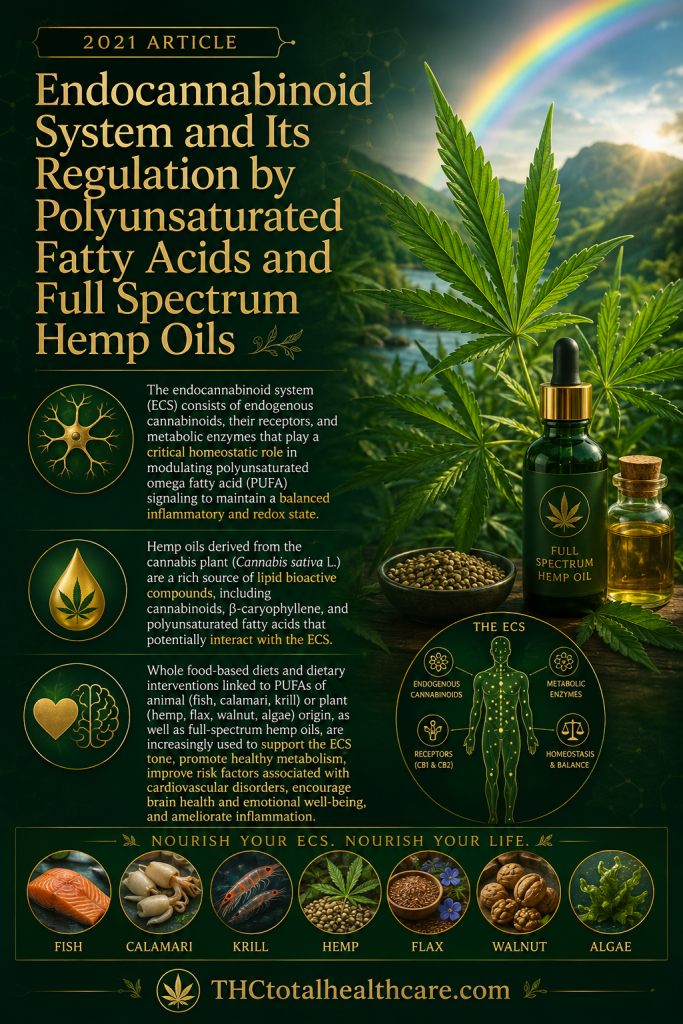
“The endocannabinoid system (ECS) consists of endogenous cannabinoids, their receptors, and metabolic enzymes that play a critical homeostatic role in modulating polyunsaturated omega fatty acid (PUFA) signaling to maintain a balanced inflammatory and redox state.

Whole food-based diets and dietary interventions linked to PUFAs of animal (fish, calamari, krill) or plant (hemp, flax, walnut, algae) origin, as well as full-spectrum hemp oils, are increasingly used to support the ECS tone, promote healthy metabolism, improve risk factors associated with cardiovascular disorders, encourage brain health and emotional well-being, and ameliorate inflammation.

While hemp cannabinoids of THC and CBD groups show distinct but complementary actions through a variety of cannabinoid (CB1 and CB2), adenosine (A2A), and vanilloid (TRPV1) receptors, they also modulate PUFA metabolism within a wide variety of specialized lipid mediators that promote or resolve inflammation and oxidative stress.

Clinical evidence reviewed in this study links PUFAs and cannabinoids to changes in ECS tone, immune function, metabolic and oxidative stress adaptation, and overall maintenance of a well-balanced systemic function of the body. Understanding how the body coordinates signals from the exogenous and endogenous ECS modulators is critical for discerning the underlying molecular mechanisms of the ECS tone in healthy and disease states.

Nutritional and lifestyle interventions represent promising approaches to address chronic metabolic and inflammatory disorders that may overlap in the population at risk. Further investigation and validation of dietary interventions that modulate the ECS are required in order to devise clinically successful second-generation management strategies.”

https://pubmed.ncbi.nlm.nih.gov/34067450

“Hemp oils derived from the cannabis plant (Cannabis sativa L.) are a rich source of lipid bioactive compounds, including cannabinoids, β-caryophyllene, and polyunsaturated fatty acids that potentially interact with the ECS.”

https://www.mdpi.com/1422-0067/22/11/5479

Don’t Sweat It: Cannabinoid CB1 Receptors Reduce Sweating in a Mouse Model

The endocannabinoid system may play a previously underappreciated role in controlling sweat production. In this preclinical study, researchers found that activation of cannabinoid CB1 receptors reduced sweating in a mouse model, providing mechanistic evidence that cannabinoid signaling can directly influence sweat-gland activity. The findings complement emerging clinical observations involving CBD and hyperhidrosis and suggest that the endocannabinoid system could represent a new biological target for excessive sweating disorders. Further research will be needed to determine whether these effects can be translated into practical treatments for people with hyperhidrosis.

“Numerous exocrine glands play key physiological roles in the body that include tearing, salivation, and lactation, as well as the control of body temperature via sweating. Malfunction of sweat glands can be deeply problematic or-in the case of anhidrosis-life-threatening. The prevalence of sweating disorders is high, affecting millions. The few available therapies are generally of limited effectiveness.

Several lines of evidence point to regulation of sweating by the cannabinoid signaling system, an arrangement that would mirror cannabinoid regulation of tearing and salivation.

Mice sweat in their paws via glands that closely resemble human eccrine sweat glands, including regulation by muscarinic signaling and by temperature. We applied a galvanic skin response-based assay to investigate cannabinoid regulation of sweating in awake, unanesthetized mice. The muscarinic agonist pilocarpine increased conductance while the antagonist glycopyrrolate reduced conductance, validating the model as a measure of sweating. The cannabinoid receptor agonist CP55940 substantially reduced conductance in wild-type and CB2 but not CB1 receptor knockout mice.

The phytocannabinoid tetrahydrocannabinol (THC) also reduced conductance, while the non-psychoactive cannabidiol (CBD) did not. Using immunohistochemistry, we detected CB1 receptors in periglandular cholinergic axons, the anandamide-synthesizing enzyme NAPE-PLD in myoepithelial cells, and the anandamide metabolizing enzyme FAAH in acinar cells. This indicates that a local CB1/anandamide-based circuit is present in mouse walking pads.

In summary, we employed a novel galvanic skin response-based assay to determine that cannabinoid CB1 receptors reduce sweating in a mouse model. This may point to a previously unappreciated effect on sweating in cannabis users.”

https://pubmed.ncbi.nlm.nih.gov/42287607

“In summary, we have made use of a galvanic skin response-based assay to measure the conductivity in the hind paws of awake, unanesthetized mice as a measure of sweating. We find the galvanic skin responses to be stable and consistent over time and, importantly, to be responsive to stimuli that increase or decrease basal sweating. Using this model, we determined that cannabinoid CB1 receptor activation reduces the galvanic skin response.

We propose that cannabinoid CB1 receptor activation reduces basal sweating in mice.

This effect may point the way to a new class of therapeutics for hyperhidrosis.”

https://faseb.onlinelibrary.wiley.com/doi/10.1096/fj.202601143R

Therapeutic potential of endocannabinoid system activation in opioid use disorder and pain

Pain and opioid use disorder are closely linked, creating a need for treatments that can reduce pain without reinforcing opioid dependence. This review examines the endocannabinoid system as a potential therapeutic target for both conditions, focusing on how cannabinoid receptors and endogenous cannabinoid signaling influence pain perception, reward, withdrawal, and opioid-related behaviors. The authors discuss evidence that activating or modulating this system may reduce pain while also affecting mechanisms involved in opioid dependence and relapse. The review highlights the endocannabinoid system as a promising bridge between pain management and addiction treatment, supporting further development of cannabinoid-based and endocannabinoid-targeted therapies.

Introduction: Opioid use disorder (OUD) and chronic pain remain major global health challenges. Although opioid-based therapies provide effective analgesia, their long-term use is limited by safety concerns, dependence, and variable efficacy. Modulation of the endocannabinoid system (ECS) has emerged as a promising therapeutic strategy for pain management and opioid-related disorders.

Areas covered: This narrative review summarizes current evidence on ECS-targeted interventions for OUD, chronic non-cancer pain, and cancer-related pain. Relevant literature was identified through PubMed using search terms related to the ECS, cannabinoid receptors (CB1 and CB2), phytocannabinoids (Δ9 -tetrahydrocannabinol [THC] and cannabidiol [CBD]), synthetic cannabinoids, fatty acid amide hydrolase (FAAH) and monoacylglycerol lipase (MAGL) inhibitors, and opioid – cannabinoid interactions. Particular emphasis is placed on mechanistic interactions between ECS and opioid signaling pathways, as well as evidence from preclinical and clinical studies evaluating therapeutic efficacy and safety.

Expert opinion: ECS modulation may alleviate pain, reduce opioid withdrawal symptoms, and improve affective outcomes. Interactions between cannabinoid and opioid receptors may produce synergistic analgesic effects while potentially mitigating opioid tolerance and dependence. However, clinical translation remains limited by small sample sizes, heterogeneous study populations, and variability in trial design. Well-controlled clinical trials are needed to establish optimal dosing strategies, evaluate long-term safety, and clarify the therapeutic role of ECS-targeted interventions in OUD and pain management.”

https://pubmed.ncbi.nlm.nih.gov/42295097

“The endocannabinoid system (ECS) represents a promising therapeutic target for opioid use disorder (OUD), chronic non-cancer pain, and cancer-related pain.”

“Cannabinoids (e.g., CBD and Δ9 -THC) exert analgesic and anti-inflammatory effects through CB1-mediated central mechanisms and CB2-mediated peripheral mechanisms.”

https://www.tandfonline.com/doi/full/10.1080/14728222.2026.2690138

Endocannabinoid system and skeletal muscle health: insights from cannabidiol

The endocannabinoid system plays an important role in skeletal muscle metabolism, inflammation, regeneration, and adaptation to physical stress. This review examines how cannabidiol may influence muscle health through cannabinoid-related signaling, oxidative stress control, mitochondrial function, and inflammatory pathways. The evidence suggests that CBD may help support muscle recovery, protect against damage, and modulate processes involved in muscle maintenance and repair. The review adds to growing interest in cannabinoids as potential tools for preserving skeletal muscle function in both health and disease.

“The endocannabinoid (EC) system is a complex network comprising endogenous ligands, enzymes responsible for their synthesis and degradation, and various receptors (including CB1 and CB2).

Present in many peripheral tissues, including skeletal muscle, EC system is now recognized to influence key physiological processes such as insulin sensitivity, mitochondrial metabolism, protein homeostasis and muscle development. Alterations in this system are associated with a variety of pathologies, including obesity, type 2 diabetes, sarcopenia, cachexia and muscle dystrophies.

In this context, cannabidiol (CBD), a phytocannabinoid devoid of psychoactive properties, is attracting growing interest as a potential therapeutic agent.

This article provides an analysis of the mechanisms by which the EC system, and more specifically the CB1 receptor, influences skeletal muscle development and function, while exploring emerging data on the potential benefits of CBD in various pathological conditions affecting skeletal muscle.”

https://pubmed.ncbi.nlm.nih.gov/42264146

“The endocannabinoid system (ECS) is composed of endogenous ligands (AEA, 2-AG), enzymes for their synthesis or degradation, and receptors (e.g., CB1, CB2). It also includes exogenous molecules like cannabidiol (CBD) produced from Cannabis sativa. Widely expressed in peripheral tissues such, the ECS plays a central role in the regulation of key skeletal muscle physiological processes, including insulin sensitivity, mitochondrial metabolism, protein homeostasis and skeletal muscle development.

Dysregulation of this system is associated with the development of metabolic and muscular disorders, such as obesity, type 2 diabetes, sarcopenia, cachexia and muscular dystrophies.

In this context, CBD, a non-psychoactive phytocannabinoid, has emerged as a potential therapeutic agent capable of modulating ECS activity, thereby contributing to the restoration of skeletal muscle function and homeostasis.”

https://www.sciencedirect.com/science/article/pii/S2212877826000803?via%3Dihub

Potential antitumor effect of cannabidiol (CBD) in canine oncology: a systematic review

Cannabidiol is increasingly being studied in veterinary oncology for effects that may go beyond symptom relief. This systematic review examined the available evidence on CBD in canine cancer and found promising antitumor activity across several models, including reduced cancer-cell viability, induction of apoptosis, and inhibition of tumor-related signaling pathways. The review also highlights CBD’s potential to complement conventional cancer treatments, reinforcing growing interest in cannabinoid-based approaches in veterinary oncology. Together, the findings support CBD as an important area of investigation for canine cancer treatment.

Introduction: Preparations of Cannabis sativa have been used for medicinal purposes for many centuries Currently, it is known that the phytocannabinoids present in the Cannabis sativa plant can modulate the endocannabinoid system, producing a variety of effects. Among the most abundant phytocannabinoids are delta-9-tetrahydrocannabinol (19-THC) and cannabidiol (CBD). CBD lacks psychotropic properties and has been shown to inhibit cell proliferation and migration, while inducing apoptosis in various human tumor cells. Studies evaluating CBD in dogs are more recent than those in humans, and to date, fewer publications are available. However, CBD has been shown to be safe and well-tolerated in dogs, supporting its potential clinical use. Since approximately 2015, some studies have been conducted evaluating CBD in different types of canine cancer; however, no comprehensive review of these findings has been performed.

Methods: we conducted a systematic review Following the PRISMA 2020 guidelines.to compile the existing evidence on the anticancer effects of CBD in dogs.

Results: We found that the studies conducted so far are pre-clinical, mostly based on cellular models, and that available data are primarily in lymphoma, mammary cancer, glioma, prostate cancer, osteosarcoma, and urothelial carcinoma. These studies consistently show that CBD exerts antiproliferative and proapoptotic effects, in some cases by modulating intracellular signaling pathways, including ERK, JNK, and caspases. Additionally, some studies have evaluated the combination of CBD with other drugs, reporting both synergistic and antagonistic effects.

Overall, these findings highlight the potential of CBD as an anticancer agent across different cancer types.

Discussion: Further studies are required to better elucidate the mechanisms underlying the effects of CBD and to standardize concentrations and formulations, enabling reliable, comparable results and the development of clinical studies evaluating the role of CBD in canine oncology.”

https://pubmed.ncbi.nlm.nih.gov/42254894

“The findings from pre-clinical studies in dogs are consistent with those observed in humans, where CBD triggers antiproliferative and pro-apoptotic effects on several cancer cell types, which support clinical trials to elucidate the pharmacodynamics, pharmacokinetics, and potential antitumor efficacy of CBD in dogs with cancer.”

https://www.frontiersin.org/journals/veterinary-science/articles/10.3389/fvets.2026.1800410/full

Combined peripheral cannabinoid CB1 and CB2 receptor activation abolishes cystitis-induced bladder hyperalgesia

Bladder pain caused by cystitis can be severe and difficult to control because inflammation sensitizes the nerves that carry pain signals from the urinary tract. In this preclinical study, combined activation of peripheral cannabinoid CB1 and CB2 receptors completely abolished cystitis-induced bladder hyperalgesia. The findings suggest that targeting both cannabinoid receptors outside the central nervous system may provide powerful pain relief while potentially avoiding some of the unwanted effects associated with centrally acting cannabinoids. The study highlights peripheral CB1/CB2 signaling as a promising therapeutic target for painful bladder disorders.

“Cannabinoid agonists may ameliorate bladder pain associated with interstitial cystitis/bladder pain syndrome.

Visceromotor responses (VMRs) to bladder distension were recorded in urethane-anesthetised control and protamine/zymosan-treated guinea pigs. The peripherally restricted preferential CB1 receptor agonist PrNMI and the selective CB2 receptor agonist 4Q3C each reduced cystitis-induced enhancement of VMRs at high intravesical pressures.

Co-activation of CB1 and CB2 receptors abolished cystitis-induced bladder hyperalgesia.

These findings indicate that simultaneous targeting of peripheral CB1 and CB2 receptors may provide clinically meaningful benefits for the treatment of bladder pain associated with cystitis.”

https://pubmed.ncbi.nlm.nih.gov/42247877

“Combined activation of peripheral CB1 and CB2 receptors using peripherally restricted agonists effectively reverses bladder hyperalgesia in a preclinical model of IC/BPS.

These findings provide strong support for the development of peripherally acting combination therapies targeting both cannabinoid receptors as a strategy to treat bladder pain and associated symptoms in IC/BPS, while minimising central cannabinoid-related side effects.”

https://www.autonomicneuroscience.com/article/S1566-0702(26)00066-4/fulltext

Interplay between the HPA axis and inflammation as mechanisms therapeutic targets of Cannabis sativa in depression

Depression is increasingly understood as a disorder involving not only brain chemistry, but also chronic inflammation and dysregulation of the hypothalamic-pituitary-adrenal (HPA) stress axis. This review examines how Cannabis sativa and its cannabinoids may influence both systems, highlighting interactions with inflammatory signaling, stress hormones, and endocannabinoid pathways involved in mood regulation. The evidence suggests that cannabis-derived compounds may help restore balance across these interconnected biological systems, offering a broader therapeutic approach to depression than targeting a single neurotransmitter pathway alone.

“Major Depressive Disorder (MDD) is a highly prevalent and disabling psychiatric disorder, representing a major global health burden across all age groups.

Increasing evidence indicates that its pathophysiology involves a complex interplay between chronic stress, dysregulation of the hypothalamic-pituitary-adrenal (HPA) axis, immune activation, and neuroinflammation. Persistent HPA axis hyperactivity, glucocorticoid resistance, and altered expression of key regulators such as FKBP51 contribute to sustained inflammatory signaling and impaired neural plasticity in brain regions involved in mood regulation. Epigenetic mechanisms, including DNA methylation and microRNA-mediated regulation, further modulate stress responsivity, inflammatory pathways, and vulnerability to major depressive disorder.

In this context, growing attention has been directed toward Cannabis sativa and its bioactive constituents as potential therapeutic agents.

Preclinical and clinical evidence suggest that cannabinoids may modulate the endocannabinoid system, attenuate HPA axis hyperactivity, reduce neuroinflammation, and influence monoaminergic and neuroplasticity-related pathways.

This review synthesizes the current literature on the mechanistic links among the HPA axis, inflammation, and MDD, highlighting the emerging role of Cannabis sativa-derived compounds in targeting these interconnected pathways.”

https://pubmed.ncbi.nlm.nih.gov/42239513

https://www.frontiersin.org/journals/pharmacology/articles/10.3389/fphar.2026.1801474/full

Emerging preclinical evidence supports a potential role for cannabidiol in the management of sickle cell disease

Sickle cell disease causes recurring pain, inflammation, vascular injury, and organ damage, creating a need for therapies that can address several disease mechanisms at once. Emerging preclinical research suggests that cannabidiol may have value through its analgesic, anti-inflammatory, antioxidant, and vascular effects. The evidence reviewed indicates that CBD can influence pathways involved in sickle cell pain and inflammatory injury while potentially helping protect tissues from downstream damage. Together, these findings support CBD as a promising therapeutic candidate for addressing both pain and underlying biological complications associated with sickle cell disease.

“Sickle cell disease (SCD) imposes a substantial global health burden, with acute and chronic pain representing a major component of morbidity. Standard pain management, largely opioid-based, carries significant risks and often provides inadequate long-term relief, highlighting an unmet need for alternative analgesics as well as disease modifiers.

Medicinal cannabinoids have analgesic and antiinflammatory properties; most clinical studies so far have used Δ9-tetrahydrocannabinol (THC)-containing products with conflicting outcomes. In contrast, purified cannabidiol (CBD) has a broader spectrum of action beyond the endocannabinoid system, lacks psychoactive effects and associated long-term risks, allows safe dose optimization and can be prescribed legally in many settings.

Here, we review evidence for CBD’s potential analgesic and disease-modifying properties for management of SCD.

Pain in SCD arises from local tissue inflammation and neuroinflammation, compounded by abnormal pain modulation and pro-nociceptive CNS alterations. CBD may attenuate the pathophysiological processes of SCD by modulating pro-inflammatory immune pathways, reducing oxidative stress and suppression of neurogenic inflammation. CBD also has a direct inhibitory effect on afferent nociceptive pathways. Furthermore, CBD has an important pain-modulating role by suppressing excitatory mechanisms in the dorsal root ganglia and CNS. Additionally, CBD may modulate pain-processing brain networks and attenuate opioidinduced reward-seeking behavior.

Although human data are very limited, emerging preclinical findings and early patient reports offer cautious optimism for CBD as a therapeutic option with potential disease-modifying properties in SCD. Clinically meaningful benefits may be expected in specific patient subgroups, identifiable through well-designed clinical and mechanistic studies focused on pain processing and neuroinflammation.”

https://pubmed.ncbi.nlm.nih.gov/42206420

https://haematologica.org/article/view/14205

Endocannabinoid system modulation in acute, chronic, and neuropathic pain: reviewing experimental models, clinical evidence, and nanotechnology delivery

The endocannabinoid system is a major regulator of pain signaling, making it an important therapeutic target across acute, chronic, and neuropathic pain conditions. This review brings together experimental and clinical evidence showing that cannabinoid receptor modulation can reduce pain through effects on inflammation, nerve signaling, and central pain processing. It also highlights emerging nanotechnology-based delivery systems designed to improve cannabinoid targeting, absorption, and treatment efficiency. The findings support cannabinoid and endocannabinoid-based strategies as a broad and increasingly sophisticated approach to pain management.

“Chronic pain is highly prevalent and inadequately managed by current therapeutic strategies, which present significant limitations such as the development of tolerance, dependence, and cognitive impairment. Therefore, searching for new pain management strategies is an ultimate goal.

The endocannabinoid system (ECS), is a broad crucial regulatory network in central nervous system’s development and in modulating various physiological and cognitive functions. It comprises endogenous cannabinoids, cannabinoid receptors, and the enzymes governing cannabinoid production and breakdown.

Recently, cannabinoids, particularly medical cannabis, have garnered renewed interest for their possibilities in treating different medical conditions, including chronic pain.

Although the risk of lethal overdose is negligible, the prevalence of non-serious adverse effects is significant and requires careful clinical consideration. Currently, there is a paucity of sufficient efficacy and long-term safety data to fully support the systematic use of medical cannabis for chronic non-malignant pain conditions.

Further research is crucial to unlock the future potential of these approaches and to delineate essential directions for exploring the ECS and its role in pain management. Advances in nanotechnology have enabled novel delivery platforms that address key limitations of cannabinoid-based therapies.

Nanocarriers, including lipid and polymeric nanoparticles, nanoemulsions, and self-emulsifying systems, can improve cannabinoid solubility, stability, bioavailability, and targeted delivery. Through controlled release and site-specific targeting, these systems hold promise for enhancing the analgesic efficacy and safety of cannabinoid therapeutics.”

https://pubmed.ncbi.nlm.nih.gov/42154330

https://link.springer.com/article/10.1007/s11011-026-01862-4

Disrupted endocannabinoid signaling contributes to systemic inflammation in acute pancreatitis

Acute pancreatitis can trigger a powerful systemic inflammatory response that contributes to complications far beyond the pancreas itself. In this study, researchers found that disrupted endocannabinoid signaling was directly associated with heightened inflammation during acute pancreatitis, linking cannabinoid-related pathways to the progression of systemic immune dysfunction. The findings suggest that restoring or modulating endocannabinoid signaling may offer a new therapeutic strategy for limiting inflammation and reducing the broader damage caused by severe pancreatitis.

“Acute pancreatitis (AP) is an inflammatory disease that can lead to systemic complications in severe cases. The endocannabinoid system has emerged as a potential modulator of inflammation in AP.

We investigated the role of the endocannabinoid 2-arachidonoylglycerol (2-AG) and the cannabinoid receptors CB1 and CB2 during AP.

A severity-dependent decrease in circulating 2-AG was found both in patients and a murine AP model. Restoring 2-AG – by avoiding its degradation via monoacylglycerol lipase inhibitor or direct 2-AG administration – reduced local and systemic inflammation, modulated peritoneal macrophage polarization, and mitigated lung injury. Notably, endocannabinoid system effects were consistent across sexes.

Both cannabinoid receptors were involved in disease pathophysiology.

Genetic Cnr1 knockout and pharmacological CB2 blockade showed distinct and complementary roles of both receptors in regulating inflammation, immune infiltration, and pulmonary damage.

These findings highlight a protective role for 2-AG and highlight the endocannabinoid system – and cannabinoid receptors in particular – as a promising therapeutic target to modulate inflammation and reduce systemic complications in acute pancreatitis.”

https://pubmed.ncbi.nlm.nih.gov/42153289

“These findings raise the possibility that counteracting the inflammation-driven decline in endogenous 2-AG through pharmacological intervention may represent a promising therapeutic strategy for AP.”

“Our data clearly support a role for both CB1 and CB2 receptors in the pathophysiology of AP.”

“Overall, our study supports the ECS as promising therapeutic target to reduce inflammation and systemic complications in AP.”

https://pathsocjournals.onlinelibrary.wiley.com/doi/10.1002/path.70076

“The Diminished Availability of 2-AG in Aged Synaptic Terminals is Ameliorated by a Full-Spectrum Cannabis Extract with a High THC Content. This highlights the potential of high THC content extracts as therapeutic agents for restoring the decreased 2-AG levels observed in the aging brain.”

https://pubmed.ncbi.nlm.nih.gov/41880097