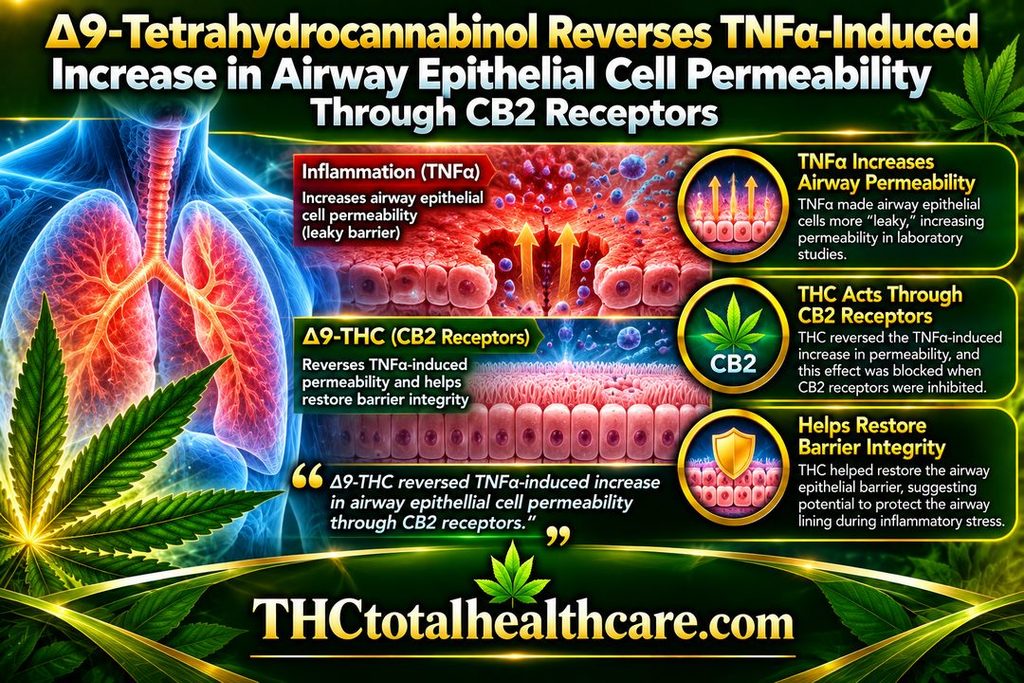
Δ9-Tetrahydrocannabinol Reverses TNFα-induced Increase in Airway Epithelial Cell Permeability through CB2 Receptors.

Δ9-THC reversed inflammation-induced damage to the airway epithelial barrier in laboratory experiments. TNFα increased the permeability of airway epithelial cells, making the barrier more “leaky,” while THC restored barrier integrity.

The effect was mediated through CB2 cannabinoid receptors. When CB2 signaling was blocked, THC lost its protective effect, showing that CB2 activation played a central role in reversing the TNFα-induced increase in airway permeability.

These findings suggest that THC may help protect the airway lining during inflammatory stress by strengthening the epithelial barrier rather than simply reducing symptoms. That makes the study especially relevant to respiratory conditions where inflammation disrupts normal airway function.

“Despite pharmacological treatment, bronchial hyperresponsiveness continues to deteriorate as airway remodelling persists in airway inflammation.

Previous studies have demonstrated that the phytocannabinoid Δ9-tetrahydrocannabinol (THC) reverses bronchoconstriction with an anti-inflammatory action.

The aim of this study was to investigate the effects of THC on bronchial epithelial cell permeability after exposure to the pro-inflammatory cytokine, TNFα. Calu-3 bronchial epithelial cells were cultured at air-liquid interface.

These data indicate that THC prevents cytokine-induced increase in airway epithelial permeability through CB2 receptor activation.

This highlights that THC, or other cannabinoid receptor ligands, could be beneficial in the prevention of inflammation-induced changes in airway epithelial cell permeability, an important feature of airways diseases.”

http://www.ncbi.nlm.nih.gov/pubmed/27641813

“These data indicate that THC prevents cytokine-induced increase in airway epithelial permeability through CB2 receptor activation. This highlights that THC, or other cannabinoid receptor ligands, could be beneficial in the prevention of inflammation-induced changes in airway epithelial cell permeability, an important feature of airways diseases.”

https://www.sciencedirect.com/science/article/abs/pii/S0006295216302878?via%3Dihub

Need this THC study explained? thcXplained.com
Activation of Cannabinoid Receptor Type II by AM1241 Ameliorates Myocardial Fibrosis via Nrf2-Mediated Inhibition of TGF-β1/Smad3 Pathway in Myocardial Infarction Mice.

Image result for Cell Physiol Biochem

“Myocardial interstitial fibrosis is a major histologic landmark resulting in cardiac dysfunction after myocardial infarction (MI).

Activation of cannabinoid receptor type II (CB2 receptor) have been demonstrated to reduce fibrosis in hepatic cirrhotic rat.

In this study, we aimed to investigate the effects of a CB2 receptor selective agonist AM1241 on myocardial fibrosis post MI in mice.

CONCLUSION:

CB2 receptor agonist AM1241 alleviated myocardial interstitial fibrosis via Nrf2 -mediated down-regulation of TGF-β1/Smad3 pathway, which suggested that CB2 receptor activation might represent a promising target for retarding cardiac fibrosis after MI.”

http://www.ncbi.nlm.nih.gov/pubmed/27614871

Activation of Cannabinoid Receptor 2 Ameliorates DSS-Induced Colitis through Inhibiting NLRP3 Inflammasome in Macrophages.

Image result for plos one logo

“Activation of cannabinoid receptor 2 (CB2R) ameliorates inflammation, but the underlying mechanism remains unclear.

In the present study, we examined whether activation of CB2R could suppress the nucleotide-binding domain and leucine-rich repeat protein 3 (NLRP3) inflammasome.

We conclude that activation of CB2R ameliorates DSS-induced colitis through enhancing autophagy that may inhibit NLRP3 inflammasome activation in macrophages.”

http://www.ncbi.nlm.nih.gov/pubmed/27611972

Selective modulator of cannabinoid receptor type 2 (CB2) against biochemical alterations and brain damage in chronic cerebral hypoperfusion induced vascular dementia.

Image result for Curr Neurovasc Res.

“Vascular dementia is the second most common cause of cognitive decline in aged people but the effectual therapeutic target is still missing.

Chronic cerebral hypoperfusion (CCH) has been widely found in vascular dementia (VaD) patients. CCH is thought to link with neurodegenerative disorders and their subsequent cognitive impairment.

The present study has been framed to investigate the role of selective agonist of CB2 receptor (1-phenylisatin) in CCH induced VaD.

These results indicate that 2VO induced CCH in rats, which was attenuated with the treatment of 1-phenylisatin.

Hence, it may be suggested that modulation in cannabinoid receptor may provide benefits in CCH as cognitive impairment and VaD.

Therefore, pharmacological positive modulation of CB2 receptors may be a potential research target for alleviation of VaD.”

http://www.ncbi.nlm.nih.gov/pubmed/27599483

Selective modulator of cannabinoid receptor type 2 reduces memory impairment and infarct size during cerebral hypoperfusion and vascular dementia.

Image result for Curr Neurovasc Res.

“Vascular dementia is the highly devastating neurodegenerative disorder after Alzheimer’s disease (AD) and mainly found in aged people but the effectual therapeutic target is still not there.

Chronic cerebral hypoperfusion (CCH) has been broadly found in vascular dementia (VaD) patients. CCH is thought to link with neurodegenerative disorders and their subsequent cognitive deteriorate on.

This study has been framed to examine the role of a selective agonist of cannabinoid receptor type 2(CB2); 1-phenylisatin in CCH induced VaD.

These results indicate that 2VO induced CCH in rats, which was attenuated with the treatment of 1-phenylisatin.

Hence, it may be suggested that modulation of cannabinoid receptor may provide benefits in CCH as cognitive impairment and VaD.

Therefore, selective agonists of CB2 receptors may be a potential research target for the alleviation of VaD.”

http://www.ncbi.nlm.nih.gov/pubmed/27586843

Cannabinoid 2 receptor is a novel anti-inflammatory target in experimental proliferative vitreoretinopathy.

Image result for neuropharmacology journal

“Proliferative vitreoretinopathy (PVR) can develop after ocular trauma or inflammation and is a common complication of surgery to correct retinal detachment.

Currently, there are no pharmacological treatments for PVR.

Cannabinoids acting at cannabinoid 2 receptor (CB2R) can decrease inflammation and fibrosis.

The objective of this study was to examine the anti-inflammatory actions of CB2R as a candidate novel therapeutic target in experimental PVR.

In conclusion, our results indicate that intervention at early stage PVR with CB2R agonists reduces ocular inflammation and disease severity.

CB2R may represent a therapeutic target to prevent PVR progression and vision loss.”

http://www.ncbi.nlm.nih.gov/pubmed/27569993

CB2 receptor activation prevents glial-derived neurotoxic mediator production, BBB leakage and peripheral immune cell infiltration and rescues dopamine neurons in the MPTP model of Parkinson’s disease.

“The cannabinoid (CB2) receptor type 2 has been proposed to prevent the degeneration of dopamine neurons in 1-methyl-4-phenyl-1,2,3,6-tetrahydropyridine (MPTP)-treated mice.

Our results suggest that targeting the cannabinoid system may be beneficial for the treatment of neurodegenerative diseases, such as PD, that are associated with glial activation, BBB disruption and peripheral immune cell infiltration.”

http://www.ncbi.nlm.nih.gov/pubmed/27534533

“The cannabinoid type two receptors (CB2), an important component of the endocannabinoid system, have recently emerged as neuromodulators and therapeutic targets for neurodegenerative diseases including Parkinson’s disease (PD).” http://www.ncbi.nlm.nih.gov/pubmed/27531971

Cannabinoid Type 2 (CB2) Receptors Activation Protects against Oxidative Stress and Neuroinflammation Associated Dopaminergic Neurodegeneration in Rotenone Model of Parkinson’s Disease.

“The cannabinoid type two receptors (CB2), an important component of the endocannabinoid system, have recently emerged as neuromodulators and therapeutic targets for neurodegenerative diseases including Parkinson’s disease (PD).

The downregulation of CB2 receptors has been reported in the brains of PD patients. Therefore, both the activation and the upregulation of the CB2 receptors are believed to protect against the neurodegenerative changes in PD.

In the present study, we investigated the CB2 receptor-mediated neuroprotective effect of β-caryophyllene (BCP), a naturally occurring CB2 receptor agonist, in, a clinically relevant, rotenone (ROT)-induced animal model of PD.

Interestingly, BCP supplementation demonstrated the potent therapeutic effects against ROT-induced neurodegeneration, which was evidenced by BCP-mediated CB2 receptor activation and the fact that, prior administration of the CB2 receptor antagonist AM630 diminished the beneficial effects of BCP.

The present study suggests that BCP has the potential therapeutic efficacy to elicit significant neuroprotection by its anti-inflammatory and antioxidant activities mediated by activation of the CB2 receptors.”

http://www.ncbi.nlm.nih.gov/pubmed/27531971

The Effect of Muscarinic Receptor Modulators on the Antinociception Induced by CB2 Receptor Agonist, JWH133 in Mice.

“There is no published study regarding the interaction between muscarinic receptor modulators and antinociception induced by cannabinoidreceptor (CB2) agonist. The effect of pilocarpine (a muscarinic agonist) and atropine (a muscarinic antagonist) on JWH-133 (a CB2 agonist) induced analgesia in mice was studied. First the analgesic effect of JWH-133 (0.001-1 mg/Kg) or pilocarpine (2.5-20 mg/kg) or atropine (0.2-5 mg/kg) was evaluated. Subsequently, the effect of co-administration of pilocarpine (2.5 mg/kg) or atropine (5 mg/kg) and JWH-133 (0.001-1 mg/Kg) were studied too. JWH-133 and pilocarpine provoked antinociception in mice but atropine did not. Pilocarpine potentiated the analgesic effect of JWH-133 but atropine antagonized that. It can be concluded that JWH-133 induced antinociception is affected by muscarinic receptor modulators in mice.”

http://www.ncbi.nlm.nih.gov/pubmed/27504865

Inhibition of interleukin-8 release in the human colonic epithelial cell line HT-29 by cannabinoids.


“We have investigated the effects of cannabinoid agonists and antagonists on tumour necrosis factor-alpha (TNF-alpha)-induced secretion of interleukin-8 from the colonic epithelial cell line, HT-29.

The cannabinoid receptor agonists [(-)-3-[2-hydroxy-4-(1,1-dimethyl-heptyl)-phenyl]4-[3-hydroxypropyl]cyclo-hexan-1-ol] (CP55,940); Delta-9-tetrahydrocannabinol; [R(+)-[2,3-dihydro-5-methyl-3-[(morpholinyl) methyl] pyrrolo[1,2,3-de]1,4-benzoxazin-6-yl](1-naphthyl) methanone mesylate] (WIN55,212-2) and 1-propyl-2-methyl-3-naphthoyl-indole (JWH 015) inhibited TNF-alpha induced release of interleukin-8 in a concentration-dependent manner.

We conclude that in HT-29 cells, TNF-alpha-induced interleukin-8 release is inhibited by cannabinoids through activation of cannabinoid CB(2) receptors.”

http://www.ncbi.nlm.nih.gov/pubmed/12498928

“Essential involvement of interleukin-8 (IL-8) in acute inflammation.”  http://www.ncbi.nlm.nih.gov/pubmed/7964163

“Interleukin-8 (IL-8) is known to possess tumorigenic and proangiogenic properties. Overexpression of IL-8 has been detected in many human tumors, including colorectal cancer (CRC). IL-8 promotes tumor growth, metastasis, chemoresistance and angiogenesis, implying IL-8 to be an important therapeutic target in CRC.”  http://www.ncbi.nlm.nih.gov/pubmed/20648559