“Cannabis sativa L. (C. sativa) is an annual dioecious plant, which shares its origins with the inception of the first agricultural human societies in Asia. Over the course of time different parts of the plant have been utilized for therapeutic and recreational purposes, for instance, extraction of healing oils from seed, or the use of inflorescences for their psychoactive effects. The key psychoactive constituent in C. sativa is called Δ-9-tetrahydrocannabinol (D9-THC). The endocannabinoid system seems to be phylogenetically ancient, as it was present in the most primitive vertebrates with a neuronal network. N-arachidonoylethanolamine (AEA) and 2-arachidonoyl glycerol (2-AG) are the main endocannabinoids ligands present in the animal kingdom, and the main endocannabinoid receptors are cannabinoid type-1 (CB1) receptor and cannabinoid type-2 (CB2) receptor.
AIM OF THE STUDY:
The review aims to provide a critical and comprehensive evaluation, from the ancient times to our days, of the ethnological, botanical, chemical and pharmacological aspects of C. sativa, with a vision for promoting further pharmaceutical research to explore its complete potential as a therapeutic agent.
RESULTS AND CONCLUSIONS:
A detailed comparative analysis of the available resources for C. sativa confirmed its origin and traditional spiritual, household and therapeutic uses and most importantly its popularity as a recreational drug. The result of several studies suggested a deeper involvement of phytocannabinoids (the key compounds in C. sativa) in several others central and peripheral pathophysiological mechanisms such as food intake, inflammation, pain, colitis, sleep disorders, neurological and psychiatric illness. However, despite their numerous medicinal benefits, they are still considered as a menace to the society and banned throughout the world, except for few countries. We believe that this review will help lay the foundation for promoting exhaustive pharmacological and pharmaceutical studies in order to better understand the clinical relevance and applications of non-psychoactive cannabinoids in the prevention and treatment of life-threatening diseases and help to improve the legal status of C. sativa.”
https://www.ncbi.nlm.nih.gov/pubmed/30205181
https://www.sciencedirect.com/science/article/pii/S0378874118316611?via%3Dihub]]>

 “Cannabinoid receptor 1 (CB1) is a promising therapeutic target for a variety of disorders. Distinct efficacy profiles showed different therapeutic effects on CB1 dependent on three classes of ligands: agonists, antagonists, and inverse agonists. To discriminate the distinct efficacy profiles of the ligands, we carried out molecular dynamics (MD) simulations to identify the dynamic behaviors of inactive and active conformations of CB1 structures with the ligands. In addition, the molecular mechanics Poisson-Boltzmann surface area (MM-PBSA) method was applied to analyze the binding free energy decompositions of the CB1-ligand complexes. With these two methods, we found the possibility that the three classes of ligands can be discriminated. Our findings shed light on the understanding of different efficacy profiles of ligands by analyzing the structural behaviors of intact CB1 structures and the binding energies of ligands, thereby yielding insights that are useful for the design of new potent CB1 drugs.”
https://www.ncbi.nlm.nih.gov/pubmed/30213978
https://www.nature.com/articles/s41598-018-31749-z
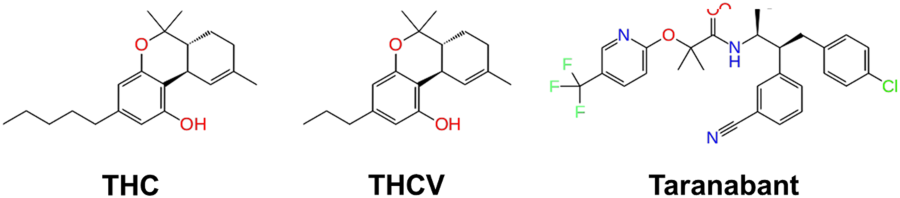
“Chemical structure of the partial agonist THC, antagonist THCV, and inverse agonist Taranabant.”
 “Drug addiction is a chronic relapsing disorder that produces a dramaticglobal health burden worldwide. Not effective treatment of drug addiction is currently available probably due to the difficulties to find an appropriate target to manage this complex disease raising the needs for further identification of novel therapeutic approaches.
The endocannabinoid system has been found to play a crucial role in the neurobiological substrate underlying drug addiction.
Endocannabinoids and cannabinoid receptors are widely expressed in the main areas of the mesocorticolimbic system that participate in the initiation and maintenance of drug consumption and in the development of compulsion and loss of behavioral control occurring during drug addiction.
The identification of the important role played by CB1 cannabinoid receptors in drug addiction encouraged the possible used of an early commercialized CB1 receptor antagonist for treating drug addiction.
However, the incidence of serious psychiatric adverse events leaded to the sudden withdrawal from the market of this CB1 antagonist and all the research programs developed by pharmaceutical companies to obtain new CB1 antagonists were stopped.
Currently, new research strategies are under development to target the endocannabinoid system for drug addiction avoiding these side effects, which include allosteric negative modulators of CB1 receptors and compounds targeting CB2 receptors.
Recent studies showing the potential role of CB2 receptors in the addictive properties of different drugs of abuse have open a promising research opportunity to develop novel possible therapeutic approaches.”
 “The evolving policies regarding the use of therapeutic Cannabis have steadily increased the public interest in its use as a complementary and alternative medicine in several disorders, including inflammatory bowel disease.
Endocannabinoids represent both an appealing therapeutic strategy and a captivating scientific dilemma.
Results from clinical trials have to be carefully interpreted owing to possible reporting-biases related to cannabinoids psychotropic effects. Moreover, discriminating between symptomatic improvement and the real gain on the underlying inflammatory process is often challenging.
This review summarizes the advances and latest discovery in this ever-changing field of investigation, highlighting the main limitations in the current use of these drugs in clinical practice and the possible future perspectives to overcome these flaws.”
 “Microglia, the resident immune cells of the brain, play important roles in defending the brain against pathogens and supporting neuronal circuit plasticity. Chronic or excessive pro-inflammatory responses of microglia damage neurons, therefore their activity is tightly regulated.
Pharmacological and genetic studies revealed that
 “Post-traumatic headache is the most common symptom of postconcussion syndrome and becomes a chronic neurological disorder in a substantial proportion of patients.
This review provides a brief overview of the epidemiology of postconcussion headache, research models used to study this disorder, as well as the proposed mechanisms.
An objective of this review is to enhance the understanding of how the endogenous cannabinoid system is essential for maintaining the balance of the CNS and regulating inflammation after injury, and in turn making the endocannabinoid system a potential modulator of the trigeminal response to concussion.
The review describes the role of endocannabinoid modulation of pain and the potential for use of phytocannabinoids to treat pain, migraine and concussion.”
 “We recently reported that a CB2R agonist, GW405833 (GW), reduced both the ACh-induced Ca2+ oscillations and the L-arginine-induced Ca2+ signal enhancement in mouse pancreatic acinar cells, suggesting that GW-induced inhibition may prevent the pathogenesis of acute pancreatitis.
In this study, we aim to evaluate the effects of other cannabinoid ligands on Ca2+ signaling in acinar cells.
In conclusion, CB2R agonists play critical roles in modulating Ca2+ signals in mouse pancreatic acinar cells, while other cannabinoid ligands modulate Ca2+ oscillations in a heterogeneous manner through a CB receptor or non-CB-receptor mechanism.”
 “Pain is characterized as a complex experience, dependent not only on the regulation of nociceptive sensory systems but also on the activation of mechanisms that control emotional processes in limbic brain areas.
Non-opioid, non-steroidal anti-inflammatory drugs (NSAIDs) are the most widely used analgesics in the treatment of not-severe pain. We have recently shown that repeated doses result in tolerance to these drugs like opioids.
Here we investigated the central brain mechanisms of non-opioid induced antinociception in the non-acute pain models of rats, such as the ‘formalin test’ and a relation between administration of NSAIDs in the limbic brain area, – the anterior cingulated cortex (ACC), – and the endocannabinoid system.
The present data support the notion that endocannabinoids’ CB1 receptor contributes in part to antinociceptive effects of NSAIDs and probably involved in activation of the descending opioid modulatory system of pain.”
 “Recently, we demonstrated that the antipsychotic dopaminergic and serotoninergic agonist aripiprazole induced peripheral antinociception. However, the mechanism underlying this effect has not been fully established.
Here, our aim was to identify possible relationships between this action of aripiprazole and the endocannabinoid system.