
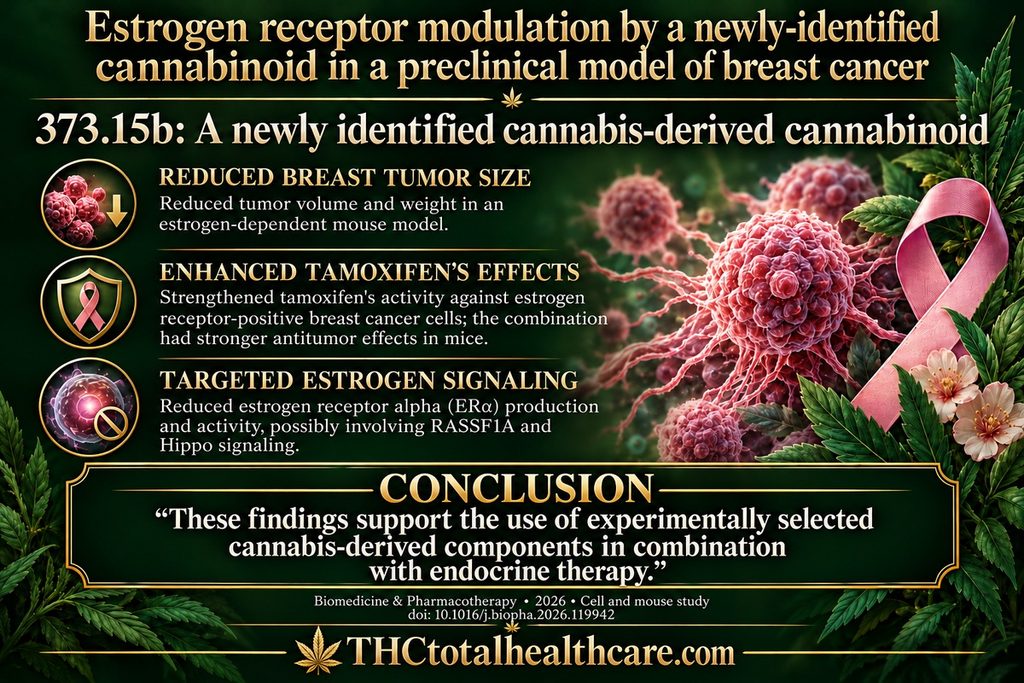
A newly identified cannabis-derived cannabinoid, 373.15b, reduced breast tumor volume and weight in mice, with stronger effects when combined with tamoxifen. Researchers isolated the compound from a cannabis extract called CANN14, which increased the sensitivity of estrogen receptor-positive breast cancer cells to tamoxifen.
The cannabinoid reduced the production and activity of estrogen receptor alpha (ERα), a protein that helps estrogen drive cancer growth. Its effects may involve RASSF1A and the Hippo signaling pathway, which help regulate cell growth.
These findings identify a potential way to strengthen hormone therapy for estrogen-dependent breast cancer. The researchers suggest that combining 373.15b with drugs such as tamoxifen could eventually permit lower treatment doses and fewer adverse effects—a possibility requiring clinical testing.
“Background: Breast cancer is a diverse group of diseases comprising subtypes with distinct behavior and response to therapy. Tumors that express estrogen receptor alpha (ERα) and depend on estrogen constitute ∼65% of all breast cancer cases. Common endocrine therapy for this kind of breast cancer includes Selective Estrogen Receptor Modulators (SERMs) such as tamoxifen. However, despite the clear benefits, many patients do not complete the recommended 5 and sometimes 10 years of treatment because of adverse effects. Medical cannabis is increasingly used by cancer patients, primarily for palliative care, yet its direct antitumor potential in breast cancer remains poorly understood.
Purpose: Examine whether cannabis-derived compounds exert selective antitumor effects in breast cancer and elucidate the underlying molecular mechanisms.
Study design: A combination of in vitro experiments in multiple ER-positive breast cancer cell lines with in vivo validation in an estrogen-dependent xenograft mouse model.
Methods: Breast cancer cell lines representing different molecular subtypes were evaluated. A panel of chemically distinct cannabis extracts was initially screened for cytotoxic activity and subsequently tested in combination with SERMs. Extracts were chemically profiled using ESI-LC/MS. Phytocannabinoid fractionation, chemical analyses, and structural elucidation were performed to isolate and characterize the bioactive phytocannabinoid in the only cannabis extract identified in the initial screen as effective in combination with tamoxifen. The mechanism of action of this phytocannabinoid was investigated in vitro using molecular and biochemical assays. Finally, antitumor efficacy was assessed in vivo using an estrogen-dependent ER-positive breast cancer xenograft mouse model.
Results: We found a unique cannabis extract, CANN14, capable of sensitizing ER-positive breast cancer cells to the cytotoxic effect of tamoxifen. We identified a novel phytocannabinoid 373.15b that mimicked the effect of the whole extract without any toxicity by itself. It has a unique structure of a dihydroxyphenol with an acetate group attached to the aromatic ring, distinguishing it from known cannabinoid scaffolds. Cannabinoid 373.15b modulated estrogen signaling by decreasing the mRNA and protein expression levels of ERα, as well as its transcriptional activity, possibly through a signaling pathway involving RASSF1A and Hippo signaling components. In an in vivo mouse model, treatment with 373.15b reduced tumor volume and weight, with a more profound effect when combined with tamoxifen.
Conclusion: The work presented here identifies a novel cannabinoid that modulates ERα signaling and enhances the antitumor efficacy of SERMs. The findings suggests that co-therapy of 373.15b with SERMs may allow dose reduction of conventional therapy, and by that, diminish the associated adverse effects and improve patient quality of life.
One-sentence summary: The newly identified cannabinoid 373.15b reduces ERα expression and activity through RASSF1A and Hippo signaling pathway thus exerting antitumor effects.”
https://pubmed.ncbi.nlm.nih.gov/42927724
“Overall, our findings demonstrate that a specific cannabis-derived compound can decrease ER signaling and inhibit ER-positive breast cancer, particularly in combination with tamoxifen. Our initial screen further highlights the substantial variability between cannabis cultivars, showing that even extracts with similar major cannabinoid compositions can produce different biological outcomes.
Through fractionation and chemical characterization, we identified a previously uncharacterized phytocannabinoid, 373.15b, which modulates ERα expression and activity. Based on our preliminary results, we hypothesize that the reduction in ERα expression occurs through a mechanism involving RASSF1A and the Hippo signaling pathway.
Both the CANN14 extract and purified 373.15b significantly inhibited tumor progression in vivo, with a more pronounced effect when combined with tamoxifen.
These findings support the use of experimentally selected cannabis-derived components in combination with endocrine therapy. In ER-positive breast cancer, enhancing therapeutic efficacy may allow dose reduction of SERMs, potentially mitigating adverse effects and improving patient adherence and quality of life.”
https://www.sciencedirect.com/science/article/pii/S0753332226009789?via%3Dihub