
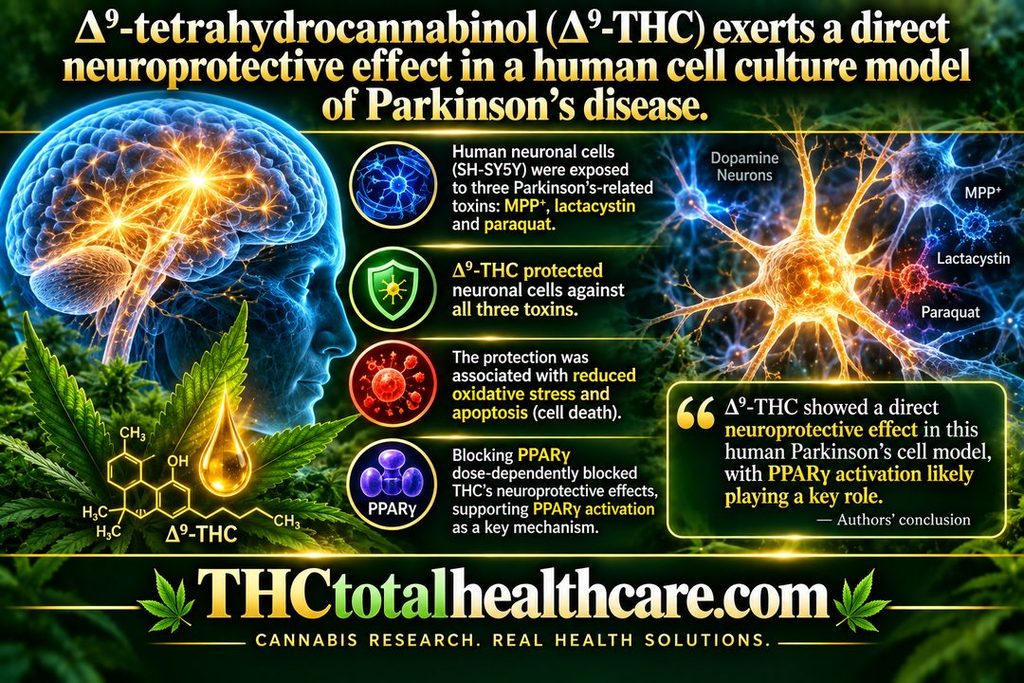
Δ9-THC directly protected human neuronal cells in a laboratory model of Parkinson’s disease from three different Parkinson’s-related toxins: MPP+, lactacystin, and paraquat. Across the experiments, THC reduced toxin-induced cell injury, oxidative stress, and apoptosis.
The researchers found that this neuroprotective effect was linked strongly to PPARγ activation. Blocking PPARγ reduced THC’s protective effects, while THC increased PPARγ expression in injured cells, pointing to this pathway as an important part of the mechanism.
These findings show that THC acted directly on vulnerable human neuronal cells in this Parkinson’s disease model, not just on symptoms. The study adds evidence that THC may have neuroprotective potential in conditions involving oxidative stress, mitochondrial dysfunction, and neuronal loss.
“Aims: Δ⁹-tetrahydrocannabinol (Δ⁹-THC) is neuroprotective in models of Parkinson’s disease (PD). Although CB1 receptors are increased within the basal ganglia of PD patients and animal models, current evidence suggests a role for CB1 receptor-independent mechanisms. Here, we utilized a human neuronal cell culture PD model to further investigate the protective properties of Δ⁹-THC.
Methods: Differentiated SH-SY5Y neuroblastoma cells were exposed to PD-relevant toxins: 1-methyl-4-phenylpyridinium (MPP+), lactacystin and paraquat. Changes in CB1 receptor level were determined by quantitative polymerase chain reaction and Western blotting. Cannabinoids and modulatory compounds were co-administered with toxins for 48 h and the effects on cell death, viability, apoptosis and oxidative stress assessed.
Results: We found CB1 receptor up-regulation in response to MPP+, lactacystin and paraquat and a protective effect of Δ⁹-THC against all three toxins. This neuroprotective effect was not reproduced by the CB1 receptor agonist WIN55,212-2 or blocked by the CB1 antagonist AM251. Furthermore, the antioxidants α-tocopherol and butylhydroxytoluene as well as the antioxidant cannabinoids, nabilone and cannabidiol were unable to elicit the same neuroprotection as Δ⁹-THC. However, the peroxisome proliferator-activated receptor-gamma (PPARγ) antagonist T0070907 dose-dependently blocked the neuroprotective, antioxidant and anti-apoptotic effects of Δ⁹-THC, while the PPARγ agonist pioglitazone resulted in protection from MPP+-induced neurotoxicity. Furthermore, Δ⁹-THC increased PPARγ expression in MPP+-treated SH-SY5Y cells, another indicator of PPARγ activation.
Conclusions: We have demonstrated up-regulation of the CB1 receptor in direct response to neuronal injury in a human PD cell culture model, and a direct neuronal protective effect of Δ⁹-THC that may be mediated through PPARγ activation.”
https://www.ncbi.nlm.nih.gov/pubmed/22236282
“In conclusion, we have demonstrated up-regulation of the CB1 receptor in a human cell culture model of PD, as well as a direct neuroprotective effect of the phytocannabinoid, Δ9-THC, not mediated by the CB2 receptor. Although a CB1 receptor-mediated effect cannot totally be excluded, we propose that activation of PPARγ leading to antioxidant effects is highly relevant in mediating the neuroprotection afforded by Δ9-THC in our model.”
http://onlinelibrary.wiley.com/doi/10.1111/j.1365-2990.2011.01248.x/full
Need this THC study explained? thcXplained.com
