

Cannabinoid receptor 1 binding activity and quantitative analysis of Cannabis sativa L. smoke and vapor.

cpb

“Cannabis sativa L. (cannabis) extracts, vapor produced by the Volcano vaporizer and smoke made from burning cannabis joints were analyzed by GC-flame ionization detecter (FID), GC-MS and HPLC. Three different medicinal cannabis varieties were investigated Bedrocan, Bedrobinol and Bediol.

Cannabinoids plus other components such as terpenoids and pyrolytic by-products were identified and quantified in all samples. Cannabis vapor and smoke was tested for cannabinoid receptor 1 (CB1) binding activity and compared to pure Delta(9)-tetrahydrocannabinol (Delta(9)-THC).

The top five major compounds in Bedrocan extracts were Delta(9)-THC, cannabigerol (CBG), terpinolene, myrcene, and cis-ocimene in Bedrobinol Delta(9)-THC, myrcene, CBG, cannabichromene (CBC), and camphene in Bediol cannabidiol (CBD), Delta(9)-THC, myrcene, CBC, and CBG.

The major components in Bedrocan vapor (>1.0 mg/g) were Delta(9)-THC, terpinolene, myrcene, CBG, cis-ocimene and CBD in Bedrobinol Delta(9)-THC, myrcene and CBD in Bediol CBD, Delta(9)-THC, myrcene, CBC and terpinolene.

The major components in Bedrocan smoke (>1.0 mg/g) were Delta(9)-THC, cannabinol (CBN), terpinolene, CBG, myrcene and cis-ocimene in Bedrobinol Delta(9)-THC, CBN and myrcene in Bediol CBD, Delta(9)-THC, CBN, myrcene, CBC and terpinolene.

There was no statistically significant difference between CB1 binding of pure Delta(9)-THC compared to cannabis smoke and vapor at an equivalent concentration of Delta(9)-THC.”

http://www.ncbi.nlm.nih.gov/pubmed/20118579

Fibromyalgia Research Might Benefit from Finding Cannabinoid Receptors in Muscles

Fibromyalgia News Today

“Receptors for the body’s own cannabinoid substances are present in muscle fascia — soft connective tissue surrounding all muscles and involved in several pain states, according to recent research from the University of Padua in Italy.

In addition to casting light on disease processes in fibromyalgia, the findings might lead to better approaches for managing pain and inflammation in the disease, for which current treatments often fail to adequately treat symptoms.

Endocannabinoids are bodily substances chemically resembling the cannabinoid molecules in cannabis. The factors send signals through two receptors that scientists have primarily explored in the brain and in immune cells, and studies show that stimulating the receptors can relieve pain and suppress inflammation.

 Patients with pain conditions such as fibromyalgia often turn to cannabis when prescription drugs are not enough to manage their symptoms. A 2005 study from the United Kingdom listed fibromyalgia among those conditions where patients frequently turn to marijuana for symptom relief, and a 2014 study of 217 U.S. patients showed that pain was the most commonly reported ailment in patients who use medical cannabis.

Research has also demonstrated that patients with fibromyalgia report that marijuana use lowers pain and improves health-related quality of life, making researchers suspect that endocannabinoid receptors, which also mediate the effects of marijuana, might exist in tissues other than the brain and immune cells.

To explore this, the study, “Expression of the endocannabinoid receptors in human fascial tissue,“ published in the European Journal of Histochemistryturned to muscle fascia, a tissue that has also been linked to other muscle pain conditions.

Extracting the tissue from thigh muscles of 11 volunteers who had orthopedic surgery, researchers isolated the main cell type of the fascia, called fibroblasts. They found both types of receptors, called CB1 and CB2, in the cells. Examining whole tissue levels of the two receptors, researchers noted somewhat higher levels, indicating that the receptors may also be present in other cell types.

A better understanding of how endocannabinoid receptors are involved in fibromyalgia might lead to treatments specifically targeting the receptors in the muscles, avoiding the effects of manipulating cannabinoid receptors in the brain which mediate the psychotropic actions of cannabis.”

https://fibromyalgianewstoday.com/2016/07/08/fibromyalgia-drug-research-might-benefit-from-finding-cannabinoid-receptors-in-muscles/

Neuroprotective effect of endogenous cannabinoids on ischemic brain injury induced by the excess microglia-mediated inflammation.

“Increasing evidence has demonstrated the role of endogenous cannabinoids system (ECS) on protecting brain injury caused by ischemia (IMI). Papers reported that microglia-mediated inflammation has become one of the most pivotal mechanisms for IMI. This study was aimed to investigate the potential roles of ECS on neuron protection under microglia-mediated inflammation. Inflammatory cytokines level both in vitro (BV-2 cells) and in vivo (brain tissue from constructed IMI model and brain-isolated microglia) was detected. ECS levels were detected, and its effects on inflammations was also analyzed. Influence of microglia-mediated inflammation on neuron injury was analyzed. Moreover, the effects of ECS on protecting neuron injury were also analyzed. Our results showed that the levels of inflammatory cytokines including TNFα and IL-1β were higher while IKBα was lower in IMI model brain tissue, brain-isolated microglia and BV-2 cells compared to the control. Inflammation was activated in microglia, as well as the activation of ECS characterized by the increasing level of AEA and 2-AG. Furthermore, the activated microglia-mediated self-inflammation performed harmful influence on neurons via suppressing cell viability and inducing apoptosis. Moreover, ECS functioned as a protector on neuron injury though promoting cell proliferation and suppressing cell apoptosis which were caused by the activated BV-2 cells (LPS induced for 3 h). Our data suggested that ECS may play certain neuroprotective effects on microglia-mediated inflammations-induced IMI through anti-inflammatory function.”

http://www.ncbi.nlm.nih.gov/pubmed/27398146

The Structure-Function Relationships of Classical Cannabinoids: CB1/CB2 Modulation.

“The cannabinoids are members of a deceptively simple class of terpenophenolic secondary metabolites isolated from Cannabis sativa highlighted by (-)-Δ(9)-tetrahydrocannabinol (THC), eliciting distinct pharmacological effects mediated largely by cannabinoid receptor (CB1 or CB2) signaling. Since the initial discovery of THC and related cannabinoids, synthetic and semisynthetic classical cannabinoid analogs have been evaluated to help define receptor binding modes and structure-CB1/CB2 functional activity relationships. This perspective will examine the classical cannabinoids, with particular emphasis on the structure-activity relationship of five regions: C3 side chain, phenolic hydroxyl, aromatic A-ring, pyran B-ring, and cyclohexenyl C-ring. Cumulative structure-activity relationship studies to date have helped define the critical structural elements required for potency and selectivity toward CB1 and CB2 and, more importantly, ushered the discovery and development of contemporary nonclassical cannabinoid modulators with enhanced physicochemical and pharmacological profiles.”

http://www.ncbi.nlm.nih.gov/pubmed/27398024

The endocannabinoid system – a target for the treatment of LUTS?

“Lower urinary tract symptoms (LUTS) are common in all age groups and both sexes, resulting in tremendous personal suffering and a substantial burden to society.

Antimuscarinic drugs are the mainstay of symptom management in patients with LUTS, although their clinical utility is limited by the high prevalence of adverse effects, which often limit patients’ long-term adherence to these agents.

Data from controversial studies in the 1990s revealed the positive effects of marijuana-based compounds on LUTS, and sparked an interest in the possibility of treating bladder disorders with cannabis.

Increased understanding of cannabinoid receptor pharmacology and the discovery of endogenous ligands of these receptors has prompted debate and further research into the clinical utility of exogenous cannabinoid receptor agonists relative to the unwanted psychotropic effects of these agents.

Currently, the endocannabinoid system is considered as a potential drug target for pharmacological management of LUTS, with a more favourable adverse event profile than antimuscarinic agents.”

http://www.ncbi.nlm.nih.gov/pubmed/27377161

The cannabinoid 2 receptor agonist β-caryophyllene modulates the inflammatory reaction induced by Mycobacterium bovis BCG by inhibiting neutrophil migration.

“β-Caryophyllene (BCP) is a sesquiterpene that binds to the cannabinoid 2 (CB2) receptor and exerts anti-inflammatory effects. In this study, we investigated the anti-inflammatory effect of BCP and another CB2 agonist, GP1a in inflammatory experimental model induced by Mycobacterium bovis (BCG).

These results suggest that the CB2 receptor may represent a new target for modulating the inflammatory reaction induced by mycobacteria.”

http://www.ncbi.nlm.nih.gov/pubmed/27379721

“β-caryophyllene (BCP) is a common constitute of the essential oils of numerous spice, food plants and major component in Cannabis.”  http://www.ncbi.nlm.nih.gov/pubmed/23138934

Microglia activation states and cannabinoid system: Therapeutic implications.

“Microglial cells are recognized as the brain’s intrinsic immune cells, mediating actions that range from the protection against harmful conditions that modify CNS homeostasis, to the control of proliferation and differentiation of neurons and their synaptic pruning. To perform these functions, microglia adopts different activation states, the so-called phenotypes that depending on the local environment involve them in neuroinflammation, tissue repair and even the resolution of the inflammatory process.

There is accumulating evidence indicating that cannabinoids (CBs) might serve as a promising tool to modify the outcome of inflammation, especially by influencing microglial activity.

Microglia has a functional endocannabinoid (eCB) signaling system, composed of cannabinoid receptors and the complete machinery for the synthesis and degradation of eCBs.

The expression of cannabinoid receptors – mainly CB2 – and the production of eCBs have been related to the activation profile of these cells and therefore, the microglial phenotype, emerging as one of the mechanisms by which microglia becomes alternatively activated.

Here, we will discuss recent studies that provide new insights into the role of CBs and their endogenous counterparts in defining the profile of microglia activation.

These actions make CBs a promising therapeutic tool to avoid the detrimental effects of inflammation and possibly paving the way to target microglia in order to generate a reparative milieu in neurodegenerative diseases.”

http://www.ncbi.nlm.nih.gov/pubmed/27373505

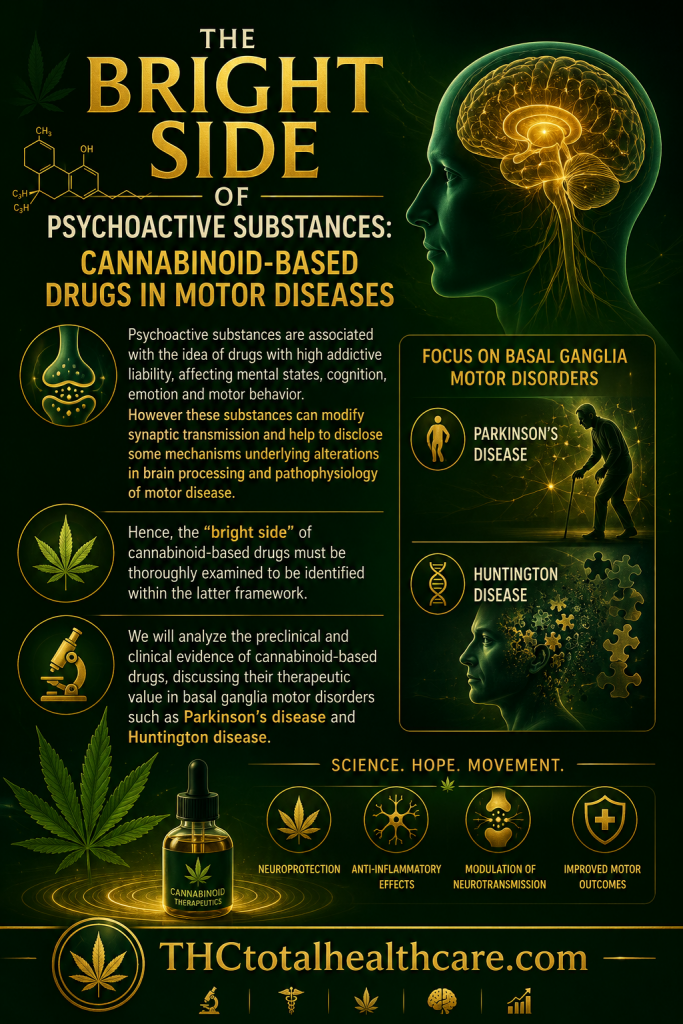
The bright side of psychoactive substances: cannabinoid-based drugs in motor diseases.

“Psychoactive substances are associated with the idea of drugs with high addictive liability, affecting mental states, cognition, emotion and motor behavior. However these substances can modify synaptic transmission and help to disclose some mechanisms underlying alterations in brain processing and pathophysiology of motor disease. Hence, the “bright side” of cannabinoid-based drugs must be thoroughly examined to be identified within the latter framework.

We will analyze the preclinical and clinical evidence of cannabinoid-based drugs, discussing their therapeutic value in basal ganglia motor disorders such as Parkinson’s disease and Huntington disease.

Expert commentary: despite the knowledge acquired in the last years, the therapeutic potential of cannabinoid-based drugs should be further tested by novel routes of investigation. This should be focused on the role of cannabinoid signaling system in mitochondrial function as well as on the physical and functional interaction with other key receptorial targets belonging to this network.”

http://www.ncbi.nlm.nih.gov/pubmed/27373318

Medical Marijuana for Epilepsy?

“Treatment-refractory epilepsy remains an important clinical problem. There is considerable recent interest by the public and physicians in using medical marijuana or its derivatives to treat seizures. The endocannabinoid system has a role in neuronal balance and ictal control. There is clinical evidence of success in diminishing seizure frequencies with cannabis derivatives, but also documentation about exacerbating epilepsy or of no discernible effect. There are lay indications and anecdotal reports of success in attenuating the severity of epilepsy, but without solid investigational corroboration. Marijuana remains largely illegal, and may induce adverse consequences. Clinical applications are not approved, thus are restricted and only recommended in selected treatment unresponsive cases, with appropriate monitoring.”

http://www.ncbi.nlm.nih.gov/pubmed/27354925

Cannabinoid receptors in the kidney.

“The endocannabinoid system modulates cell signaling targets that are essential for energy homeostasis. Endocannabinoids bind to G protein-coupled receptors in the central nervous system and periphery, including the kidney. Modulation of cannabinoid receptor 1 (CB1) and CB2 activity in the kidney in diabetes and obesity has been identified as potential therapeutic target to reduce albuminuria and renal fibrosis.

CB1 and CB2 have been reported to play key roles in renal function and dysfunction. Recent studies have determined that antagonism of CB1 and agonism of CB2 in diabetic nephropathy and obesity associated kidney disease can reduce albuminuria, potentially by acting on both the glomeruli and tubules. Emerging studies have also identified a role for CB1 in renal diseases associated with fibrosis, with CB1 upregulated in multiple models of human nephropathies.

Emerging studies using isolated cells, rodent models, and human studies have identified a critical role for the endocannabinoid system in renal function and disease. Thus, therapeutics that modulate the activity of CB1 and CB2 in renal disease could become clinically relevant.”

http://www.ncbi.nlm.nih.gov/pubmed/27367912