
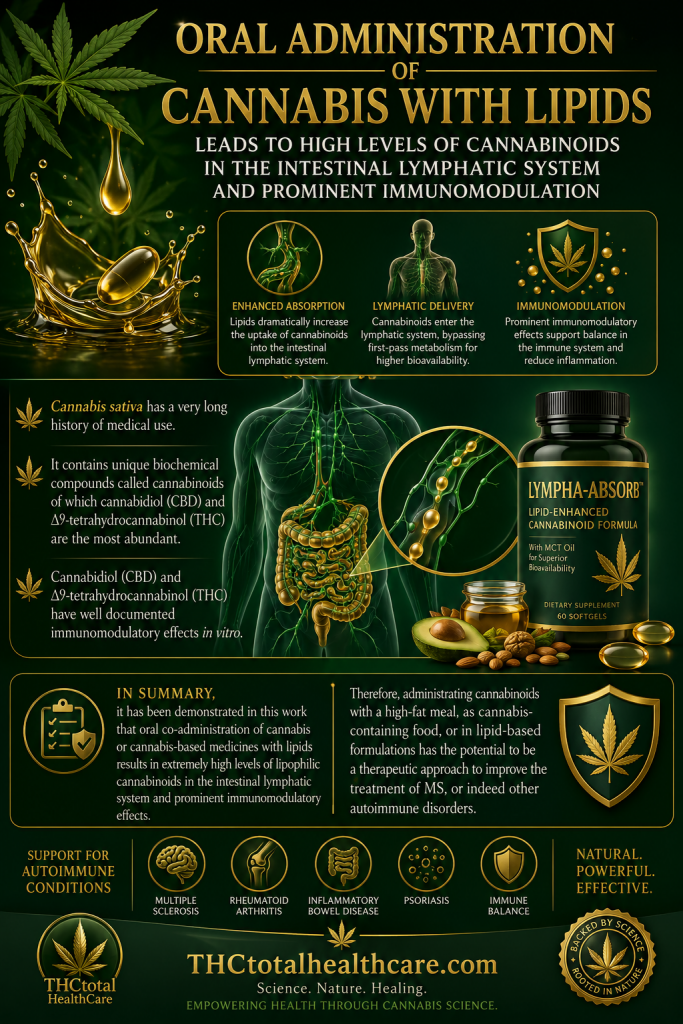

“Cannabidiol (CBD) and ∆9-tetrahydrocannabinol (THC) have well documented immunomodulatory effects in vitro, but not following oral administration in humans. Here we show that oral co-administration of cannabinoids with lipids can substantially increase their intestinal lymphatic transport in rats. Moreover, immune cells from MS patients were more susceptible to the immunosuppressive effects of cannabinoids than those from healthy volunteers or cancer patients. Therefore, administering cannabinoids with a high-fat meal or in lipid-based formulations has the potential to be a therapeutic approach to improve the treatment of MS, or indeed other autoimmune disorders.” https://www.ncbi.nlm.nih.gov/pubmed/29109461
“Cannabis sativa has a very long history of medical use. In summary, it has been demonstrated in this work that oral co-administration of cannabis or cannabis-based medicines with lipids results in extremely high levels of lipophilic cannabinoids in the intestinal lymphatic system and prominent immunomodulatory effects. Therefore, administering cannabinoids with a high-fat meal, as cannabis-containing food, or in lipid-based formulations has the potential to be a therapeutic approach to improve the treatment of MS, or indeed other autoimmune disorders.” https://www.nature.com/articles/s41598-017-15026-z


 “Multiple sclerosis (MS) is a chronic inflammatory and demyelinating disorder of the central nervous system (CNS) that can cause cognition, mobility, and sensory impairments. It is considered one of the most common non-traumatic causes of disability in the world.
The aim of the present article was to review the clinical evidence related to medicinal plants in the management of MS symptoms.
Electronic databases, including the Cochrane Library, Pubmed, and Scopus, were searched for entries from 1966 to February 2017. Only clinical studies were included in this review. Different medicinal plants have positive effects on MS, including Andrographis paniculata, Boswellia papyrifera, Ruta graveolens, Vaccinium spp., Camellia sinensis, Panax ginseng, Aloysia citrodora, Ginkgo biloba, Oenothera biennis, and Cannabis sativa.
C. sativa had the highest level of clinical evidence, supporting its efficacy in MS symptoms.
Proanthocyanidins, ginkgo flavone glycosides, ginsenosides, epigallocatechin-3-gallate,
“Multiple sclerosis (MS) is a chronic inflammatory and demyelinating disorder of the central nervous system (CNS) that can cause cognition, mobility, and sensory impairments. It is considered one of the most common non-traumatic causes of disability in the world.
The aim of the present article was to review the clinical evidence related to medicinal plants in the management of MS symptoms.
Electronic databases, including the Cochrane Library, Pubmed, and Scopus, were searched for entries from 1966 to February 2017. Only clinical studies were included in this review. Different medicinal plants have positive effects on MS, including Andrographis paniculata, Boswellia papyrifera, Ruta graveolens, Vaccinium spp., Camellia sinensis, Panax ginseng, Aloysia citrodora, Ginkgo biloba, Oenothera biennis, and Cannabis sativa.
C. sativa had the highest level of clinical evidence, supporting its efficacy in MS symptoms.
Proanthocyanidins, ginkgo flavone glycosides, ginsenosides, epigallocatechin-3-gallate,  “Spasticity is a common neurologic condition in patients with multiple sclerosis, stroke,