
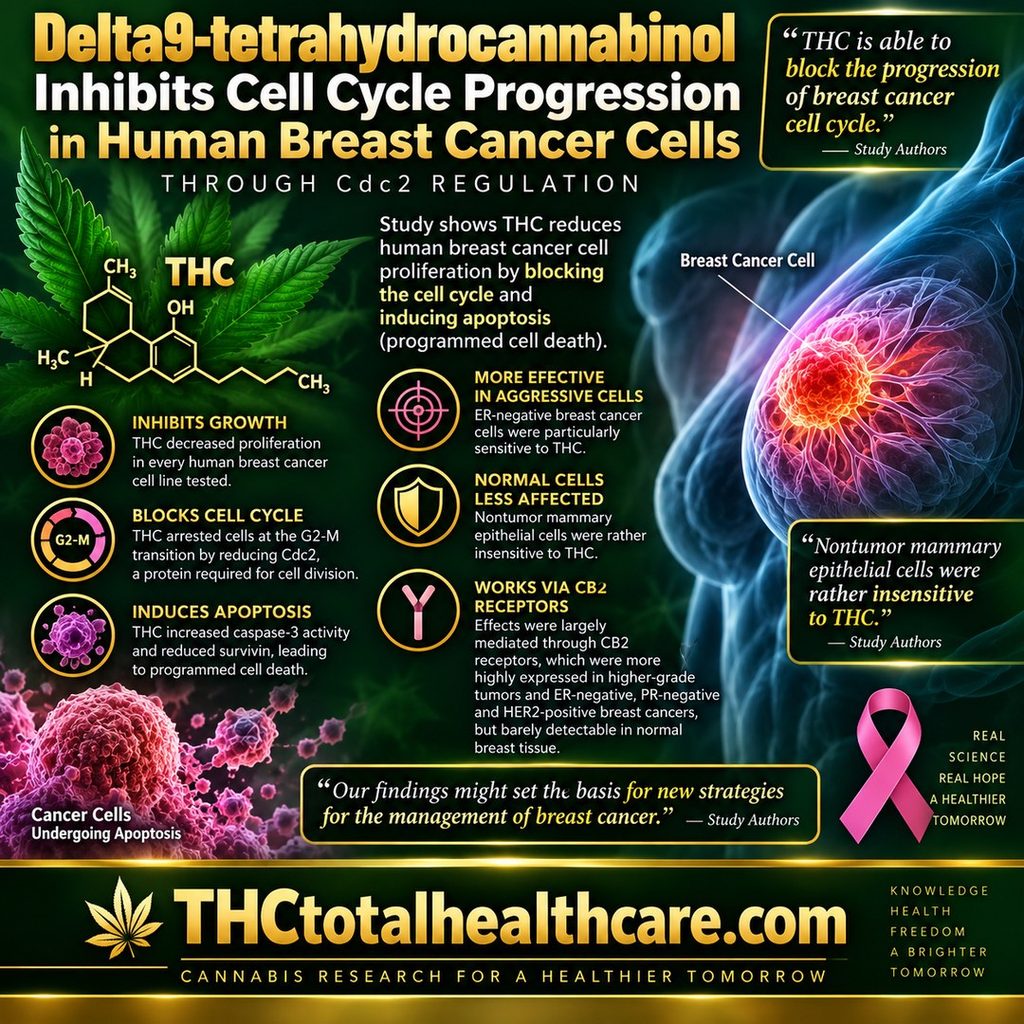
Researchers found that Δ9-tetrahydrocannabinol (THC) reduced the growth of multiple human breast cancer cell lines by stopping cells from progressing through the cell cycle and by triggering apoptosis, or programmed cell death. THC blocked the cells at the G2-M stage by reducing Cdc2, a protein needed for cell division, and breast cancer cells engineered to produce more Cdc2 became more resistant to THC.
The study also found that aggressive ER-negative breast cancer cells were particularly sensitive to THC, while normal human mammary epithelial cells were much less affected. THC’s effects were largely associated with CB2 cannabinoid receptors, which were more highly expressed in higher-grade tumors and in ER-negative, PR-negative and HER2-positive breast tumors, while CB2 expression was barely detectable in normal breast tissue.
The researchers concluded that these findings could help form the basis for new cannabinoid-based strategies for managing breast cancer.
“It has been proposed that cannabinoids are involved in the control of cell fate. Thus, these compounds can modulate proliferation, differentiation, and survival in different manners depending on the cell type and its physiopathologic context. However, little is known about the effect of cannabinoids on the cell cycle, the main process controlling cell fate.
Here, we show that Delta(9)-tetrahydrocannabinol (THC), through activation of CB(2) cannabinoid receptors, reduces human breast cancer cell proliferation by blocking the progression of the cell cycle and by inducing apoptosis. In particular, THC arrests cells in G(2)-M via down-regulation of Cdc2, as suggested by the decreased sensitivity to THC acquired by Cdc2-overexpressing cells.
Of interest, the proliferation pattern of normal human mammary epithelial cells was much less affected by THC. We also analyzed by real-time quantitative PCR the expression of CB(1) and CB(2) cannabinoid receptors in a series of human breast tumor and nontumor samples. We found a correlation between CB(2) expression and histologic grade of the tumors. There was also an association between CB(2) expression and other markers of prognostic and predictive value, such as estrogen receptor, progesterone receptor, and ERBB2/HER-2 oncogene. Importantly, no significant CB(2) expression was detected in nontumor breast tissue.
Taken together, these data might set the bases for a cannabinoid therapy for the management of breast cancer.”
https://pubmed.ncbi.nlm.nih.gov/16818634
“Cannabinoid receptors are expressed in human breast tumors.”
“THC inhibits proliferation of human breast cancer cells.“
Need this THC study explained? thcXplained.com