“Preparations of Cannabis sativa have been used for medicinal and recreational purposes for at least 4000 years and extracts of C. sativa contain over 60 different pharmacologically active components the most prominent being Δ9-tetrahydrocannabinol (Δ9-THC) and cannabidiol
Ligands such as cannabidiol and abnormal cannabidiol which exhibit no CB1or CB2 activity and are believed to function at a novel cannabinoid receptor, also showed activity at GPR55.
These data suggest that GPR55 is a novel cannabinoid receptor, and its ligand profile with respect to CB1and CB2 described here will permit delineation of its physiological function(s).”
“The lipophilic phytocannabinoids cannabidiol (CBD) and Δ9-tetrahydrocannabinol (THC) show therapeutic efficacy in various medical conditions. Both molecules are poorly water soluble and subjected to extensive first pass metabolism in the gastrointestinal tract, leading to a limited oral bioavailability of approximately 9%. We have developed an advanced lipid based Self-Emulsifying Drug Delivery System termed Advanced Pro-NanoLiposphere (PNL) pre-concentrate. The PNL is composed of lipid and emulsifying excipients of GRAS status and are known to increase solubility and reduce Phase I metabolism of lipophilic active compounds. Advanced PNLs are PNLs with an incorporated natural absorption enhancers. These molecules are natural alkaloids and phenolic compounds which were reported to inhibit certain phase I and phase II metabolism processes. Here we use piperine, curcumin and resveratrol to formulate the Advanced-PNL formulations. Consequently, we have explored the utility of these Advanced-PNLs on CBD and THC oral bioavailability. Oral administration of CBD-piperine-PNL resulted in 6-fold in AUC compared to CBD solution, proving to be the most effective of the screened formulations. The same trend was found in pharmacokinetic experiments of THC-piperine-PNL with resulted in a 9.3-fold increase in AUC as compared to THC solution. Our Piperine-PNL can be used as a platform for synchronized delivery of piperine and CBD or THC to the enterocyte site. This co-localization provides an increase in CBD and THC bioavailability by its effect at the pre-enterocyte and the enterocyte levels of the absorption process. The extra augmentation in the absorption of CBD and THC by incorporating piperine into PNL is attributed to the inhibition of Phase I and phase II metabolism by piperine in addition to the Phase I metabolism and P-gp inhibition by PNL. These novel results pave the way to utilize piperine-PNL delivery system for other poorly soluble, highly metabolized compounds that currently cannot be administered orally.”
https://www.ncbi.nlm.nih.gov/pubmed/28736128http://www.sciencedirect.com/science/article/pii/S0928098717304025]]>
“This study investigated whether intramuscular injection of delta-9-tetrahydrocannabinol (THC), by acting on peripheral cannabinoid (CB) receptors, could decrease nerve growth factor (NGF)-induced sensitization in female rat masseter muscle; a model which mimics the symptoms of myofascial temporomandibular disorders.
It was found that CB1 and CB2 receptors are expressed by trigeminal ganglion neurons that innervate the masseter muscle and also on their peripheral endings.
These results suggest that reduced inhibitory input from the peripheral cannabinoid system may contribute to NGF-induced local myofascial sensitization of mechanoreceptors. Peripheral application of THC may counter this effect by activating the CB1 receptors on masseter muscle mechanoreceptors to provide analgesic relief without central side effects.
“The beta amyloid (Aβ) and other aggregating proteins in the brain increase with age and are frequently found within neurons. The mechanistic relationship between intracellular amyloid, aging and neurodegeneration is not, however, well understood.
We use a proteotoxicity model based upon the inducible expression of Aβ in a human central nervous system nerve cell line to characterize a distinct form of nerve cell death caused by intracellular Aβ. It is shown that intracellular Aβ initiates a toxic inflammatory response leading to the cell’s demise. Aβ induces the expression of multiple proinflammatory genes and an increase in both arachidonic acid and eicosanoids, including prostaglandins that are neuroprotective and leukotrienes that potentiate death.
Cannabinoids such as tetrahydrocannabinol stimulate the removal of intraneuronal Aβ, block the inflammatory response, and are protective.
Altogether these data show that there is a complex and likely autocatalytic inflammatory response within nerve cells caused by the accumulation of intracellular Aβ, and that this early form of proteotoxicity can be blocked by the activation of cannabinoid receptors.”
“Multiple sclerosis (MS) is a chronic demyelinating central nervous system (CNS) disease that involve oligodendrocyte loss and failure to remyelinate damaged brain areas causing a progressive neurological disability.
Studies in MS mouse model suggest that cannabinoids ameliorate symptoms as spasticity, tremor and pain reducing inflammation via cannabinoid-mediated system.
The aim of our study is to investigate the changes in cannabinoid type 1 (CNR1) and 2 (CNR2) receptors mRNA expression levels and promoter methylation in peripheral blood mononuclear cells (PBMCs) of MS secondary progressive (MSS-SP) patients treated with Sativex®.
These results suggest that the different expression of cannabinoid receptors by Sativex® treatment in leukocytes might be regulated through a molecular mechanism that involve interferon modulation.”
https://www.ncbi.nlm.nih.gov/pubmed/28716266http://www.jns-journal.com/article/S0022-510X(17)30392-1/fulltext]]>
“Δ9-tetrahydrocannabinolic acid (THCA) is a plant derived secondary natural product from the plant Cannabis sativa l. The discovery of the human endocannabinoid system in the late 1980s resulted in a growing number of known physiological functions of both synthetic and plant derived cannabinoids. Thus, manifold therapeutic indications of cannabinoids currently comprise a significant area of research. Here we reconstituted the final biosynthetic cannabinoid pathway in yeasts. The use of the soluble prenyltransferase NphB from Streptomyces sp. strain CL190 enables the replacement of the native transmembrane prenyltransferase cannabigerolic acid synthase from C. sativa. In addition to the desired product cannabigerolic acid, NphB catalyzes an O-prenylation leading to 2-O-geranyl olivetolic acid. We show for the first time that the bacterial prenyltransferase and the final enzyme of the cannabinoid pathway tetrahydrocannabinolic acid synthase can both be actively expressed in the yeasts Saccharomyces cerevisiae and Komagataella phaffii simultaneously. While enzyme activities in S. cerevisiae were insufficient to produce THCA from olivetolic acid and geranyl diphosphate, genomic multi-copy integrations of the enzyme’s coding sequences in K. phaffii resulted in successful synthesis of THCA from olivetolic acid and geranyl diphosphate. This study is an important step toward total biosynthesis of valuable cannabinoids and derivatives and demonstrates the potential for developing a sustainable and secure yeast bio-manufacturing platform.” https://www.ncbi.nlm.nih.gov/pubmed/28694184http://www.sciencedirect.com/science/article/pii/S0168165617315201
“Production of Δ9-tetrahydrocannabinolic acid from cannabigerolic acid by whole cells of Pichia (Komagataella) pastoris expressing Δ9-tetrahydrocannabinolic acid synthase from Cannabis sativa L.” https://www.ncbi.nlm.nih.gov/pubmed/25994576
“Limited efficacy for current pharmacotherapy for PTSD indicates that improved pharmacological treatments are needed. Neurobiological research points to cannabinoids as possible therapeutic agents of interest. Moreover, observational reports indicate that there is growing popular interest in therapeutic use of cannabinoids for the alleviation of trauma symptoms. The aim of this review was to present an up-to-date look at current research on the possible therapeutic value of cannabinoids for PTSD. Experimental, preclinical, and clinical findings are discussed.
Highlights
•
Neurobiological research indicates cannabis as possible pharmacological intervention for PTSD.
•
CBD and THC + CBD modulate fear memory in rodents.
•
Experimental data suggest CBD has acute anti-depressive and anxiolytic effects.
•
Data suggest THC reduces nightmares and OSA, while THC + CBD could reduce insomnia.
•
Randomized placebo-controlled human trials of cannabinoids for PTSD are underway.”
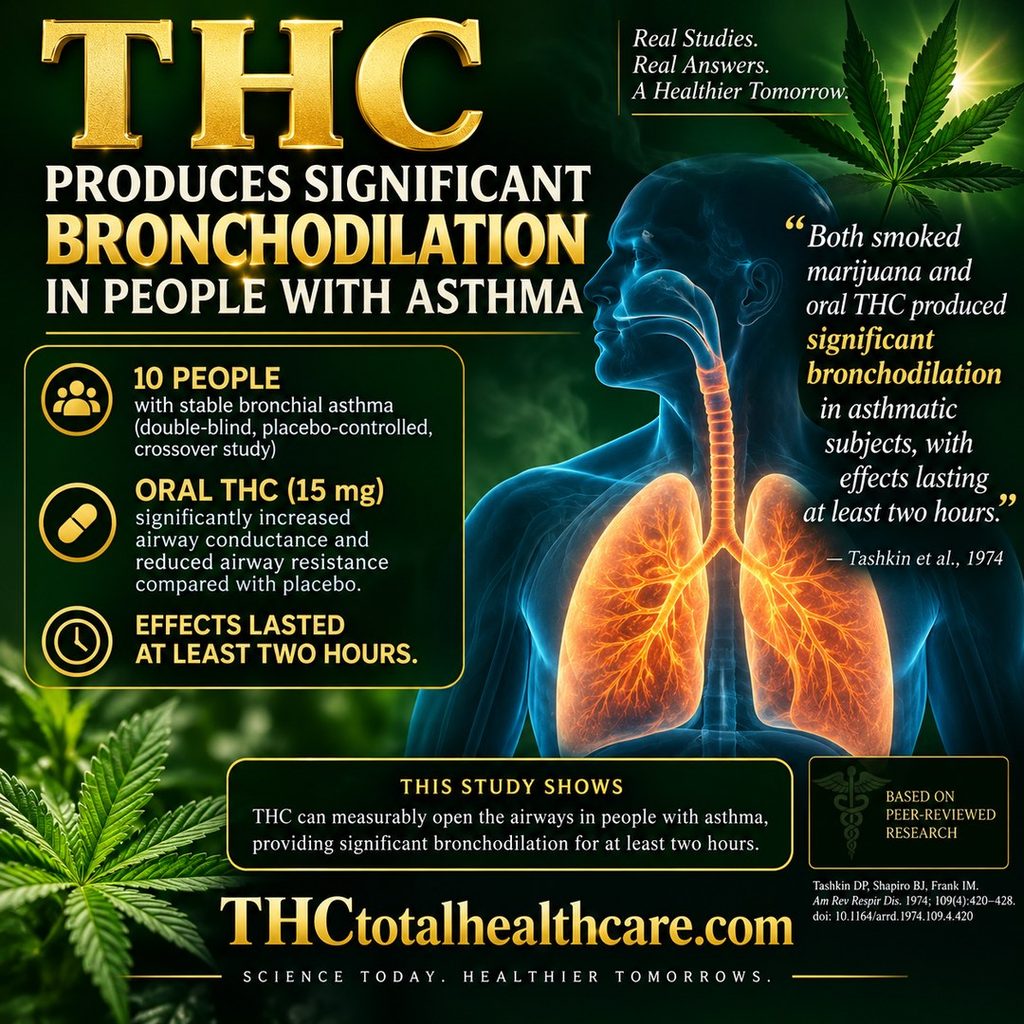
A human study found that Δ9-tetrahydrocannabinol (THC) produced significant bronchodilation in people with stable bronchial asthma. In the double-blind crossover trial, researchers compared smoked marijuana and oral THC with placebo and measured changes in airway function. Oral THC significantly increased specific airway conductance and reduced airway resistance, showing that THC was able to measurably open the airways. The bronchodilator effect lasted for at least two hours, providing early clinical evidence that THC can directly affect respiratory function in people with asthma.
“The acute effects of smoked 2 per cent natural marijuana (7 mg per kg) and 15 mg of oral Δ9-tetrahydrocannabinol (THC) on plethysmographically determined airway resistance (Raw) and specific airway conductance (SGaw) were compared with those of placebo in 10 subjects with stable bronchial asthma using a double-blind crossover technique.
After smoked marijuana, SGaw increased immediately and remained significantly elevated (33 to 48 per cent above initial control values) for at least 2 hours, whereas SGaw did not change after placebo. The peak bronchodilator effect of 1,250 µg of isoproterenol was more pronounced than that of marijuana, but the effect of marijuana lasted longer.
After ingestion of 15 mg of THC, SGaw was elevated significantly at 1 and 2 hours, and Raw was reduced significantly at 1 to 4 hours, whereas no changes were noted after placebo.
These findings indicated that in the asthmatic subjects, both smoked marijuana and oral THC caused significant bronchodilation of at least 2 hours’ duration.”
“After experimental induction of acute bronchospasm in 8 subjects with clinically stable bronchial asthma, effects of 500 mg of smoked marijuana (2.0 per cent delta9-tetrahydrocannabinol) on specific airway conductance and thoracic gas volume were compared with those of 500 mg of smoked placebo marijuana (0.0 per cent delta9-tetrahydrocannabinol), 0.25 ml of aerosolized saline, and 0.25 ml of aerosolized isoproterenol (1,250 mug).
After methacholine-induced bronchospasm, placebo marijuana and saline inhalation produced minimal changes in specific airway conductance and thoracic gas volume, whereas 2.0 per cent marijuana and isoproterenol each caused a prompt correction of the bronchospasm and associated hyperinflation. After exercise-induced bronchospasm, placebo marijuana and saline were followed by gradual recovery during 30 to 60 min, whereas 2.0 per cent marijuana and isoproterenol caused an immediate reversal of exercise-induced asthma and hyperinflation.” https://www.ncbi.nlm.nih.gov/pubmed/1099949
“After exercise-induced bronchospasm, placebo marijuana and saline were followed by gradual recovery during 30 to 60 min, whereas 2.0 per cent marijuana and isoproterenol caused an immediate reversal of exercise-induced asthma and hyperinflation.”
“Cannabis extracts have been used for centuries, but its main active principle ∆9-tetrahydrocannabinol (THC) was identified about 50 years ago. Yet, it is only 25 years ago that the first endogenous ligand of the same receptors engaged by the cannabis agents was discovered. This “endocannabinoid (eCB)” was identified as N-arachidonoylethanolamine (or anandamide (AEA)), and was shown to have several receptors, metabolic enzymes and transporters that altogether drive its biological activity. Here I report on the latest advances about AEA metabolism, with the aim of focusing open questions still awaiting an answer for a deeper understanding of AEA activity, and for translating AEA-based drugs into novel therapeutics for human diseases.”
https://www.ncbi.nlm.nih.gov/pubmed/28611591

 “The beta amyloid (Aβ) and other aggregating proteins in the brain increase with age and are frequently found within neurons. The mechanistic relationship between intracellular amyloid, aging and neurodegeneration is not, however, well understood.
We use a proteotoxicity model based upon the inducible expression of Aβ in a human central nervous system nerve cell line to characterize a distinct form of nerve cell death caused by intracellular Aβ. It is shown that intracellular Aβ initiates a toxic inflammatory response leading to the cell’s demise. Aβ induces the expression of multiple proinflammatory genes and an increase in both arachidonic acid and eicosanoids, including prostaglandins that are neuroprotective and leukotrienes that potentiate death.
 “After experimental induction of acute bronchospasm in 8 subjects with clinically stable bronchial asthma, effects of 500 mg of smoked marijuana (2.0 per cent delta9-tetrahydrocannabinol) on specific airway conductance and thoracic gas volume were compared with those of 500 mg of smoked placebo marijuana (0.0 per cent delta9-tetrahydrocannabinol), 0.25 ml of aerosolized saline, and 0.25 ml of aerosolized isoproterenol (1,250 mug).
After methacholine-induced bronchospasm, placebo marijuana and saline inhalation produced minimal changes in specific airway conductance and thoracic gas volume, whereas 2.0 per cent marijuana and isoproterenol each caused a prompt correction of the bronchospasm and associated hyperinflation. After exercise-induced bronchospasm, placebo marijuana and saline were followed by gradual recovery during 30 to 60 min, whereas 2.0 per cent marijuana and isoproterenol caused an immediate reversal of exercise-induced asthma and hyperinflation.”
 “Cannabis extracts have been used for centuries, but its main active principle ∆9-tetrahydrocannabinol (THC) was identified about 50 years ago. Yet, it is only 25 years ago that the first endogenous ligand of the same receptors engaged by the cannabis agents was discovered. This “endocannabinoid (eCB)” was identified as N-arachidonoylethanolamine (or anandamide (AEA)), and was shown to have several receptors, metabolic enzymes and transporters that altogether drive its biological activity. Here I report on the latest advances about AEA metabolism, with the aim of focusing open questions still awaiting an answer for a deeper understanding of AEA activity, and for translating AEA-based drugs into novel therapeutics for human diseases.”