
“In the past two decades, there has been increasing interest in the therapeutic potential of cannabis and single cannabinoids, mainly cannabidiol (CBD) and delta-9-tetrahydrocannabinol (THC). THC and cannabis products rich in THC exert their effects mainly through the activation of cannabinoid receptors (CB1 and CB2). Since 1975, 140 controlled clinical trials using different cannabinoids or whole-plant preparations for the treatment of a large number of disorders and symptoms have been conducted. Results have led to the approval of cannabis-based medicines [dronabinol, nabilone, and the cannabis extract nabiximols (Sativex®, THC:CBD = 1:1)] as well as cannabis flowers in several countries. Controlled clinical studies provide substantial evidence for the use of cannabinoid receptor agonists in cancer chemotherapy induced nausea and vomiting, appetite loss and cachexia in cancer and HIV patients, neuropathic and chronic pain, and in spasticity in multiple sclerosis. In addition, there is also some evidence suggesting a therapeutic potential of cannabis-based medicines in other indications including Tourette syndrome, spinal cord injury, Crohn’s disease, irritable bowel syndrome, and glaucoma. In several other indications, small uncontrolled and single-case studies reporting beneficial effects are available, for example in posttraumatic stress disorder, attention deficit hyperactivity disorder, and migraine. The most common side effects of THC and cannabis-based medicines rich in THC are sedation and dizziness (in more than 10% of patients), psychological effects, and dry mouth. Tolerance to these side effects nearly always develops within a short time. Withdrawal symptoms are hardly ever a problem in the therapeutic setting. In recent years there is an increasing interest in the medical use of CBD, which exerts no intoxicating side effects and is usually well-tolerated. Preliminary data suggest promising effects in the treatment of anxiety disorders, schizophrenia, dystonia, and some forms of epilepsy. This review gives an overview on clinical studies which have been published over the past 40 years.” http://www.tandfonline.com/doi/abs/10.1080/07352689.2016.1265360?needAccess=true&journalCode=bpts20
Tag Archives: Delta-9-Tetrahydrocannabinol
Anticancer effects of phytocannabinoids used with chemotherapy in leukaemia cells can be improved by altering the sequence of their administration.
 “Phytocannabinoids possess anticancer activity when used alone, and a number have also been shown to combine favourably with each other in vitro in leukaemia cells to generate improved activity.
We have investigated the effect of pairing cannabinoids and assessed their anticancer activity in cell line models. Those most effective were then used with the common anti-leukaemia drugs cytarabine and vincristine, and the effects of this combination therapy on cell death studied in vitro.
Results show a number of cannabinoids could be paired together to generate an effect superior to that achieved if the components were used individually.
For example, in HL60 cells, the IC50 values at 48 h for cannabidiol (CBD) and tetrahydrocannabinol (THC) when used alone were 8 and 13 µM, respectively; however, if used together, it was 4 µM. Median-effect analysis confirmed the benefit of using cannabinoids in pairs, with calculated combination indices being <1 in a number of cases.
The most efficacious cannabinoid-pairs subsequently synergised further when combined with the chemotherapy agents, and were also able to sensitise leukaemia cells to their cytotoxic effects.
The sequence of administration of these drugs was important though; using cannabinoids after chemotherapy resulted in greater induction of apoptosis, whilst this was the opposite when the schedule of administration was reversed.
Our results suggest that when certain cannabinoids are paired together, the resulting product can be combined synergistically with common anti-leukaemia drugs allowing the dose of the cytotoxic agents to be dramatically reduced yet still remain efficacious. Nevertheless, the sequence of drug administration is crucial to the success of these triple combinations and should be considered when planning such treatments.”
The endocannabinoid system as a target for addiction treatment: Trials and tribulations.
“Addiction remains a major public health concern, and while pharmacotherapies can be effective, clinicians are limited by the paucity of existing interventions. Endocannabinoid signaling is involved in reward and addiction, which raises the possibility that drugs targeting this system could be used to treat substance use disorders. This review discusses findings from randomized controlled trials evaluating cannabinergic medications for addiction. Current evidence suggests that pharmacotherapies containing delta-9-tetrahydrocannabinol, such as dronabinol and nabiximols, are effective for cannabis withdrawal. Dronabinol may also reduce symptoms of opioid withdrawal. The cannabinoid receptor 1 (CB1) inverse agonist rimonabant showed promising effects for smoking cessation but also caused psychiatric side effects and currently lacks regulatory approval. Few trials have investigated cannabinergic medications for alcohol use disorder. Overall, the endocannabinoid system remains a promising target for addiction treatment. Development of novel medications such as fatty acid amide hydrolase inhibitors and neutral CB1 antagonists promises to extend the range of available interventions.” https://www.ncbi.nlm.nih.gov/pubmed/28564576 http://www.sciencedirect.com/science/article/pii/S0028390817302563]]>
Cannabinoid CB1/CB2 receptor agonists attenuate hyperactivity and body weight loss in a rat model of activity-based anorexia.
“Anorexia nervosa (AN) is a serious psychiatric condition characterized by excessive body weight loss and disturbed perceptions of body shape and size, often associated with excessive physical activity. There is currently no effective drug-related therapy of this disease and this leads to high relapse rate. Clinical data suggest that a promising therapy to treat and reduce reoccurrence of AN may be based on the use of drugs that target the endocannabinoid (EC) system, which appears dysregulated in AN patients.
Our data show that subchronic treatment with both the CB1/CB2 receptor natural agonist Δ9-tetrahydrocannabinol and the synthetic CB1/CB2 receptor agonist CP-55,940 significantly reduced body weight loss and running wheel activity in ABA rats. These behavioral effects were accompanied by an increase in leptin signaling and a decrease in plasma levels of corticosterone.
Taken together, our results further demonstrate EC system involvement in AN pathophysiology and that strategies which modulate EC signaling are useful to treat this disorder, specifically in patients where physical hyperactivity plays a central role in its progression and maintenance.” https://www.ncbi.nlm.nih.gov/pubmed/28561272 http://onlinelibrary.wiley.com/doi/10.1111/bph.13892/abstract]]>Single and combined effects of delta9 -tetrahydrocannabinol and cannabidiol in a mouse model of chemotherapy-induced neuropathic pain.
“It has been suggested that the non-psychoactive phytocannabinoid cannabidiol (CBD) can impact the pharmacological effects of delta-9-tetrahydrocannabinol (THC). We tested the hypothesis that CBD and THC would significantly mitigate mechanical sensitivity in a mouse model of paclitaxel-induced neuropathic pain, and that CBD+THC combinations would produce synergistic effects. We also tested the hypothesis that CBD would attenuate oxaliplatin- and vincristine- induced mechanical sensitivity.
KEY RESULTS:
Both CBD and THC alone attenuated mechanical allodynia in mice treated with paclitaxel. Very low ineffective doses of CBD and THC were synergistic when given in combination. CBD also attenuated oxaliplatin- but not vincristine-induced mechanical sensitivity, while THC significantly attenuated vincristine- but not oxaliplatin-induced mechanical sensitivity. The low dose combination significantly attenuated oxaliplatin- but not vincristine-induced mechanical sensitivity.CONCLUSIONS AND IMPLICATIONS:
CBD may be potent and effective at preventing the development of CIPN, and its clinical utility may be enhanced by co-administration of low doses of THC. These treatment strategies would increase the therapeutic window of Cannabis-based pharmacotherapies.” https://www.ncbi.nlm.nih.gov/pubmed/28548225 http://onlinelibrary.wiley.com/doi/10.1111/bph.13887/abstract]]>The Standard Joint Unit.
“Reliable data on cannabis quantities is required to improve assessment of cannabis consumption for epidemiological analysis and clinical assessment, consequently a Standard Joint Unit (SJU) based on quantity of 9-Tetrahydrocannabinol (9-THC) has been established.
METHODOLOGY:
Naturalistic study of a convenience sample recruited from February 2015-June 2016 in universities, leisure spaces, mental health services and cannabis clubs in Barcelona. Adults, reporting cannabis use in the last 60 days, without cognitive impairment or language barriers, answered a questionnaire on cannabis use and were asked to donate a joint to further determine their 9-THC and Cannabidiol (CBD) content.RESULTS:
492 participants donated 315 valid joints. Donators were on average 29 years old, mostly men (77%), single (75%), with at least secondary studies (73%) and in active employment (63%). Marijuana joints (N=232) contained a median of 6.56mg of 9-THC (Interquartile range-IQR=10,22) and 0.02mg of CBD (IQR=0.02); hashish joints (N=83) a median of 7.94mg of 9-THC (IQR=10,61) and 3.24mg of CBD (IQR=3.21). Participants rolled 4 joints per gram of cannabis and paid 5€ per gram (median values).CONCLUSION:
Consistent 9-THC-content in joints lead to a SJU of 7mg of 9-THC, the integer number closest to the median values shared by both cannabis types. Independently if marijuana or hashish, 1 SJU = 1 joint = 0.25 g of cannabis = 7 mg of 9-THC. For CBD, only hashish SJU contained relevant levels. Similarly to the Standard Drink Unit for alcohol, the SJU is useful for clinical, epidemiological and research purposes.” https://www.ncbi.nlm.nih.gov/pubmed/28531767 http://www.drugandalcoholdependence.com/article/S0376-8716(17)30194-1/fulltext]]>A chronic low dose of Δ9-tetrahydrocannabinol (THC) restores cognitive function in old mice
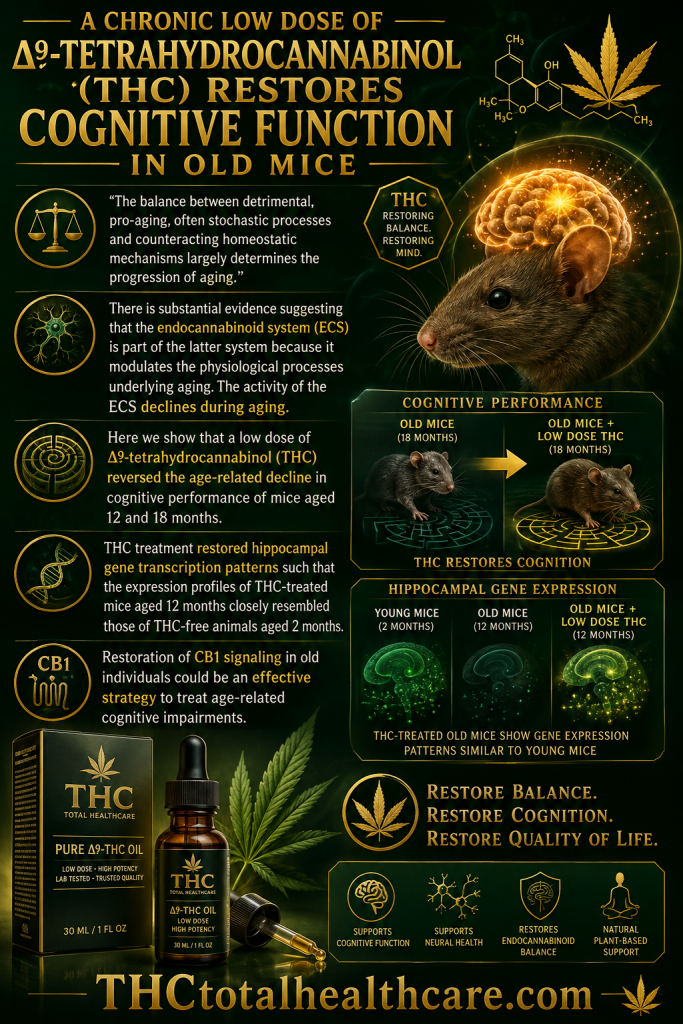
“The balance between detrimental, pro-aging, often stochastic processes and counteracting homeostatic mechanisms largely determines the progression of aging. There is substantial evidence suggesting that the endocannabinoid system (ECS) is part of the latter system because it modulates the physiological processes underlying aging. The activity of the ECS declines during aging, as CB1 receptor expression and coupling to G proteins are reduced in the brain tissues of older animals and the levels of the major endocannabinoid 2-arachidonoylglycerol (2-AG) are lower. However, a direct link between endocannabinoid tone and aging symptoms has not been demonstrated. Here we show that a low dose of Δ9-tetrahydrocannabinol (THC) reversed the age-related decline in cognitive performance of mice aged 12 and 18 months. This behavioral effect was accompanied by enhanced expression of synaptic marker proteins and increased hippocampal spine density. THC treatment restored hippocampal gene transcription patterns such that the expression profiles of THC-treated mice aged 12 months closely resembled those of THC-free animals aged 2 months. The transcriptional effects of THC were critically dependent on glutamatergic CB1 receptors and histone acetylation, as their inhibition blocked the beneficial effects of THC. Thus, restoration of CB1 signaling in old individuals could be an effective strategy to treat age-related cognitive impairments.” https://www.ncbi.nlm.nih.gov/pubmed/28481360 https://www.nature.com/nm/journal/vaop/ncurrent/full/nm.4311.html
“CAN MARIJUANA RESTORE MEMORY? NEW STUDY SHOWS CANNABIS CAN REVERSE COGNITIVE DECLINE IN MICE” http://www.newsweek.com/cannabis-marijuana-restores-memory-learning-cognitive-decline-596160
“A little cannabis every day might keep brain ageing at bay” https://www.newscientist.com/article/2130257-a-little-cannabis-every-day-might-keep-brain-ageing-at-bay/
“Low-dose cannabinoid THC restores memory and learning in old mice” http://www.medicalnewstoday.com/articles/317342.php
“Daily Dose Of Cannabis May Protect And Heal The Brain From Effects Of Aging” https://www.forbes.com/sites/janetwburns/2017/05/08/daily-dose-of-cannabis-may-protect-and-heal-the-brain-from-effects-of-aging/#70ef658f2e44
“Cannabis reverses aging processes in the brain” https://medicalxpress.com/news/2017-05-cannabis-reverses-aging-brain.html
“Future dementia cure – Chemical in cannabis could REVERSE the ageing process” http://www.express.co.uk/life-style/health/801827/dementia-cure-cannabis-THC-chemical-memory
]]>Delta-9-tetrahydrocannabinol shows antispastic and analgesic effects in a single case double-blind trial.
 “A double-blind study was performed comparing 5 mg delta-9-tetrahydrocannabinol (THC) p.o., 50 mg codeine p.o., and placebo in a patient with spasticity and pain due to spinal cord injury. The three conditions were applied 18 times each in a randomized and balanced order. Delta-9-THC and codeine both had an analgesic effect in comparison with placebo. Only delta-9-THC showed a significant beneficial effect on spasticity. In the dosage of THC used no altered consciousness occurred.”