“There is clear evidence that CB(2), historically referred to as the peripheral cannabinoid receptor, mediates many of the immune modulatory effects of cannabinoids.
However, cannabinoid receptors cannot be classified simply as central or peripheral since CB(2) has been shown to play a role in the central nervous system (CNS) and CB(1) mediates many immune system effects. Although Cnr1 mRNA and CB(1) protein expression is lower than Cnr2 mRNA or CB(2) protein expression in cells of the immune system, several studies have shown direct modulation of immune function via CB(1) by endogenous and exogenous cannabinoids in T cells, innate cells, and to a lesser extent, B cells.
In addition, indirect, but CB(1)-dependent, mechanisms of immune modulation exist. In fact, the mechanism by which cannabinoids attenuate neuroinflammation via CB(1) is likely a combination of immune suppression and neuroprotection.
Although many studies demonstrate that agonists for CB(1) are immune suppressive and anti-inflammatory, CB(1) antagonists also exhibit anti-inflammatory properties. Overall, the data demonstrate that many of the immune modulatory effects of cannabinoids are mediated via CB(1).”
“The type 2 cannabinoid receptor (CB2R) was recently shown to mediate neuroprotection in ischemic injury. However, the role of CB2Rs in the central nervous system, especially neuronal and glial CB2Rs in the cortex, remains unclear. We, therefore, investigated anti-ischemic mechanisms of cortical CB2R activation in various ischemic models….
Collectively, these data demonstrate that cortical CB2R activation by TC (trans-caryophyllene, a CB2R agonist,), ameliorates ischemic injury, potentially through modulation of AMPK/CREB signaling, and suggest that cortical CB2Rs might serve as a putative therapeutic target for cerebral ischemia.”
“These results provide evidence that alteration of the activation patterns of the various cannabinoid receptors warrant consideration for future therapeutic strategies.
Interest in the medicinal use of Cannabis sativa (marijuana) has a long historical record, extending back thousands of years. In comparison to the extensive history for medicinal applications of marijuana, the existence of an “endocannabinoid system”, with important homeostatic and pathologic functions, has only recently gained appreciation. The endocannabinoid system consists of endogenously produced cannabinoids, their receptors, and the enzymes responsible for their synthesis and degradation…
Although used in ancient Greece, Rome, and China for therapeutic purposes, concern about the use of cannabinoids as a drug of abuse has dampened interest in developing the potential therapeutic benefits of these compounds. However, a better understanding of the biologic effects has led recently to an upsurge in interest for the development of therapeutic drugs through modification of the endocannabinoid system. An additional incentive was provided by the development of synthetic cannabinoid analogs and specific inhibitors of cannabinoid receptors. Several excellent reviews cover the therapeutic potential of cannabinoids….
The present review is focused on the effects of CB2 receptor activation in models of multiple sclerosis (experimental autoimmune encephalomyelitis) and stroke (middle cerebral occlusion/reperfusion).
In summary, selective CB2 receptor agonists and CB1 receptor antagonists have significant potential for neuroprotection in animal models of two devastating diseases that currently lack effective treatment options.”
“A link between the endocannabinoid system and Alzheimer’s disease has been discovered which has provided a new therapeutic target for the treatment of patients suffering from Alzheimer’s disease. These studies have demonstrated the ability of cannabinoids to provide neuroprotection against β-amyloid peptide (Aβ) toxicity.
Here, we demonstrate that the active component of marijuana, Δ9-tetrahydrocannabinol (THC), competitively inhibits the enzyme acetylcholinesterase (AChE) as well as prevents AChE-induced amyloid β-peptide (Aβ) aggregation, the key pathological marker of Alzheimer’s disease.
Compared to currently approved drugs prescribed for the treatment of Alzheimer’s disease, THC is a considerably superior inhibitor of Aβ aggregation, and this study provides a previously unrecognized molecular mechanism through which cannabinoid molecules may directly impact the progression of this debilitating disease.
Since the characterization of the Cannabis sativa-produced cannabinoid, Δ9-tetrahydrocannabinol (THC), in the 1960’s,1 this natural product has been widely explored as an anti-emetic, anti-convulsive, anti-inflammatory, and analgesic.”
“Apart from their effects on mood and reward, cannabinoids exert beneficial actions such as neuroprotection and attenuation of inflammation. The immunosuppressive activity of cannabinoids has been well established. We previously showed that the psychoactive cannabinoid Δ(9) -tetrahydrocannabinol (THC) and the non-psychoactive cannabidiol (CBD) differ in their anti-inflammatory signalling pathways.
CONCLUSIONS AND IMPLICATIONS:
These observations indicated that CBD, but much less than THC, induced a cellular stress response in microglial cells and suggested that this effect could underlie its anti-inflammatory activity.”
“…the involvement of the endocannabinoid system was investigated by using selective inhibitors of endocannabinoid inactivation (cellular re-uptake or enzymatic hydrolysis) and selective cannabinoid CB1 and CB2 receptor antagonists and by silencing the CB1 receptor…
Our data suggest that selective activation of CB1 receptors by either exogenous or endogenous cannabinoids might afford neuroprotection…”
“Amyloid beta (Aβ) is believed to be responsible for the synaptic failure that occurs in Alzheimer’s disease (AD), but there is little known about the functional impact of Aβ on intrinsic neuronal properties. Here, the cellular effect of Aβ-induced neurotoxicity on the electrophysiological properties of CA1 pyramidal neurons and the mechanism(s) of neuroprotection by CB1 cannabinoid receptor activation was explored.
CONCLUSIONS:
In vivo Aβ treatment altered significantly the intrinsic electrophysiological properties of CA1 pyramidal neurons and the activation of CB1 cannabinoid receptors exerted a strong neuroprotective action against Aβ toxicity.”
“Amyotrophic lateral sclerosis (ALS) is a fatal neurodegenerative disorder characterized by the selective loss of motoneurons in the spinal cord, brain stem, and motor cortex. However, despite intensive research, an effective treatment for this disease remains elusive. In this study we show that treatment of postsymptomatic, 90-day-old SOD1G93A mice with a synthetic cannabinoid, WIN55,212-2, significantly delays disease progression…
Increasing evidence suggests that cannabinoids might have therapeutic potential in neurodegenerative conditions. In a variety of in vivo and in vitro models, cannabinoids exert neuroprotective effects under excitotoxic, ischemic, and inflammatory conditions. This combination of neuroprotective actions might be particularly relevant to ALS and suggests that cannabinoids might have a greater impact on disease progression than the established therapy that targets excitotoxicity alone.
… the neuroprotective effects observed following pharmacological and genetic augmentation of cannabinoid levels are not necessarily mediated by the CB1 receptor, and indeed inhibition of the CB1 receptor might actually be neuroprotective. Therefore, in contrast to previous studies that have suggested that cannabinoids exert neuroprotection via the CB1 receptor, the present results suggest that activation of CB2 receptors might underlie the beneficial effects of cannabinoids at least in SOD1G93A mice .”
Together these results show that cannabinoids have significant neuroprotective effects in this model of ALS and suggest that these beneficial effects may be mediated by non-CB1 receptor mechanisms.”
“NSC-34 cells, a hybridoma cell line derived from the fusion of neuroblastoma cells with mice spinal cord cells, have been widely used as an in vitro model for the study of motor neuron diseases [i.e. amyotrophic lateral sclerosis (ALS)]. In the present study, they were used to characterize different elements of the cannabinoid signaling system, which have been reported to serve as targets for the neuroprotective action of different natural and synthetic cannabinoid compounds…
Assuming that glutamate toxicity is one of the major causes of neuronal damage in ALS and other motor neurons diseases, the differentiated NSC-34 cells might serve as a useful model for studying neuroprotection with cannabinoids in conditions of excitotoxic injury, mitochondrial malfunctioning and oxidative stress.”
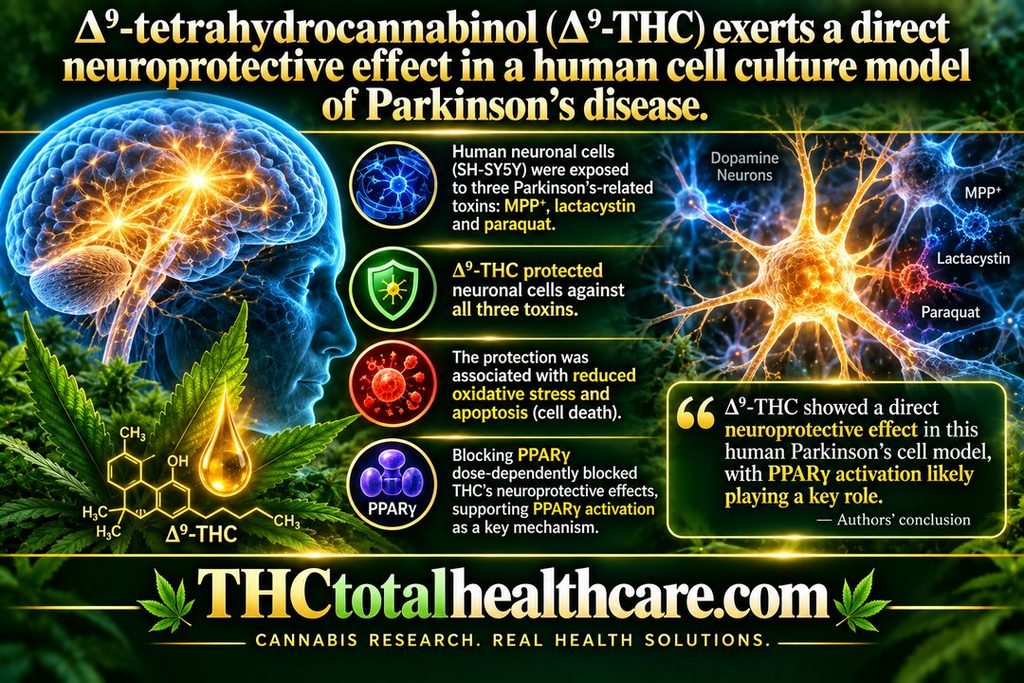
Δ9-THC directly protected human neuronal cells in a laboratory model of Parkinson’s disease from three different Parkinson’s-related toxins: MPP+, lactacystin, and paraquat. Across the experiments, THC reduced toxin-induced cell injury, oxidative stress, and apoptosis.
The researchers found that this neuroprotective effect was linked strongly to PPARγ activation. Blocking PPARγ reduced THC’s protective effects, while THC increased PPARγ expression in injured cells, pointing to this pathway as an important part of the mechanism.
These findings show that THC acted directly on vulnerable human neuronal cells in this Parkinson’s disease model, not just on symptoms. The study adds evidence that THC may have neuroprotective potential in conditions involving oxidative stress, mitochondrial dysfunction, and neuronal loss.
“Aims: Δ⁹-tetrahydrocannabinol (Δ⁹-THC) is neuroprotective in models of Parkinson’s disease (PD). Although CB1 receptors are increased within the basal ganglia of PD patients and animal models, current evidence suggests a role for CB1 receptor-independent mechanisms. Here, we utilized a human neuronal cell culture PD model to further investigate the protective properties of Δ⁹-THC.
Methods: Differentiated SH-SY5Y neuroblastoma cells were exposed to PD-relevant toxins: 1-methyl-4-phenylpyridinium (MPP+), lactacystin and paraquat. Changes in CB1 receptor level were determined by quantitative polymerase chain reaction and Western blotting. Cannabinoids and modulatory compounds were co-administered with toxins for 48 h and the effects on cell death, viability, apoptosis and oxidative stress assessed.
Results: We found CB1 receptor up-regulation in response to MPP+, lactacystin and paraquat and a protective effect of Δ⁹-THC against all three toxins. This neuroprotective effect was not reproduced by the CB1 receptor agonist WIN55,212-2 or blocked by the CB1 antagonist AM251. Furthermore, the antioxidants α-tocopherol and butylhydroxytoluene as well as the antioxidant cannabinoids, nabilone and cannabidiol were unable to elicit the same neuroprotection as Δ⁹-THC. However, the peroxisome proliferator-activated receptor-gamma (PPARγ) antagonist T0070907 dose-dependently blocked the neuroprotective, antioxidant and anti-apoptotic effects of Δ⁹-THC, while the PPARγ agonist pioglitazone resulted in protection from MPP+-induced neurotoxicity. Furthermore, Δ⁹-THC increased PPARγ expression in MPP+-treated SH-SY5Y cells, another indicator of PPARγ activation.
Conclusions: We have demonstrated up-regulation of the CB1 receptor in direct response to neuronal injury in a human PD cell culture model, and a direct neuronal protective effect of Δ⁹-THC that may be mediated through PPARγ activation.”
“In conclusion, we have demonstrated up-regulation of the CB1 receptor in a human cell culture model of PD, as well as a direct neuroprotective effect of the phytocannabinoid, Δ9-THC, not mediated by the CB2 receptor. Although a CB1 receptor-mediated effect cannot totally be excluded, we propose that activation of PPARγ leading to antioxidant effects is highly relevant in mediating the neuroprotection afforded by Δ9-THC in our model.”