Δ 9 -Tetrahydrocannabinol promotes oligodendrocyte development and CNS myelination in vivo

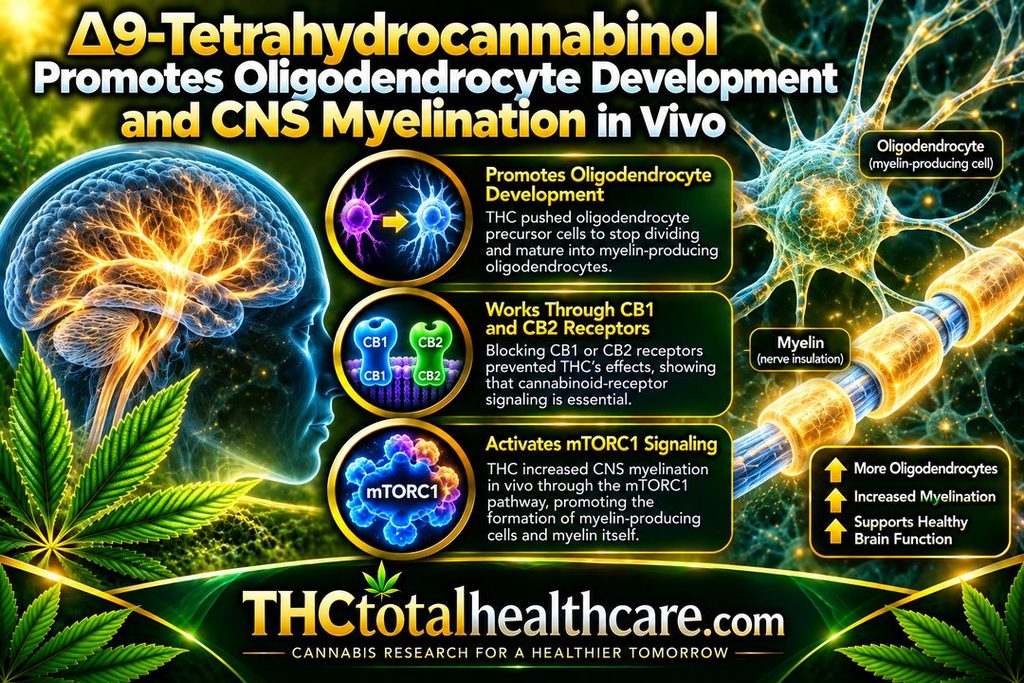
Δ9-THC promoted the development of oligodendrocytes, the cells responsible for producing myelin, and increased central nervous system myelination in young mice. THC pushed oligodendrocyte precursor cells to stop dividing and mature into myelin-producing cells.

The effect depended on both CB1 and CB2 cannabinoid receptors. When researchers blocked those receptors, THC’s effects on oligodendrocyte development and myelination were prevented, showing that cannabinoid-receptor signaling was central to the response.

The study also identified the mTORC1 signaling pathway as an important part of the mechanism. The authors concluded that THC represents a novel pharmacological candidate for enhancing oligodendrocyte development and CNS myelination in vivo.

“Δ9 -Tetrahydrocannabinol (THC), the main bioactive compound found in the plant Cannabis sativa, exerts its effects by activating cannabinoid receptors present in many neural cells.

Cannabinoid receptors are also physiologically engaged by endogenous cannabinoid compounds, the so-called endocannabinoids. Specifically, the endocannabinoid 2-arachidonoylglycerol has been highlighted as an important modulator of oligodendrocyte (OL) development at embryonic stages and in animal models of demyelination. However, the potential impact of THC exposure on OL lineage progression during the critical periods of postnatal myelination has never been explored.

Here, we show that acute THC administration at early postnatal ages in mice enhanced OL development and CNS myelination in the subcortical white matter by promoting oligodendrocyte precursor cell cycle exit and differentiation.

Mechanistically, THC-induced-myelination was mediated by CB1 and CB2 cannabinoid receptors, as demonstrated by the blockade of THC actions by selective receptor antagonists. Moreover, the THC-mediated modulation of oligodendroglial differentiation relied on the activation of the mammalian target of rapamycin complex 1 (mTORC1) signaling pathway, as mTORC1 pharmacological inhibition prevented the THC effects.

Our study identifies THC as an effective pharmacological strategy to enhance oligodendrogenesis and CNS myelination in vivo.”

https://pubmed.ncbi.nlm.nih.gov/32956517

 “In summary, our findings identify THC as a novel pharmacological candidate to enhance OL development and CNS myelination in vivo.”

https://onlinelibrary.wiley.com/doi/10.1002/glia.23911

Need this THC study explained? thcXplained.com

Natural cannabinoids suppress the cytokine storm in sepsis-like in vitro model

 John Libbey Eurotext“Natural cannabinoids may have beneficial effects on various tissues and functions including a positive influence on the immune system and the inflammatory process.

The purpose of this study was to investigate the effects of natural cannabinoids on the production of pro-inflammatory cytokines by lipopolysaccharide (LPS)-stimulated whole human blood cells.

Levels of the pro-inflammatory cytokines interleukin-1β (IL-1β), interleukin-6 (IL-6), and tumor necrosis factor-α (TNF-α) were measured before and after exposure of LPS-stimulated whole blood to different concentrations of Cannabidiol (CBD) or a combination of CBD and Tetrahydrocannabinol (THC) extract.

LPS stimulated the production of the pro-inflammatory cytokines. Exposure to both CBD and CBD/THC extracts significantly suppressed cytokine production in a dose-dependent manner. Exposure to cannabinoid concentrations of 50 μg/ml or 100 μg/ml resulted in a near-complete inhibition of cytokine production.

This study demonstrates that natural cannabinoids significantly suppress pro-inflammatory cytokine production in LPS-stimulated whole blood in a dose-dependent manner. The use of human whole blood, rather than isolated specific cells or tissues, may closely mimic an in vivo sepsis environment.

These findings highlight the role that natural cannabinoids may play in suppressing inflammation and call for additional studies of their use as possible novel therapeutic agents for acute and chronic inflammation.”

https://pubmed.ncbi.nlm.nih.gov/32933892/

https://www.jle.com/fr/revues/ecn/e-docs/natural_cannabinoids_suppress_the_cytokine_storm_in_sepsis_like_in_vitro_model__318510/article.phtml

Activation of Cannabinoid Receptor 2 Prevents Colitis-Associated Colon Cancer through Myeloid Cell De-activation Upstream of IL-22 Production

iScience journal (@iScience_CP) | Twitter
” Here we show that delta-9-tetrahydrocannabinol (THC) attenuates colitis-associated colon cancer and colitis induced by anti-CD40.
 THC can prevent the development of colitis-associated colon cancer in mice.”

“Study reveals how cannabinoids may be useful to prevent colon cancer”   https://medicalxpress.com/news/2020-09-reveals-cannabinoids-colon-cancer.html

“Key cannabis chemical may help prevent colon cancer, researchers say”   https://www.heraldmailmedia.com/news/nation/key-cannabis-chemical-may-help-prevent-colon-cancer-researchers-say/article_7afd0a72-eead-57f0-a1d3-006be62b7469.html

“Treatment with a cannabinoid prevented the development of colon cancers in mice” https://www.news-medical.net/news/20200915/Treatment-with-a-cannabinoid-prevented-the-development-of-colon-cancers-in-mice.aspx

Figure thumbnail fx1

Druggable Targets in Endocannabinoid Signaling

 “Cannabis and cannabinoid-based extracts have long been utilized for their perceived therapeutic value, and support for the legalization of cannabis for medicinal purposes continues to increase worldwide.

Since the discovery of Δ9-tetrahydrocannabinol (THC) as the primary psychoactive component of cannabis over 50 years ago, substantial effort has been directed toward detection of endogenous mediators of cannabinoid activity. The discovery of anandamide and 2-arachidonoylglycerol as two endogenous lipid mediators of cannabinoid-like effects (endocannabinoids) has inspired exponential growth in our understanding of this essential pathway, as well as the pathological conditions that result from dysregulated endocannabinoid signaling.

This review examines current knowledge of the endocannabinoid system including metabolic enzymes involved in biosynthesis and degradation and their receptors, and evaluates potential druggable targets for therapeutic intervention.”

https://pubmed.ncbi.nlm.nih.gov/32894511/

https://link.springer.com/chapter/10.1007%2F978-3-030-50621-6_8

Δ9 Tetrahydrocannabinol attenuates Staphylococcal enterotoxin B-induced inflammatory lung injury and prevents mortality in mice by modulation of miR-17-92 cluster and induction of T-regulatory cells

Logo of brjpharm“Staphylococcal enterotoxin B (SEB) is a potent activator of Vβ8+T-cells resulting in the clonal expansion of ∼30% of the T-cell pool. Consequently, this leads to the release of inflammatory cytokines, toxic shock, and eventually death.

In the current study, we investigated if Δ9tetrahydrocannabinol (THC), a cannabinoid known for its anti-inflammatory properties, could prevent SEB-induced mortality and alleviate symptoms of toxic shock.

Key Results

Exposure to SEB resulted in acute mortality, while THC treatment led to 100% survival of mice. SEB induced the miRNA-17-92 cluster, specifically miRNA-18a, which targeted Pten (phosphatase and tensin homologue), an inhibitor of the PI3K/Akt signalling pathway, thereby suppressing T-regulatory cells. In contrast, THC treatment inhibited the individual miRNAs in the cluster, reversing the effects of SEB.

Conclusions and Implications

We report, for the first time a role for the miRNA 17–92 cluster in SEB-mediated inflammation. Furthermore, our results suggest that THC is a potent anti-inflammatory compound that may serve as a novel therapeutic to suppress SEB-induced pulmonary inflammation by modulating critical miRNA involved in SEB-induced toxicity and death.

Δ9-Tetrahydrocannabinol (THC) is a marijuana plant-derived cannabinoid known for its robust anti-inflammatory and immunosuppressive properties. The anti-inflammatory and immunosuppressive effects of THC are diverse and function effectively to abrogate a number of inflammatory processes.

Taken together, our data demonstrate that THC is a strong anti-inflammatory agent capable of rescuing mice from SEB-mediated toxicity and death.”

https://www.ncbi.nlm.nih.gov/pmc/articles/PMC4376457/

Protective Effects of Δ9‐Tetrahydrocannabinol Against Enterotoxin‐induced Acute Respiratory Distress Syndrome is Mediated by Modulation of Microbiota

British Journal of Pharmacology“Staphylococcal enterotoxin‐B (SEB) is one of the most potent bacterial superantigens that exerts profound toxic effects by inducing cytokine storm. When SEB is inhaled, it can cause Acute Respiratory Distress Syndrome (ARDS), which is often fatal and currently there are no effective treatment modalities.
Experimental Approach

We used mouse model of SEB‐mediated ARDS to test the efficacy of Δ9‐tetrahydrocannabinol (THC). These mice were monitored for lung inflammation, alterations in gut and lung microbiota and production of short‐chain fatty acids (SCFA). Gene dysregulation of lung epithelial cells was studied by transcriptome arrays. Fecal microbiota transplantation (FMT) was performed to confirm the role of microbiota in suppressing ARDS.

Key results

While SEB triggered ARDS and 100% mortality in mice, THC protected the mice from fatality effects. Pyrosequencing analysis revealed that THC caused significant and similar alterations in microbiota in the lungs and gut of mice exposed to SEB. THC significantly increased the abundance of beneficial bacterial species, Ruminococcus gnavus, but decreased pathogenic microbiota, Akkermansia muciniphila. FMT confirmed that THC‐mediated reversal of microbial dysbiosis played crucial role in attenuation of SEB‐mediated ARDS. THC treatment also led to increase in SCFA, of which propionic acid was found to inhibit the inflammatory response. Transcriptome array showed that THC up‐regulated several genes like lysozyme‐1&2, β‐defensin‐2, claudin, zonula‐1, occludin‐1, Mucin2 and Muc5b while downregulating β‐defensin‐1.

Conclusions

Current study demonstrates for the first time that THC attenuates SEB‐mediated ARDS and toxicity by altering the microbiota in the lungs and the gut as well as promoting anti‐microbial and anti‐inflammatory pathways.”

https://www.ncbi.nlm.nih.gov/pmc/articles/PMC7436585/

https://bpspubs.onlinelibrary.wiley.com/doi/10.1111/bph.15226

Δ9-Tetrahydrocannabinol Prevents Mortality from Acute Respiratory Distress Syndrome through the Induction of Apoptosis in Immune Cells, Leading to Cytokine Storm Suppression

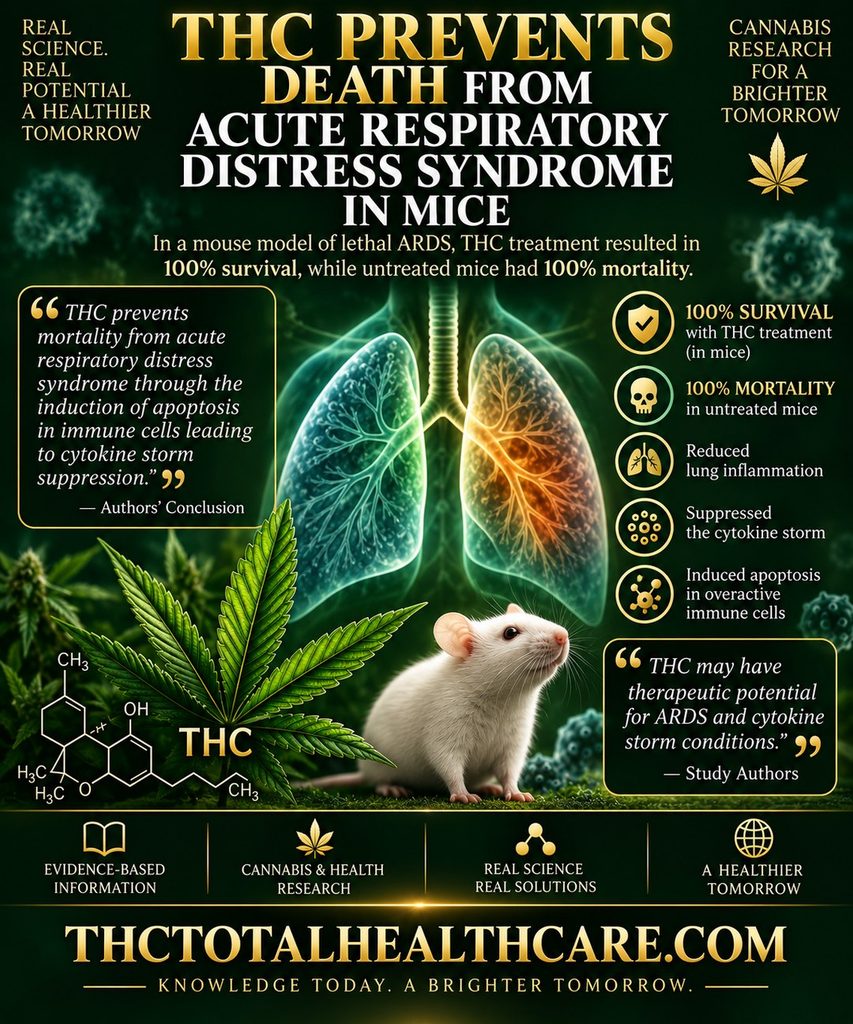
Researchers found that Δ9-tetrahydrocannabinol (THC) completely prevented death in a mouse model of acute respiratory distress syndrome (ARDS) triggered by staphylococcal enterotoxin B. The untreated condition produced 100% mortality, while THC-treated mice showed 100% survival.

THC also reduced severe lung inflammation and suppressed the cytokine storm associated with the lethal immune response. The researchers linked this protection to the induction of apoptosis in activated immune cells and changes in mitochondrial pathways involved in inflammatory damage.

The findings suggest that THC was able to interrupt an otherwise fatal inflammatory cascade in this experimental model, leading the authors to conclude that THC may have therapeutic potential for ARDS and other conditions involving cytokine storm.

“Acute Respiratory Distress Syndrome (ARDS) causes up to 40% mortality in humans and is difficult to treat. ARDS is also one of the major triggers of mortality associated with coronavirus-induced disease (COVID-19). We used a mouse model of ARDS induced by Staphylococcal enterotoxin B (SEB), which triggers 100% mortality, to investigate the mechanisms through which Δ9-tetrahydrocannabinol (THC) attenuates ARDS.

SEB was used to trigger ARDS in C3H mice. These mice were treated with THC and analyzed for survival, ARDS, cytokine storm, and metabolome. Additionally, cells isolated from the lungs were used to perform single-cell RNA sequencing and transcriptome analysis. A database analysis of human COVID-19 patients was also performed to compare the signaling pathways with SEB-mediated ARDS.

The treatment of SEB-mediated ARDS mice with THC led to a 100% survival, decreased lung inflammation, and the suppression of cytokine storm. This was associated with immune cell apoptosis involving the mitochondrial pathway, as suggested by single-cell RNA sequencing. A transcriptomic analysis of immune cells from the lungs revealed an increase in mitochondrial respiratory chain enzymes following THC treatment. In addition, metabolomic analysis revealed elevated serum concentrations of amino acids, lysine, n-acetyl methionine, carnitine, and propionyl L-carnitine in THC-treated mice. THC caused the downregulation of miR-185, which correlated with an increase in the pro-apoptotic gene targets. Interestingly, the gene expression datasets from the bronchoalveolar lavage fluid (BALF) of human COVID-19 patients showed some similarities between cytokine and apoptotic genes with SEB-induced ARDS.

Collectively, this study suggests that the activation of cannabinoid receptors may serve as a therapeutic modality to treat ARDS associated with COVID-19.”

https://pubmed.ncbi.nlm.nih.gov/32872332

“Δ9-tetrahydrocannabinol (THC) is a psychoactive cannabinoid derived from Cannabis sativa that has potential therapeutic value for pain relief, control of nausea and vomiting, appetite stimulation, and its anti-inflammatory properties [7]. Indeed, a previous report from our laboratory showed that exposure to THC prior to the administration of SEB can prevent SEB-induced ARDS and associated mortality through the miRNA (miR) regulation of regulatory T cells [8]. In the current study, we tested whether THC administration after exposure to SEB would prevent SEB-mediated ARDS; to further understand the mechanisms, we used single-cell RNA sequencing (scRNA-seq) of cells isolated from the lungs.”

“The current study concludes that the treatment of mice with THC post-SEB challenge protects mice from SEB-mediated toxicity by inhibiting inflammation and ARDS through the modulation of miRs targeting mitochondria-related apoptotic genes. Because SEB is a superantigen that drives cytokine storm, our studies revealed that THC is a potent anti-inflammatory agent that has the potential to be used as a therapeutic modality to treat SEB-induced ARDS. Importantly, the metabolomic and metabolic profiling indicates profound effects on mitochondrial functions that may be responsible for the anti-inflammatory activity of THC. This study also concludes that THC may mediate its effects through downregulating the expression of miR-185-3p and the consequent upregulation of apoptotic genes and pathways; thus, targeting miR-185-3p may constitute another therapeutic modality for the alleviation of ARDS. Using gene expression datasets from the BALF of human COVID-19 patients, we found similarities between the cytokine and apoptotic genes with SEB-induced ARDS. Thus, our data suggests that THC may be useful in treating ARDS and cytokine storm seen in COVID-19 patients.”

https://www.mdpi.com/1422-0067/21/17/6244

Need this THC study explained? thcXplained.com

Targeting Endocannabinoid Signaling: FAAH and MAG Lipase Inhibitors

Annual Reviews adds Remarq® across its collection of 47 journals – RedLink“Inspired by the medicinal properties of the plant Cannabis sativa and its principal component (-)-trans-Δ9-tetrahydrocannabinol (THC), researchers have developed a variety of compounds to modulate the endocannabinoid system in the human brain.

Inhibitors of fatty acid amide hydrolase (FAAH) and monoacylglycerol lipase (MAGL), which are the enzymes responsible for the inactivation of the endogenous cannabinoids anandamide and 2-arachidonoylglycerol, respectively, may exert therapeutic effects without inducing the adverse side effects associated with direct cannabinoid CB1 receptor stimulation by THC.

Here we review the FAAH and MAGL inhibitors that have reached clinical trials, discuss potential caveats, and provide an outlook on where the field is headed.”

https://pubmed.ncbi.nlm.nih.gov/32867595/

https://www.annualreviews.org/doi/10.1146/annurev-pharmtox-030220-112741

Cannabinoids in multiple sclerosis: A neurophysiological analysis

“Objectives

To investigate the action of cannabinoids on spasticity and pain in secondary progressive multiple sclerosis, by means of neurophysiological indexes.

Material and Methods

We assessed 15 patients with progressive MS (11 females) using clinical scales for spasticity and pain, as well as neurophysiological variables (H/M ratio, cutaneous silent period or CSP). Testing occurred before (T0) and during (T1) a standard treatment with an oral spray containing delta‐9‐tetrahydrocannabinol (THC) and cannabidiol (CBD). Neurophysiological measures at T0 were compared with those of 14 healthy controls of similar age and sex (HC). We then compared the patient results at the two time points (T1 vs T0).

Results

At T0, neurophysiological variables did not differ significantly between patients and controls. At T1, spasticity and pain scores improved, as detected by the Modified Ashworth Scale or MAS (P = .001), 9‐Hole Peg Test or 9HPT (P = .018), numeric rating scale for spasticity or NRS (P = .001), and visual analogue scale for pain or VAS (P = .005). At the same time, the CSP was significantly prolonged (P = .001).

Conclusions

The THC‐CBD spray improved spasticity and pain in secondary progressive MS patients. The spray prolonged CSP duration, which appears a promising tool for assessing and monitoring the analgesic effects of THC‐CBD in MS.”

https://onlinelibrary.wiley.com/doi/abs/10.1111/ane.13313

“THC, CBD Combo Eases MS Symptoms, Extends Cutaneous Silent Period”   https://www.ajmc.com/view/thc-cbd-combo-eases-ms-symptoms-extends-cutaneous-silent-period

Receptors and Channels Possibly Mediating the Effects of Phytocannabinoids on Seizures and Epilepsy

pharmaceuticals-logo“Epilepsy contributes to approximately 1% of the global disease burden. By affecting especially young children as well as older persons of all social and racial variety, epilepsy is a present disorder worldwide. Currently, only 65% of epileptic patients can be successfully treated with antiepileptic drugs. For this reason, alternative medicine receives more attention.

Cannabis has been cultivated for over 6000 years to treat pain and insomnia and used since the 19th century to suppress epileptic seizures.

The two best described phytocannabinoids, (-)-trans-Δ9-tetrahydrocannabinol (THC) and cannabidiol (CBD) are claimed to have positive effects on different neurological as well as neurodegenerative diseases, including epilepsy.

There are different cannabinoids which act through different types of receptors and channels, including the cannabinoid receptor 1 and 2 (CB1, CB2), G protein-coupled receptor 55 (GPR55) and 18 (GPR18), opioid receptor µ and δ, transient receptor potential vanilloid type 1 (TRPV1) and 2 (TRPV2), type A γ-aminobutyric acid receptor (GABAAR) and voltage-gated sodium channels (VGSC).

The mechanisms and importance of the interaction between phytocannabinoids and their different sites of action regarding epileptic seizures and their clinical value are described in this review.”

https://pubmed.ncbi.nlm.nih.gov/32751761/

https://www.mdpi.com/1424-8247/13/8/174