
 “The intraperitoneal administration of chemotherapeutics has emerged as a potential route in ovarian cancer treatment. Nanoparticles as carriers for these agents could be interesting by increasing the retention of chemotherapeutics within the peritoneal cavity. Moreover, nanoparticles could be internalised by cancer cells and let the drug release near the biological target, which could increase the anticancer efficacy.
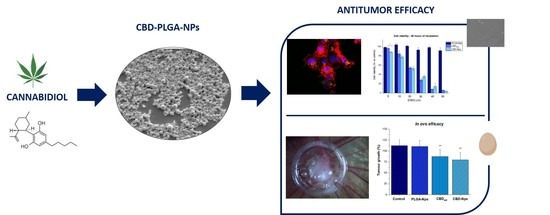
Cannabidiol (CBD), the main nonpsychotropic cannabinoid, appears as a potential anticancer drug. The aim of this work was to develop polymer nanoparticles as CBD carriers capable of being internalised by ovarian cancer cells.
The drug-loaded nanoparticles (CBD-NPs) exhibited a spherical shape, a particle size around 240 nm and a negative zeta potential (-16.6 ± 1.2 mV). The encapsulation efficiency was high, with values above 95%. A controlled CBD release for 96 h was achieved. Nanoparticle internalisation in SKOV-3 epithelial ovarian cancer cells mainly occurred between 2 and 4 h of incubation. CBD antiproliferative activity in ovarian cancer cells was preserved after encapsulation. In fact, CBD-NPs showed a lower IC50 values than CBD in solution. Both CBD in solution and CBD-NPs induced the expression of PARP, indicating the onset of apoptosis. In SKOV-3-derived tumours formed in the chick embryo model, a slightly higher-although not statistically significant-tumour growth inhibition was observed with CBD-NPs compared to CBD in solution.
To sum up, poly-lactic-co-glycolic acid (PLGA) nanoparticles could be a good strategy to deliver CBD intraperitoneally for ovarian cancer treatment.”
https://www.ncbi.nlm.nih.gov/pubmed/32397428
https://www.mdpi.com/1999-4923/12/5/439
.jpg) “Despite limited data demonstrating pronounced negative effects of prenatal cannabis exposure, popular opinion and public policies still reflect the belief that cannabis is fetotoxic.
“Despite limited data demonstrating pronounced negative effects of prenatal cannabis exposure, popular opinion and public policies still reflect the belief that cannabis is fetotoxic. “The antioxidant and CB2 receptor agonist properties of Δ9-tetrahydrocannabivarin (Δ9-THCV) afforded neuroprotection in experimental Parkinson’s disease (PD), whereas its CB1 receptor antagonist profile at doses lower than 5 mg/kg caused anti-hypokinetic effects.
 “Lenabasum is an oral synthetic
  “An emerging area of preclinical research has investigated whether drug use in parents prior to conception influences drug responsivity in their offspring.
 “Cannabis sativa and its principal components, Δ9-tetrahydrocannabinol (Δ9-THC) and
  “The therapeutic effect of the Cannabis plant largely depends on the presence and specific ratio of a spectrum of phytocannabinoids. While prescription of medicinal Cannabis for various conditions constantly grows, its consumption is mostly limited to oral or respiratory pathways, impeding its duration of action, bioavailability and efficacy. Herein, a long-acting formulation in the form of melt-printed polymeric microdepots for full-spectrum

 “To examine acute and residual mood and cognitive performance in young adult regular
  “The prevalence rates of depression and anxiety are at least two times higher in diabetic patients, increasing morbidity and mortality.