
A Phase I, Open-Label, Parallel-Group, Single-Dose Trial of the Pharmacokinetics, Safety, and Tolerability of Cannabidiol in Subjects with Mild to Severe Renal Impairment.

“As patients who receive cannabidiol (CBD) may have co-existing renal morbidities, it is important to understand whether dose adjustments are necessary to mitigate the risk of exposure-related toxicity. This study was conducted to evaluate the pharmacokinetics, safety, and tolerability of CBD in patients with renal impairment.

METHODS:

The pharmacokinetics and safety of a single oral 200 mg dose of a plant-derived pharmaceutical formulation of highly purified CBD in oral solution (Epidiolex® in the USA; 100 mg/mL) were assessed in subjects with mild, moderate, or severe renal impairment (n = 8/group) relative to matched subjects with normal renal function (n = 8). Blood samples were collected until 48 h post-dose and evaluated by liquid chromatography with tandem mass spectrometry. Analysis of variance was used to compare primary pharmacokinetic parameters (maximum measured plasma concentration [Cmax], oral clearance of drug from plasma [CL/F], renal clearance [CLR], area under the plasma concentration-time curve [AUC] from time zero to last measurable concentration [AUCt], and AUC from time zero to infinity [AUC]); descriptive analysis was used for secondary pharmacokinetic parameters (time to Cmax [tmax], terminal [elimination] half-life [t½], cumulative amount excreted from time zero to the last quantifiable sample [Aelast], and fraction of the systemically available drug excreted into the urine [fe]).

RESULTS:

No statistically significant differences were observed in Cmax, AUCt, AUC, or tmax values between subjects with mild, moderate, or severe renal impairment and subjects with normal renal function for CBD or its major metabolites, 7-carboxy-CBD (7-COOH-CBD) and 7-hydroxy-CBD (7-OH-CBD), and minor metabolite, 6-hydroxy-CBD (6-OH-CBD); geometric mean ratio for Cmax values ranged from 0.68 to 1.35. No differences were observed for other secondary parameters (Aelast and fe). CBD, 7-COOH-CBD, 7-OH-CBD, and 6-OH-CBD were highly protein bound (> 90%); binding was similar in all subject groups. Urine analysis for CBD recorded no appreciable amount, and thus no urinary pharmacokinetic parameters could be derived. Adverse events (AEs) affected two subjects; all five AEs were mild in severity and resolved during the trial. There were no serious AEs or discontinuations due to AEs. Laboratory, physical examination, vital sign, and 12-lead electrocardiogram findings were not clinically significant.

CONCLUSION:

Renal impairment had no effect on the metabolism of CBD after a single oral 200 mg dose. CBD was generally well tolerated in subjects with varying degrees of renal function.”

https://www.ncbi.nlm.nih.gov/pubmed/31802404

“Renal impairment status had no effect on CBD pharmacokinetics following a single oral 200 mg dose, with no statistically significant effects on Cmax, AUCt, AUC, or tmax. CBD was generally well tolerated; there were no serious or severe AEs, and no new safety concerns were identified.”

https://link.springer.com/article/10.1007%2Fs40262-019-00841-6

Transcriptomic Analysis of Stem Cells Treated with Moringin or Cannabidiol: Analogies and Differences in Inflammation Pathways.

ijms-logo“Inflammation is a common feature of many neurodegenerative diseases.

The treatment of stem cells as a therapeutic approach to repair damage in the central nervous system represents a valid alternative.

In this study, using Next-Generation Sequencing (NGS) technology, we analyzed the transcriptomic profile of human Gingival Mesenchymal Stem Cells (hGMSCs) treated with Moringin [4-(α-l-ramanosyloxy)-benzyl isothiocyanate] (hGMSCs-MOR) or with Cannabidiol (hGMSCs-CBD) at dose of 0.5 or 5 µM, respectively. Moreover, we compared their transcriptomic profiles in order to evaluate analogies and differences in pro- and anti-inflammatory pathways.

The hGMSCs-MOR selectively downregulate TNF-α signaling from the beginning, reducing the expression of TNF-α receptor while hGMSCs-CBD limit its activity after the process started.

The treatment with CBD downregulates the pro-inflammatory pathway mediated by the IL-1 family, including its receptor while MOR is less efficient.

Furthermore, both the treatments are efficient in the IL-6 signaling. In particular, CBD reduces the effect of the pro-inflammatory JAK/STAT pathway while MOR enhances the pro-survival PI3K/AKT/mTOR.

In addition, both hGMSCs-MOR and hGMSCs-CBD improve the anti-inflammatory activity enhancing the TGF-β pathway.”

https://www.ncbi.nlm.nih.gov/pubmed/31801206

https://www.mdpi.com/1422-0067/20/23/6039

Vasodilatory effects of cannabidiol in human pulmonary and rat small mesenteric arteries: modification by hypertension and the potential pharmacological opportunities.

 Image result for ovid journal“Cannabidiol (CBD) has been suggested as a potential antihypertensive drug.

The aim of our study was to investigate its vasodilatory effect in isolated human pulmonary arteries (hPAs) and rat small mesenteric arteries (sMAs).

METHODS:

Vascular effects of CBD were examined in hPAs obtained from patients during resection of lung carcinoma and sMAs isolated from spontaneously hypertensive (SHR); 11-deoxycorticosterone acetate (DOCA-salt) hypertensive rats or their appropriate normotensive controls using organ bath and wire myography, respectively.

RESULTS:

CBD induced almost full concentration-dependent vasorelaxation in hPAs and rat sMAs. In hPAs, it was insensitive to antagonists of CB1 (AM251) and CB2 (AM630) receptors but it was reduced by endothelium denudation, cyclooxygenase inhibitors (indomethacin and nimesulide), antagonists of prostanoid EP4 (L161982), IP (Cay10441), vanilloid TRPV1 (capsazepine) receptors and was less potent under KCl-induced tone and calcium-activated potassium channel (KCa) inhibitors (iberiotoxin, UCL1684 and TRAM-34) and in hypertensive, overweight and hypercholesteremic patients. The time-dependent effect of CBD was sensitive to the PPARγ receptor antagonist GW9662. In rats, the CBD potency was enhanced in DOCA-salt and attenuated in SHR. The CBD-induced relaxation was inhibited in SHR and DOCA-salt by AM251 and only in DOCA-salt by AM630 and endothelium denudation.

CONCLUSION:

The CBD-induced relaxation in hPAs that was reduced in hypertensive, obese and hypercholesteremic patients was endothelium-dependent and mediated via KCa and IP, EP4, TRPV1 receptors. The CBD effect in rats was CB1-sensitive and dependent on the hypertension model. Thus, modification of CBD-mediated responses in disease should be considered when CBD is used for therapeutic purposes.”

https://www.ncbi.nlm.nih.gov/pubmed/31800399

https://insights.ovid.com/crossref?an=00004872-900000000-97067

An Open-Label Pilot Study Testing the Feasibility of Assessing Total Symptom Burden in Trials of Cannabinoid Medications in Palliative Care.

View details for Journal of Palliative Medicine cover image“There is considerable interest in the use of cannabinoids for symptom control in palliative care, but there is little high-quality evidence to guide clinical practice.

Objectives: Assess the feasibility of using global symptom burden measures to assess response to medicinal cannabis, to determine median tolerated doses of cannabidiol (CBD) and tetrahydrocannabinol (THC), and to document adverse events (AEs).

Design: Prospective two-arm open-label pilot trial of escalating doses of CBD and THC oil.

Setting/Subjects: Participants had advanced cancer and cancer-related symptoms in a palliative and supportive care service in an Australian cancer center.

Measurements: The main outcome measures were the number of participants screened and randomized over the time frame, the number of participants completing days 14 and 28 and providing total symptom distress scores (TSDSs) (measured using the Edmonton Symptom Assessment Scale), and the change from baseline of the TSDS at day 14.

Results: Of the 21 participants enrolled (CBD, n = 16; THC, n = 5), 18 (86%) completed the primary outcome measure at day 14 and 8 completed at day 28. The median maximum tolerated doses were CBD, 300 mg/day (range 100-600 mg); THC, 10 mg/day (range 5-30 mg). Nine of 21 patients (43%) met the definition of response (≥6 point reduction in TSDS). Drowsiness was the most common AE.

Conclusions: Trials of medicinal cannabis in advanced cancer patients undergoing palliative care are feasible. The doses of THC and CBD used in this study were generally well tolerated and the outcome measure of total symptom distress is promising as a measure of overall symptom benefit.”

https://www.ncbi.nlm.nih.gov/pubmed/31800354

https://www.liebertpub.com/doi/10.1089/jpm.2019.0540

Long-term benefit from immune modulation and anti-inflammatory treatment in metastatic mesothelioma.

Respiratory Medicine Case Reports“A 64 year old male heating engineer was investigated for a persistent cough and found to have epithelioid mesothelioma with pleural effusion, lung nodules and increased thoracic lymph nodes. He declined standard of care treatment following his own research and he was enrolled in a named patient programme of IMM-101. He was advised to correct his low vitamin D3 level and to start using anti-inflammatories such as aspirin, bromelain and low dose Naltrexone. At review one year later a CT scan showed no change and he continued on the regimen. Four years after the diagnosis a CT scan showed that there was a modest but definite progression of the left malignant pleural thickening, and a new right-sided effusion, enlargement of several intrathoracic nodes which had been noted on the early scans. The chest wall lump eventually broke down and required local radiotherapy. He then developed abdominal pain and found to have peritoneal disease. Last year he obtained the cannabinoids CBD and THC which slowed down the disease and a CT scan after he had been on this for six months, showed that his disease was fairly stable with marginal progression.”

https://www.ncbi.nlm.nih.gov/pubmed/31788420

“The patient gave his full written consent for this report and is keen that others can benefit from this treatment.”

https://www.sciencedirect.com/science/article/pii/S2213007119303168?via%3Dihub

Has Cannabis Use Among Youth Increased After Changes in Its Legal Status? A Commentary on Use of Monitoring the Future for Analyses of Changes in State Cannabis Laws.

“As US states move toward various forms of adult access to cannabis, there has been a great interest in measuring the impact of such changes on adolescent cannabis use.

Using the Washington Health Youth Survey, we estimate that after recreational cannabis legalization past 30-day cannabis use prevalence in grade 8 decreased by 22.0%, in grade 10 prevalence decreased by 12.7%, and no effect in grade 12.

These trends are consistent with those in states without recreational cannabis laws, suggesting that legalization did not impact adolescent use prevalence.”

https://www.ncbi.nlm.nih.gov/pubmed/31792712

https://link.springer.com/article/10.1007%2Fs11121-019-01068-4

Short-term effects of cannabis consumption on cognitive performance in medical cannabis patients.

Publication Cover “This observational study examined the acute cognitive effects of cannabis.
We hypothesized that cognitive performance would be negatively affected by acute cannabis intoxication.

Contrary to expectations, performance on neuropsychological tests remained stable or even improved during the acute intoxication stage (THC; d: .49-.65, medium effect), and continued to increase during Recovery (d: .45-.77, medium-large effect).

Contrary to our hypothesis, there was no psychometric evidence for a decline in cognitive ability following THC intoxication.”

https://www.ncbi.nlm.nih.gov/pubmed/31790276

https://www.tandfonline.com/doi/abs/10.1080/23279095.2019.1681424?journalCode=hapn21

Cannabinoids: A Guide for Use in the World of Gastrointestinal Disease.

Image result for ovid journal“Cannabinoids have been known as the primary component of cannabis for decades, but the characterization of the endocannabinoid system (ECS) in the 1990s opened the doors for cannabis’ use in modern medicine.

The 2 main receptors of this system, cannabinoid receptors 1 and 2, are found on cells of various tissues, with significant expression in the gastrointestinal (GI) tract. The characterization of the ECS also heralded the understanding of endocannabinoids, naturally occurring compounds synthesized in the human body.

Although research on the effects of both endogenous and exogenous cannabinoids has been slow due to the complicated legal history of cannabis, discoveries of cannabinoids‘ treatment potential have been found in various fields of medicine, including the GI world.

Medical cannabis has since been offered as a treatment for a myriad of conditions and malignancies, including cancer, human immunodeficiency virus/acquired immunodeficiency syndrome, multiple sclerosis, chronic pain, nausea, posttraumatic stress disorder, amyotrophic lateral sclerosis, cachexia, glaucoma, and epilepsy.

This article hopes to create an overview of current research on cannabinoids and the ECS, detail the potential advantages and pitfalls of their use in GI diseases, and explore possible future developments in this field.”

https://www.ncbi.nlm.nih.gov/pubmed/31789770

https://insights.ovid.com/crossref?an=00004836-900000000-97668

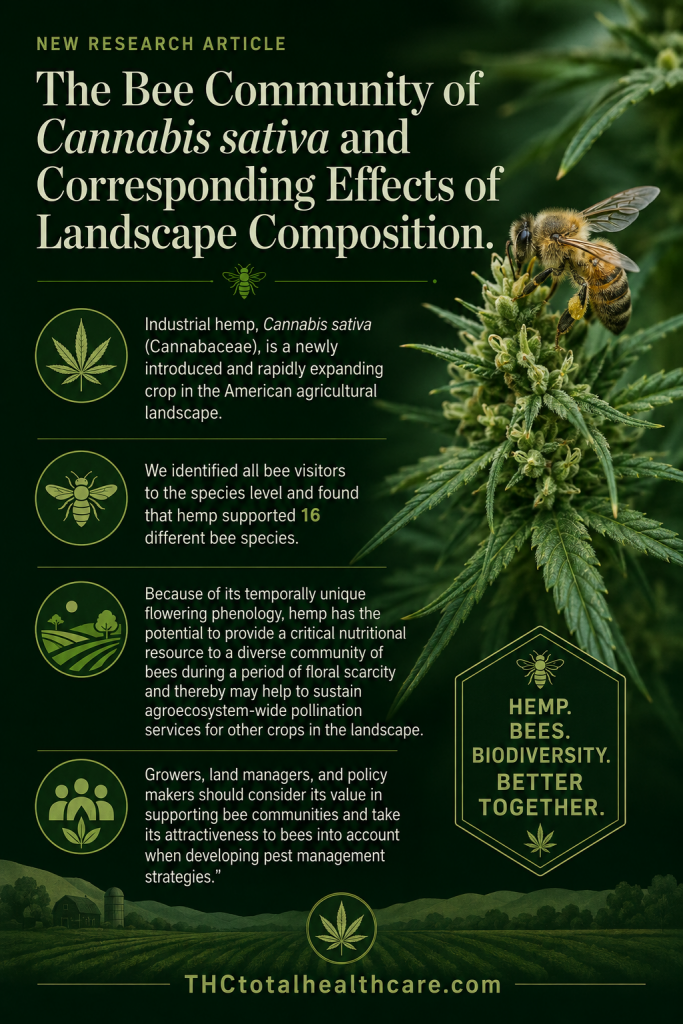
The Bee Community of Cannabis sativa and Corresponding Effects of Landscape Composition.

“Industrial hemp, Cannabis sativa (Cannabaceae), is a newly introduced and rapidly expanding crop in the American agricultural landscape. As an exclusively wind-pollinated crop, hemp lacks nectar but produces an abundance of pollen during a period of floral dearth in agricultural landscapes. These pollen resources are attractive to a range of bee species but the diversity of floral visitors and their use of hemp across a range of agricultural contexts remains unclear. We made repeated sweep net collections of bees visiting hemp flowers on farms in New York, which varied in both landscape context and phenotypic traits of hemp varieties. We identified all bee visitors to the species level and found that hemp supported 16 different bee species. Landscape simplification negatively impacted the abundance of bees visiting hemp flowers but did not affect the species richness of the community. Plant height, on the other hand, was strongly correlated with bee species richness and abundance for hemp plots with taller varieties attracting a broader diversity of bee species. Because of its temporally unique flowering phenology, hemp has the potential to provide a critical nutritional resource to a diverse community of bees during a period of floral scarcity and thereby may help to sustain agroecosystem-wide pollination services for other crops in the landscape. As cultivation of hemp increases, growers, land managers, and policy makers should consider its value in supporting bee communities and take its attractiveness to bees into account when developing pest management strategies.”

https://www.ncbi.nlm.nih.gov/pubmed/31789341

https://academic.oup.com/ee/advance-article/doi/10.1093/ee/nvz141/5634339

Image result for environmental entomology

The Effectiveness of Topical Cannabidiol Oil in Symptomatic Relief of Peripheral Neuropathy of the Lower Extremities.

“Peripheral neuropathy can significantly impact the quality of life for those who are affected, as therapies from the current treatment algorithm often fail to deliver adequate symptom relief. There has, however, been an increasing body of evidence for the use of cannabinoids in the treatment of chronic, noncancer pain. The efficacy of a topically delivered cannabidiol (CBD) oil in the management of neuropathic pain was examined in this four-week, randomized and placebo-controlled trial.

RESULTS:

The study population included 62.1% males and 37.9% females with a mean age of 68 years. There was a statistically significant reduction in intense pain, sharp pain, cold and itchy sensations in the CBD group when compared to the placebo group. No adverse events were reported in this study.

CONCLUSIONS:

Our findings demonstrate that the transdermal application of CBD oil can achieve significant improvement in pain and other disturbing sensations in patients with peripheral neuropathy. The treatment product was well tolerated and may provide a more effective alternative compared to other current therapies in the treatment of peripheral neuropathy.”

https://www.ncbi.nlm.nih.gov/pubmed/31793418

http://www.eurekaselect.com/177080/article