
 “Current literature on the effect of cannabis use on sleep quality is mixed, and few studies have used objectively-measured sleep measures or real-time sampling of cannabis use to examine this relationship.
The prevalence of cannabis use among older adults and persons living with HIV has increased in recent years, and poor sleep quality is elevated in these populations as well. However, research examining cannabis-sleep relationships in these populations is lacking. Thus, we aimed to examine the relationship between daily cannabis use and subsequent objectively-measured sleep quality in middle-aged and older adults with and without HIV.
In this pilot study, seventeen (11 HIV+, 6 HIV-) adults aged 50-70 who consumed cannabis completed four daily smartphone-based surveys for 14 days, in which they reported their cannabis use (yes/no) since the last survey. Participants also wore actigraphy watches during the 14-day period to objectively assess sleep quality (i.e., efficiency, total sleep time, and sleep fragmentation).
In linear mixed-effects models, cannabis use was significantly associated with greater subsequent total sleep time (β=0.56; p=0.046). Cannabis use was not related to a change in sleep efficiency (β=1.50; p=0.46) nor sleep fragmentation (β=0.846, p=0.756) on days with cannabis use versus days without cannabis use.
These preliminary results indicate cannabis use may have a positive effect on sleep duration in middle-aged and older adults. However, future studies with larger sample sizes that assess cannabis use in more detail (e.g., route of administration, dose, reason for use) are needed to further understand this relationship.”
https://pubmed.ncbi.nlm.nih.gov/32905460/
https://publications.sciences.ucf.edu/cannabis/index.php/Cannabis/article/view/59
 “HIV is associated with disruptions in cognition and brain function.
 “HIV/SIV-associated oral mucosal disease/dysfunction (HAOMD) (gingivitis/periodontitis/salivary adenitis) represents a major comorbidity affecting HIV patients on anti-retroviral therapy.
 “Objective: To determine whether cannabis may reduce HIV-related persistent inflammation, we evaluated the relationship of cannabis use in people with HIV (PWH) to inflammatory cytokines in CSF and blood plasma.
 “HIV infection affects an estimated 38 million people. Approximately 50% of HIV patients exhibit neurocognitive dysfunction termed HIV-Associated Neurocognitive Disorder (HAND). HAND is a consequence of chronic low-level neuroinflammation due to HIV entry into the brain. Initially, monocytes become activated in circulation and traffic to the brain. Monocytes, when activated, become susceptible to infection by HIV and can then carry the virus across the blood brain barrier. Once in the brain, activated monocytes secrete chemokines, which recruit virus-specific CD8+ T cells into the brain to further promote neuroinflammation. HAND is closely linked to systemic inflammation driven, in part, by HIV but is also due to persistent translocation of microorganisms across the GI tract. Persistent anti-viral responses in the GI tract compromise microbial barrier integrity. Indeed, HIV patients can exhibit remarkably high levels of activated (CD16+) monocytes in circulation.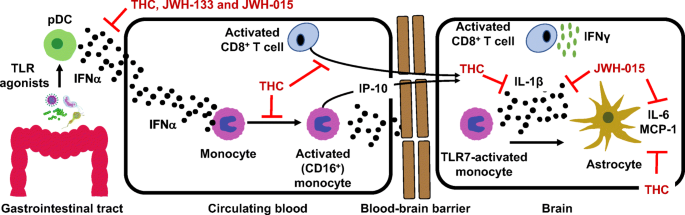
 “HIV infection leads to blood-brain barrier (BBB) dysfunction that does not resolve despite viral suppression on antiretroviral therapy and is associated with adverse clinical outcomes.
 “Neuropathic pain associated with nucleoside reverse transcriptase inhibitors (NRTIs), therapeutic agents for human immunodeficiency virus (HIV), responds poorly to available drugs.
 “Aging and HIV have adverse effects on the central nervous system, including increased inflammation and neural injury and confer risk of neurocognitive impairment (NCI).
 “HIV-associated neurocognitive disorder (HAND) affects nearly half of all HIV-infected individuals. Synaptodendritic damage correlates with neurocognitive decline in HAND, and many studies have demonstrated that HIV-induced neuronal injury results from excitotoxic and inflammatory mechanisms.
 “Heavy cannabis users had decreased frequencies of human leukocyte antigen (HLA)-DR+CD38+CD4+ and CD8+ T-cell frequencies, compared to frequencies of these cells in non-cannabis-using individuals.