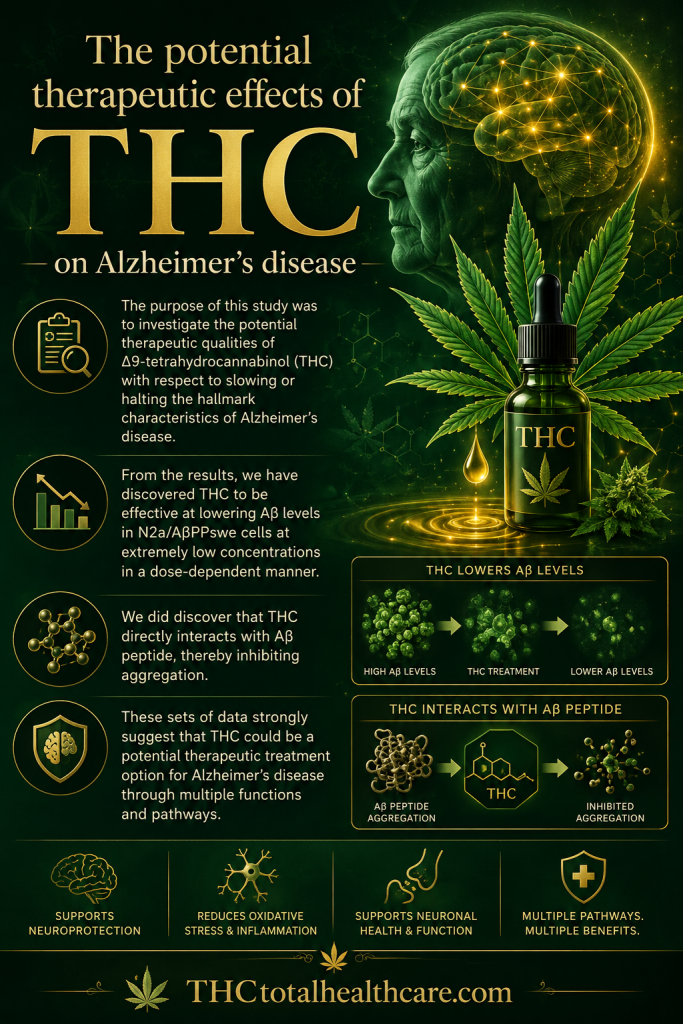
The Potential Therapeutic Effects of THC on Alzheimer’s Disease.

“The purpose of this study was to investigate the potential therapeutic qualities of Δ9-tetrahydrocannabinol (THC) with respect to slowing or halting the hallmark characteristics of Alzheimer’s disease.

N2a-variant amyloid-β protein precursor (AβPP) cells were incubated with THC and assayed for amyloid-β (Aβ) levels at the 6-, 24-, and 48-hour time marks. THC was also tested for synergy with caffeine, in respect to the reduction of the Aβ level in N2a/AβPPswe cells. THC was also tested to determine if multiple treatments were beneficial. The MTT assay was performed to test the toxicity of THC. Thioflavin T assays and western blots were performed to test the direct anti-Aβ aggregation significance of THC. Lastly, THC was tested to determine its effects on glycogen synthase kinase-3β (GSK-3β) and related signaling pathways.

From the results, we have discovered THC to be effective at lowering Aβ levels in N2a/AβPPswe cells at extremely low concentrations in a dose-dependent manner. However, no additive effect was found by combining caffeine and THC together.

We did discover that THC directly interacts with Aβ peptide, thereby inhibiting aggregation. Furthermore, THC was effective at lowering both total GSK-3β levels and phosphorylated GSK-3β in a dose-dependent manner at low concentrations. At the treatment concentrations, no toxicity was observed and the CB1 receptor was not significantly upregulated. Additionally, low doses of THC can enhance mitochondria function and does not inhibit melatonin’s enhancement of mitochondria function.

These sets of data strongly suggest that THC could be a potential therapeutic treatment option for Alzheimer’s disease through multiple functions and pathways.”

https://pubmed.ncbi.nlm.nih.gov/25024327

https://journals.sagepub.com/doi/abs/10.3233/JAD-140093


University Of Saskatchewan Research Suggests Marijuana Analogue Stimulates Brain Cell Growth

ScienceDaily: Your source for the latest research news

“A synthetic substance similar to ones found in marijuana stimulates cell growth in regions of the brain associated with anxiety and depression, pointing the way for new treatments for these diseases, according to University of Saskatchewan medical research published today in The Journal of Clinical Investigation.

Xia Zhang, an associate professor in the U of S neuropsychiatry research unit, led the team that tested the effects of HU-210, a potent synthetic cannabinoid similar to a group of compounds found in marijuana. The synthetic version is about 100 times as powerful as THC, the compound responsible for the high experienced by recreational users.

The team found that rats treated with HU-210 on a regular basis showed neurogenesis – the growth of new brain cells in the hippocampus. This region of the brain is associated with learning and memory, as well as anxiety and depression.

The effect is the opposite of most legal and illicit drugs such as alcohol, nicotine, heroin, and cocaine.

“Most ‘drugs of abuse’ suppress neurogenesis,” Zhang says. “Only marijuana promotes neurogenesis.””

http://www.sciencedaily.com/releases/2005/10/051016083817.htm

“Cannabinoids promote embryonic and adult hippocampus neurogenesis and produce anxiolytic- and antidepressant-like effects… In summary, since adult hippocampal neurogenesis is suppressed following chronic administration of opiates, alcohol, nicotine, and cocaine, the present study suggests that cannabinoids are the only illicit drug that can promote adult hippocampal neurogenesis following chronic administration.”  http://www.jci.org/articles/view/25509

The endocannabinoid system: a putative role in neurodegenerative diseases.

An external file that holds a picture, illustration, etc.
Object name is ijhrba-02-100-i001.jpg

“Scientific evidence shows that an hypofunction or a dysregulation of the endocannabinoid system may be responsible for some of the symptoms of diseases such as multiple sclerosis, amyotrophic lateral sclerosis, Huntington’s, Parkinson’s and Alzheimer’s diseases.

The aim of this review is to highlight the role of endocannabinoid system in neurodegenerative diseases

Scientific evidence shows that cannabis can provide symptomatic relief in several neurodegenerative diseases such as multiple sclerosis, Huntington’s, Parkinson’s and Alzheimer’s diseases, and amyotrophic lateral sclerosis. These findings imply that a hypofunction or a dysregulation of the endocannabinoid system may be responsible for some of the symptoms of these diseases. Moreover, given the abundance of CB1 receptors in areas associated with movement and executive thought, researchers’ interest has often focused on endocannabinoid levels in patients with motor degenerative disorders.

CONCLUSIONS:

The important role played by endocannabinoid system promises interesting developments, in particular to evaluate the effectiveness of new drugs in both psychiatry and neurology.”

http://www.ncbi.nlm.nih.gov/pmc/articles/PMC4070159/

CANNABINOIDs INHIBIT angiogenic capacities of Endothelial cells via release of Tissue inhibitor of matrix metalloproteinases-1 from lung cancer cells.

“Cannabinoids inhibit tumor neovascularisation as part of their tumorregressive action.

However, the underlying mechanism is still under debate. In the present study the impact of cannabinoids on potential tumor-to-endothelial cell communication conferring anti-angiogenesis was studied…

Collectively, our data suggest a pivotal role of the anti-angiogenic factor TIMP-1 inintercellular tumor-endothelial cell communication resulting in anti-angiogenic features of endothelial cells.”

http://www.ncbi.nlm.nih.gov/pubmed/24976505

http://www.thctotalhealthcare.com/category/lung-cancer/

Marijuana Ingredient Kills Herpes Virus, Study Says

“Marijuana’s active ingredient killed herpes viruses in test-tube experiments…

University of South Florida microbiologist Gerald Lancz said his study may help scientists discover new anti-herpes medicines.

http://articles.orlandosentinel.com/1990-05-15/news/9005150630_1_herpes-virus-people-with-herpes-anti-herpes


THC in marijuana may block the spread of forms of cancer causing herpes viruses

Medical News

“The compound in marijuana that produces a high, delta-9 tetrahydrocannbinol or THC, may block the spread of several forms of cancer causing herpes viruses, University of South Florida College of Medicine scientists report.

The findings, published Sept. 15 in the online journal BMC Medicine, could lead to the creation of antiviral drugs based on nonpsychoactive derivatives of THC.”

http://www.news-medical.net/news/2004/09/22/4990.aspx

The effect of delta-9-tetrahydrocannabinol on herpes simplex virus replication.

“Both herpes simplex virus type 1 (HSV-1) and herpes simplex virus type 2 (HSV-2) failed, in an identical fashion to replicate and produce extensive c.p.e. in human cell monolayer cultures which were exposed (8 h before infection, at infection, or 8 h p.i.) to various concentrations of delta-9-tetrahydrocannabinol. Similar results were obtained with a plaque assay utilizing confluent monkey cells. Possible mechanisms for this antiviral activity are discussed.”

http://www.ncbi.nlm.nih.gov/pubmed/6255077

Inhibition of cell-associated herpes simplex virus type 2 glycoproteins by delta 9-tetrahydrocannabinol.

“This study was conducted to define the effect of micromolar concentrations of delta 9-tetrahydrocannabinol (delta 9-THC) on the biosynthesis and expression of herpes simplex virus type 2 (HSV2)-specified glycoproteins. Dose-related reductions in all species of virus glycoproteins were recorded by one-dimensional SDS-polyacrylamide gel electrophoresis (SDS-PAGE) and autoradiography of [14C]glucosamine-labeled infected Vero cells treated with 10(-7) to 10(-5) M delta 9-THC. A drug dose-related depletion of the mature HSV2 major envelope glycoprotein complex (119-kDa average molecular weight), accompanied by accumulation of immature unglycosylated species, was demonstrated by two-dimensional SDS-PAGE in concert with Western immunoblotting or autoradiography. Light and electron microscopy immunoperoxidase staining revealed that delta 9-THC effected depletion of 119-kDa determinants from the infected cell surface. This depletion occurred concomitantly with accumulation of 119-kDa components at the perinucleus. However, the expression of 119-kDa glycoproteins on the virion envelope was not affected. These results indicate that delta 9-THC inhibits the synthesis, maturation, and cellular transport of HSV2-specified glycoproteins. Decreased expression of virus glycoproteins on the infected cell surface may affect host immune responsiveness to HSV2.”

http://www.ncbi.nlm.nih.gov/pubmed/3033681

Suppressive effect of delta-9-tetrahydrocannabinol on herpes simplex virus infectivity in vitro.

“Delta-9-Tetrahydrocannabinol (THC) was found to reduce the infectivity of herpes simplex virus and was without effect against adenovirus type 2 or poliovirus.

The effective THC concentration resulting in an 80% decrement in virus viability was dependent upon the presence or absence of serum in the incubation mixture, as a 5% serum concentration decreased the drug activity by approximately 50-fold. THC-mediated inactivation of herpes simplex virus was both time and dose dependent and did not result in virion disassembly or clumping. The THC-related effect was not influenced by the pH of the suspending medium, suggesting that the mechanism of inactivation differed from that associated with the thermal inactivation of the virus.

Thus, the data suggest that THC preferentially reduces the infectivity of the enveloped herpes simplex virus, and that this activity is modulated by the presence of serum proteins.”

http://www.ncbi.nlm.nih.gov/pubmed/1848937

Delta-9 tetrahydrocannabinol (THC) inhibits lytic replication of gamma oncogenic herpesviruses in vitro

Figure 2

“The major psychoactive cannabinoid compound of marijuana, delta-9 tetrahydrocannabinol (THC), has been shown to modulate immune responses and lymphocyte function. After primary infection the viral DNA genome of gamma herpesviruses persists in lymphoid cell nuclei in a latent episomal circular form. In response to extracellular signals, the latent virus can be activated, which leads to production of infectious virus progeny. Therefore, we evaluated the potential effects of THC on gamma herpesvirus replication.

THC specifically targets viral and/or cellular mechanisms required for replication and possibly shared by these gamma herpesviruses, and the endocannabinoid system is possibly involved in regulating gamma herpesvirus latency and lytic replication. The immediate early gene ORF 50 promoter activity was specifically inhibited by THC. These studies may also provide the foundation for the development of antiviral strategies utilizing non-psychoactive derivatives of THC.

 We believe that studies on cannabinoids and herpesviruses are important to continue because there are obvious potential benefits. Better understanding may lead to the development of specific non-psychoactive drugs that may inhibit reactivation of oncogenic herpesviruses.”