Marijuana Fights Cancer and Helps Manage Side Effects, Researchers Find

 “Mounting evidence shows ‘cannabinoids’ in marijuana slow cancer growth, inhibit formation of new blood cells that feed a tumor, and help manage pain, fatigue, nausea, and other side effects.

“Cannabidiol offers hope of a non-toxic therapy that could treat aggressive forms of cancer without any of the painful side effects of chemotherapy,” says McAllister, who is seeking support to conduct clinical trials with the marijuana compound on breast cancer patients.

Within the medical science community, the discovery that cannabinoids have anti-tumoral properties is increasingly recognized as a seminal advancement in cancer therapeutics.”
 

Marijuana And Cancer: Scientists Find Cannabis Compound Stops Metastasis In Aggressive Cancers

“A pair of scientists at California Pacific Medical Center in San Francisco has found that a compound derived from marijuana could stop metastasis in many kinds of aggressive cancer, potentially altering the fatality of the disease forever.

“What we found was that Cannabidiol could essentially ‘turn off’ the ID-1,” Desprez told HuffPost. The cells stopped spreading and returned to normal.”

http://www.huffingtonpost.com/2012/09/19/marijuana-and-cancer_n_1898208.html?utm_hp_ref=fb&src=sp&comm_ref=false

Cannabinoids: A new hope for breast cancer therapy?

“Experimental evidence accumulated during the last decade supports that cannabinoids, the active components of Cannabis sativa and their derivatives, possess anticancer activity… these compounds exert anti-proliferative, pro-apoptotic, anti-migratory and anti-invasive actions in a wide spectrum of cancer cells… Moreover, tumor growth, angiogenesis and metastasis are hampered by cannabinoids… our current knowledge on the anti-tumor potential of cannabinoids in breast cancer… suggests that cannabinoid-based medicines may be useful for the treatment of most breast tumor subtypes.”

http://www.ncbi.nlm.nih.gov/pubmed/22776349 

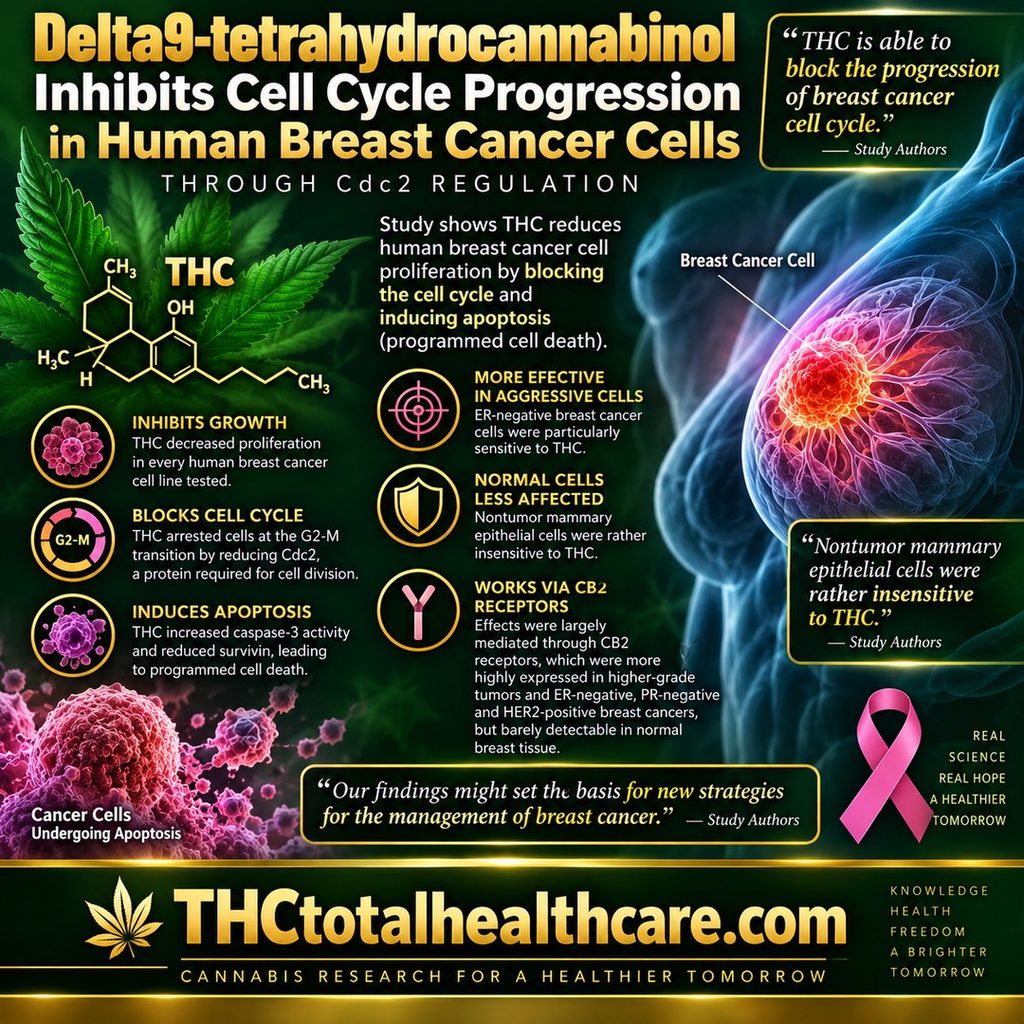
Delta9-tetrahydrocannabinol inhibits cell cycle progression in human breast cancer cells through Cdc2 regulation.

Researchers found that Δ9-tetrahydrocannabinol (THC) reduced the growth of multiple human breast cancer cell lines by stopping cells from progressing through the cell cycle and by triggering apoptosis, or programmed cell death. THC blocked the cells at the G2-M stage by reducing Cdc2, a protein needed for cell division, and breast cancer cells engineered to produce more Cdc2 became more resistant to THC.

The study also found that aggressive ER-negative breast cancer cells were particularly sensitive to THC, while normal human mammary epithelial cells were much less affected. THC’s effects were largely associated with CB2 cannabinoid receptors, which were more highly expressed in higher-grade tumors and in ER-negative, PR-negative and HER2-positive breast tumors, while CB2 expression was barely detectable in normal breast tissue.

The researchers concluded that these findings could help form the basis for new cannabinoid-based strategies for managing breast cancer.

“It has been proposed that cannabinoids are involved in the control of cell fate. Thus, these compounds can modulate proliferation, differentiation, and survival in different manners depending on the cell type and its physiopathologic context. However, little is known about the effect of cannabinoids on the cell cycle, the main process controlling cell fate.

Here, we show that Delta(9)-tetrahydrocannabinol (THC), through activation of CB(2) cannabinoid receptors, reduces human breast cancer cell proliferation by blocking the progression of the cell cycle and by inducing apoptosis. In particular, THC arrests cells in G(2)-M via down-regulation of Cdc2, as suggested by the decreased sensitivity to THC acquired by Cdc2-overexpressing cells.

Of interest, the proliferation pattern of normal human mammary epithelial cells was much less affected by THC. We also analyzed by real-time quantitative PCR the expression of CB(1) and CB(2) cannabinoid receptors in a series of human breast tumor and nontumor samples. We found a correlation between CB(2) expression and histologic grade of the tumors. There was also an association between CB(2) expression and other markers of prognostic and predictive value, such as estrogen receptor, progesterone receptor, and ERBB2/HER-2 oncogene. Importantly, no significant CB(2) expression was detected in nontumor breast tissue.

Taken together, these data might set the bases for a cannabinoid therapy for the management of breast cancer.”

https://pubmed.ncbi.nlm.nih.gov/16818634

“Cannabinoid receptors are expressed in human breast tumors.” 

“THC inhibits proliferation of human breast cancer cells.“

https://aacrjournals.org/cancerres/article/66/13/6615/525923/9-Tetrahydrocannabinol-Inhibits-Cell-Cycle

Need this THC study explained? thcXplained.com

CANNABINOIDS: POTENTIAL ANTICANCER AGENTS

The study by Manuel Guzmán of Madrid Spain found that cannabinoids, the active components of marijuana, inhibit tumor growth in laboratory animals. They do so by modulating key cell-signalling pathways, thereby inducing direct growth arrest and death of tumor cells, as well as by inhibiting the growth of blood vessels that supply the tumor.

http://americanmarijuana.org/Guzman-Cancer.pdf 

Cannabis Science Reports: National Cancer Institute Updates Confirm Successful Cancer Treatments with Medical Cannabis

“As we’ve previously reported, one of the most interesting findings that has emerged since the discovery of the endocannabinoid system (marijuana like compounds produced by humans, and all vertebrates) is that cannabinoids have profound cancer-killing and anti-metastatic properties.

There is strong scientific support, demonstrated in tissue culture and animal studies, of the potent cancer killing properties of cannabinoids for such deadly cancers as glioma, lung cancer, breast and prostate cancer, leukemias and lymphomas, and as well as skin cancers.”

http://www.cannabisscience.com/index.php/news-media/news-archive/195-cannabis-science-reports-national-cancer-institute-updates-confirm-successful-cancer-treatments-with-medical-cannabis

“Cannabis Science, Inc. (OTCBB:CBIS), a pioneering US biotech company developing pharmaceutical cannabis products, is pleased to report a government released update on cancer treatments using medical cannabis (marijuana), updated March 17, 2011, summarizing how the treatment of cancer with cannabinoids goes beyond the simple treatment of symptoms and side effects by exhibiting possible direct antitumor activities.

This summary contains the following key information:

– Cannabis has been used for medicinal purposes for thousands of years prior to its current status as an illegal substance.

– Chemical components of Cannabis, called cannabinoids, activate specific receptors found throughout the body to produce pharmacologic effects, particularly in the central nervous system and the immune system.

– Cannabinoids may have benefits in the treatment of cancer-related side effects.

– The potential benefits of medicinal Cannabis for people living with cancer include antiemetic effects, appetite stimulation, pain relief, and improved sleep.

– Though no relevant surveys of practice patterns exist, it appears that physicians caring for cancer patients who prescribe medicinal Cannabis predominantly do so for symptom management.

– Unlike other commonly used drugs, cannabinoids are stored in adipose tissue and excreted at a low rate (half-life 1-3 days).

– Even abrupt cessation of cannabinoid intake is not associated with rapid declines in plasma concentrations that would precipitate severe or abrupt withdrawal symptoms or drug cravings.

Robert Melamede, Ph.D., Cannabis Science’s CEO stated, “As we’ve previously reported, one of the most interesting findings that has emerged since the discovery of the endocannabinoid system (marijuana like compounds produced by humans, and all vertebrates) is that cannabinoids have profound cancer-killing and anti-metastatic properties. There is strong scientific support, demonstrated in tissue culture and animal studies, of the potent cancer killing properties of cannabinoids for such deadly cancers as glioma, lung cancer, breast and prostate cancer, leukemias and lymphomas, and as well as skin cancers.

Currently the federal government prohibitionist position on cannabis is hindering the medical community by delaying vitally important clinical cannabis research.

 I was quite elated when I recently saw that the NCI posted on their webpage

“In the practice of integrative oncology, the health care provider may recommend medicinal Cannabis not only for symptom management but also for its possible direct antitumor effect.”

 I foolishly thought that finally there would be official recognition of the modern peer reviewed science that shows the cancer killing properties of cannabinoids. Sadly, this statement was removed, without comment, within hours of its posting.””

More: http://www.medicalnewstoday.com/releases/221024.php