“The worldwide prevalence of neurological and neurodegenerative disorders, such as depression or Alzheimer’s disease, has spread extensively throughout the last decades, becoming an enormous health issue.
Numerous data indicate a distinct correlation between the altered endocannabinoid signaling and different aspects of brain physiology, such as memory or neurogenesis. Moreover, the endocannabinoid system is widely regarded as a crucial factor in the development of neuropathologies. Thus, targeting those disorders via synthetic cannabinoids, as well as phytocannabinoids, becomes a widespread research issue.
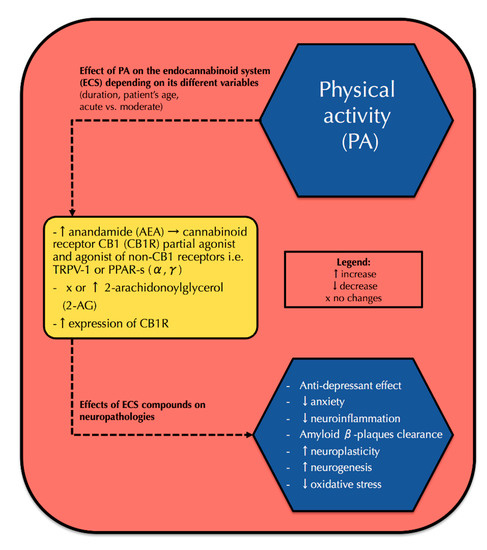
Over the last decade, the endocannabinoid system has been extensively studied for its correlation with physical activity. Recent data showed that physical activity correlates with elevated endocannabinoid serum concentrations and increased cannabinoid receptor type 1 (CB1R) expression in the brain, which results in positive neurological effects including antidepressant effect, ameliorated memory, neuroplasticity development, and reduced neuroinflammation. However, none of the prior reviews presented a comprehensive correlation between physical activity, the endocannabinoid system, and neuropathologies.
Thus, our review provides a current state of knowledge of the endocannabinoid system, its action in physical activity, as well as neuropathologies and a possible correlation between all those fields. We believe that this might contribute to finding a new preventive and therapeutic approach to both neurological and neurodegenerative disorders.”
https://pubmed.ncbi.nlm.nih.gov/32545780/
https://www.mdpi.com/1422-0067/21/12/4221
 “Growing evidence recognises cannabinoid receptors as potential therapeutic targets for pain. Consequently, there is increasing interest in developing cannabinoid receptor agonists for treating pain.
 “Alcohol use disorders affect millions of people worldwide and there is growing evidence that excessive alcohol intake causes severe damage to the brain of both humans and animals.
 “Obesity rates are increasing worldwide and there is a need for novel therapeutic treatment options.
 “Δ9‐THCA‐A, the precursor of Δ9‐THC, is a non‐psychotropic phytocannabinoid that shows PPARγ agonistic activity. Herein, we investigated Δ9‐THCA ability to modulate classic cannabinoid receptors (CB1 and CB2) and evaluated its anti‐arthritis activity.

 “Alzheimer’s Dementia (AD) is a devastating neurodegenerative disease that affects approximately 17% of people aged 75-84. Neuropsychiatric symptoms (NPS) such as delusions, agitation, anxiety, and hallucinations are present in up to 95% of patients in all stages of dementia. To date, any approved and effective pharmacological interventions for the treatment of NPS are still not available.
 “Background: Recent approved medicines whose active principles are Δ9Tetrahidrocannabinol (Δ9-THC) and/or cannabidiol (CBD) open novel perspectives for other phytocannabinoids also present in Cannabis sativa L. varieties. Furthermore, solid data on the potential benefits of acidic and varinic phytocannabinoids in a variety of diseases are already available. Mode of action of cannabigerol (CBG), cannabidiolic acid (CBDA), cannabigerolic acid (CBGA), cannabidivarin (CBDV) and cannabigerivarin (CBGV) is, to the very least, partial.