

Cannabinoids inhibit HIV-1 Gp120-mediated insults in brain microvascular endothelial cells.

Logo of nihpa

“HIV-1 infection has significant effect on the immune system as well as on the nervous system.

Breakdown of the blood-brain barrier (BBB) is frequently observed in patients with HIV-associated dementia (HAD) despite lack of productive infection of human brain microvascular endothelial cells (HBMEC).

Cellular products and viral proteins secreted by HIV-1 infected cells, such as the HIV-1 Gp120 envelope glycoprotein, play important roles in BBB impairment and HIV-associated dementia development.

HBMEC are a major component of the BBB.

Using cocultures of HBMEC and human astrocytes as a model system for human BBB as well as in vivo model, we show for the first time that cannabinoid agonists inhibited HIV-1 Gp120-induced calcium influx mediated by substance P and significantly decreased the permeability of HBMEC as well as prevented tight junction protein down-regulation of ZO-1, claudin-5, and JAM-1 in HBMEC.

Furthermore, cannabinoid agonists inhibited the transmigration of human monocytes across the BBB and blocked the BBB permeability in vivo.

These results demonstrate that cannabinoid agonists are able to restore the integrity of HBMEC and the BBB following insults by HIV-1 Gp120.

These studies may lead to better strategies for treatment modalities targeted to the BBB following HIV-1 infection of the brain based on cannabinoid pharmacotherapies.”

http://www.ncbi.nlm.nih.gov/pmc/articles/PMC3735224/

Cannabinoids for Symptom Management and Cancer Therapy: The Evidence.

“Cannabinoids bind not only to classical receptors (CB1 and CB2) but also to certain orphan receptors (GPR55 and GPR119), ion channels (transient receptor potential vanilloid), and peroxisome proliferator-activated receptors. Cannabinoids are known to modulate a multitude of monoamine receptors. Structurally, there are 3 groups of cannabinoids.

Multiple studies, most of which are of moderate to low quality, demonstrate that tetrahydrocannabinol (THC) and oromucosal cannabinoid combinations of THC and cannabidiol (CBD) modestly reduce cancer pain.

Dronabinol and nabilone are better antiemetics for chemotherapy-induced nausea and vomiting (CINV) than certain neuroleptics, but are not better than serotonin receptor antagonists in reducing delayed emesis, and cannabinoids have largely been superseded by neurokinin-1 receptor antagonists and olanzapine; both cannabinoids have been recommended for breakthrough nausea and vomiting among other antiemetics. Dronabinol is ineffective in ameliorating cancer anorexia but does improve associated cancer-related dysgeusia.

Multiple cancers express cannabinoid receptors directly related to the degree of anaplasia and grade of tumor.

Preclinical in vitro and in vivo studies suggest that cannabinoids may have anticancer activity.

Paradoxically, cannabinoid receptor antagonists also have antitumor activity.

There are few randomized smoked or vaporized cannabis trials in cancer on which to judge the benefits of these forms of cannabinoids on symptoms and the clinical course of cancer. Smoked cannabis has been found to contain Aspergillosis. Immunosuppressed patients should be advised of the risks of using “medical marijuana” in this regard.”

http://www.ncbi.nlm.nih.gov/pubmed/27407130

Inhibition of the cataleptic effect of tetrahydrocannabinol by other constituents of Cannabis sativa L.

“Tetrahydrocannabinol (THC) induced catalepsy in mice, whereas a cannabis oil (6.68% w/w THC), four cannabinoids and a synthetic mixture did not. Cannabinol (CBN) and olivetol inhibited THC-induced catalepsy in the mornings and the evenings, but cannabidiol (CBD) exhibited this effect only in the evenings. A combination of CBN and CBD inhibited THC-induced catalepsy equal to that of CBN alone in the mornings, but this inhibition was greater than that produced by CBN alone in the evenings.”  http://www.ncbi.nlm.nih.gov/pubmed/2897447

Cannabinoid signalling in glioma cells

SpringerPlus Cover Image

“Cannabinoids, originally derived from Cannabis sativa, as well as their endogenous and synthetic counterparts, were shown to induce apoptosis of glioma cells in vitro and tumour regression in vivo via their specific receptors, cannabinoid receptors CB1 and/or CB2.

CB2 are abnormally expressed in human gliomas and glioma cell lines. Most of the analysed gliomas expressed significant levels of CB2 receptor and the extent of CB2 expression in the tumour specimens was related to tumour malignancy.

A synthetic cannabinoid, WIN 55,212-2, down-regulated the Akt and Erk signalling pathways in C6 glioma cells that resulted in reduction of phosphorylated Bad levels, mitochondrial depolarization and activation of caspase cascade leading to apoptosis.

We examined whether synthetic cannabinoids with different receptor specificity: WIN55,212-2 (a non-selective CB1/CB2 agonist) and JWH133 (a CB2-selective agonist) affect survival of four human glioma cell lines and three primary human glioma cell lines.

WIN-55,212-2 decreased cell viability in all examined cell lines and induced cell death. Susceptibility of the cells to JWH133 treatment correlated with the CB2 expression. Cannabinoids triggered a decrease of mitochondrial membrane potential, cleavage of caspase-9 and effector caspases.

Induction of cell death by cannabinoid treatment led to the generation of a pro-apoptotic sphingolipid ceramide and disruption of signalling pathways crucial for regulation of proliferation and survival. Increased ceramide levels induced ER-stress and autophagy in drug-treated glioblastoma cells.

We conclude that cannabinoids are efficient inhibitors of human glioma cells growth, once the cells express specific type of cannabinoid receptor.”

http://springerplus.springeropen.com/articles/10.1186/2193-1801-4-S1-L11

Does cannabidiol have a role in the treatment of schizophrenia?

“Schizophrenia is a debilitating psychiatric disorder which places a significant emotional and economic strain on the individual and society-at-large. Unfortunately, currently available therapeutic strategies do not provide adequate relief and some patients are treatment-resistant.

In this regard, cannabidiol (CBD), a non-psychoactive constituent of Cannabis sativa, has shown significant promise as a potential antipsychotic for the treatment of schizophrenia.

However, there is still considerable uncertainty about the mechanism of action of CBD as well as the brain regions which are thought to mediate its putative antipsychotic effects. We argue that further research on CBD is required to fast-track its progress to the clinic and in doing so, we may generate novel insights into the neurobiology of schizophrenia.”

http://www.ncbi.nlm.nih.gov/pubmed/27374322

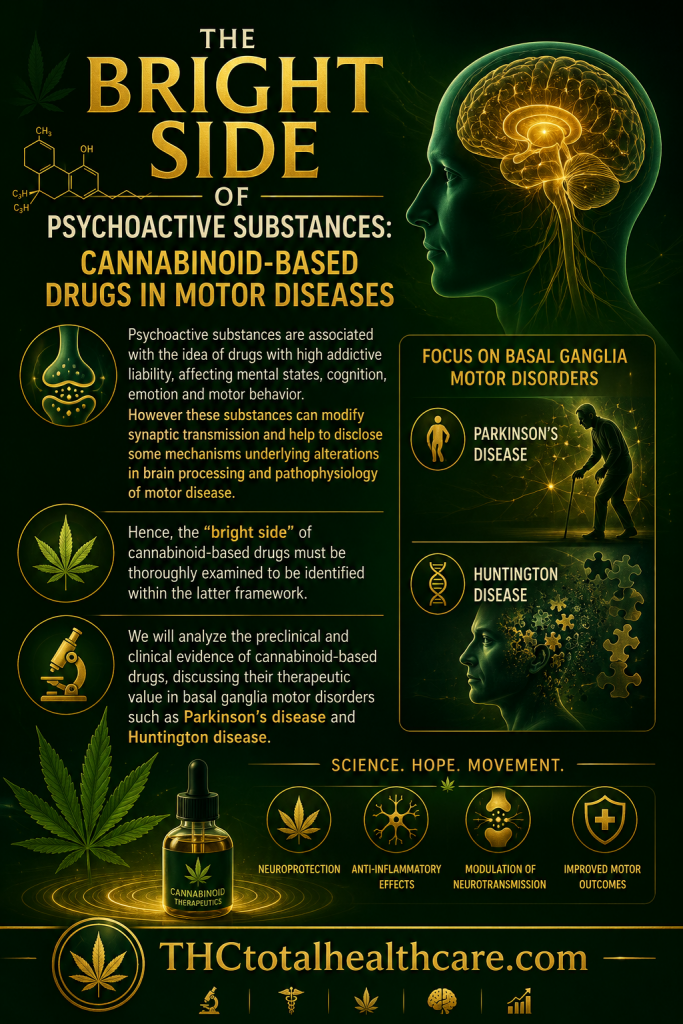
The bright side of psychoactive substances: cannabinoid-based drugs in motor diseases.

“Psychoactive substances are associated with the idea of drugs with high addictive liability, affecting mental states, cognition, emotion and motor behavior. However these substances can modify synaptic transmission and help to disclose some mechanisms underlying alterations in brain processing and pathophysiology of motor disease. Hence, the “bright side” of cannabinoid-based drugs must be thoroughly examined to be identified within the latter framework.

We will analyze the preclinical and clinical evidence of cannabinoid-based drugs, discussing their therapeutic value in basal ganglia motor disorders such as Parkinson’s disease and Huntington disease.

Expert commentary: despite the knowledge acquired in the last years, the therapeutic potential of cannabinoid-based drugs should be further tested by novel routes of investigation. This should be focused on the role of cannabinoid signaling system in mitochondrial function as well as on the physical and functional interaction with other key receptorial targets belonging to this network.”

http://www.ncbi.nlm.nih.gov/pubmed/27373318

Delta-9-tetrahydrocannabinol protects against MPP+ toxicity in SH-SY5Y cells by restoring proteins involved in mitochondrial biogenesis.

Related image

“Proliferator-activated receptor γ (PPARγ) activation can result in transcription of proteins involved in oxidative stress defence and mitochondrial biogenesis which could rescue mitochondrial dysfunction in Parkinson’s disease (PD). The PPARγ agonist pioglitazone is protective in models of PD; however side effects have limited its clinical use.

The cannabinoid Δ9-tetrahydrocannabinol (Δ9-THC) may have PPARγ dependent anti-oxidant properties. Here we investigate the effects of Δ9-THC and pioglitazone on mitochondrial biogenesis and oxidative stress.

We found that only Δ9-THC was able to restore mitochondrial content in MPP+ treated SH-SY5Y cells in a PPARγ dependent manner by increasing expression of the PPARγ co-activator 1α (PGC-1α), the mitochondrial transcription factor (TFAM) as well as mitochondrial DNA content.

… unlike pioglitazone, Δ9-THC resulted in a PPARγ dependent reduction of MPP+ induced oxidative stress.

We therefore suggest that, in contrast to pioglitazone, Δ9-THC mediates neuroprotection via PPARγ-dependent restoration of mitochondrial content which may be beneficial for PD treatment.”

http://www.ncbi.nlm.nih.gov/pubmed/27366949

http://www.oncotarget.com/index.php?journal=oncotarget&page=article&op=view&path[]=10314&path[]=32486

Basolateral amygdala CB1 cannabinoid receptors are involved in cross state-dependent memory retrieval between morphine and ethanol.

“Ethanol and morphine are largely co-abused and affect memory formation.

The present study intended to investigate the involvement of cannabinoid CB1 receptors of the basolateral amygdala (BLA) in cross state-dependent memory retrieval between morphine and ethanol.

Taken together, it can be concluded that morphine and ethanol can induce state-dependent memory retrieval.

In addition, the BLA endocannabinoid system mediates via CB1 receptors the functional interaction of morphine and ethanol state-dependent memory retrieval which may depend on the rewarding effects of the drugs.”

http://www.ncbi.nlm.nih.gov/pubmed/27327764

The cannabinoid WIN 55,212-2 prevents neuroendocrine differentiation of LNCaP prostate cancer cells.

“Neuroendocrine (NE) differentiation represents a common feature of prostate cancer and is associated with accelerated disease progression and poor clinical outcome. Nowadays, there is no treatment for this aggressive form of prostate cancer.

The aim of this study was to determine the influence of the cannabinoid WIN 55,212-2 (WIN, a non-selective cannabinoid CB1 and CB2 receptor agonist) on the NE differentiation of prostate cancer cells.

Taken together, we demonstrate that PI3K/Akt/AMPK might be an important axis modulating NE differentiation of prostate cancer that is blocked by the cannabinoid WIN, pointing to a therapeutic potential of cannabinoids against NE prostate cancer.”

http://www.ncbi.nlm.nih.gov/pubmed/27324222
