
“Cannabinoids have demonstrated anticarcinogenic properties in a variety of malignancies, including in prostate cancer. In the present study, we explored the anti-cancer effects of the synthetic cannabinoid WIN 55,212-2 (WIN) in prostate cancer.
Tag Archives: Cannabinoids
Care After Chemotherapy: Peripheral Neuropathy, Cannabis for Symptom Control, and Mindfulness.
 “As cancer therapies improve, patients are living longer. With these improvements in therapy comes a responsibility to optimize patients’ quality of life during cancer therapy and beyond. This report reviews three timely and important topics.
The first section reviews the mechanism underlying chemotherapy-induced peripheral neuropathy and evaluates the evidence for interventions to prevent and treat peripheral neuropathy. It also provides a framework for approaching the diagnosis and management of this common and bothersome side effect.
The second section addresses the controversial but effective use of cannabinoids for cancer and chemotherapy symptoms. Although clinical trials are difficult to conduct because of the political and social stigma of this class of drugs, this review provides evidence of the efficacy of cannabinoids for treatment of pain and nausea.
The last section addresses the mind-body connection, with a focus on the negative emotions patients with cancer often experience. This section assesses the literature regarding mindfulness-based programs to improve cancer-related stress. These three topics may appear unrelated, but all address one common goal: treating the body and the mind to optimize quality of life during and after cancer therapy.”
“As cancer therapies improve, patients are living longer. With these improvements in therapy comes a responsibility to optimize patients’ quality of life during cancer therapy and beyond. This report reviews three timely and important topics.
The first section reviews the mechanism underlying chemotherapy-induced peripheral neuropathy and evaluates the evidence for interventions to prevent and treat peripheral neuropathy. It also provides a framework for approaching the diagnosis and management of this common and bothersome side effect.
The second section addresses the controversial but effective use of cannabinoids for cancer and chemotherapy symptoms. Although clinical trials are difficult to conduct because of the political and social stigma of this class of drugs, this review provides evidence of the efficacy of cannabinoids for treatment of pain and nausea.
The last section addresses the mind-body connection, with a focus on the negative emotions patients with cancer often experience. This section assesses the literature regarding mindfulness-based programs to improve cancer-related stress. These three topics may appear unrelated, but all address one common goal: treating the body and the mind to optimize quality of life during and after cancer therapy.”
“Although commercially available dronabinol is not superior to other antiemetics and oromucosal nabiximols is not very effective for treating cancer pain, cannabis has been shown to be effective for treating pain and may help patients reduce opioid intake.”
]]>
Inflammation and CB2 signaling drive novel changes in the ocular lipidome and regulate immune cell activity in the eye.
“Uveitis is inflammation of the uvea which consists of the iris, ciliary body and the choroid of the eye. Uveitis can lead to impaired vision and is responsible for 10% of all cases of blindness globally. Using an endotoxin-induced uveitis (EIU) rodent model, our previous data implicated the endogenous cannabinoid system (ECS) in the amelioration of many of the components of the inflammatory response. Here, we test the hypothesis that the reduction in inflammatory mediators in the EIU model by the CB2 agonist, HU308, is associated with changes in ECS endogenous ligands as well as related lipids, prostaglandins (PGs), 2-acyl glycerols, and lipoamines. These data implicate ocular CB2 as a key component of lipid signaling in the eye and part of the regulatory processes of inflammation.” https://www.ncbi.nlm.nih.gov/pubmed/30232034 https://www.sciencedirect.com/science/article/pii/S109888231830025X?via%3Dihub]]>
Cannabinoids and spinal cord stimulation for the treatment of failed back surgery syndrome refractory pain
“This study aimed to evaluate pain and its symptoms in patients with failed back surgery syndrome (FBSS) refractory to other therapies, treated with a combination of delta-9-tetrahydrocannabinol (THC) and cannabidiol (CBD), in association with spinal cord stimulation (SCS). Results: Effective pain management as compared to baseline result was achieved in all the cases studied. The positive effect of cannabinoid agonists on refractory pain was maintained during the entire duration of treatment with minimal dosage titration. Pain perception, evaluated through numeric rating scale, decreased from a baseline mean value of 8.18±1.07–4.72±0.9 by the end of the study duration (12 months) (P<0.001). Conclusion: The results indicate that cannabinoid agonists (THC/CBD) can have remarkable analgesic capabilities, as adjuvant of SCS, for the treatment of chronic refractory pain of FBSS patients.” https://www.ncbi.nlm.nih.gov/pubmed/30233233 https://www.dovepress.com/cannabinoids-and-spinal-cord-stimulation-for-the-treatment-of-failed-b-peer-reviewed-article-JPR
“Outcomes indicate remarkable analgesic capabilities of cannabinoid agonists (THC/CBD) as an adjuvant to SCS for treating chronic refractory pain in FBSS patients, since all the cases studied achieved effective pain management compared to baseline.”
https://www.mdlinx.com/journal-summaries/cannabinoids-delta-9-tetrahydrocannabinol-thc-cannabidiol/2018/09/13/7544234/
]]>
A Comparative Study on Hemp (Cannabis sativa) Essential Oil Extraction Using Traditional and Advanced Techniques.
 “A comparative study of Cannabis sativa (Hemp) essential constituents obtained by using Supercritical Fluid Extraction (SCFE), Steam Distillation (SD) and Hydrodistillation (HD) is presented here.
The optimized extraction temperatures were 130,110 and 50 ℃ for hydrodistillation, steam distillation and supercritical fluid extraction respectively. The essential oil of C. sativa was analyzed by using Gas chromatography mass spectrometry (GC-MS). A total of 33, 30 and 31 components have been identified in HD, SD and SCFE respectively. Yield of essential oil using SCFE (0.039%) was more than HD (0.025%) and SD (0.035%) extraction respectively.
The main component of sesquiterpenes obtained by hydrodistillation at 130 ℃ with their percentages included caryophyllene (40.58%), trans-α-bergamotene (5.41%), humulene (10.97%), cis-β-farnesene (8.53%) and monoterpenes included α-pinene (2.13%), d-limonene (6.46%), p-cymol (0.65%) and cineole (2.58%) respectively.
The main component of sesquiterpenes obtained by SD steam distillation at 110 ℃ including caryophyllene (38.60%) trans-α-bergamotene (4.22%), humulene (10.26%), cis-β-farnesene (6.67%) and monoterpenes included α-pinene (3.21%), d-limonene (7.07%), p-cymol (2.59%) and cineole (3.88%) whereas the more percentages of major components were obtained by SCFE at 50 ℃ included caryophyllene (44.31%), trans-α-bergamotene (6.79%), humulene (11.97%) cis-β-farnesene (9.71%) and monoterpenes included α-pinene (0.45%), d-limonene (2.13%) p-cymol (0.19%) and cineole (1.38 %) respectively.
We found yield/efficiency, chemical composition, quality of the essential oils by supercritical fluid extraction superior in terms of modern, green, saving energy and a rapid approach as compared to traditional techniques.”
https://www.ncbi.nlm.nih.gov/pubmed/30221908
“A comparative study of Cannabis sativa (Hemp) essential constituents obtained by using Supercritical Fluid Extraction (SCFE), Steam Distillation (SD) and Hydrodistillation (HD) is presented here.
The optimized extraction temperatures were 130,110 and 50 ℃ for hydrodistillation, steam distillation and supercritical fluid extraction respectively. The essential oil of C. sativa was analyzed by using Gas chromatography mass spectrometry (GC-MS). A total of 33, 30 and 31 components have been identified in HD, SD and SCFE respectively. Yield of essential oil using SCFE (0.039%) was more than HD (0.025%) and SD (0.035%) extraction respectively.
The main component of sesquiterpenes obtained by hydrodistillation at 130 ℃ with their percentages included caryophyllene (40.58%), trans-α-bergamotene (5.41%), humulene (10.97%), cis-β-farnesene (8.53%) and monoterpenes included α-pinene (2.13%), d-limonene (6.46%), p-cymol (0.65%) and cineole (2.58%) respectively.
The main component of sesquiterpenes obtained by SD steam distillation at 110 ℃ including caryophyllene (38.60%) trans-α-bergamotene (4.22%), humulene (10.26%), cis-β-farnesene (6.67%) and monoterpenes included α-pinene (3.21%), d-limonene (7.07%), p-cymol (2.59%) and cineole (3.88%) whereas the more percentages of major components were obtained by SCFE at 50 ℃ included caryophyllene (44.31%), trans-α-bergamotene (6.79%), humulene (11.97%) cis-β-farnesene (9.71%) and monoterpenes included α-pinene (0.45%), d-limonene (2.13%) p-cymol (0.19%) and cineole (1.38 %) respectively.
We found yield/efficiency, chemical composition, quality of the essential oils by supercritical fluid extraction superior in terms of modern, green, saving energy and a rapid approach as compared to traditional techniques.”
https://www.ncbi.nlm.nih.gov/pubmed/30221908
 “The opioid epidemic has become an immense problem in North America, and despite decades of research on the most effective means to treat opioid use disorder (OUD), overdose deaths are at an all-time high, and relapse remains pervasive.
Although there are a number of FDA-approved opioid replacement therapies and maintenance medications to help ease the severity of opioid withdrawal symptoms and aid in relapse prevention, these medications are not risk free nor are they successful for all patients. Furthermore, there are legal and logistical bottlenecks to obtaining traditional opioid replacement therapies such as methadone or buprenorphine, and the demand for these services far outweighs the supply and access.
To fill the gap between efficacious OUD treatments and the widespread prevalence of misuse, relapse, and overdose, the development of novel, alternative, or adjunct OUD treatment therapies is highly warranted. In this article, we review emerging evidence that suggests that cannabis may play a role in ameliorating the impact of OUD. Herein, we highlight knowledge gaps and discuss cannabis’ potential to prevent opioid misuse (as an analgesic alternative), alleviate opioid withdrawal symptoms, and decrease the likelihood of relapse.
Conclusion: The compelling nature of these data and the relative safety profile of cannabis warrant further exploration of cannabis as an adjunct or alternative treatment for OUD.”
“The opioid epidemic has become an immense problem in North America, and despite decades of research on the most effective means to treat opioid use disorder (OUD), overdose deaths are at an all-time high, and relapse remains pervasive.
Although there are a number of FDA-approved opioid replacement therapies and maintenance medications to help ease the severity of opioid withdrawal symptoms and aid in relapse prevention, these medications are not risk free nor are they successful for all patients. Furthermore, there are legal and logistical bottlenecks to obtaining traditional opioid replacement therapies such as methadone or buprenorphine, and the demand for these services far outweighs the supply and access.
To fill the gap between efficacious OUD treatments and the widespread prevalence of misuse, relapse, and overdose, the development of novel, alternative, or adjunct OUD treatment therapies is highly warranted. In this article, we review emerging evidence that suggests that cannabis may play a role in ameliorating the impact of OUD. Herein, we highlight knowledge gaps and discuss cannabis’ potential to prevent opioid misuse (as an analgesic alternative), alleviate opioid withdrawal symptoms, and decrease the likelihood of relapse.
Conclusion: The compelling nature of these data and the relative safety profile of cannabis warrant further exploration of cannabis as an adjunct or alternative treatment for OUD.”
 “Cannabinoid receptor 1 (CB1) is a promising therapeutic target for a variety of disorders. Distinct efficacy profiles showed different therapeutic effects on CB1 dependent on three classes of ligands: agonists, antagonists, and inverse agonists. To discriminate the distinct efficacy profiles of the ligands, we carried out molecular dynamics (MD) simulations to identify the dynamic behaviors of inactive and active conformations of CB1 structures with the ligands. In addition, the molecular mechanics Poisson-Boltzmann surface area (MM-PBSA) method was applied to analyze the binding free energy decompositions of the CB1-ligand complexes. With these two methods, we found the possibility that the three classes of ligands can be discriminated. Our findings shed light on the understanding of different efficacy profiles of ligands by analyzing the structural behaviors of intact CB1 structures and the binding energies of ligands, thereby yielding insights that are useful for the design of new potent CB1 drugs.”
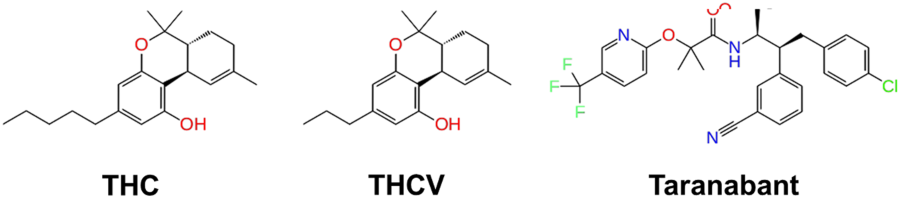
 “Drug addiction is a chronic relapsing disorder that produces a dramaticglobal health burden worldwide. Not effective treatment of drug addiction is currently available probably due to the difficulties to find an appropriate target to manage this complex disease raising the needs for further identification of novel therapeutic approaches.
The endocannabinoid system has been found to play a crucial role in the neurobiological substrate underlying drug addiction.
Endocannabinoids and cannabinoid receptors are widely expressed in the main areas of the mesocorticolimbic system that participate in the initiation and maintenance of drug consumption and in the development of compulsion and loss of behavioral control occurring during drug addiction.
The identification of the important role played by CB1 cannabinoid receptors in drug addiction encouraged the possible used of an early commercialized CB1 receptor antagonist for treating drug addiction.
However, the incidence of serious psychiatric adverse events leaded to the sudden withdrawal from the market of this CB1 antagonist and all the research programs developed by pharmaceutical companies to obtain new CB1 antagonists were stopped.
Currently, new research strategies are under development to target the endocannabinoid system for drug addiction avoiding these side effects, which include allosteric negative modulators of CB1 receptors and compounds targeting CB2 receptors.
Recent studies showing the potential role of CB2 receptors in the addictive properties of different drugs of abuse have open a promising research opportunity to develop novel possible therapeutic approaches.”
“Drug addiction is a chronic relapsing disorder that produces a dramaticglobal health burden worldwide. Not effective treatment of drug addiction is currently available probably due to the difficulties to find an appropriate target to manage this complex disease raising the needs for further identification of novel therapeutic approaches.
The endocannabinoid system has been found to play a crucial role in the neurobiological substrate underlying drug addiction.
Endocannabinoids and cannabinoid receptors are widely expressed in the main areas of the mesocorticolimbic system that participate in the initiation and maintenance of drug consumption and in the development of compulsion and loss of behavioral control occurring during drug addiction.
The identification of the important role played by CB1 cannabinoid receptors in drug addiction encouraged the possible used of an early commercialized CB1 receptor antagonist for treating drug addiction.
However, the incidence of serious psychiatric adverse events leaded to the sudden withdrawal from the market of this CB1 antagonist and all the research programs developed by pharmaceutical companies to obtain new CB1 antagonists were stopped.
Currently, new research strategies are under development to target the endocannabinoid system for drug addiction avoiding these side effects, which include allosteric negative modulators of CB1 receptors and compounds targeting CB2 receptors.
Recent studies showing the potential role of CB2 receptors in the addictive properties of different drugs of abuse have open a promising research opportunity to develop novel possible therapeutic approaches.”