
“Data are limited on marijuana use and its impact on liver transplant (LT) waitlist outcomes. We aimed to assess the risk of waitlist mortality/delisting and likelihood of LT among prior marijuana users, and to determine the prevalence and factors associated with marijuana use. Unlike illicit drug use, marijuana use was not associated with worse outcomes on the LT waitlist.” https://www.ncbi.nlm.nih.gov/pubmed/29319619 https://insights.ovid.com/crossref?an=00007890-900000000-96711 https://journals.lww.com/transplantjournal/Abstract/onlinefirst/History_of_marijuana_use_does_not_affect_outcomes.96711.aspx
Tag Archives: cannabis
Cannabis, cannabinoids, and health.
“Cannabis does have therapeutic properties for certain indications.” https://www.ncbi.nlm.nih.gov/pubmed/29302228 “The legislative policies that have been established to reduce the risks in relation to cannabis have long represented an obstacle to research concerning medical cannabis use. Improved knowledge of the endocannabinoid system and of exocannabinoids has proven that cannabis may have significant therapeutic effects.” https://www.ncbi.nlm.nih.gov/pmc/articles/PMC5741114/]]>
Cannabidiol for drug-resistant seizures in the Dravet syndrome
“Dravet syndrome (severe myoclonic epilepsy of infancy) is characterised by difficult-to-control seizures. Media reports and small clinical trials suggest that cannabidiol, a non-toxic extract of cannabis, can reduce seizure frequency. A recent multicentre randomised controlled trial of 120 children aged 2–18 years with Dravet syndrome supports its efficacy. Over a 14-week period, children taking 20 mg/kg/day of cannabidiol had a 22.8% reduction (95% confidence interval 5.4–41.1) in seizure frequency compared to a 4-week baseline period. Median convulsive frequency fell from 12.4 to 5.9 per month on cannabidiol, while the placebo group had no change from baseline. No attempt was made to measure non-convulsive seizures (e.g. absences). Subjects took a median of three other anti-convulsant drugs during the trial. Adverse effects were common with cannabidiol, particularly somnolence, fatigue, loss of appetite, vomiting and diarrhoea. Eight patients in the cannabidiol group withdrew compared to one in the placebo group. Nevertheless, 62% of caregivers in the cannabidiol group felt the patient’s overall condition had improved, using a validated global score, compared to 34% in the placebo group (P = 0.02). Unfortunately, the high rate of adverse events may have led to widespread loss of caregiver blinding, and the study is relatively short term. Nevertheless, the reduction in seizures is clinically relevant, and further longer-term randomised controlled trials are clearly warranted. ” https://www.ncbi.nlm.nih.gov/pubmed/29314377 http://onlinelibrary.wiley.com/doi/10.1111/jpc.13803/full]]>
Cannabis Use is Associated with Lower Odds of Prescription Opioid Analgesic Use Among HIV-Infected Individuals with Chronic Pain.
“Chronic pain is common in the United States and prescribed opioid analgesics use for noncancer pain has increased dramatically in the past two decades, possibly accounting for the current opioid addiction epidemic. Co-morbid drug use in those prescribed opioid analgesics is common, but there are few data on polysubstance use patterns.
We explored patterns of use of cigarette, alcohol, and illicit drugs in HIV-infected people with chronic pain who were prescribed opioid analgesics.
Almost half of the sample of people with HIV and chronic pain reported current prescribed opioid analgesic use (N = 372, 47.1%). Illicit drug use was common (N = 505, 63.9%), and cannabis was the most commonly used illicit substance (N = 311, 39.4%).
In multivariate analyses, only cannabis use was significantly associated with lower odds of prescribed opioid analgesic use (adjusted odds ratio = 0.57; 95% confidence interval: 0.38-0.87). Conclusions/Importance: Our data suggest that new medical cannabis legislation might reduce the need for opioid analgesics for pain management, which could help to address adverse events associated with opioid analgesic use.” https://www.ncbi.nlm.nih.gov/pubmed/29338578 http://www.tandfonline.com/doi/abs/10.1080/10826084.2017.1416408?journalCode=isum20]]>Medical Cannabis, a Beneficial High in Treatment of Blepharospasm? An Early Observation.
“The objective of this study was to observe the effect of medical cannabis in benign essential blepharospasm (BEB) as an adjunct to botulinum toxin.
Three out of four patients (75%) reported symptomatic improvement.
Medical cannabis has made great strides as a treatment modality for symptom relief for many disease processes, including muscle spasms related to multiple sclerosis. Medical cannabis is an accepted therapy for muscle spastic disorders.
We believe that this observational case series provides a backdrop to exploring prospective, double-masked studies to determine the therapeutic effect of cannabis for patients suffering from BEB” https://www.ncbi.nlm.nih.gov/pmc/articles/PMC5764009/
http://www.tandfonline.com/doi/abs/10.1080/01658107.2017.1318150?journalCode=ioph20
“Blepharospasm is any abnormal contraction or twitch of the eyelid” https://en.wikipedia.org/wiki/Blepharospasm
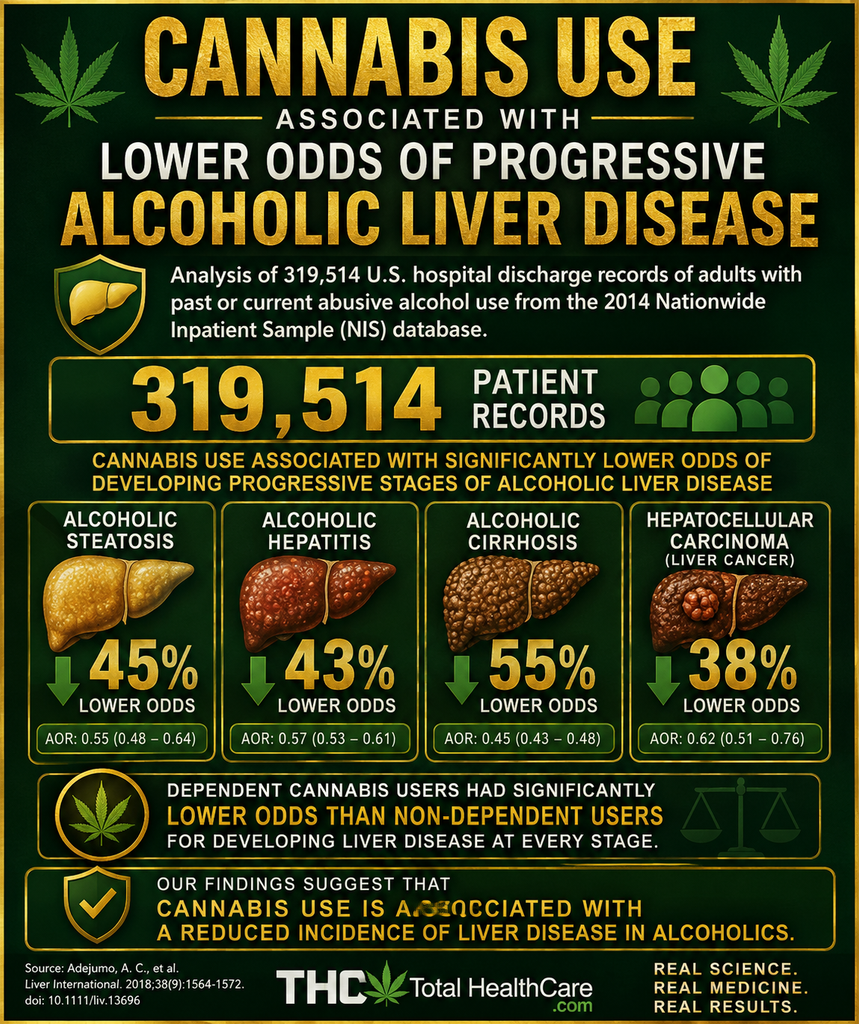
Cannabis use is associated with reduced prevalence of progressive stages of alcoholic liver disease

“Background: Abusive alcohol use has well-established health risks including causing liver disease (ALD) characterized by alcoholic steatosis (AS), steatohepatitis (AH), fibrosis, cirrhosis (AC) and hepatocellular carcinoma (HCC). Strikingly, a significant number of individuals who abuse alcohol also use Cannabis, which has seen increased legalization globally. While cannabis has demonstrated anti-inflammatory properties, its combined use with alcohol and the development of liver disease remain unclear.
Aim: The aim of this study was to determine the effects of cannabis use on the incidence of liver disease in individuals who abuse alcohol.
Methods: We analysed the 2014 Healthcare Cost and Utilization Project-Nationwide Inpatient Sample (NIS) discharge records of patients 18 years and older, who had a past or current history of abusive alcohol use (n = 319 514). Using the International Classification of Disease, Ninth Edition codes, we studied the four distinct phases of progressive ALD with respect to three cannabis exposure groups: non-cannabis users (90.39%), non-dependent cannabis users (8.26%) and dependent cannabis users (1.36%). We accounted for the complex survey sampling methodology and estimated the adjusted odds ratio (AOR) for developing AS, AH, AC and HCC with respect to cannabis use (SAS 9.4).
Results: Our study revealed that among alcohol users, individuals who additionally use cannabis (dependent and non-dependent cannabis use) showed significantly lower odds of developing AS, AH, AC and HCC (AOR: 0.55 [0.48-0.64], 0.57 [0.53-0.61], 0.45 [0.43-0.48] and 0.62 [0.51-0.76]). Furthermore, dependent users had significantly lower odds than non-dependent users for developing liver disease.
Conclusions: Our findings suggest that cannabis use is associated with a reduced incidence of liver disease in alcoholics.”
https://www.ncbi.nlm.nih.gov/pubmed/29341392
http://onlinelibrary.wiley.com/doi/10.1111/liv.13696/abstract
Benefits of VCE-003.2, a cannabigerol quinone derivative, against inflammation-driven neuronal deterioration in experimental Parkinson's disease: possible involvement of different binding sites at the PPARγ receptor.
“Neuroprotection with cannabinoids in Parkinson’s disease (PD) has been afforded predominantly with antioxidant or anti-inflammatory cannabinoids. In the present study, we investigated the anti-inflammatory and neuroprotective properties of VCE-003.2, a quinone derivative of the non-psychotrophic phytocannabinoid cannabigerol (CBG), which may derive its activity at the peroxisome proliferator-activated receptor-γ (PPARγ). The compound is also an antioxidant. We have demonstrated that VCE-003.2 is neuroprotective against inflammation-driven neuronal damage in an in vivo model of PD and in in vitro cellular models of neuroinflammation. Such effects might involve PPARγ receptors, although in silico and in vitro experiments strongly suggest that VCE-003.2 targets PPARγ by acting through two binding sites at the LBP, one that is sensitive to T0070907 (canonical binding site) and other that is not affected by this PPARγ antagonist (alternative binding site).” https://www.ncbi.nlm.nih.gov/pubmed/29338785 https://jneuroinflammation.biomedcentral.com/articles/10.1186/s12974-018-1060-5]]>
Is Legal Pot Crippling Mexican Drug Trafficking Organisations?
“We show that the introduction of medical marijuana laws (MMLs) leads to a decrease in violent crime in states that border Mexico. The reduction in crime is strongest for counties close to the border (less than 350 kilometres) and for crimes that relate to drug trafficking. In addition, we find that MMLs in inland states lead to a reduction in crime in the nearest border state. Our results are consistent with the theory that decriminalisation of the production and distribution of marijuana leads to a reduction in violent crime in markets that are traditionally controlled by Mexican drug trafficking organisations.” http://onlinelibrary.wiley.com/doi/10.1111/ecoj.12521/full “Legal marijuana cuts violence says US study, as medical-use laws see crime fall. Murder and violent crime found to have decreased most in states bordering Mexico as drug cartels lose business to regulation.” https://www.theguardian.com/world/2018/jan/14/legal-marijuana-medical-use-crime-rate-plummets-us-study
“Marijuana legalisation causing violent crime to fall in US states, study finds” http://www.independent.co.uk/news/world/americas/medical-marijuana-legalisation-cannabis-us-states-violent-crime-drop-numbers-study-california-new-a8160311.html
]]>Betacaryophyllene – A phytocannabinoid as potential therapeutic modality for human sepsis?
“Sepsis is a clinical condition resulting from a dysregulated immune response to an infection that leads to organ dysfunction. Despite numerous efforts to optimize treatment, sepsis remains to be the main cause of death in most intensive care units.
The endogenous cannabinoid system (ECS) plays an important role in inflammation. Cannabinoid receptor 2 (CB2R) activation is immunosuppressive, which might be beneficial during the hyper-inflammatory phase of sepsis.
Beta-caryophyllene (BCP) is a non-psychoactive natural cannabinoid (phytocannabinoid) found in Cannabis sativa and in essential oils of spices and food plants, that acts as a selective agonist of CB2R.
We propose BCP administration as novel treatment to reduce hyper-inflammation in human sepsis.”
“Cannabis has been employed medicinally throughout history, but its recent legal prohibition, biochemical complexity and variability, quality control issues, previous dearth of appropriately powered randomised controlled trials, and lack of pertinent education have conspired to leave clinicians in the dark as to how to advise patients pursuing such treatment.
With the advent of pharmaceutical cannabis-based medicines (Sativex/nabiximols and Epidiolex), and liberalisation of access in certain nations, this ignorance of cannabis pharmacology and therapeutics has become untenable.
In this article, the authors endeavour to present concise data on cannabis pharmacology related to tetrahydrocannabinol (THC), cannabidiol (CBD) et al., methods of administration (smoking, vaporisation, oral), and dosing recommendations. Adverse events of cannabis medicine pertain primarily to THC, whose total daily dose-equivalent should generally be limited to 30mg/day or less, preferably in conjunction with CBD, to avoid psychoactive sequelae and development of tolerance.
CBD, in contrast to THC, is less potent, and may require much higher doses for its adjunctive benefits on pain, inflammation, and attenuation of THC-associated anxiety and tachycardia. Dose initiation should commence at modest levels, and titration of any cannabis preparation should be undertaken slowly over a period of as much as two weeks.
Suggestions are offered on cannabis-drug interactions, patient monitoring, and standards of care, while special cases for cannabis therapeutics are addressed: epilepsy, cancer palliation and primary treatment, chronic pain, use in the elderly, Parkinson disease, paediatrics, with concomitant opioids, and in relation to driving and hazardous activities.”