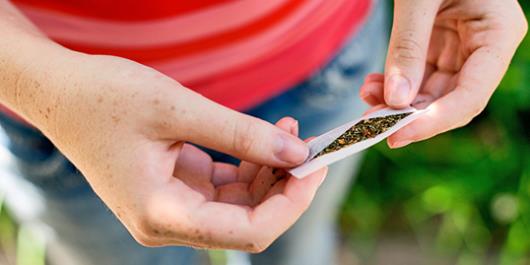
[So called ((soft)) drugs: cannabis and the amotivational syndrome].

“… there is a minority of problematic cannabis users.

 There is a scientific consensus to claim that cannabis induces a state of dependence in a small proportion of users.

Severe abuse of cannabis can also lead to cognitive impairments, especially on memory, although these effects usually improve after the cessation of cannabis use.

The statistical link between cannabis use and the development of psychotic disorders is more worrying, although the causal nature of this relationship remains controversial.

 Finally, a chronic abuse of cannabis is reputed to induce an amotivational syndrome, mainly characterized by a state of apathy.

Although the symptoms of the amotivational syndrome are in keeping with some clinical observations, it remains difficult to ascertain whether this clinical picture is causally produced by cannabis abuse.”
http://www.ncbi.nlm.nih.gov/pubmed/23888577

Police custody following driving under the influence of cannabis: A prospective study.

“We hypothesized that drug intoxication while driving could correspond to specific medical conditions of the detainees. Our objective was to evaluate medical features and addictive behaviours of suspected drug drivers and to collect data regarding assaults or injuries in these individuals.

We conducted a prospective study of suspected drug driving arrestees, who were compared to drink drivers or persons aged over 18 detained for other reasons. Data collected concerned persons’ characteristics, reported assaults, and observed injuries…

  Cannabis-only users accounted for 201 of 205 drug drivers (98%).

Suspected drug driving arrestees had good overall health rating.

Drug drivers were younger than controls and requested more rarely medical examination.

 They were rarely involved in addiction treatment and reported assaults or presented traumatic injuries less often than drink drivers and controls.

 Drug drivers were less often alcohol abusers than controls.

 Their opinion on custody was better than that of controls and they were considered unconditionally fit for detention more frequently.

 We conclude that arrested drug drivers were young, healthy, and infrequently reported assaults or presented traumatic injuries, which does not put them in a high risk medical condition…”

http://www.ncbi.nlm.nih.gov/pubmed/23890621

Anti-inflammatory activity of topical THC in DNFB-mediated mouse allergic contact dermatitis independent of CB1 and CB2 receptors.

“∆9 -Tetrahydrocannabinol (THC), the active constituent of Cannabis sativa, exerts its biological effects in part through the G-protein-coupled CB1 and CB2 receptors, which were initially discovered in brain and spleen tissue, respectively. However, THC also has CB1/2 receptor-independent effects. Because of its immune-inhibitory potential, THC and related cannabinoids are being considered for the treatment of inflammatory skin diseases.

Here we investigated the mechanism of the anti-inflammatory activity of THC and the role of CB1 and CB2 receptors…

CONCLUSIONS:

Topically applied THC can effectively attenuate contact allergic inflammation by decreasing keratinocyte-derived pro-inflammatory mediators that orchestrate myeloid immune cell infiltration independent of CB1/2 receptors.

This has important implications for the future development of strategies to harness cannabinoids for the treatment of inflammatory skin diseases.”

http://www.ncbi.nlm.nih.gov/pubmed/23889474

Marijuana cannabinoids found to help combat autism

cannabinoids

“(NaturalNews) The cannabinoid compounds naturally found in many varieties of cannabis, also known more commonly as marijuana, may help children with autism spectrum disorders experience dramatic behavioral improvements, and potentially even full recovery from their symptoms. These are the findings of a new study published in the journal Nature Communications that help reinforce the growing body of evidence which shows that medicinal cannabinoids hold incredible potential in both treating and potentially curing chronic illness…
 

Can non-psychoactive cannabinoid compounds actually cure chronic illness?

Though the researchers were quick to deny that cannabinoids hold any potential at actually curing autism, which more than likely was a politically-motivated denial rather than a factual admission, other research and actual case studies suggest that cannabinoid compounds are, indeed, powerful enough to mitigate many or all of the symptoms associated with autism, as well as many other diseases.”


Stanford University Study Finds That Marijuana Could Help With Autism

“A study conducted by Stanford University has found that there might be compounds in marijuana which have some very specific health benefits. The study’s results reveal that cannabinoids – which are found in cannabis – might help to treat autism.”

article image

“A new study shows that mutations associated with autism block the action of brain molecules that act on the same receptors that marijuana’s active chemical acts on,” according to the Autism Daily Newscast. “Thomas Sudhof, a cellular physiologist at Stanford University, tested mutations associated with autism in mice. Two mutations associated with autism in a synapse-adhesion protein led to deficits in prolonged endocannabinoid signaling in mice. This suggests that autism could caused by a disruption of the brain’s ability to send clear signals.
 
ADN references another study that supports the theory that cannabinoids could be used as a treatment to autism…”
 

More: http://www.opposingviews.com/i/health/stanford-university-study-finds-marijuana-could-help-autism#

Study Finds Cannabis May Provide Treatment For Autism

“A new study out of Standford University has found promising signs to suggest that cannabinoids – compounds found in cannabis, as well as naturally produced in our body – may help to treat autism.

According to Autism Daily Newscast (ADN); ”A new study shows that mutations associated with autism block the action of brain molecules that act on the same receptors that marijuana’s active chemical acts on”.

They continue: “Thomas Sudhof, a cellular physiologist at Stanford University, tested mutations associated with autism in mice. Two mutations associated with autism in a synapse-adhesion protein led to deficits in prolonged endocannabinoid signaling in mice. This suggests that autism could caused by a disruption of the brain’s ability to send clear signals”.

These findings suggest that cannabinoids could be used as a treatment to autism as they can unblock a disruption in the body’s cannabinoid receptors…”

More: http://www.theweedblog.com/study-finds-cannabis-may-provide-treatment-for-autism/

Hope for autistic children might lie in medical marijuana, study says – msn

Marijuana in a prescription bottle (© Gary Morrison/Getty Images)

“Stanford University released a study that will most likely add more fuel to the already contentious debate over medical marijuana, especially regarding its possible use by kids. The study, released in April, shows that cannabinoids, which are found in cannabis, might help treat autism. In the human brain, endocannabinoid signaling affects memory formation, learning, and other processes, but forms of autism can block these signals. When cannabinoids were present in the brains of mice being studied, these signals were able to get through. While more research is needed, autism groups are hopefull about the possibilties of medical marijuana. As the Autism Daily Newscast put it, “Many children with autism are already given cocktails of drugs that may be even stronger than marijuana, with serious side effects and limited results.”

http://now.msn.com/marijuana-affects-autism-by-helping-brain-signals-get-through-says-stanford-study

The pot diet

“Never mind the munchies, study finds that pot smokers weigh less than non-smokers.”

“Turns out that in spite of the late-night pizza binges and countless bags of Doritos they consume, the average marijuana user is actually less likely to be obese than the general, non-pot-smoking public.”

 More: http://healthyliving.msn.com/blogs/daily-apple-blog-post?post=5adb2a7c-1969-4a65-8554-1275f46faa94&_p=f178c720-63e5-4a6a-b939-6ba03f0bdc94

Health Benefits of Cannabis Tea

Health Benefits of Cannabis Tea 


“Reduces Chronic Pain

Reduces Anxiety

Reduces Nausea

May Treat Autoimmune Diseases”

“Marijuana-Infused Tea… Mom always said a cup of tea at night makes it easier to sleep.. Kevin Reed, of The Green Cross medical marijuana dispensary in San Francisco, advises patients to add a little milk after brewing to get the full effect of the cannabis.”  http://www.cbsnews.com/2300-204_162-10004358-12.html


“Cannabis Tea… Other names: Pot Tea, Weed Tea…Translations: Kaņepes Tēja, Kanapių arbata, Ceai de canabis, Kanabis Tea, Cần sa trà, Cannabis urządzenia, कैनबिस चाय, Chá de Cannabis, Каннабис чай, Η κάνναβη Τσάι, القنب الشاي, 대마초 차, Cannabis Čaj, Cannabis Teh, 大麻茶, Cannabis para preparar té, Cannabis Čaj, קנאביס תה, Канабис чај, 大麻コーヒー, Cannabis Te, Cannabis per a preparar te, Каннабіс чай, Kannabis Tea, Канабис чай”     http://www.foodista.com/food/3HJ8KNK6/cannabis-tea#

“Cannabis tea revisited: a systematic evaluation of the cannabinoid composition of cannabis tea.”   http://www.ncbi.nlm.nih.gov/pubmed/17604926

25 Benefits to Drinking Green Tea

Medicinal Cannabis Does Not Influence the Clinical Pharmacokinetics of Irinotecan and Docetaxel

“For the past 4,000 years, patients and doctors of each era have resorted to cannabis when conventional treatments were ineffective or lacking. Indeed, in oncology beneficial effects have been reported for cancer-associated anorexia, chemotherapy-induced nausea and vomiting, and palliation…

The only U.S. Food and Drug Administration (FDA)-approved medicinal cannabis products are an oral formulation containing dronabinol (Marinol®)… the synthetic version of delta9-tetrahydrocannabinol (THC), the main pharmacologically active cannabinoid, and capsules containing nabilone, an analog of dronabinol (Cesamet®)…

…many patients claim (subjectively) that a whole or partially purified extract of Cannabis sativa L. offers advantages over a single isolated ingredient…

We anticipated an increased use of medicinal cannabis concurrent with anticancer drugs, and undertook a drug-interaction study to evaluate the effect of concomitant medicinal cannabis on the pharmacokinetics of irinotecan and docetaxel…

Conclusion. Coadministration of medicinal cannabis, as herbal tea, in cancer patients treated with irinotecan or docetaxel does not significantly influence the plasma pharmacokinetics of these drugs. The evaluated variety of medicinal cannabis can be administered concomitantly with both anticancer agents without dose adjustments.”

Full text: http://theoncologist.alphamedpress.org/content/12/3/291.long