
Cannabidiol as a novel inhibitor of Id-1 gene expression in aggressive breast cancer cells

“Invasion and metastasis of aggressive breast cancer cells is the final and fatal step during cancer progression, and is the least understood genetically. Clinically, there are still limited therapeutic interventions for aggressive and metastatic breast cancers available. Clearly, effective and nontoxic therapies are urgently required. Id-1, an inhibitor of basic helix-loop-helix transcription factors, has recently been shown to be a key regulator of the metastatic potential of breast and additional cancers. Using a mouse model, we previously determined that metastatic breast cancer cells became significantly less invasive in vitro and less metastatic in vivo when Id-1 was down-regulated by stable transduction with antisense Id-1. It is not possible at this point, however, to use antisense technology to reduce Id-1 expression in patients with metastatic breast cancer. Here, we report that cannabidiol (CBD), a cannabinoid with a low-toxicity profile, could down-regulate Id-1 expression in aggressive human breast cancer cells. The CBD concentrations effective at inhibiting Id-1 expression correlated with those used to inhibit the proliferative and invasive phenotype of breast cancer cells. CBD was able to inhibit Id-1 expression at the mRNA and protein level in a concentration-dependent fashion. These effects seemed to occur as the result of an inhibition of the Id-1 gene at the promoter level. Importantly, CBD did not inhibit invasiveness in cells that ectopically expressed Id-1. In conclusion, CBD represents the first nontoxic exogenous agent that can significantly decrease Id-1 expression in metastatic breast cancer cells leading to the down-regulation of tumor aggressiveness.

Cannabinoids Reduce the Growth of Aggressive Human Breast Cancer Cells”

Cannabinoids Reduce Breast Cancer Cell Invasiveness

CBD Down-regulates Id-1 Expression

The Effects of CBD on Invasion and Id-1 Protein Expression Can Be Reproduced in an Additional Breast Cancer Cell Line

Plant cannabinoids are stable compounds with low-toxicity profiles that are well tolerated by animals and humans during chronic administration. 

If CBD shows efficacy for treatment of metastatic breast cancer in humans, the low toxicity of the compound would make it an ideal candidate for chronic administration.”
http://mct.aacrjournals.org/content/6/11/2921.long

Pathways mediating the effects of cannabidiol on the reduction of breast cancer cell proliferation, invasion, and metastasis

“Invasion and metastasis of aggressive breast cancer cells are the final and fatal steps during cancer progression. Clinically, there are still limited therapeutic interventions for aggressive and metastatic breast cancers available. Therefore, effective, targeted, and non-toxic therapies are urgently required. Id-1, an inhibitor of basic helix-loop-helix transcription factors, has recently been shown to be a key regulator of the metastatic potential of breast and additional cancers. We previously reported that cannabidiol (CBD), a cannabinoid with a low toxicity profile, down-regulated Id-1 gene expression in aggressive human breast cancer cells in culture. Using cell proliferation and invasion assays, cell flow cytometry to examine cell cycle and the formation of reactive oxygen species, and Western analysis, we determined pathways leading to the down-regulation of Id-1 expression by CBD and consequently to the inhibition of the proliferative and invasive phenotype of human breast cancer cells. Then, using the mouse 4T1 mammary tumor cell line and the ranksum test, two different syngeneic models of tumor metastasis to the lungs were chosen to determine whether treatment with CBD would reduce metastasis in vivo. We show that CBD inhibits human breast cancer cell proliferation and invasion through differential modulation of the extracellular signal-regulated kinase (ERK) and reactive oxygen species (ROS) pathways, and that both pathways lead to down-regulation of Id-1 expression. Moreover, we demonstrate that CBD up-regulates the pro-differentiation factor, Id-2. Using immune competent mice, we then show that treatment with CBD significantly reduces primary tumor mass as well as the size and number of lung metastatic foci in two models of metastasis. Our data demonstrate the efficacy of CBD in pre-clinical models of breast cancer. The results have the potential to lead to the development of novel non-toxic compounds for the treatment of breast cancer metastasis, and the information gained from these experiments broaden our knowledge of both Id-1 and cannabinoid biology as it pertains to cancer progression.”

http://www.ncbi.nlm.nih.gov/pmc/articles/PMC3410650/

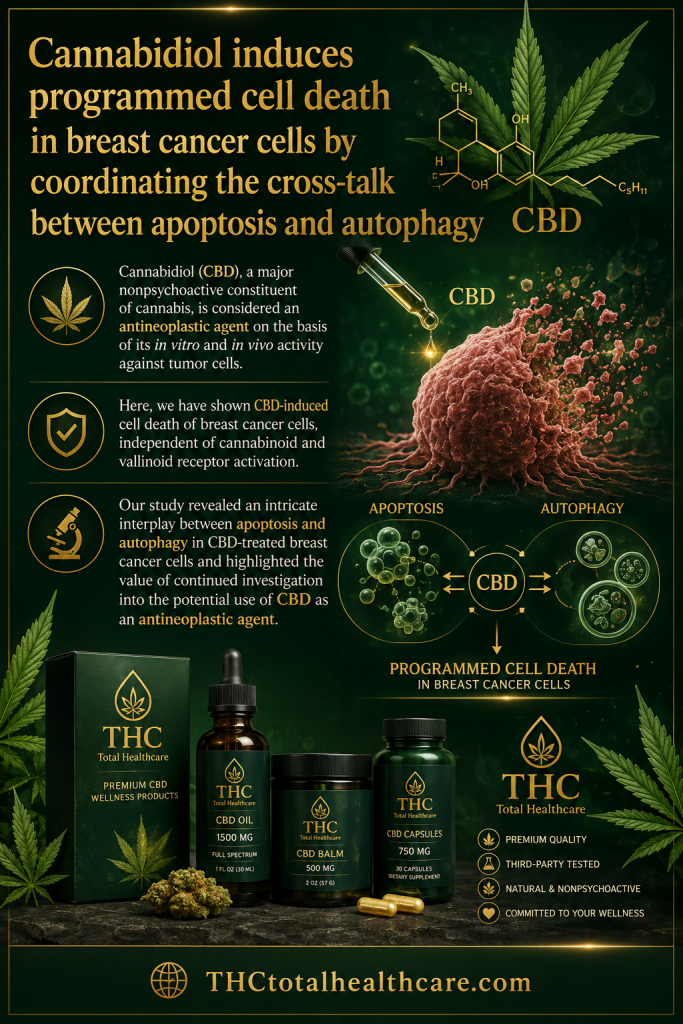
Cannabidiol Induces Programmed Cell Death in Breast Cancer Cells by Coordinating the Cross-talk between Apoptosis and Autophagy

“Cannabidiol (CBD), a major nonpsychoactive constituent of cannabis, is considered an antineoplastic agent on the basis of its in vitro and in vivo activity against tumor cells. However, the exact molecular mechanism through which CBD mediates this activity is yet to be elucidated.

Here, we have shown CBD-induced cell death of breast cancer cells, independent of cannabinoid and vallinoid receptor activation.

Electron microscopy revealed morphologies consistent with the coexistence of autophagy and apoptosis. Western blot analysis confirmed these findings. We showed that CBD induces endoplasmic reticulum stress and, subsequently, inhibits AKT and mTOR signaling as shown by decreased levels of phosphorylated mTOR and 4EBP1, and cyclin D1. Analyzing further the cross-talk between the autophagic and apoptotic signaling pathways, we found that beclin1 plays a central role in the induction of CBD-mediated apoptosis in MDA-MB-231 breast cancer cells. Although CBD enhances the interaction between beclin1 and Vps34, it inhibits the association between beclin1 and Bcl-2.

In addition, we showed that CBD reduces mitochondrial membrane potential, triggers the translocation of BID to the mitochondria, the release of cytochrome c to the cytosol, and, ultimately, the activation of the intrinsic apoptotic pathway in breast cancer cells. CBD increased the generation of reactive oxygen species (ROS), and ROS inhibition blocked the induction of apoptosis and autophagy.

Our study revealed an intricate interplay between apoptosis and autophagy in CBD-treated breast cancer cells and highlighted the value of continued investigation into the potential use of CBD as an antineoplastic agent.”

http://mct.aacrjournals.org/content/10/7/1161.long

“In summary, we showed that CBD, a plant-derived cannabinoid, preferentially kills breast cancer cells by inducing ER stress, inhibiting mTOR signaling, enhancing ROS generation, and mediating a complex balance between autophagy and mitochondria-mediated apoptosis in MDA-MB-231 breast cancer cells. These findings support the continued exploration of CBD as an alternative agent for breast cancer treatment.”

https://aacrjournals.org/mct/article/10/7/1161/91099/Cannabidiol-Induces-Programmed-Cell-Death-in

THC inhibits breast cancer cell proliferation through JunD

“Tetrahydrocannabinol is a potent inhibitor of proliferation in cultured breast cancer cells and exerts its effect through the JunD transcription factor complex, researchers report.

There is increasing evidence that cannabinoids, the active components of marijuana, possess antitumoral properties by inhibiting proliferation and angiogenesis or promoting apoptosis.

A previous study reported by MedWire News showed that cannabidiol, a non-toxic phytocannabinoid, can inhibit breast cancer spread in a rodent model of the disease.

In the present study, Cristina Sanchez (Complutense University, Madrid, Spain) and colleagues turned their attention to the more potent plant-derived cannabinoid, Δ9-tetrahydrocannabinol (THC).

“These findings point therefore to a new target to inhibit breast cancer progression, which may contribute to the design of efficient treatments for this malignancy,’ Sanchez et al conclude in the journal Oncogene.”

http://www.medwire-news.md/46/74849/Oncology/THC_inhibits_breast_cancer_cell_proliferation_through_JunD.html

The Data is Very Strong: Marijuana Plant Extract Stops Cancers From Spreading

” A compound found in cannabis could halt the spread of many forms of aggressive cancer, scientists say.

Researchers have now found that the compound, called cannabidiol, had the ability to ‘switch off’ the gene responsible for metastasis in an aggressive form of breast cancer. Importantly, this substance does not produce the psychoactive properties of the cannabis plant.

Nonpsychoactive cannabinoids, such as cannabidoil, are particularly advantageous to use because they avoid toxicity that is encountered with psychoactive cannabinoids at high doses useful in the method of the present invention. CBD (Cannabidiol), one of the main constituents of the cannabis plant has been proven medically to relieve many diseases including the inhibition of cancer cell growth. Recent studies have shown it to be an effective atypical anti-psychotic in treating schizophrenia. CBD also interferes with the amount of THC your brain processes, balancing the psychotropic effect of marijuana. That is precisely why the power of raw cannabis is turning heads.”

http://myscienceacademy.org/2012/09/28/the-data-is-very-strong-marijuana-plant-extract-stops-cancers-from-spreading/

Marijuana Compound Fights Cancer; Human Trials Next

“The “medical” bit of medical marijuana may be legitimate after all: Turns out a component of cannabis fights cancer, according to research.

Scientists at California Pacific Medical Center found that cannabidiol, or CBD, has the ability to “turn off” the DNA that causes “breast and other types of cancers” to metastasize, according to the San Francisco Chronicle.

“If this plant were discovered in the Amazon today, scientists would be falling all over each other to be the first to bring it to market,” said Dr. Donald Abrams, chief of oncology at the University of California San Francisco, which has also found science behind marijuana’s efficacy.”

http://www.nbcbayarea.com/news/local/Marijuana-Compound-Fights-Cancer-Human-Trials-Next-170406116.html

Marijuana compound could help fight breast cancer

“There may be a new weapon in the fight against aggressive forms of breast cancer in the future, and it comes from an unlikely source: Marijuana. Researchers at California Pacific Medical Center in San Francisco believe a compound in marijuana may help.

The research funded by the California Breast Cancer Research Program builds on more than a decade of studies involving the genes responsible for the spread of cancer. Now scientists have found at the cellular level, a compound in cannabis inhibits the gene that controls the spread of cancer.”

http://abclocal.go.com/kgo/story?section=news/health&id=5771385

NBC News Reports that Cannabidiol (CBD) “Turns Off” the Cancer Gene Involved in Metastasis Findings by Scientists at California Pacific Medical Center gives Scientific Support for Cannabis Science Initiatives

“cannabidiol, (CBD), has the ability to “turn off” a gene that causes breast and other types of cancers to metastasize, according to the San Francisco Chronicle newspaper.

“What they found is that the cannabinoid turns off the overexpression of ID-1, which makes the cells lose their ability to travel to distant tissues. In other words, it keeps the cells more local and blocks their ability to metastasize. (spread to a new location) The researchers stressed cannabidiol works only on cancer cells that have these high levels of ID-1 and these do not include all cancerous tumors but, rather, aggressive, metastatic cells. But they’ve found such high levels in leukemia, colorectal, pancreatic, lung, ovarian, brain and other cancers.””

http://www.cnbc.com/id/49106127/NBC_News_Reports_that_Cannabidiol_CBD_Turns_Off_the_Cancer_Gene_Involved_in_Metastasis_Findings_by_Scientists_at_California_Pacific_Medical_Center_gives_Scientific_Support_for_Cannabis_Science_Initiatives

Medical Cannabis prevents the spread of Breast Cancer – NBC News

“This video is from NBC News San Francisco.  It demonstrates some of the findings of some Bay Area doctors when researching cannabis and it’s effect on cancer.”

http://berkeleypatientscare.com/2011/06/10/medical-cannabis-prevents-the-spread-of-breast-cancer-nbc-news/

Marijuana Chemical Cannabidiol Halts Spread of Breast Cancer Tumors

“A non-psychoactive chemical that occurs naturally in the marijuana plant may prevent breast cancer from spreading, according to a study published in the journal Molecular Cancer Therapeutics.

Researchers found that a chemical called cannabidiol (CBD) affects the activity of a gene known as Id-1 in patients with hormone-independent breast cancer.

“Right now we have a limited range of options in treating aggressive forms of cancer,” co-author Sean D. McAllister said. “Those treatments, such as chemotherapy, can be effective but they can also be extremely toxic and difficult for patients. This compound offers the hope of a non-toxic therapy that could achieve the same results without any of the painful side effects.”

The researchers also expressed hope that CBD will also prove effective against other cancers that rely on Id-1, including brain, colon and prostate cancer.” 

http://www.naturalnews.com/023340_breast_cancer_Marijuana.html#ixzz29PViQxfy