Cannabinoid system in the skin – a possible target for future therapies in dermatology.

“Cannabinoids and their derivatives are group of more than 60 biologically active chemical agents, which have been used in natural medicine for centuries.

The major agent of exogenous cannabinoids is Delta(9)-tetrahydrocannabinol (Delta(9)-THC), natural psychoactive ingredient of marijuana.

Recent discoveries of endogenous cannabinoids (e.g. arachidonoylethanolamide, 2-arachidonoylglycerol or palmithyloethanolamide) and their receptors initiated discussion on the role of cannabinoid system in physiological conditions as well as in various diseases.

Based on the current knowledge, it could be stated that cannabinoids are important mediators in the skin, however their role have not been well elucidated yet.

In our review, we summarized the current knowledge about the significant role of the cannabinoid system in the cutaneous physiology and pathology, pointing out possible future therapeutic targets.”
http://www.ncbi.nlm.nih.gov/pubmed/19664006

Characterization of delta9-tetrahydrocannabinol and anandamide antinociception in nonarthritic and arthritic rats.

“The hypothesis was tested that THC and anandamide elicit antinociception in the paw pressure test, and that arthritic rats would exhibit a different response.

THC and anandamide appear to release an as yet unknown endogenous opioid, because naloxone significantly blocked their effects.

This study indicates that anandamide and THC may act at different receptor sites to modulate endogenous opioid levels in mechanical nociception.”

http://www.ncbi.nlm.nih.gov/pubmed/9610941

Effects of cannabinoids on nitric oxide production by chondrocytes and proteoglycan degradation in cartilage.

“Cannabinoids have been reported to have anti-inflammatory effects and reduce joint damage in animal models of arthritis.

This suggests a potential therapeutic role in arthritis of this group of compounds.

Cannabinoids were studied to determine whether they have direct effects on chondrocyte metabolism resulting in cartilage protection.

Synthetic cannabinoids, R-(+)-Win-55,212 (Win-2) and S-(-)-Win-55,212 (Win-3) and the endocannabinoid, anandamide, were investigated on unstimulated or IL-1-stimulated nitric oxide (NO) production in bovine articular chondrocytes as well as on cartilage proteoglycan breakdown in bovine nasal cartilage explants.

Win-2 significantly inhibited (P < 0.05) NO production in chondrocytes at 1-10 microM concentrations. The combined CB(1) and CB(2) cannabinoid receptor antagonists, AM281 and AM630, respectively, at 100 microM did not block this effect, but instead they potentiated it. Anandamide and Win-2 (5-50 microM) also inhibited the release of sulphated glycosaminoglycans in bovine cartilage explants.

The results suggest that some cannabinoids may prevent cartilage resorption, in part, by inhibiting cytokine-induced NO production by chondrocytes and also by inhibiting proteoglycan degradation.”

http://www.ncbi.nlm.nih.gov/pubmed/15670582

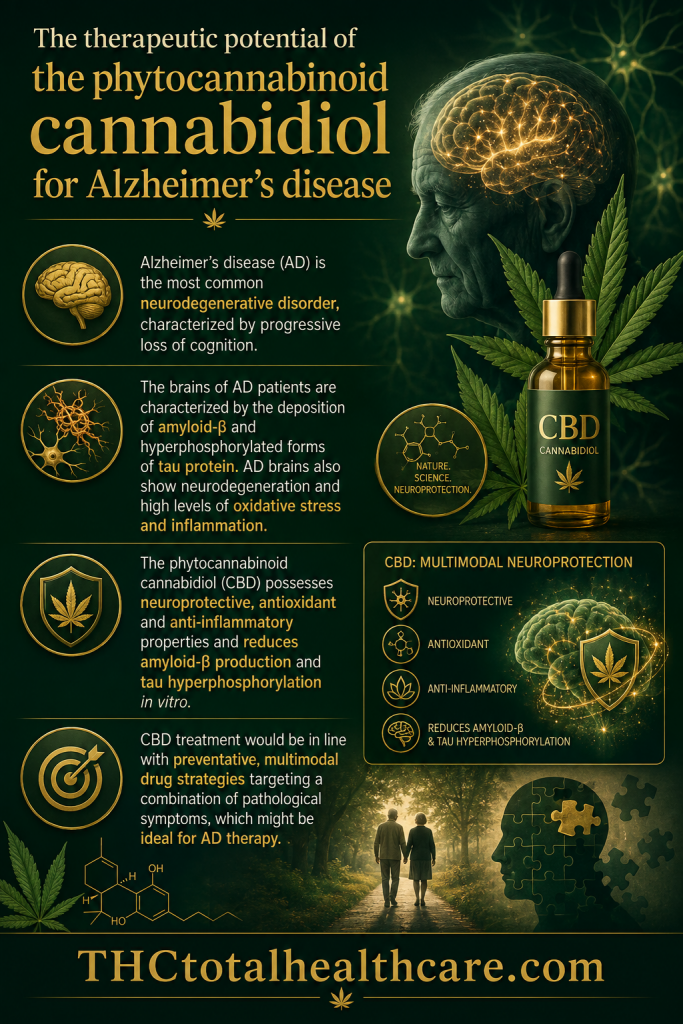
The therapeutic potential of the phytocannabinoid cannabidiol for Alzheimer’s disease.

“Alzheimer’s disease (AD) is the most common neurodegenerative disorder, characterized by progressive loss of cognition. Over 35 million individuals currently have AD worldwide. Unfortunately, current therapies are limited to very modest symptomatic relief.

The brains of AD patients are characterized by the deposition of amyloid-β and hyperphosphorylated forms of tau protein. AD brains also show neurodegeneration and high levels of oxidative stress and inflammation.

The phytocannabinoid cannabidiol (CBD) possesses neuroprotective, antioxidant and anti-inflammatory properties and reduces amyloid-β production and tau hyperphosphorylation in vitro.

CBD has also been shown to be effective in vivo making the phytocannabinoid an interesting candidate for novel therapeutic interventions in AD, especially as it lacks psychoactive or cognition-impairing properties.

CBD treatment would be in line with preventative, multimodal drug strategies targeting a combination of pathological symptoms, which might be ideal for AD therapy.

Thus, this review will present a brief introduction to AD biology and current treatment options before outlining comprehensively CBD biology and pharmacology, followed by in-vitro and in-vivo evidence for the therapeutic potential of CBD. We will also discuss the role of the endocannabinioid system in AD before commenting on the potential future of CBD for AD therapy (including safety aspects).”

http://www.ncbi.nlm.nih.gov/pubmed/27471947

The future of cannabinoids as analgesic agents: a pharmacologic, pharmacokinetic, and pharmacodynamic overview.


“For thousands of years, physicians and their patients employed cannabis as a therapeutic agent.

Despite this extensive historical usage, in the Western world, cannabis fell into disfavor among medical professionals because the technology available in the 1800s and early 1900s did not permit reliable, standardized preparations to be developed.

However, since the discovery and cloning of cannabinoid receptors (CB1 and CB2) in the 1990s, scientific interest in the area has burgeoned, and the complexities of this fascinating receptor system, and its endogenous ligands, have been actively explored.

Recent studies reveal that cannabinoids have a rich pharmacology and may interact with a number of other receptor systems-as well as with other cannabinoids-to produce potential synergies.

Cannabinoids-endocannabinoids, phytocannabinoids, and synthetic cannabinoids-affect numerous bodily functions and have indicated efficacy of varying degrees in a number of serious medical conditions.

Cannabinoid receptor agonists and/or molecules that affect the modulation of endocannabinoid synthesis, metabolism, and transport may, in the future, offer extremely valuable tools for the treatment of a number of currently intractable disorders.”

 http://www.ncbi.nlm.nih.gov/pubmed/17890938

Blood pressure regulation by endocannabinoids and their receptors

Logo of nihpa

“Cannabinoids and their endogenous and synthetic analogs exert powerful hypotensive and cardiodepressor effects by complex mechanisms involving direct and indirect effects on myocardium and vasculature.

On the one hand, endocannabinoids and cannabinoid receptors have been implicated in the hypotensive state associated with hemorrhagic, endotoxic and cardiogenic shock, and advanced liver cirrhosis.

On the other hand, there is emerging evidence suggesting that the endocannabinergic system plays an important role in the cardiovascular regulation in hypertension.

This review is aimed to discuss the in vivo hypotensive and cardiodepressant effects of cannabinoids mediated by cannabinoid and TRPV1 receptors, and focuses on the novel therapeutical strategies offered by targeting the endocannabinoid system in the treatment of hypertension.

The endocannabinergic system plays an important cardiovascular regulatory role not only in pathophysiological conditions associated with excessive hypotension but also in hypertension.

Thus, the pharmacological manipulation of this system may offer novel therapeutic approaches in a variety of cardiovascular disorders.”

http://www.ncbi.nlm.nih.gov/pmc/articles/PMC2225528/

A frequent polymorphism in the coding exon of the human cannabinoid receptor (CNR1) gene.

“The central cannabinoid receptor (CB1) mediates the pharmacological activities of cannabis, the endogenous agonist anandamide and several synthetic agonists.

The cloning of the human cannabinoid receptor (CNR1) gene facilitates molecular genetic studies in disorders like Gilles de la Tourette syndrome (GTS), obsessive compulsive disorder (OCD), Parkinsons disease, Alzheimers disease or other neuro psychiatric or neurological diseases, which may be predisposed or influenced by mutations or variants in the CNR1 gene.

We detected a frequent silent mutation (1359G–>A) in codon 453 (Thr) of the CNR1 gene that turned out to be a common polymorphism in the German population. Allele frequencies of this polymorphism are 0.76 and 0.24, respectively.

We developed a simple and rapid polymerase chain reaction (PCR)-based assay by artificial creation of a Msp I restriction site in amplified wild-type DNA (G-allele), which is destroyed by the silent mutation (A-allele).

The intragenic CNR1 polymorphism 1359(G/A) should be useful for association studies in neuro psychiatric disorders which may be related to anandamide metabolism disturbances.”

http://www.ncbi.nlm.nih.gov/pubmed/10441206

Endocannabinoid analogues exacerbate marble-burying behavior in mice via TRPV1 receptor.

“Activation of cannabinoid CB(1) receptor is shown to inhibit marble-burying behavior (MBB), a behavioral model for assessing obsessive-compulsive disorder (OCD).

Anandamide, an endogenous agonist at CB(1) receptor also activates the transient receptor potential vanilloid type 1 (TRPV1) channels but at a higher concentration.

Furthermore, anandamide-mediated TRPV1 effects are opposite to that of the CB(1) receptor. Therefore, the present study was carried out to investigate the influence of low and high doses of anandamide on MBB in CB(1) and TRPV1 antagonist pre-treated mice.

Thus, the study indicates the biphasic influence of anandamide on MBB, and chronic administration of capsazepine either alone or with URB597 might be an effective tool in the treatment of OCD.”

http://www.ncbi.nlm.nih.gov/pubmed/22248639

Facilitation of CB1 receptor-mediated neurotransmission decreases marble burying behavior in mice.

“Obsessive-compulsive disorder (OCD) is a common psychiatric disorder characterized by the occurrence of obsessions and compulsions.

Glutamatergic abnormalities have been related to the pathophysiology of OCD.

Cannabinoids inhibit glutamate release in the central nervous system, but the involvement of drugs targeting the endocannabinoid system has not yet been tested in animal models of repetitive behavior.

Thus, the aim of the present study was to verify the effects of the CB1 receptor agonist WIN55,212-2, the inhibitor of anandamide uptake AM404 and the anandamide hydrolysis inhibitor URB597, on compulsive-associate behavior in male C57BL/6J mice submitted to the marble burying test (MBT), an animal model used for anti-compulsive drug screening.

These results suggest a potential role for drugs acting on the cannabinoid system in modulating compulsive behavior.”

http://www.ncbi.nlm.nih.gov/pubmed/21111767

Cannabidiol inhibitory effect on marble-burying behaviour: involvement of CB1 receptors.

“Cannabidiol (CBD) is a major non-psychotomimetic component of Cannabis sativa that has been shown to have an anxiolytic effect in human and animal models.

Earlier studies suggest that these effects involve facilitation of serotonin, a neurotransmitter that has also been related to obsessive-compulsive disorder.

On the basis of this evidence, this study investigated the effects of CBD in C57BL/6J mice submitted to the marble-burying test (MBT), an animal model proposed to reflect compulsive behaviour.

CBD induced a significant decrease in the number of buried marbles compared with controls.

These results indicated that CBD and paroxetine decrease the number of buried marbles in the MBT through distinct pharmacological mechanisms.

They also suggest a potential role of drugs acting on the cannabinoid system in modulating compulsive behaviour.”

http://www.ncbi.nlm.nih.gov/pubmed/20695034