Tag Archives: neuroprotection
Neuroprotective Properties of Endocannabinoids N-Arachidonoyl Dopamine and N-Docosahexaenoyl Dopamine Examined in Neuronal Precursors Derived from Human Pluripotent Stem Cells.

“Neuroprotective properties of endocannabinoids N-arachidonoyl dopamine (NADA) and N-docosahexaenoyl dopamine (DHDA) were examined in neuronal precursor cells differentiated from human induced pluripotent stem cells and subjected to oxidative stress. Both compounds exerted neuroprotective activity, which was enhanced by elevating the concentration of the endocannabinoids within the 0.1-10 µM range. However, both agents at 10 µM concentration showed a marked toxic effect resulting in death of ~30% of the cells. Finally, antagonists of cannabinoid receptors as well as the receptor of the TRPV1 endovanilloid system did not hamper the neuroprotective effects of these endocannabinoids.”
Cannabinoid Receptor Type 1 Agonist ACEA Protects Neurons from Death and Attenuates Endoplasmic Reticulum Stress-Related Apoptotic Pathway Signaling.

“Neurodegeneration is the result of progressive destruction of neurons in the central nervous system, with unknown causes and pathological mechanisms not yet fully elucidated. Several factors contribute to neurodegenerative processes, including neuroinflammation, accumulation of neurotoxic factors, and misfolded proteins in the lumen of the endoplasmic reticulum (ER).
Endocannabinoid signaling has been pointed out as an important modulatory system in several neurodegeneration-related processes, inhibiting the inflammatory response and increasing neuronal survival. Thus, we investigated the presumptive protective effect of the selective cannabinoid type 1 (CB1) receptor agonist) against inflammatory (lipopolysaccharide, LPS) and ER stress (tunicamycin) stimuli in an in vitro neuronal model (Neuro-2a neuroblastoma cells). Cell viability analysis revealed that ACEA was able to protect against cell death induced by LPS and tunicamycin.
This neuroprotective effect occurs via the CB1 receptor in the inflammation process and via the transient receptor potential of vanilloid type-1 (TRPV1) channel in ER stress. Furthermore, the immunoblotting analyses indicated that the neuroprotective effect of ACEA seems to involve the modulation of eukaryotic initiation factor 2 (eIF2α), transcription factor C/EBP homologous protein (CHOP), and caspase 12, as well as the survival/death p44/42 MAPK, ERK1/2-related signaling pathways.
Together, these data suggest that the endocannabinoid system is a potential therapeutic target in neurodegenerative processes, especially in ER-related neurodegenerative diseases.”
https://www.ncbi.nlm.nih.gov/pubmed/29134561
https://link.springer.com/article/10.1007%2Fs12640-017-9839-1
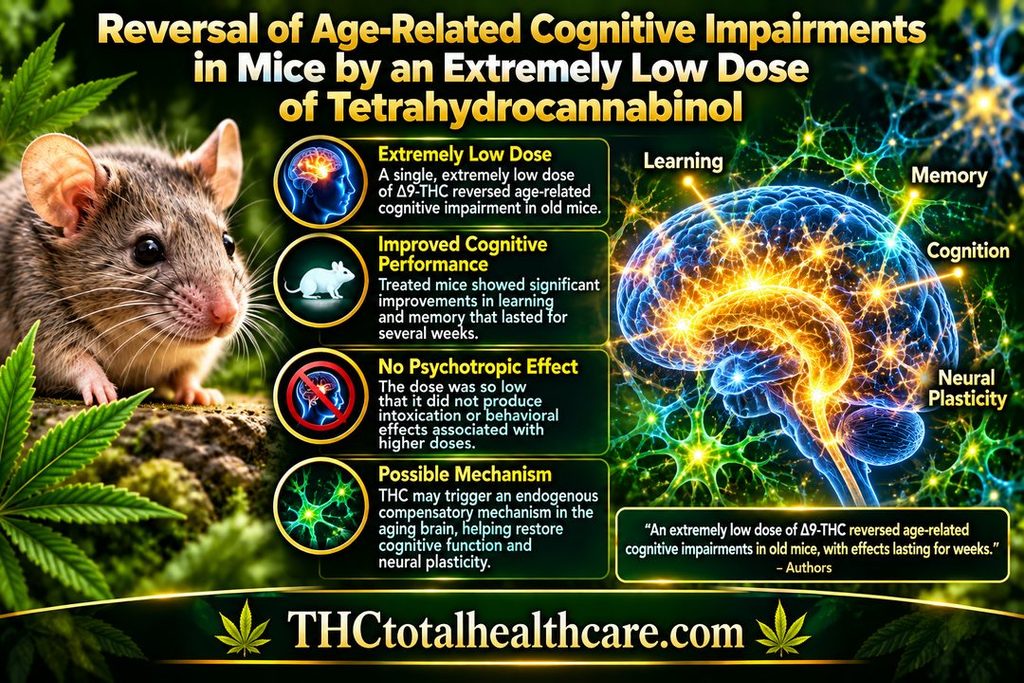
Reversal of age-related cognitive impairments in mice by an extremely low dose of tetrahydrocannabinol.

A single extremely low dose of Δ9-THC reversed age-related cognitive impairment in old mice, improving cognitive performance for several weeks after treatment. The dose was so low that it produced no psychotropic effect in the animals.
The researchers proposed that THC triggered an endogenous compensatory mechanism in the aging brain, helping restore cognitive function rather than simply producing a short-lived behavioral effect. The study also builds on evidence that the endocannabinoid system may be involved in the brain’s natural defenses against age-related decline.
The authors concluded that ultra-low-dose THC deserved investigation as a potential approach to cognitive decline in older adults, noting that the improvement in the mice lasted for weeks after a single treatment.
“This study was designed to test our hypothesis that an ultra-low dose of delta-9 tetrahydrocannabinol (THC) reverses age-dependent cognitive impairments in old mice and to examine the possible biological mechanisms that underlie this behavioral effect. These findings suggest that extremely low doses of THC that are devoid of any psychotropic effect and do not induce desensitization may provide a safe and effective treatment for cognitive decline in aging humans.” https://www.ncbi.nlm.nih.gov/pubmed/29107185
“Cognitive decline is an integral aspect of aging. The idea that age-related cognitive decline can be reversed and that the old brain can be revitalized is not new. It has been previously suggested that the endocannabinoid system is part of an antiaging homeostatic defense system. In previous studies, we have shown that ultra-low doses of tetrahydrocannabinol (THC, the main psychotropic ingredient in cannabis) protected young mice from cognitive impairments that were evoked by various insults. In the present study, we tested our hypothesis that a single ultra-low dose of THC can reverse age-dependent cognitive decline in mice. Here, we show that a single extremely low dose of THC devoid of any psychotropic activity can trigger an endogenous compensatory mechanism that improves cognitive functioning in old mice and that this effect lasts for at least several weeks. Since THC in high doses (dronabinol, 1–10 mg) is already approved for medical treatments in humans, and since its safety profile is well characterized, we believe that the initiation of clinical trials with ultra-low doses of THC designed to reverse cognitive decline in elderly patients should be straightforward.” http://www.sciencedirect.com/science/article/pii/S0197458017303214
“Reversal of age-related cognitive impairments in mice by an extremely low dose of tetrahydrocannabinol. These findings suggest that extremely low doses of THC that are devoid of any psychotropic effect and do not induce desensitization may provide a safe and effective treatment for cognitive decline in aging humans.” http://www.neurobiologyofaging.org/article/S0197-4580(17)30321-4/fulltext
Need this THC study explained? thcXplained.com
AM1241 alleviates MPTP-induced Parkinson’s disease and promotes the regeneration of DA neurons in PD mice.

“The main pathological feature of Parkinson’s disease (PD) is the loss of dopaminergic neurons in the substantia nigra. In this study, we investigated the role of cannabinoid receptor 2 (CB2R) agonist AM1241 on 1-methyl-4-phenyl-1,2,3,6-tetrahydropyridine (MPTP)-induced neurotoxicity in a mouse model of PD.
Upon treatment with AM1241, the decreased CB2R level in the PD mouse brain was reversed and the behavior score markedly elevated, accompanied with a dose-dependent increase of dopamine and serotonin. In addition, western blot assay and immunostaining results suggested that AM1241 significantly activated PI3K/Akt/MEK phosphorylation and increased the expression of Parkin and PINK1, both in the substantia nigra and hippocampus. The mRNA expression analysis further demonstrated that AM1241 increased expression of the CB2R and activated Parkin/PINK1 signaling pathways. Furthermore, the increased number of TH-positive cells in the substantia nigra indicated that AM1241 regenerated DA neurons in PD mice, and could therefore be a potential candidate for PD treatment. The clear co-localization of CB2R and DA neurons suggested that AM1241 targeted CB2R, thus also identifying a novel target for PD treatment.
In conclusion, the selective CB2 agonist AM1241 has a significant therapeutic effect on PD mice and resulted in regeneration of DA neurons following MPTP-induced neurotoxicity. The possible mechanisms underlying the neurogenesis effect of AM1241 might be the induction of CB2R expression and an increase in phosphorylation of the PI3K/AKT signaling pathway.”
Intra-cerebral cannabidiol infusion-induced neuroprotection is partly associated with the TNF-α/TNFR1/NF-кB pathway in transient focal cerebral ischaemia.
“Stroke is a neurological disease, which, in addition to high mortality, imposes many financial and mental burdens on families and the society. The main objective of this study was to investigate the effect of cannabidiol (CBD) on one of the major inflammatory pathways in cerebral ischaemia.
RESULTS:
Administration of CBD (100 and 200 ng/rat) caused a significant reduction in infarction, brain oedema, and BBB permeability compared with the vehicle-received group. Down-regulation of TNF-α, TNFR1, and NF-кB expression was also observed by CBD.CONCLUSION:
The results achieved in this study support the idea that CBD has a cerebroprotective effect (partly through suppression of TNF-α, TNFR1, and NF-кB) on ischaemic injury.” https://www.ncbi.nlm.nih.gov/pubmed/28872345 http://www.tandfonline.com/doi/abs/10.1080/02699052.2017.1358397?journalCode=ibij20]]>Interplay Between n-3 and n-6 Long-Chain Polyunsaturated Fatty Acids and the Endocannabinoid System in Brain Protection and Repair.
“The brain is enriched in arachidonic acid (ARA) and docosahexaenoic acid (DHA), long-chain polyunsaturated fatty acids (LCPUFAs) of the n-6 and n-3 series, respectively. Both are essential for optimal brain development and function. Dietary enrichment with DHA and other long-chain n-3 PUFA, such as eicosapentaenoic acid (EPA), has shown beneficial effects on learning and memory, neuroinflammatory processes, and synaptic plasticity and neurogenesis. ARA, DHA and EPA are precursors to a diverse repertoire of bioactive lipid mediators, including endocannabinoids.
The endocannabinoid system comprises cannabinoid receptors, their endogenous ligands, the endocannabinoids, and their biosynthetic and degradation enzymes. Anandamide (AEA) and 2-arachidonoylglycerol (2-AG) are the most widely studied endocannabinoids and are both derived from phospholipid-bound ARA. The endocannabinoid system also has well-established roles in neuroinflammation, synaptic plasticity and neurogenesis, suggesting an overlap in the neuroprotective effects observed with these different classes of lipids.
Indeed, growing evidence suggests a complex interplay between n-3 and n-6 LCPUFA and the endocannabinoid system. For example, long-term DHA and EPA supplementation reduces AEA and 2-AG levels, with reciprocal increases in levels of the analogous endocannabinoid-like DHA and EPA-derived molecules. This review summarises current evidence of this interplay and discusses the therapeutic potential for brain protection and repair.”
https://www.ncbi.nlm.nih.gov/pubmed/28875399
https://link.springer.com/article/10.1007%2Fs11745-017-4292-8
“The seed of Cannabis sativa L. has been an important source of nutrition for thousands of years in Old World cultures. Technically a nut, hempseed typically contains over 30% oil and about 25% protein, with considerable amounts of dietary fiber, vitamins and minerals. Hempseed oil is over 80% in polyunsaturated fatty acids (PUFAs), and is an exceptionally rich source of the two essential fatty acids (EFAs) linoleic acid (18:2 omega-6) and alpha-linolenic acid (18:3 omega-3). The omega-6 to omega-3 ratio (n6/n3) in hempseed oil is normally between 2:1 and 3:1, which is considered to be optimal for human health. Hempseed has been used to treat various disorders for thousands of years in traditional oriental medicine.” http://link.springer.com/article/10.1007%2Fs10681-004-4811-6