Dosage Related Efficacy and Tolerability of Cannabidiol in Children With Treatment-Resistant Epileptic Encephalopathy: Preliminary Results of the CARE-E Study.

 Image result for frontiers in neurology“There is uncertainty regarding the appropriate dose of Cannabidiol (CBD) for childhood epilepsy.

We present the preliminary data of seven participants from the Cannabidiol in Children with Refractory Epileptic Encephalopathy (CARE-E) study.

Methods: The study is an open-label, prospective, dose-escalation trial. Participants received escalating doses of a Cannabis Herbal Extract (CHE) preparation of 1:20 Δ9-tetrahydrocannabinol (THC): CBD up to 10-12 mg CBD/kg/day. Seizure frequency was monitored in daily logs, participants underwent regular electroencephalograms, and parents filled out modified Quality of Life in Childhood Epilepsy (QOLCE) and Side Effect rating scale questionnaires. Steady-state trough levels (Css, Min) of selected cannabinoids were quantified.

Results: All seven participants tolerated the CHE up to 10-12 mg CBD/kg/day and had improvements in seizure frequency and QOLCE scores. CSS, Min plasma levels for CBD, THC, and cannabichromene (CBC) showed dose-independent pharmacokinetics in all but one participant. CSS, Min CBD levels associated with a >50% reduction in seizures and seizure freedom were lower than those reported previously with purified CBD. In most patients, CSS, Min levels of THC remained lower than what would be expected to cause intoxication.

Conclusion: The preliminary data suggest an initial CBD target dose of 5-6 mg/kg/day when a 1:20 THC:CBD CHE is used. Possible non-linear pharmacokinetics of CBD and CBC needs investigation. The reduction in seizure frequency seen suggests improved seizure control when a whole plant CHE is used. Plasma THC levels suggest a low risk of THC intoxication when a 1:20 THC:CBD CHE is used in doses up to 12 mg/kg CBD/kg/day.”

https://www.ncbi.nlm.nih.gov/pubmed/31333569

https://www.frontiersin.org/articles/10.3389/fneur.2019.00716/full
Pharmacology of Medical Cannabis.

 “The Cannabis plant has been used for many of years as a medicinal agent in the relief of pain and seizures. It contains approximately 540 natural compounds including more than 100 that have been identified as phytocannabinoids due to their shared chemical structure. The predominant psychotropic component is Δ9-tetrahydrocannabinol (Δ9-THC), while the major non-psychoactive ingredient is cannabidiol (CBD). These compounds have been shown to be partial agonists or antagonists at the prototypical cannabinoid receptors, CB1 and CB2. The therapeutic actions of Δ9-THC and CBD include an ability to act as analgesics, anti-emetics, anti-inflammatory agents, anti-seizure compounds and as protective agents in neurodegeneration. However, there is a lack of well-controlled, double blind, randomized clinical trials to provide clarity on the efficacy of either Δ9-THC or CBD as therapeutics. Moreover, the safety concerns regarding the unwanted side effects of Δ9-THC as a psychoactive agent preclude its widespread use in the clinic. The legalization of cannabis for medicinal purposes and for recreational use in some regions will allow for much needed research on the pharmacokinetics and pharmocology of medical cannabis. This brief review focuses on the use of cannabis as a medicinal agent in the treatment of pain, epilepsy and neurodegenerative diseases. Despite the paucity of information, attention is paid to the mechanisms by which medical cannabis may act to relieve pain and seizures.”

https://www.ncbi.nlm.nih.gov/pubmed/31332738

https://link.springer.com/chapter/10.1007%2F978-3-030-21737-2_8

Acute and short-term administrations of delta-9-tetrahydrocannabinol modulate major gut metabolomic regulatory pathways in C57BL/6 mice.

Scientific Reports “Delta-9-tetrahydrocannabinol (THC) is the primary psychoactive compound in Cannabis, which is studied extensively for its medicinal value. A central gap in the science is the underlying mechanisms surrounding THC’s therapeutic effects and the role of gut metabolite profiles. Using a mass-spectrometry based metabolomics, we show here that intraperitoneal injection of THC in C57BL/6 mice modulates metabolic profiles that have previously been identified as integral to health. Specifically, we investigated the effects of acute (single THC injection denoted here as ‘1X’) and short -term (five THC injections on alternate days denoted as ‘5X’) THC administration on fecal and intestinal tissue metabolite profiles. Results are consistent with the hypothesis that THC administration alters host metabolism by targeting two prominent lipid metabolism pathways: glycerophospholipid metabolism and fatty acid biosynthesis.”
https://www.ncbi.nlm.nih.gov/pubmed/31324830

https://www.nature.com/articles/s41598-019-46478-0

Probing the antioxidant activity of Δ9-tetrahydrocannabinol and cannabidiol in Cannabis sativa extracts.

“Herein, we report the antioxidant activity of cannabidiol (CBD) and Δ9-tetrahydrocannabinol (THC) in pure and mixed solutions at different ratios, as well as of six different Cannabis sativa extracts containing various proportions of CBD and THC by using spectrophotometric (reducing power assay, 2,2′-azino-bis(3-ethylbenzothiazoline-6-sulphonic acid) (ABTS), 2,2-diphenyl-1-picrylhydrazyl (DPPH), hypochlorous acid (HOCl) scavenging assays) and electrochemical methods (cyclic voltammetry and differential pulse voltammetry).
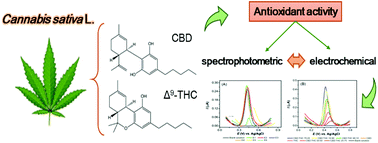
The isolated cannabinoids, the different stoichiometric ratios of CBD and THC, and the natural extracts proved to have remarkable antioxidant properties in all the methods employed in this work.

The antioxidant activity of CBD and THC was compared against that of the well-defined antioxidants such as ascorbic acid (AA), resveratrol (Resv) and (-)-epigallocatechin-3-gallate (EGCG). Clear evidence of the synergistic and antagonistic effects between CBD and THC regarding to their antioxidant activities was observed.

Moreover, a good correlation was obtained between the optical and electrochemical methods, which proved that the reported experimental procedures can easily be adapted to determine the antioxidant activity of extracts from various Cannabis sativa species and related compounds.”

https://www.ncbi.nlm.nih.gov/pubmed/31318364

https://pubs.rsc.org/en/content/articlelanding/2019/AN/C9AN00890J#!divAbstract

Graphical abstract: Probing the antioxidant activity of Δ9-tetrahydrocannabinol and cannabidiol in Cannabis sativa extracts

Nabiximols for the Treatment of Cannabis Dependence: A Randomized Clinical Trial.

Image result for jama network

“This study demonstrates that cannabinoid agonist treatment, in this case using nabiximols, in combination with psychosocial interventions is a safe approach for reducing cannabis use among individuals with cannabis dependence who are seeking treatment.”   https://www.ncbi.nlm.nih.gov/pubmed/31305874
https://jamanetwork.com/journals/jamainternalmedicine/fullarticle/2737918
“nabiximols: An herbal preparation containing a defined quantity of specific cannabinoids formulated for oromucosal spray administration with potential analgesic activity. Nabiximols contains a standardized extract of tetrahydrocannabinol (THC), the non-psychoactive cannabinoid cannabidiol (CBD), other minor cannabinoids, flavonoids, and terpenes from two cannabis plant varieties.” https://www.cancer.gov/publications/dictionaries/cancer-drug/def/nabiximols
“Cannabis treatment counters addiction: First study of its kind. Trial shows cannabis replacement therapy can be effective” https://www.sciencedaily.com/releases/2019/07/190715114247.htm

Model-based analysis on systemic availability of coadministered cannabinoids after controlled vaporised administration.

Publication cover image

“The most important two medicinal cannabinoids are Δ9 -tetrahydrocannabinol (THC) and cannabidiol (CBD).

The results observed in this study are useful for guiding future pharmacokinetic studies of medicinal cannabinoids, and for development of dosing guidelines for medical use of cannabis in the ‘real world’ setting.”

https://www.ncbi.nlm.nih.gov/pubmed/31264294

https://onlinelibrary.wiley.com/doi/abs/10.1111/imj.14415

Distinct Functions of Endogenous Cannabinoid System in Alcohol Abuse Disorders.

British Journal of Pharmacology banner

“Δ9-tetrahydrocannabinol (Δ9 -THC), the principal active component in Cannabis sativa extracts such as marijuana, participates in cell signaling by binding to cell surface receptors. CB1 receptors (CB1 s) are present in both inhibitory and excitatory presynaptic terminals. CB2 receptors (CB2 s) found in neuronal subpopulations in addition to microglial cells and astrocytes and are present in both pre- and postsynaptic terminals.

Subsequent to endocannabinoid (eCB) system discoveries, studies have suggested that alcohol alters the eCB system and that the eCB system plays a major role in the motivation to abuse alcohol.

Preclinical studies have provided evidence that chronic alcohol consumption modulates eCBs and CB1 expression in brain addiction circuits. In addition, studies have further established the distinct function of the eCB system in the development of fetal alcohol spectrum disorders. This review provides a recent and comprehensive assessment of the literature related to the function of the eCB system in alcohol abuse disorders.”

https://www.ncbi.nlm.nih.gov/pubmed/31265740

https://bpspubs.onlinelibrary.wiley.com/doi/abs/10.1111/bph.14780

“Cannabis and Alcohol: From Basic Science to Public Policy.”  https://www.ncbi.nlm.nih.gov/pubmed/31265135

“Cannabis Found Effective in Fighting Drug-Resistant Bacteria”

1957: “[Hemp (Cannabis sativa); antibiotic drug. I. Hemp in the old & popular medicine].” https://www.ncbi.nlm.nih.gov/pubmed/13484424
1958: “[Hemp (Cannabis sativa)–antibiotic drugs. II. Method & results of bacteriological experiments & preliminary clinical experience].” https://www.ncbi.nlm.nih.gov/pubmed/13553773
1959: “[Hemp (Cannabis sativa)-an antibiotic drug. 3. Isolation and constitution of two acids from Cannabis sativa].” https://www.ncbi.nlm.nih.gov/pubmed/14411912
1962: “Antibiotic activity of various types of cannabis resin.” https://www.ncbi.nlm.nih.gov/pubmed/14489783
2008: “Antibacterial cannabinoids from Cannabis sativa: a structure-activity study.” https://www.ncbi.nlm.nih.gov/pubmed/18681481
“Cannabis plant extracts can effectively fight drug-resistant bacteria.” http://abcnews.go.com/Technology/story?id=5787866
“According to research, the five most common cannabinoid compounds in weed—tetrahydrocannabinol (THC), cannabidiol, cannabigerol, cannabinol and cannabichromene—can kill antibiotic-resistant bacteria.” https://blogs.scientificamerican.com/news-blog/whoa-the-stuff-in-pot-kills-germs-2008-08-27/
“All five cannabinoids (THC, CBD, CBG, CBC, and CBN) were potent against bacteria. Notably, they performed well against bacteria that were known to be multidrug resistant, like the strains of MRSA” http://arstechnica.com/science/2008/08/killing-bacteria-with-cannabis/
2014: “Better than antibiotics, cannabinoids kill antibiotic-resistant MRSA bacteria” http://usahealthresource.blogspot.com/2014/02/marijuana-extracts-and-compounds-kill.html
2019: “Cannabis Found Effective in Fighting Drug-Resistant Bacteria” https://www.courthousenews.com/cannabis-found-effective-in-fighting-drug-resistant-bacteria/
“Cannabis oil kills bacteria better than established antibiotics… providing a possible new weapon in the war on superbugs, according to new research. It offers hope of curing killer infections – including MRSA and pneumonia, say scientists.” https://www.thelondoneconomic.com/lifestyle/cannabis-oil-kills-bacteria-better-than-established-antibiotics/24/06/ 
“CANNABIS COMPOUND COULD BE LATEST WEAPON IN WAR AGAINST SUPERBUGS”
“Marijuana skin cream kills superbugs, says Botanix” https://stockhead.com.au/health/marijuana-skin-cream-kills-superbugs-says-botanix/
“Botanix’s CBD-based product destroys superbug skin infections in another ‘world first’” https://smallcaps.com.au/botanix-cbd-based-product-destroys-skin-superbug-infections/
“Compound in cannabis found to be ‘promising’ new antibiotic that does not lose its effectiveness with use” https://www.kelownanow.com/watercooler/news/news/Cannabis/Compound_in_cannabis_found_to_be_promising_new_antibiotic_that_does_not_lose_its_effectiveness_with_use/
Image may contain: plant and text

Therapeutic impact of orally administered cannabinoid oil extracts in an experimental autoimmune encephalomyelitis animal model of multiple sclerosis.

Biochemical and Biophysical Research Communications“There is a growing surge of investigative research involving the beneficial use of cannabinoids as novel interventional alternatives for multiple sclerosis (MS) and associated neuropathic pain (NPP).

Using an experimental autoimmune encephalomyelitis (EAE) animal model of MS, we demonstrate the therapeutic effectiveness of two cannabinoid oil extract formulations (10:10 & 1:20 – tetrahydrocannabinol/cannabidiol) treatment.

Our research findings confirm that cannabinoid treatment produces significant improvements in neurological disability scoring and behavioral assessments of NPP that directly result from their ability to reduce tumor necrosis factor alpha (TNF-α) production and enhance brain derived neurotrophic factor (BDNF) production.

Henceforth, this research represents a critical step in advancing the literature by scientifically validating the merit for medical cannabinoid use and sets the foundation for future clinical trials.”

https://www.ncbi.nlm.nih.gov/pubmed/31213295

“Cannabinoid treatment produces improvements in neurological disability scoring. Cannabinoid treatment also improves behavioral assessments of neuropathic pain.”

https://www.sciencedirect.com/science/article/pii/S0006291X19311568?via%3Dihub

Safety and effectiveness of cannabinoids for the treatment of neuropsychiatric symptoms in dementia: a systematic review.

SAGE Journals“Neuropsychiatric symptoms (NPS) in dementia impact profoundly on the quality of life of people living with dementia and their care givers. Evidence for the effectiveness and safety of current therapeutic options is varied.

Cannabinoids have been proposed as an alternative therapy, mainly due to their activity on CB1 receptors in the central nervous system. However, little is known regarding the safety and effectiveness of cannabinoid therapy in people with dementia.

A literature review was undertaken to identify, describe and critically appraise studies investigating cannabinoid use in treating NPS in dementia.

RESULTS:

Twelve studies met the inclusion criteria. There was considerable variability across the studies with respect to study design (50% randomized controlled trials), intervention [dronabinol (33%), nabilone (25%) or delta-9 tetrahydrocannabinol (THC; 42%)] and outcome measures.

Dronabinol (three studies) and THC (one study) were associated with significant improvements in a range of neuropsychiatric scores.

The most common adverse drug event (ADE) reported was sedation. A high risk of bias was found in eight studies. The highest-quality trial found no significant improvement in symptoms or difference in ADE rate between treatment arms. Included studies used low doses of oral cannabinoids and this may have contributed to the lack of demonstrated efficacy.

CONCLUSION:

While the efficacy of cannabinoids was not proven in a robust randomized control trial, observational studies showed promising results, especially for patients whose symptoms were refractory. In addition, the safety profile is favourable as most of the ADEs reported were mild. Future trials may want to consider dose escalation and formulations with improved bioavailability.”

https://www.ncbi.nlm.nih.gov/pubmed/31205674

https://journals.sagepub.com/doi/10.1177/2042098619846993