
Cannabinoids for gastrointestinal diseases: potential therapeutic applications.

“Delta(9)-Tetrahydrocannabinol (the active ingredient of marijuana), as well as endogenous and synthetic cannabinoids, exert many biological functions by activating two types of cannabinoid receptors, CB(1) and CB(2) receptors. CB(1) receptors have been detected on enteric nerves, and pharmacological effects of their activation include gastroprotection, reduction of gastric and intestinal motility and reduction of intestinal secretion.

 The digestive tract also contains endogenous cannabinoids (i.e., the endocannabinoids anandamide and 2-aracidonylglycerol) and mechanisms for endocannabinoid inactivation (i.e., endocannabinoids uptake and enzymatic degradation). Cannabinoid receptors, endocannabinoids and the proteins involved in endocannabinoids inactivation are collectively referred as the ‘endogenous cannabinoid system’.

 A pharmacological modulation of the endogenous cannabinoid system could provide new therapeutics for the treatment of a number of gastrointestinal diseases, including nausea and vomiting, gastric ulcers, irritable bowel syndrome, Crohn’s disease, secretory diarrhoea, paralytic ileus and gastroesophageal reflux disease. Some cannabinoids are already in use clinically, for example, nabilone and delta(9)-tetrahydrocannabinol are used as antiemetics.”

http://www.ncbi.nlm.nih.gov/pubmed/12517253

Endocannabinoids and the gastrointestinal tract.

“In the past centuries, different preparations of marijuana have been used for the treatment of gastrointestinal (GI) disorders, such as GI pain, gastroenteritis and diarrhea.

 Delta9-tetrahydrocannabinol (THC; the active component of marijuana), as well as endogenous and synthetic cannabinoids, exert their biological functions on the gastrointestinal tract by activating two types of cannabinoid receptors, cannabinoid type 1 receptor (CB1 receptor) and cannabinoid type 2 receptor (CB2 receptor). While CB1 receptors are located in the enteric nervous system and in sensory terminals of vagal and spinal neurons and regulate neurotransmitter release, CB2 receptors are mostly distributed in the immune system, with a role presently still difficult to establish.

Under pathophysiological conditions, the endocannabinoid system conveys protection to the GI tract, eg from inflammation and abnormally high gastric and enteric secretion.

 For such protective activities, the endocannabinoid system may represent a new promising therapeutic target against different GI disorders, including frankly inflammatory bowel diseases (eg, Crohn’s disease), functional bowel diseases (eg, irritable bowel syndrome), and secretion- and motility-related disorders.”

http://www.ncbi.nlm.nih.gov/pubmed/16751708

The endocannabinoid system in the physiology and pathophysiology of the gastrointestinal tract.

“Numerous investigations have recently demonstrated the important roles of the endocannabinoid system in the gastrointestinal (GI) tract under physiological and pathophysiological conditions.

 In the GI tract, cannabinoid type 1 (CB1) receptors are present in neurons of the enteric nervous system and in sensory terminals of vagal and spinal neurons, while cannabinoid type 2 receptors are located in immune cells. Activation of CB1 receptors was shown to modulate several functions in the GI tract, including gastric secretion, gastric emptying and intestinal motility.

Under pathophysiological conditions induced experimentally in rodents, the endocannabinoid system conveys protection to the GI tract (e.g. from inflammation and abnormally high gastric and enteric secretions).

Such protective activities are largely in agreement with anecdotal reports from folk medicine on the use of Cannabis sativa extracts by subjects suffering from various GI disorders.

 Thus, the endocannabinoid system may serve as a potentially promising therapeutic target against different GI disorders, including frankly inflammatory bowel diseases (e.g. Crohn’s disease), functional bowel diseases (e.g. irritable bowel syndrome) and secretion- and motility-related disorders.

As stimulation of this modulatory system by CB1 receptor agonists can lead to unwanted psychotropic side effects, an alternative and promising avenue for therapeutic applications resides in the treatment with CB1 receptor agonists that are unable to cross the blood-brain barrier, or with compounds that inhibit the degradation of endogenous ligands (endocannabinoids) of CB1 receptors, hence prolonging the activity of the endocannabinoid system.”

http://www.ncbi.nlm.nih.gov/pubmed/16133420

Medical cannabis: the opportunity versus the temptation.

“The cannabis plant has been known to humanity for centuries as a remedy for pain, diarrhea, and inflammation. Current research has shown cannabis to be a useful remedy for many diseases, including multiple sclerosis, dystonia, and chronic pain.

 Cannabinoids are used to improve food intake in anorexia of AIDS patients and to prevent vomiting due to cancer chemotherapy. In inflammatory conditions cannabinoids improve pain in rheumatoid arthritis and pain and diarrhea in Crohn’s disease. Cannabinoids reduce the size of brain infarct and cardiac reperfusion injury. However, cannabinoid treatment is not free of side effects including euphoria, psychosis, anxiety, paranoia, dependence and abuse.

Since the cannabinoid system is involved in many physiological and pathological processes, the therapeutic potential is great. We must not be blind to the opportunity offered to us by medical cannabis just because it is an illicit drug, nor should we be temped by the quick response of patients to the central effect of cannabis. More research is warranted to explore the full potential of cannabis as medicine.”

http://www.ncbi.nlm.nih.gov/pubmed/22352284

Involvement of PPARγ in the antitumoral action of cannabinoids on hepatocellular carcinoma.

Logo of cddis “Cannabinoids exert antiproliferative effects in a wide range of tumoral cells, including hepatocellular carcinoma (HCC) cells. In this study, we examined whether the PPARγ-activated pathway contributed to the antitumor effect of two cannabinoids, Δ9-tetrahydrocannabinol (THC) and JWH-015, against HepG2 and HUH-7 HCC cells. Taken together, we demonstrate for the first time that the antiproliferative action of the cannabinoids THC and JWH-015 on HCC, in vitro and in vivo, are modulated by upregulation of PPARγ-dependent pathways.”  http://www.ncbi.nlm.nih.gov/pubmed/23640460
“The antitumor activity of cannabinoids against HCC cells has been related to the ability of these drugs to induce apoptosis and autophagy. In particular, it has been previously described that cannabinoids arrest cell proliferation, reduce cell migration and inhibit angiogenesis, and therefore, cannabinoid-like compounds offer a therapeutic potential for the treatment of many types of cancer.”  https://www.ncbi.nlm.nih.gov/pmc/articles/PMC3674350/

“We here illustrate that the cannabinoids THC and JWH-015 exert antitumor effect against the human HCC cell lines HepG2 and HUH-7 in vitro and in vivo through PPARγ.”  https://www.nature.com/articles/cddis2013141

Evaluation of anti-invasion effect of cannabinoids on human hepatocarcinoma cells.

“Cancer is a disease characterized by abnormal growth of cells. One of the most common types of liver cancers is called hepatocellular carcinoma (HCC) which is highly metastatic. As most of cannabinoids have shown anticancer effect against different cell lines in a number of reports, a biological investigation of two cannabinoids, CB65 (CB2 receptor agonist) and ACEA (CB1 receptor agonist) was carried out in this study.

In an attempt to find natural products as a new solution of cancer, this study was designed to investigate the potential antitumoral and anti-invasive activity of cannabinoids…

The results revealed that both cannabinoids reduce cell viability, cell invasion as well as MMP-2 and MMP-9 expression in higher dose of 20 nM. Furthermore, higher concentrations of examined cannabinoids were more effective.

These data suggest ACEA and CB65 as an option for novel treatment of hepatocellular cancer.

Our findings may contribute to design of new therapeutic strategies for the management of HCC.”

http://www.ncbi.nlm.nih.gov/pubmed/22978792

Anti-proliferative effects of anandamide in human hepatocellular carcinoma cells.

“In our previous study, we reported that the cannabinoid receptors CB1 and CB2 are overexpressed in human hepatocellular carcinoma (HCC) tissues. Recently, the antitumor potential of the endogenous cannabinoid anandamide (AEA) has also been addressed. The present study was conducted to investigate the anti-proliferative effects of AEA in HCC cells…

The results of this study demonstrated that AEA inhibited the proliferation of Huh7 cells, resulted in G1 cell cycle arrest and induced apoptosis…

This study defines the anti-proliferative effects of anandamide in HCC cells and suggests that AEA has therapeutic potential in the management of HCC patients.”

http://www.ncbi.nlm.nih.gov/pubmed/22970038

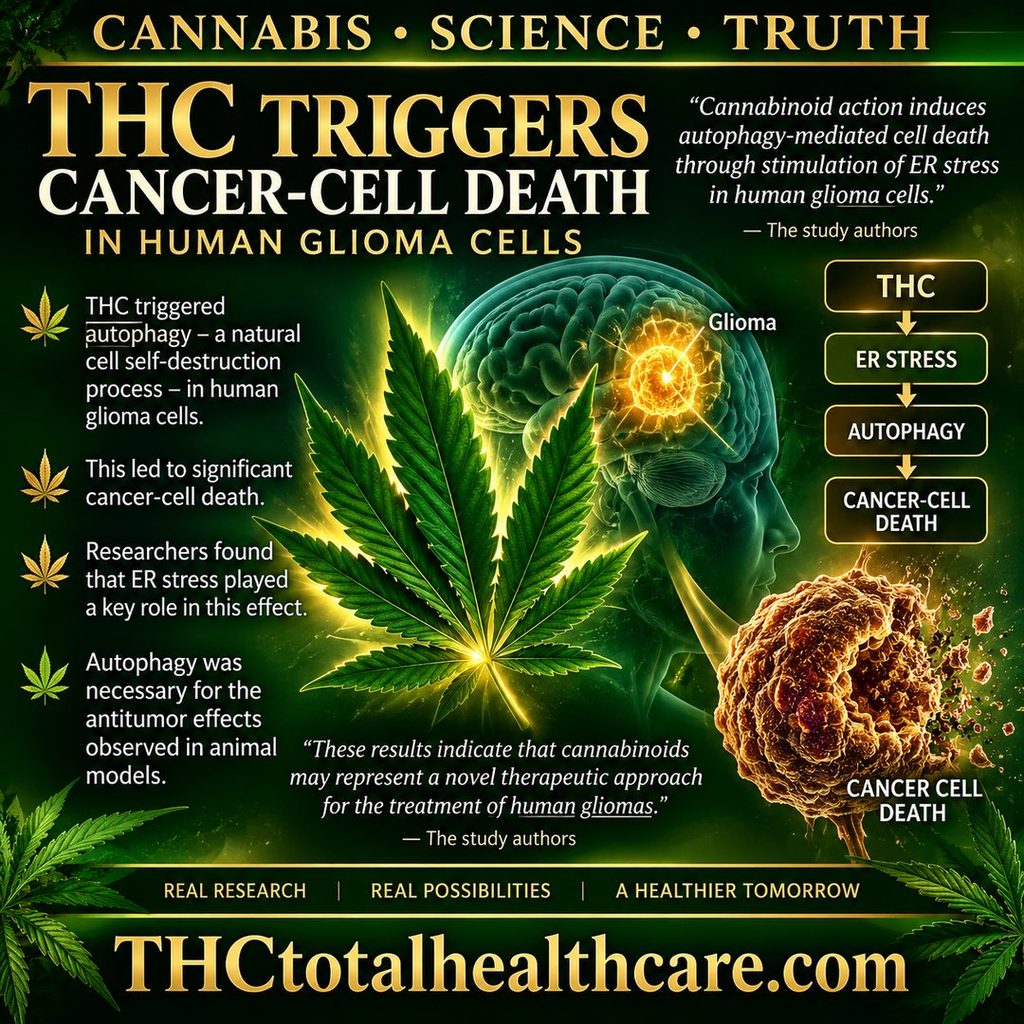
Cannabinoid action induces autophagy-mediated cell death through stimulation of ER stress in human glioma cells

THC triggered a self-destruction process called autophagy in human glioma cells, leading to cancer-cell death. Researchers also found that this pathway was necessary for the antitumor effects of cannabinoids observed in animal models.

“Autophagy can promote cell survival or cell death, but the molecular basis underlying its dual role in cancer remains obscure. Here we demonstrate that Δ9-tetrahydrocannabinol (THC), the main active component of marijuana, induces human glioma cell death through stimulation of autophagy…We also showed that autophagy is upstream of apoptosis in cannabinoid-induced human and mouse cancer cell death and that activation of this pathway was necessary for the antitumor action of cannabinoids in vivo.”

An external file that holds a picture, illustration, etc.<br />
Object name is JCI37948.f8.jpg

“These findings describe a mechanism by which THC can promote the autophagic death of human and mouse cancer cells and provide evidence that cannabinoid administration may be an effective therapeutic strategy for targeting human cancers.

Δ9-Tetrahydrocannabinol (THC), the main active component of marijuana, exerts a wide variety of biological effects by mimicking endogenous substances — the endocannabinoids — that bind to and activate specific cannabinoid receptors. One of the most exciting areas of research in the cannabinoid field is the study of the potential application of cannabinoids as antitumoral agents.

Cannabinoid administration has been found to curb the growth of several types of tumor xenografts in rats and mice…

 Considering that no signs of toxicity were observed in the clinical trial patients or in tumor-bearing animals treated intracranially, peritumorally, or intraperitoneally with THC, and that no overt toxic effects have been reported in other clinical trials of cannabinoid use in cancer patients for various applications (e.g., inhibition of nausea, vomiting, and pain) and using different routes of administration (e.g., oral, oro-mucosal) our findings support that safe, therapeutically efficacious doses of THC may be reached in cancer patients.”

 http://www.ncbi.nlm.nih.gov/pmc/articles/PMC2673842/

Need this THC study explained? thcXplained.com

A tale of two cannabinoids: the therapeutic rationale for combining tetrahydrocannabinol and cannabidiol.

“This study examines the current knowledge of physiological and clinical effects of tetrahydrocannabinol (THC) and cannabidiol (CBD) and presents a rationale for their combination in pharmaceutical preparations. Cannabinoid and vanilloid receptor effects as well as non-receptor mechanisms are explored, such as the capability of THC and CBD to act as anti-inflammatory substances independent of cyclo-oxygenase (COX) inhibition.

CBD is demonstrated to antagonise some undesirable effects of THC including intoxication, sedation and tachycardia, while contributing analgesic, anti-emetic, and anti-carcinogenic properties in its own right.

In modern clinical trials, this has permitted the administration of higher doses of THC, providing evidence for clinical efficacy and safety for cannabis based extracts in treatment of spasticity, central pain and lower urinary tract symptoms in multiple sclerosis, as well as sleep disturbances, peripheral neuropathic pain, brachial plexus avulsion symptoms, rheumatoid arthritis and intractable cancer pain. Prospects for future application of whole cannabis extracts in neuroprotection, drug dependency, and neoplastic disorders are further examined.

The hypothesis that the combination of THC and CBD increases clinical efficacy while reducing adverse events is supported.”

http://www.ncbi.nlm.nih.gov/pubmed/16209908

Cannabinoid Inhibition of Macrophage Migration to the Trans-Activating (Tat) Protein of HIV-1 Is Linked to the CB2 Cannabinoid Receptor

“Macrophage-like cells are primary targets for infection by HIV-1…  In the present study, the exogenous cannabinoids δ-9-tetrahydrocannabinol (THC) and (−)-cis-3-[2-hydroxy-4-(1,1-dimethylheptyl)phenyl]-trans-4-(3-hydroxypropyl) cyclohexanol (CP55940) were shown to significantly inhibit migration of human U937 macrophage-like cells to the Tat protein in a concentration-related manner….

Collectively, the pharmacological and biochemical knockdown data indicate that cannabinoid-mediated modulation of macrophage migration to the HIV-1 Tat protein is linked to the CB2 cannabinoid receptor. Furthermore, these results suggest that the CB2 cannabinoid receptor has potential to serve as a therapeutic target for ablation of HIV-1-associated untoward inflammatory response…

,,, the CB2 receptor has the potential to serve as a molecular target for ablating hyperinflammatory responses of macrophage-like cells while avoiding untoward psychotropic effects caused by activation of the CB1 receptor.

 In conclusion, the immunosuppressive and anti-inflammatory properties of select cannabinoids may have profound therapeutic potential in moderating HIV-associated immunopathology, including microglial activation, chemokine/cytokine dysregulation, and monocyte infiltration in the CNS.”

Full text: http://www.ncbi.nlm.nih.gov/pmc/articles/PMC2846023/