Cannabinoids as therapeutic for PTSD

“Limited efficacy for current pharmacotherapy for PTSD indicates that improved pharmacological treatments are needed. Neurobiological research points to cannabinoids as possible therapeutic agents of interest. Moreover, observational reports indicate that there is growing popular interest in therapeutic use of cannabinoids for the alleviation of trauma symptoms. The aim of this review was to present an up-to-date look at current research on the possible therapeutic value of cannabinoids for PTSD. Experimental, preclinical, and clinical findings are discussed.

Highlights

•

Neurobiological research indicates cannabis as possible pharmacological intervention for PTSD.

•

CBD and THC + CBD modulate fear memory in rodents.

•

Experimental data suggest CBD has acute anti-depressive and anxiolytic effects.

•

Data suggest THC reduces nightmares and OSA, while THC + CBD could reduce insomnia.

•

Randomized placebo-controlled human trials of cannabinoids for PTSD are underway.”

http://www.sciencedirect.com/science/article/pii/S2352250X16302342 https://www.researchgate.net/publication/311949481_Cannabinoids_as_therapeutic_for_PTSD
]]>

Cannabinoids prevent the differential long-term effects of exposure to severe stress on hippocampal- and amygdala-dependent memory and plasticity.

“Exposure to excessive or uncontrolled stress is a major factor associated with various diseases including post-traumatic stress disorder (PTSD). The consequences of exposure to trauma are affected not only by aspects of the event itself, but also by the frequency and severity of trauma reminders. It was suggested that in PTSD, hippocampal-dependent memory is compromised while amygdala-dependent memory is strengthened. Several lines of evidence support the role of the endocannabinoid (eCB) system as a modulator of the stress response. In this study we aimed to examine cannabinoids modulation of the long-term effects (i.e., 1 month) of exposure to a traumatic event on memory and plasticity in the hippocampus and amygdala. Cannabinoids prevent the differential long-term effects of exposure to severe stress on hippocampal- and amygdala-dependent memory and plasticity. Taken together, these findings suggest the involvement of the endocannabinoid system, and specifically CB1 receptors, in the opposite effects of severe stress on memory and plasticity in the hippocampus and amygdala.”  https://www.ncbi.nlm.nih.gov/pubmed/28667676 http://onlinelibrary.wiley.com/resolve/doi?DOI=10.1002/hipo.22755]]>

Cannabis as a Substitute for Opioid-Based Pain Medication: Patient Self-Report

“Prescription drug overdoses are the leading cause of accidental death in the United States. Alternatives to opioids for the treatment of pain are necessary to address this issue. Cannabis can be an effective treatment for pain, greatly reduces the chance of dependence, and eliminates the risk of fatal overdose compared to opioid-based medications. Medical cannabis patients report that cannabis is just as effective, if not more, than opioid-based medications for pain. The results of this study provide implications from both a micro and macro level. First, from the macro level, there have been three previously published indicators of public health changes in states that permit medical cannabis: decreases in opioid related mortality, decreases in spending on opioids, and a decrease in traffic fatalities. While none of these studies shows a cause and effect relationship, they do suggest public health related population based changes in localities where cannabis can be accessed to treat pain. Given that the participants in this study reported a greater likelihood of using cannabis as a substitute in a less stigmatized and easily accessible environment, it makes sense why we would see these changes in locations where medical cannabis is sanctioned versus places where it is illegal.

At the micro level, there is a great deal of individual risk associated with prolonged use of opioids and perhaps even nonopioid-based pain medications. The prescribing of opioids has not been curbed in the United States, despite the growing number of fatal overdoses and reported dependence. Providing the patient with the option of cannabis as a method of pain treatment alongside the option of opioids might assist with pain relief in a safer environment with less risk. A society with less opioid dependent people will result in fewer public health harms.”

http://online.liebertpub.com/doi/10.1089/can.2017.0012]]>

Acute Effects of Smoked Marijuana and Oral Δ9-Tetrahydrocannabinol on Specific Airway Conductance in Asthmatic Subjects

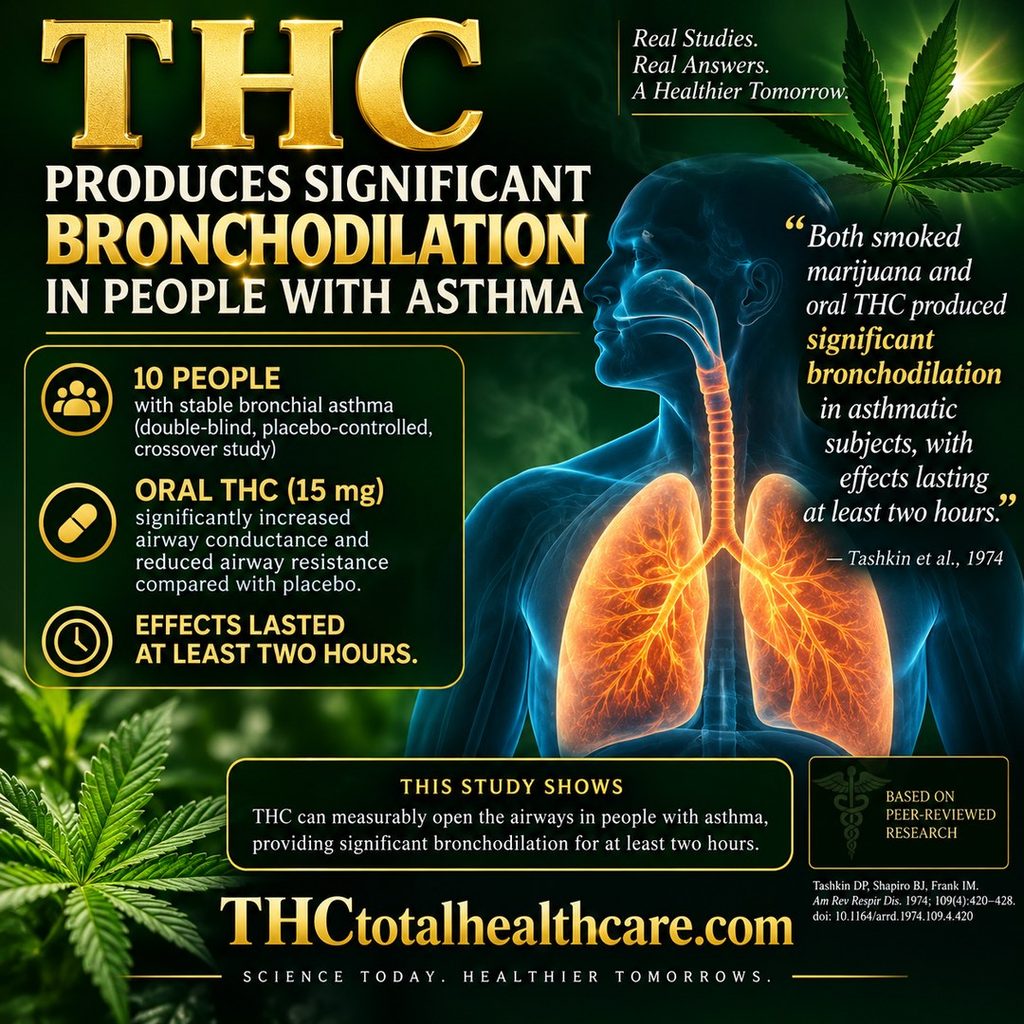
A human study found that Δ9-tetrahydrocannabinol (THC) produced significant bronchodilation in people with stable bronchial asthma. In the double-blind crossover trial, researchers compared smoked marijuana and oral THC with placebo and measured changes in airway function. Oral THC significantly increased specific airway conductance and reduced airway resistance, showing that THC was able to measurably open the airways. The bronchodilator effect lasted for at least two hours, providing early clinical evidence that THC can directly affect respiratory function in people with asthma.

“The acute effects of smoked 2 per cent natural marijuana (7 mg per kg) and 15 mg of oral Δ9-tetrahydrocannabinol (THC) on plethysmographically determined airway resistance (Raw) and specific airway conductance (SGaw) were compared with those of placebo in 10 subjects with stable bronchial asthma using a double-blind crossover technique.

After smoked marijuana, SGaw increased immediately and remained significantly elevated (33 to 48 per cent above initial control values) for at least 2 hours, whereas SGaw did not change after placebo. The peak bronchodilator effect of 1,250 µg of isoproterenol was more pronounced than that of marijuana, but the effect of marijuana lasted longer.

After ingestion of 15 mg of THC, SGaw was elevated significantly at 1 and 2 hours, and Raw was reduced significantly at 1 to 4 hours, whereas no changes were noted after placebo.

These findings indicated that in the asthmatic subjects, both smoked marijuana and oral THC caused significant bronchodilation of at least 2 hours’ duration.”

https://pubmed.ncbi.nlm.nih.gov/4816823

https://academic.oup.com/ajrccm/article-abstract/109/4/420/8566859?utm_source=chatgpt.com&login=false

Need this THC study explained? thcXplained.com

Effects of smoked marijuana in experimentally induced asthma.

ATS Journals Logo “After experimental induction of acute bronchospasm in 8 subjects with clinically stable bronchial asthma, effects of 500 mg of smoked marijuana (2.0 per cent delta9-tetrahydrocannabinol) on specific airway conductance and thoracic gas volume were compared with those of 500 mg of smoked placebo marijuana (0.0 per cent delta9-tetrahydrocannabinol), 0.25 ml of aerosolized saline, and 0.25 ml of aerosolized isoproterenol (1,250 mug). After methacholine-induced bronchospasm, placebo marijuana and saline inhalation produced minimal changes in specific airway conductance and thoracic gas volume, whereas 2.0 per cent marijuana and isoproterenol each caused a prompt correction of the bronchospasm and associated hyperinflation. After exercise-induced bronchospasm, placebo marijuana and saline were followed by gradual recovery during 30 to 60 min, whereas 2.0 per cent marijuana and isoproterenol caused an immediate reversal of exercise-induced asthma and hyperinflation.”  https://www.ncbi.nlm.nih.gov/pubmed/1099949
“After exercise-induced bronchospasm, placebo marijuana and saline were followed by gradual recovery during 30 to 60 min, whereas 2.0 per cent marijuana and isoproterenol caused an immediate reversal of exercise-induced asthma and hyperinflation.”
]]>