
“Treatment-refractory epilepsy remains an important clinical problem. There is considerable recent interest by the public and physicians in using medical marijuana or its derivatives to treat seizures. The endocannabinoid system has a role in neuronal balance and ictal control. There is clinical evidence of success in diminishing seizure frequencies with cannabis derivatives, but also documentation about exacerbating epilepsy or of no discernible effect. There are lay indications and anecdotal reports of success in attenuating the severity of epilepsy, but without solid investigational corroboration. Marijuana remains largely illegal, and may induce adverse consequences. Clinical applications are not approved, thus are restricted and only recommended in selected treatment unresponsive cases, with appropriate monitoring.”
Delta-9-tetrahydrocannabinol protects against MPP+ toxicity in SH-SY5Y cells by restoring proteins involved in mitochondrial biogenesis.

“Proliferator-activated receptor γ (PPARγ) activation can result in transcription of proteins involved in oxidative stress defence and mitochondrial biogenesis which could rescue mitochondrial dysfunction in Parkinson’s disease (PD). The PPARγ agonist pioglitazone is protective in models of PD; however side effects have limited its clinical use.
The cannabinoid Δ9-tetrahydrocannabinol (Δ9-THC) may have PPARγ dependent anti-oxidant properties. Here we investigate the effects of Δ9-THC and pioglitazone on mitochondrial biogenesis and oxidative stress.
We found that only Δ9-THC was able to restore mitochondrial content in MPP+ treated SH-SY5Y cells in a PPARγ dependent manner by increasing expression of the PPARγ co-activator 1α (PGC-1α), the mitochondrial transcription factor (TFAM) as well as mitochondrial DNA content.
… unlike pioglitazone, Δ9-THC resulted in a PPARγ dependent reduction of MPP+ induced oxidative stress.
We therefore suggest that, in contrast to pioglitazone, Δ9-THC mediates neuroprotection via PPARγ-dependent restoration of mitochondrial content which may be beneficial for PD treatment.”
Cannabinoid receptors in the kidney.
“The endocannabinoid system modulates cell signaling targets that are essential for energy homeostasis. Endocannabinoids bind to G protein-coupled receptors in the central nervous system and periphery, including the kidney. Modulation of cannabinoid receptor 1 (CB1) and CB2 activity in the kidney in diabetes and obesity has been identified as potential therapeutic target to reduce albuminuria and renal fibrosis.
CB1 and CB2 have been reported to play key roles in renal function and dysfunction. Recent studies have determined that antagonism of CB1 and agonism of CB2 in diabetic nephropathy and obesity associated kidney disease can reduce albuminuria, potentially by acting on both the glomeruli and tubules. Emerging studies have also identified a role for CB1 in renal diseases associated with fibrosis, with CB1 upregulated in multiple models of human nephropathies.
Emerging studies using isolated cells, rodent models, and human studies have identified a critical role for the endocannabinoid system in renal function and disease. Thus, therapeutics that modulate the activity of CB1 and CB2 in renal disease could become clinically relevant.”
Endocannabionoid System in Neurological Disorders.
“Several studies support the evidence that the endocannabinoid system and cannabimimetic drugs might have therapeutic potential in numerous pathologies. These pathologies range from neurological disorders, atherosclerosis, stroke, cancer to obesity/metabolic syndrome and others.
In this paper we review the endocannabinoid system signaling and its alteration in neurodegenerative disorders like multiple sclerosis, Alzheimer’s disease, Parkinson’s disease and Huntington’s disease and discuss the main findings about the use of cannabinoids in the therapy of these pathologies.
Despite different etiologies, neurodegenerative disorders exhibit similar mechanisms like neuro-inflammation, excitotoxicity, deregulation of intercellular communication, mitochondrial dysfunction and disruption of brain tissue homeostasis.
Current treatments ameliorate the symptoms but are not curative.
Interfering with the endocannabinoid signaling might be a valid therapeutic option in neuro-degeneration.
To this aim, pharmacological intervention to modulate the endocannabinoid system and the use of natural and synthetic cannabimimetic drugs have been assessed. CB1 and CB2 receptor signaling contributes to the control of Ca2+ homeostasis, trophic support, mitochondrial activity, and inflammatory conditions.
Several studies and patents suggest that the endocannabinoid system has neuro-protective properties and might be a target in neurodegenerative diseases.”
Marijuana fights Alzheimer’s disease, Salk Institute scientists discover

“Salk Institute scientists have discovered that a main compound found in marijuana can fight a toxic protein associated with Alzheimer’s disease. According to the scientists, at this time, there are no drugs that significantly inhibit cell death associated with Alzheimer’s disease (AD), Parkinson’s or Huntington’s diseases. However, the most recent data about Alzheimer’s and marijuana suggests that there is a therapeutic potential of cannabinoids (the chemical compounds secreted by cannabis flowers) for the treatment of AD. Cannabinoids are able to remove plaque-forming Alzheimer’s proteins from brain cells, reports the Medical Express on June 29.” http://www.examiner.com/article/marijuana-fights-alzheimer-s-disease-salk-institute-scientists-discover
“Cannabinoids remove plaque-forming Alzheimer’s proteins from brain cells” http://medicalxpress.com/news/2016-06-cannabinoids-plaque-forming-alzheimer-proteins-brain.html
“Cannabinoids remove toxic proteins associated with Alzheimer’s disease from the brain” http://www.irishexaminer.com/examviral/science-world/cannabinoids-remove-toxic-proteins-associated-with-alzheimers-disease-from-the-brain-407788.html
“Marijuana Compound Helps Remove Alzheimer’s Disease Protein From Brain” -brain.” http://www.scienceworldreport.com/articles/42990/20160630/marijuana-compound-helps-remove-alzheimers-disease-protein-from-brain.htm
“Cannabinoids remove plaque-forming Alzheimer’s proteins from brain cells” https://www.sciencedaily.com/releases/2016/06/160629095609.htm
“Cannabinoids Remove Plaque-forming Alzheimer’s Proteins from Brain Cells” https://www.laboratoryequipment.com/news/2016/06/cannabinoids-remove-plaque-forming-alzheimers-proteins-brain-cells
“MARIJUANA COMPOUND REMOVES ALZHEIMER’S PLAQUE FROM BRAIN CELLS, STUDY FINDS” http://www.popsci.com/marijuana-compound-removes-alzheimers-plaque-from-brain-cells-study
“Cannabinoids remove plaque-forming Alzheimer’s proteins from brain cells. Preliminary lab studies at the Salk Institute find THC reduces beta amyloid proteins in human neurons.” http://www.salk.edu/news-release/cannabinoids-remove-plaque-forming-alzheimers-proteins-from-brain-cells/
Amyloid proteotoxicity initiates an inflammatory response blocked by cannabinoids
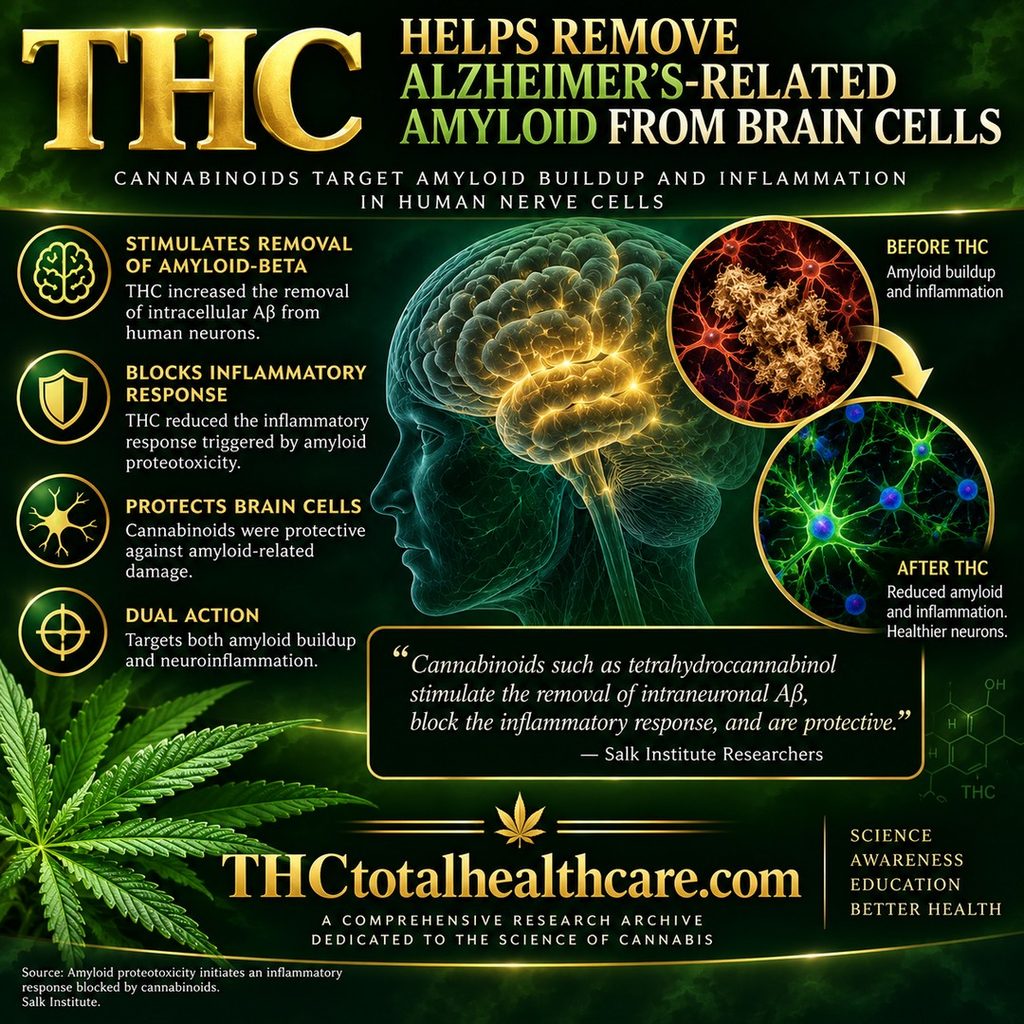
Researchers found that THC and other cannabinoids helped remove beta-amyloid from human nerve cells while also reducing the inflammatory response linked to amyloid buildup. The study reported that THC stimulated the removal of intracellular amyloid-beta and protected the cells from amyloid-related damage. Because beta-amyloid accumulation is a hallmark of Alzheimer’s disease, the findings point to a possible role for cannabinoids in targeting both amyloid buildup and inflammation.
“The beta amyloid (Aβ) and other aggregating proteins in the brain increase with age and are frequently found within neurons. The mechanistic relationship between intracellular amyloid, aging and neurodegeneration is not, however, well understood.
We use a proteotoxicity model based upon the inducible expression of Aβ in a human central nervous system nerve cell line to characterize a distinct form of nerve cell death caused by intracellular Aβ.
It is shown that intracellular Aβ initiates a toxic inflammatory response leading to the cell’s demise. Aβ induces the expression of multiple proinflammatory genes and an increase in both arachidonic acid and eicosanoids, including prostaglandins that are neuroprotective and leukotrienes that potentiate death.
Cannabinoids such as tetrahydrocannabinol stimulate the removal of intraneuronal Aβ, block the inflammatory response, and are protective.
Altogether these data show that there is a complex and likely autocatalytic inflammatory response within nerve cells caused by the accumulation of intracellular Aβ, and that this early form of proteotoxicity can be blocked by the activation of cannabinoid receptors.”
http://www.nature.com/articles/npjamd201612
“Cannabinoids remove plaque-forming Alzheimer’s proteins from brain cells. Preliminary lab studies at the Salk Institute find THC reduces beta amyloid proteins in human neurons.” http://www.salk.edu/news-release/cannabinoids-remove-plaque-forming-alzheimers-proteins-from-brain-cells/
Need this THC study explained? thcXplained.com
Expression of the endocannabinoid receptors in human fascial tissue.
“Cannabinoid receptors have been localized in the central and peripheral nervous system as well as on cells of the immune system, but recent studies on animal tissue gave evidence for the presence of cannabinoid receptors in different types of tissues.
Their presence was supposed also in myofascial tissue, suggesting that the endocannabinoid system may help resolve myofascial trigger points and relieve symptoms of fibromyalgia.
However, until now the expression of CB1 (cannabinoid receptor 1) and CB2 (cannabinoid receptor 2) in fasciae has not yet been established.
Small samples of fascia were collected from volunteers patients during orthopedic surgery. For each sample were done a cell isolation, immunohistochemical investigation (CB1 and CB2 antibodies) and real time RT-PCR to detect the expression of CB1 and CB2.
Both cannabinoid receptors are expressed in human fascia and in human fascial fibroblasts culture cells, although to a lesser extent than the control gene. We can assume that the expression of mRNA and protein of CB1 and CB2 receptors in fascial tissue are concentrated into the fibroblasts.
This is the first demonstration that the fibroblasts of the muscular fasciae express CB1 and CB2. The presence of these receptors could help to provide a description of cannabinoid receptors distribution and to better explain the role of fasciae as pain generator and the efficacy of some fascial treatments.
Indeed the endocannabinoid receptors of fascial fibroblasts can contribute to modulate the fascial fibrosis and inflammation.”
The Cannabinoid Receptor 2 Protects Against Alcoholic Liver Disease Via a Macrophage Autophagy-Dependent Pathway.
“Kupffer cells, the resident macrophages of the liver, play a major role in the pathogenesis of alcoholic liver disease. We have previously demonstrated that CB2 receptor protects against alcoholic liver disease by inhibiting alcohol-induced inflammation and steatosis via the regulation of Kupffer cell activation.
Here, we explored the mechanism underlying these effects and hypothesized that the anti-inflammatory properties of CB2 receptor in Kupffer cells rely on activation of autophagy.
Altogether these results demonstrate that CB2 receptor activation in macrophages protects from alcohol-induced steatosis by inhibiting hepatic inflammation through an autophagy-dependent pathway.”
Fatty Acid Amide Hydrolase Binding in Brain of Cannabis Users: Imaging With the Novel Radiotracer [11C]CURB.
“One of the major mechanisms for terminating the actions of the endocannabinoid anandamide is hydrolysis by fatty acid amide hydrolase (FAAH), and inhibitors of the enzyme were suggested as potential treatment for human cannabis dependence.
In cannabis users, FAAH binding was significantly lower by 14%-20% across the brain regions examined than in matched control subjects.
Lower FAAH binding levels in the brain may be a consequence of chronic and recent cannabis exposure and could contribute to cannabis withdrawal. This effect should be considered in the development of novel treatment strategies for cannabis use disorder that target FAAH and endocannabinoids.”
Dissecting the signaling pathways involved in the crosstalk between mGlu5 and CB1 receptors.
“The metabotropic glutamate (mGlu) receptor 5 and the cannabinoid type 1 (CB1) receptor are G-protein-coupled receptors (GPCR) that are widely expressed in the central nervous system (CNS). mGlu5 receptors, present at the postsynaptic site, are coupled to Gαq/11 proteins and display an excitatory response upon activation, while the CB1 receptor, mainly present at presynaptic terminals, is coupled to the Gi/o protein and triggers an inhibitory response. Recent studies suggest that the glutamatergic and endocannabinoid systems exhibit a functional interaction to modulate several neural processes. In this review we discuss possible mechanisms involved in this crosstalk and its relationship with physiological and pathological conditions, including nociception, addiction and fragil X syndrome.”