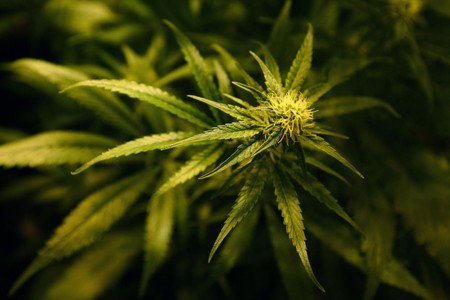
Towards a better Cannabis drug.

“Opium smoking has been mostly replaced by i.v. injection of morphine and heroin and we see cocaine sniffing rather than chewing of coca leaves. Cannabis use – be it of marijuana, hashish or bhang – differs.

Any cannabis cognoscente will insist that the crude material is ‘much better’ than pure Δ9 – tetrahydrocannabinol (THC), the only major psychoactive constituent of cannabis (Mechoulam et al., 1970).

Indeed, although pure THC is available as a drug (named Dronabinol) it is apparently not used illicitly.

The pharmacological/biochemical basis for this difference is not clear and is presumably due to several factors. A major reason seems to be the pharmacokinetic difference between cannabis smoking and the oral administration of THC.

 On smoking, the cannabis effects are noted almost immediately, while a 1.5 – 2 hour delay is observed on oral administration.

A further factor may be conditioning to the smell, although there are no published data along these lines. A further factor may be the presence of the terpenoid CB2 agonist beta-caryophyllene in cannabis (Gertsch et al., 2008).

CB2 agonists are well known to cause numerous effects (mostly of a protective nature) which may counteract some of the effects of THC (Pacher & Mechoulam, 2011).”

http://www.ncbi.nlm.nih.gov/pubmed/24024867

Cannabinoid receptors give cells the tools they need to defend against HIV infection

“Researchers have reported that when healthy cells were placed in a sample dish with the human immunodeficiency virus (HIV), along with a dose of cannabinoids, the cells, which normally would rather quickly become infected, simply denied entry to the virus, and responded as if it were not a threat at all…
 

HIV isn’t special – cannabinoids don’t like any viruses

The stimulation of the receptors wasn’t just detrimental to the AIDS virus, it increased the cells abilities to defend itself against any number of viruses and bacteria…”

More: http://www.naturalnews.com/035656_cannabinoids_HIV_marijuana.html

Cannabis exposure associated with weight reduction and β-cell protection in an obese rat model.

“The aim of this study was to investigate the effect of an organic cannabis extract on β-cell secretory function in an in vivo diet-induced obese rat model and determine the associated molecular changes within pancreatic tissue…

These results suggest that the cannabis extract protects pancreatic islets against the negative effects of obesity.”

http://www.ncbi.nlm.nih.gov/pubmed/22421529

Therapeutic potential of cannabinoid medicines.

Drug Testing and Analysis

“Cannabis was extensively used as a medicine throughout the developed world in the nineteenth century but went into decline early in the twentieth century ahead of its emergence as the most widely used illicit recreational drug later that century. Recent advances in cannabinoid pharmacology alongside the discovery of the endocannabinoid system (ECS) have re-ignited interest in cannabis-based medicines.

The ECS has emerged as an important physiological system and plausible target for new medicines. Its receptors and endogenous ligands play a vital modulatory role in diverse functions including immune response, food intake, cognition, emotion, perception, behavioural reinforcement, motor co-ordination, body temperature, wake/sleep cycle, bone formation and resorption, and various aspects of hormonal control. In disease it may act as part of the physiological response or as a component of the underlying pathology.

In the forefront of clinical research are the cannabinoids delta-9-tetrahydrocannabinol and cannabidiol, and their contrasting pharmacology will be briefly outlined. The therapeutic potential and possible risks of drugs that inhibit the ECS will also be considered. This paper will then go on to review clinical research exploring the potential of cannabinoid medicines in the following indications: symptomatic relief in multiple sclerosis, chronic neuropathic pain, intractable nausea and vomiting, loss of appetite and weight in the context of cancer or AIDS, psychosis, epilepsy, addiction, and metabolic disorders.”

http://www.ncbi.nlm.nih.gov/pubmed/24006213

http://onlinelibrary.wiley.com/doi/10.1002/dta.1529/abstract

Small animal PET imaging of the type 1 cannabinoid receptor in a rodent model for anorexia nervosa.

“Several lines of evidence strongly implicate a dysfunctional endocannabinoid system (ECS) in eating disorders…

CONCLUSION:

These data point to a widespread transient disturbance of the endocannabinoid transmission, specifically for CB1 receptors in the ABA model. Our data also suggest (1) gender effects on regional CB1 receptor binding in the hippocampus and (2) add further proof to the validity of the ABA model to mimic aspects of human disease.”

http://www.ncbi.nlm.nih.gov/pubmed/24006151

Islet Cannabinoid Receptors: Cellular Distribution and Biological Function.

“This study aimed to determine the cellular distribution of islet cannabinoid receptors (CBs) and their involvement in the development of metabolic and hormonal changes in rats fed a fructose-rich diet (F)…

Cannabinoid receptors appeared exclusively in islet α cells…

CONCLUSIONS:

Islet CBs would exert an important modulatory role in metabolic homeostasis…

 Selective islet CB1 blockers could be useful to prevent/treat the alterations induced by the intake of unbalanced/unhealthy diets.”

http://www.ncbi.nlm.nih.gov/pubmed/24005231

Cannabis-Derived Drug for Type 2 Enters Phase 2

“Cannabis-based drug for type 2s on the way?”

 
“A British drug company is looking to medical marijuana- or at least a derivative of it-to help treat a variety of different diseases, including type 2 diabetes.

The company, GW Pharma, is in the process of creating a collection of cannabinoid-based drugs, including one that takes aim at diabetes. The first of this type of drug the company has produced is Sativex, a nasal spray used to treat spasms associated with multiple sclerosis. Sativex has been okayed in eight countries, and is currently awaiting FDA approval in the United States.

The diabetes drug, GWP4204, is currently in its second phase of testing after a small but successful double-blind study. That study featured 62 type 2 patients who received various levels of the oral-administered drug or a placebo.”

More: http://diabeteshealth.com/read/2013/07/20/7933/cannabis-derived-drug-for-type-2-enters-phase-2–

Protective effect of cannabidiol against cadmium hepatotoxicity in rats.

“The protective effect of cannabidiol, the non-psychoactive component of Cannabis sativa, against liver toxicity induced by a single dose of cadmium chloride was investigated in rats…

 It was concluded that cannabidiol may represent a potential option to protect the liver tissue from the detrimental effects of cadmium toxicity.”

http://www.ncbi.nlm.nih.gov/pubmed/23993482

Cannabis Kills Cancer Cells

“Marijuana also found to prevent pain associated with chemotherapy”

Cannabis Kills Cancer Cells

“Studies in Spain have shown findings that Tetrahydrocannabinol (THC), the active ingredient found in marijuana, can induce the death of brain cancer cells, according to scientist Guillermo Velasco and his research team from the School of Biology at Complutense University in Madrid.

In a laboratory study where mice were “engineered” to carry three varying kinds of human cancer tumor grafts, THC was introduced into the brain, triggering a self-digestion development on a cellular level, known as “autophagy.” Within this process, the research team managed to isolate the particular activation route from which this process evolved.

The research team was also conducting clinical trials in concert, on two consenting brain cancer patients, said to be suffering from a rapidly aggressive form of cancer, known as “recurrent glioblastoma multiforme.”

The team, using electron microscopes to analyze brain tissue extracted before and after the 26 to 30-day regime, found that the THC had eradicated cancer cells, leaving the healthy cells undamaged.

The findings can now lend themselves to future design in newer cancer therapies, using the concept of autophagy activation.”

More: http://guardianlv.com/2013/08/cannabis-kills-cancer-cells/

Cannabis Can Prevent Cancer Caused By Cigarette Use, According To New Study

tobacco cigarettes marijuana cannabis

“A new study published by the journal J-Stage, and funded by the Ministry of Education, Culture, Sports, Science and Technology of Japan, has found that cannabinoids – whether THC, CBD or CBDV – were effective at blocking a certain enzyme which is known to cause cancer, and is produced in large amount when cigarettes are consumed.”

“These results suggest that the pentylresorcinol structure in CBD may have structurally important roles in direct CYP1A1 inhibition, although the whole structure of CBD is required for overall inhibition”, according to researchers.

CYP1A1 is an enzyme which isn’t dangerous at low-levels, but is produced in large quantities when someone smokes cigarettes; at large doses, the enzyme has been linked to cancer.

Researchers state that; “Accordingly, CBD and its related compounds, which are potent inhibitors of CYP1A1 activity, would be useful as a lead compound in anticancer chemotherapy.””

http://www.theweedblog.com/cannabis-can-prevent-cancer-caused-by-cigarette-use-according-to-new-study/

“Marijuana Disrupts Cancer Pathway of Cigarettes: Study” http://www.truthonpot.com/2013/08/19/marijuana-disrupts-cancer-pathway-of-cigarettes-study/

Chemicals in marijuana block the activity of a cancer-causing enzyme present in cigarette smokers.
 
“Chemicals in marijuana can block the activity of a cancer-causing enzyme commonly found in cigarette smokers.”


“Cannabis Can Prevent Cancer Caused by Cigarette Use, According to New Study” http://thejointblog.com/cannabis-can-prevent-cancer-caused-by-cigarrette-use-according-to-new-study/ 

“Marijuana Can Prevent Millions of Tobacco Deaths” http://salem-news.com/articles/august122013/tobacco-marijuanapl.php