“Cannabinoid receptors (CBR), including CB1 and CB2 have been therapeutic targets for a number of conditions.
Recently, splice variants of the CB1R have been identified in humans.
The isoforms differ in their N-terminus sequence and pharmacological activity relative to the CB1R, as a result, the differentiation between the CB1 receptor and its isoform is required.
As a result, a selected reaction monitoring mass spectrometry (SRM-MS) method was developed for the quantitation of CB1 and the CB1b isoform in CHO cells transduced with CB1 and CB1b.
The SRM-MS protocol was assessed with isotopically labeled peptide standards and had high reproducibility of intra-day assay (CVs from 1.9 to 4.3% for CB1 and 0.5 to 5.9% for CB1b) and inter-day assay (CVs from 1.2 to 5.2% for CB1 and 1.2 to 6.1% for CB1b).”
“THC, or tetrahydrocannabinol, is the chemical responsible for most of marijuana’s psychological effects. It acts much like the cannabinoid chemicals made naturally by the body, according to the National Institute on Drug Abuse (NIDA).
Cannabinoid receptors are concentrated in certain areas of the brain associated with thinking, memory, pleasure, coordination and time perception. THC attaches to these receptors and activates them and affects a person’s memory, pleasure, movements, thinking, concentration, coordination, and sensory and time perception, according to NIDA.
THC is one of many compounds found in the resin secreted by glands of the marijuana plant. More of these glands are found around the reproductive organs of the plant than on any other area of the plant. Other compounds unique to marijuana, called cannabinoids, are present in this resin.
“Marijuana has been used for thousands of years as a treatment for medical conditions.
However, untoward side effects limit its medical value. Here, we show that synaptic and cognitive impairments following repeated exposure to Δ9-tetrahydrocannabinol (Δ9-THC) are associated with the induction of cyclooxygenase-2 (COX-2), an inducible enzyme that converts arachidonic acid to prostanoids in the brain. COX-2 induction by Δ9-THC is mediated via CB1 receptor-coupled G protein βγ subunits.
Pharmacological or genetic inhibition of COX-2 blocks downregulation and internalization of glutamate receptor subunits and alterations of the dendritic spine density of hippocampal neurons induced by repeated Δ9-THC exposures. Ablation of COX-2 also eliminates Δ9-THC-impaired hippocampal long-term synaptic plasticity, spatial, and fear memories.
Importantly, the beneficial effects of decreasing β-amyloid plaques and neurodegeneration by Δ9-THC in Alzheimer’s disease animals are retained in the presence of COX-2 inhibition.
These results suggest that the applicability of medical marijuana would be broadened by concurrent inhibition of COX-2.”
“Smoking weed helps patients give up opiates such as heroin, a new study has found.
Researchers at Columbia University monitored patients undergoing treatment for opiate addiction – and found that patients who smoked weed were more able to sleep, less anxious, and more likely to complete their course.
The researchers also found that dosing patients with dronabinol – a drug consisting of the ‘active’ ingredient in cannabis, THC – helped with withdrawal symptoms.”
“Cannabis is a widely used illicit drug with various threats of personality syndrome, and Nigella sativa has been widely implicated as having therapeutic efficacy in many neurological diseases.
The present study investigates the ameliorative efficacy of Nigella sativa oil (NSO) on cannabis-induced moto-cognitive defects.
CONCLUSIONS:
The observed ameliorative effects of NSO make it a promising agent against moto-cognitive dysfunction and cerebelo-hippocampal alterations induced by cannabis.”
“Extreme obesity is a core phenotypic feature of Prader-Willi syndrome (PWS).
Among numerous metabolic regulators, the endocannabinoid (eCB) system is critically involved in controlling feeding, body weight, and energy metabolism, and a globally acting cannabinoid-1 receptor (CB1R) blockade reverses obesity both in animals and humans.
The first-in-class CB1R antagonist rimonabant proved effective in inducing weight loss in adults with PWS. However, it is no longer available for clinical use because of its centrally mediated, neuropsychiatric, adverse effects.
CONCLUSIONS:
Dysregulation of the eCB/CB1R system may contribute to hyperphagia and obesity in Magel2-null mice and in individuals with PWS. Our results demonstrate that treatment with peripherally restricted CB1R antagonists may be an effective strategy for the management of severe obesity in PWS.”
“Stroke is a leading cause of adult disability characterized by physical, cognitive, and emotional disturbances. Unfortunately, pharmacological options are scarce.
The cannabinoid type-2 receptor (CB2R) is neuroprotective in acute experimental stroke by anti-inflammatory mechanisms.
CONCLUSIONS:
Our data support that CB2R is fundamental for driving neuroblast migration and suggest that an endocannabinoid tone is required for poststroke neurogenesis by promoting neuroblast migration toward the injured brain tissue, increasing the number of new cortical neurons and, conceivably, enhancing motor functional recovery after stroke.”
“Preclinical research demonstrates that cannabinoids have differing effects in adolescent and adult animals. Whether these findings translate to humans has not yet been investigated. Here we believe we conducted the first study to compare the acute effects of cannabis in human adolescent (n=20; 16-17 years old) and adult (n=20; 24-28 years old) male cannabis users, in a placebo-controlled, double-blind cross-over design.
After inhaling vaporized active or placebo cannabis, participants completed tasks assessing spatial working memory, episodic memory and response inhibition, alongside measures of blood pressure and heart rate, psychotomimetic symptoms and subjective drug effects (for example, ‘stoned’, ‘want to have cannabis’).
Results showed that on active cannabis, adolescents felt less stoned and reported fewer psychotomimetic symptoms than adults. Further, adults but not adolescents were more anxious and less alert during the active cannabis session (both pre- and post-drug administration). Following cannabis, cognitive impairment (reaction time on spatial working memory and prose recall following a delay) was greater in adults than adolescents. By contrast, cannabis impaired response inhibition accuracy in adolescents but not in adults.
Moreover, following drug administration, the adolescents did not show satiety; instead they wanted more cannabis regardless of whether they had taken active or placebo cannabis, while the opposite was seen for adults. These contrasting profiles of adolescent resilience (blunted subjective, memory, physiological and psychotomimetic effects) and vulnerability (lack of satiety, impaired inhibitory processes) show some degree of translation from preclinical findings, and may contribute to escalated cannabis use by human adolescents.” https://www.ncbi.nlm.nih.gov/pubmed/27898071
“Developmental observations suggest further that CB1 receptors develop only gradually during the postnatal period, which correlates with an insensitivity to the psychoactive effects of cannabinoid treatment in the young organism. Therefore, it is suggested that children may respond positively to medicinal applications of cannabinoids without undesirable central effects.” https://www.ncbi.nlm.nih.gov/pubmed/15159678
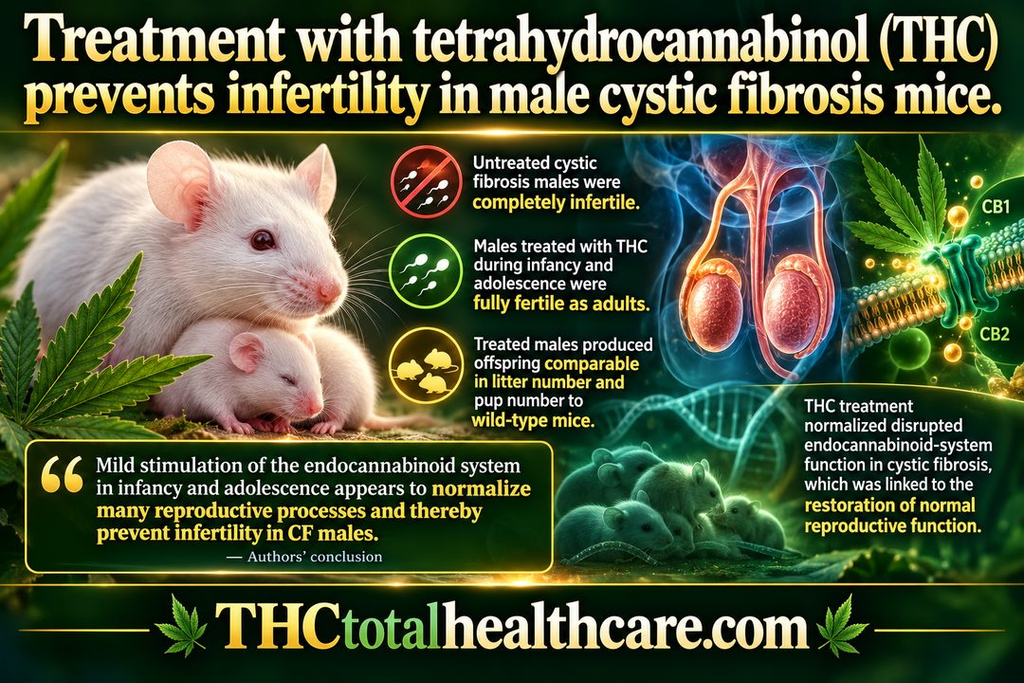
Male cystic fibrosis mice treated with THC during infancy and adolescence were fully fertile as adults, producing litters and numbers of pups comparable to healthy wild-type mice. In contrast, untreated cystic fibrosis males in the study were completely infertile.
The researchers were testing whether cystic fibrosis disrupts endocannabinoid-system function in a way that contributes to infertility. THC was used to stimulate cannabinoid receptors early in life, and the resulting restoration of fertility supported the idea that abnormal endocannabinoid signaling may play an important role in the reproductive problems associated with cystic fibrosis.
The authors concluded that mild stimulation of the endocannabinoid system during infancy and adolescence appeared to normalize reproductive processes and prevent infertility in the cystic fibrosis males they studied. The findings point to a potentially important connection between cystic fibrosis, endocannabinoid-system dysfunction, and male fertility.
“Background: Cystic fibrosis (CF) is a hereditary disease caused by mutations of the gene encoding a channel protein CFTR, conducting Cl- and HCO3 – ions. The disease is characterized by disturbances in most physiological systems, and more than 95% of men are infertile. The mechanism underlying the etiology of CF is associated with an imbalance of fatty acids. It has been suggested that the function of the endocannabinoid system is also disturbed in CF, because endocannabinoids are derivatives of fatty acids. We assumed, therefore, that endocannabinoid activity, which plays an important role in fertility, is disrupted in CF and could be one of the causes of infertility. The aim of the present study was to test the hypothesis that stimulation of endocannabinoid receptors in infancy would normalize their function and prevent infertility in adulthood.
Methods: Knockout male mice (cftr-/-) were treated with tetrahydrocannabinol (THC), endocannabinoid receptors agonist, in infancy from days 7 until 28, daily.
Results: CF males treated with THC were fully fertile, producing offspring comparable by the number of litters and the number of pups with wild-type mice. CF males that were not treated with THC were completely infertile.
Conclusions: The present study shows that (i) endocannabinoid function is impaired in CF mice, as evidenced by the regenerating effect of its stimulation on the fertility of otherwise infertile males, (ii) endocannabinoid system dysfunction is apparently the determining factor causing infertility in CF, and (iii) mild stimulation of the endocannabinoid system in infancy and adolescence appears to normalize many reproductive processes and thereby prevent infertility in CF males.”
“Substantial data have been accumulated regarding the molecular basis of cystic fibrosis (CF) pathogenesis, whereas the influence of biochemical impairments on brain processes has been the focus of much less attention. We have studied some behavioral parameters, such as motor activity and anxiety level, in a mice model of CF.
We have assumed that functioning of the endocannabinoid system could be impaired in CF (endocannabinoids are fatty acid derivatives, and fatty acid deficiency is considered a major factor in CF etiology). We have suggested that chronic treatment with cannabinoid receptors agonist during infancy would balance cannabinoid levels and prevent CF-related behavioral alterations.
Motor activity and anxiety level were studied in naïve adult CF mice (cftr-deficient mice) and compared with wild-type mice and to CF mice treated chronically with Δ9-tetrahydrocannabinol (Δ9-THC; endocannabinoid receptor agonist) during infancy (from days 7 to 28). Motor activity was tested in the tetrad, and level of anxiety in the plus maze, a month after cessation of treatment.
Motor activity decrease and elevated anxiety level were found in adult naïve CF mice compared with wild-type mice. CF mice treated with THC in infancy showed normal motor activity and anxiety levels in adulthood. Motor function alteration and elevated anxiety levels in CF can result from lack of CFTR-channel in neurons and disturbed activity of various brain areas, as well as being secondary and mediated by fatty acids deficiency, altered levels of endocannabinoids and their receptors.
It can be suggested that chronic treatment during infancy restores endocannabinoid function and thus prevents behavioral alterations.”