
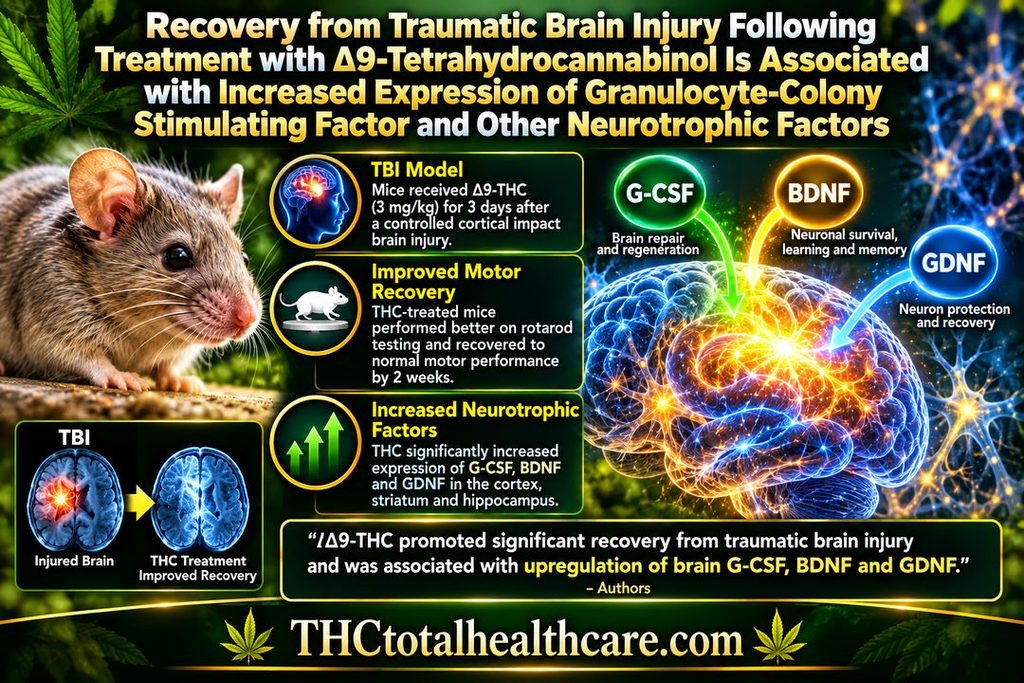
Δ9-THC promoted recovery after traumatic brain injury in mice. Animals treated with THC for three days after a controlled cortical impact performed better on motor testing and returned to normal motor performance within two weeks.
The recovery was accompanied by increased expression of G-CSF, BDNF, and GDNF in brain regions including the cortex, striatum, and hippocampus. These neurotrophic factors are involved in neuronal survival, brain repair, and recovery after injury.
The findings suggest that THC may support recovery after traumatic brain injury by increasing the brain’s own repair-related signaling. In this study, the effect went beyond symptom relief and was associated with biological changes tied to neuroprotection and regeneration.
“Introduction: The hematopoietic cytokine granulocyte-colony stimulating factor (G-CSF) is well known to stimulate proliferation of blood stem/progenitor cells of the leukocyte lineage, but is also recognized as a neurotrophic factor involved in brain self-repair processes. G-CSF administration has been shown to promote recovery from experimental models of traumatic brain injury (TBI) and to modulate components of the endocannabinoid system (eCS). Conversely, Δ9-tetrahydrocannabinol (Δ9THC) treatment of normal mice has been shown to increase blood levels of G-CSF in the periphery.
Hypothesis: Administration of the phytocannabinoid Δ9THC will enhance brain repair following controlled cortical impact (CCI) by upregulating G-CSF and other neurotrophic factors (brain-derived neurotrophic factor [BDNF] and glial-derived neurotrophic factor [GDNF]) in brain regions.
Materials and Methods: C57BL/6J mice underwent CCI and were treated for 3 days with THC 3 mg/kg intraperitoneally. Motor function on a rotarod was recorded at baseline and 3, 7, and 14 days after CCI. Groups of mice were euthanized at 7 and 14 days. G-CSF, BDNF, and GDNF expression were measured at 7 and 14 days in cerebral cortex, striatum, and hippocampus on the side of the trauma.
Results: Δ9THC-treated mice ran on the rotarod longer than vehicle-treated mice and recovered to normal rotarod performance levels at 2 weeks. These mice, compared to vehicle-treated animals, exhibited significant upregulation of G-CSF as well as BDNF and GDNF in cerebral cortex, striatum, and hippocampus. Conclusion: Administration of the phytocannabinoid Δ9THC promotes significant recovery from TBI and is associated with upregulation of brain G-CSF, BDNF, and GDNF, neurotrophic factors previously shown to mediate brain self-repair following TBI and stroke.”
https://pubmed.ncbi.nlm.nih.gov/33998887/
https://journals.sagepub.com/doi/10.1089/can.2020.0119
Need this THC study explained? thcXplained.com
 “There is not a single pharmacological agent with demonstrated therapeutic efficacy for traumatic brain injury (TBI). With recent legalization efforts and the growing popularity of medical cannabis, patients with TBI will inevitably consider medical cannabis as a treatment option.
 “The prevalence of mild traumatic brain injury is highest amongst the adolescent population and can lead to complications including neuroinflammation and excitotoxicity.
 “Neurological disorders such as neurodegenerative diseases or traumatic brain injury are associated with cognitive, motor and behavioural changes that influence the quality of life of the patients. Although different therapeutic strategies have been developed and tried until now to decrease the neurological decline, no treatment has been found to cure these pathologies.
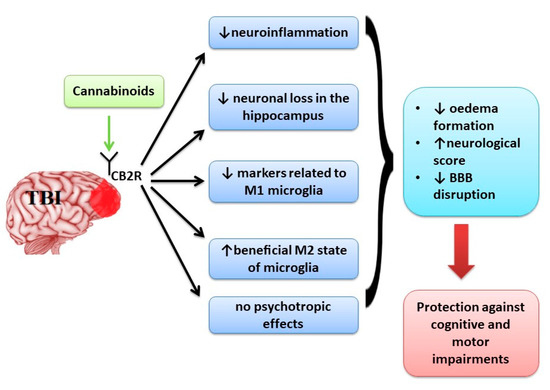
 “Recently, several studies have reported that the pharmacological effects exerted by
 “In the sports domain, cannabis is prohibited by the World Anti-Doping Agency (WADA) across all sports in competition since 2004. The few studies on physical exercise and cannabis focused on the main compound i.e. Δ9-tetrahydrocannabinol.
 “To determine whether adjunctive dronabinol, a licensed form of delta-9-tetrahydrocannabinol, reduces opioid consumption when used off-label for managing acute pain following traumatic injury.
 “Brain trauma was clinically associated with increased osteogenesis in the appendicular skeleton. We showed previously in C57BL/6J mice that mild traumatic brain injury (mTBI) transiently induced bone formation in the femur via the
