
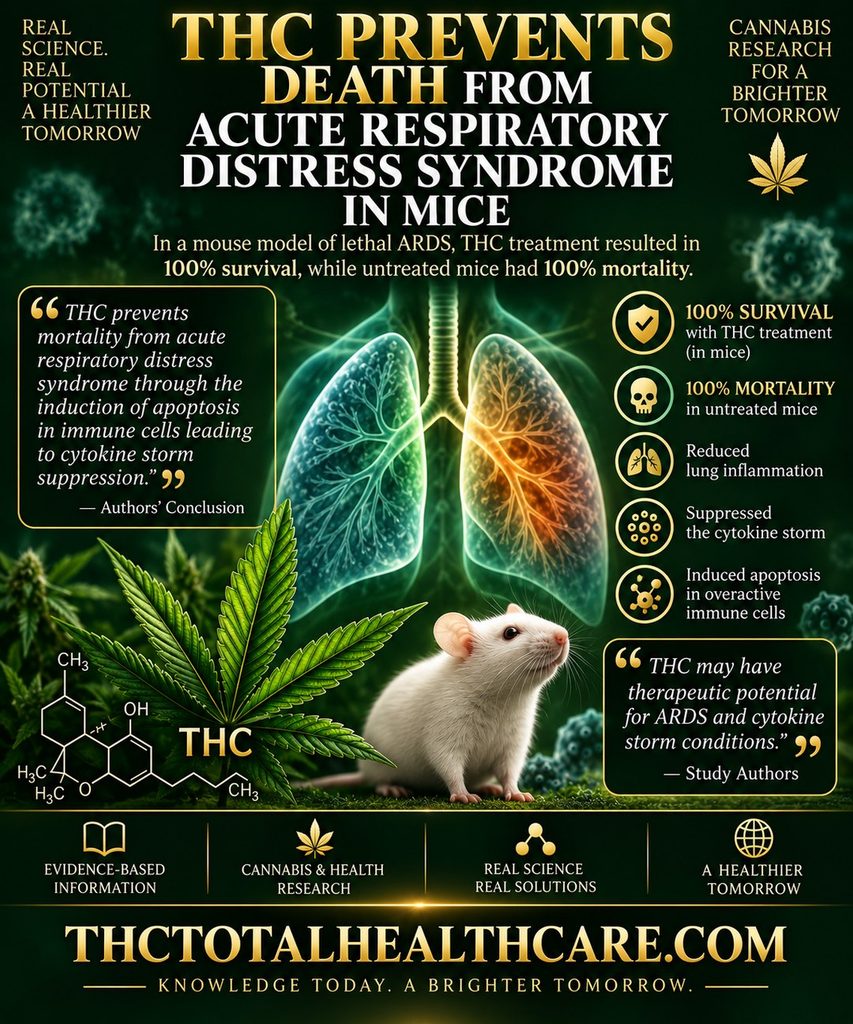
Researchers found that Δ9-tetrahydrocannabinol (THC) completely prevented death in a mouse model of acute respiratory distress syndrome (ARDS) triggered by staphylococcal enterotoxin B. The untreated condition produced 100% mortality, while THC-treated mice showed 100% survival.
THC also reduced severe lung inflammation and suppressed the cytokine storm associated with the lethal immune response. The researchers linked this protection to the induction of apoptosis in activated immune cells and changes in mitochondrial pathways involved in inflammatory damage.
The findings suggest that THC was able to interrupt an otherwise fatal inflammatory cascade in this experimental model, leading the authors to conclude that THC may have therapeutic potential for ARDS and other conditions involving cytokine storm.
“Acute Respiratory Distress Syndrome (ARDS) causes up to 40% mortality in humans and is difficult to treat. ARDS is also one of the major triggers of mortality associated with coronavirus-induced disease (COVID-19). We used a mouse model of ARDS induced by Staphylococcal enterotoxin B (SEB), which triggers 100% mortality, to investigate the mechanisms through which Δ9-tetrahydrocannabinol (THC) attenuates ARDS.
SEB was used to trigger ARDS in C3H mice. These mice were treated with THC and analyzed for survival, ARDS, cytokine storm, and metabolome. Additionally, cells isolated from the lungs were used to perform single-cell RNA sequencing and transcriptome analysis. A database analysis of human COVID-19 patients was also performed to compare the signaling pathways with SEB-mediated ARDS.
The treatment of SEB-mediated ARDS mice with THC led to a 100% survival, decreased lung inflammation, and the suppression of cytokine storm. This was associated with immune cell apoptosis involving the mitochondrial pathway, as suggested by single-cell RNA sequencing. A transcriptomic analysis of immune cells from the lungs revealed an increase in mitochondrial respiratory chain enzymes following THC treatment. In addition, metabolomic analysis revealed elevated serum concentrations of amino acids, lysine, n-acetyl methionine, carnitine, and propionyl L-carnitine in THC-treated mice. THC caused the downregulation of miR-185, which correlated with an increase in the pro-apoptotic gene targets. Interestingly, the gene expression datasets from the bronchoalveolar lavage fluid (BALF) of human COVID-19 patients showed some similarities between cytokine and apoptotic genes with SEB-induced ARDS.
Collectively, this study suggests that the activation of cannabinoid receptors may serve as a therapeutic modality to treat ARDS associated with COVID-19.”
https://pubmed.ncbi.nlm.nih.gov/32872332
“Δ9-tetrahydrocannabinol (THC) is a psychoactive cannabinoid derived from Cannabis sativa that has potential therapeutic value for pain relief, control of nausea and vomiting, appetite stimulation, and its anti-inflammatory properties [7]. Indeed, a previous report from our laboratory showed that exposure to THC prior to the administration of SEB can prevent SEB-induced ARDS and associated mortality through the miRNA (miR) regulation of regulatory T cells [8]. In the current study, we tested whether THC administration after exposure to SEB would prevent SEB-mediated ARDS; to further understand the mechanisms, we used single-cell RNA sequencing (scRNA-seq) of cells isolated from the lungs.”
“The current study concludes that the treatment of mice with THC post-SEB challenge protects mice from SEB-mediated toxicity by inhibiting inflammation and ARDS through the modulation of miRs targeting mitochondria-related apoptotic genes. Because SEB is a superantigen that drives cytokine storm, our studies revealed that THC is a potent anti-inflammatory agent that has the potential to be used as a therapeutic modality to treat SEB-induced ARDS. Importantly, the metabolomic and metabolic profiling indicates profound effects on mitochondrial functions that may be responsible for the anti-inflammatory activity of THC. This study also concludes that THC may mediate its effects through downregulating the expression of miR-185-3p and the consequent upregulation of apoptotic genes and pathways; thus, targeting miR-185-3p may constitute another therapeutic modality for the alleviation of ARDS. Using gene expression datasets from the BALF of human COVID-19 patients, we found similarities between the cytokine and apoptotic genes with SEB-induced ARDS. Thus, our data suggests that THC may be useful in treating ARDS and cytokine storm seen in COVID-19 patients.”
https://www.mdpi.com/1422-0067/21/17/6244
Need this THC study explained? thcXplained.com
 “The endocannabinoid signaling system (ECSS) is altered by exposure to stress and mediates and modulates the effects of stress on the brain.
 “Inspired by the medicinal properties of the plant Cannabis sativa and its principal component (-)-trans-Δ9-tetrahydrocannabinol (THC), researchers have developed a variety of compounds to modulate the endocannabinoid system in the human brain.
 “Epilepsy contributes to approximately 1% of the global disease burden. By affecting especially young children as well as older persons of all social and racial variety, epilepsy is a present disorder worldwide. Currently, only 65% of epileptic patients can be successfully treated with antiepileptic drugs. For this reason, alternative medicine receives more attention.
 “Diabetes is a chronic disease associated with a high number of complications such as peripheral neuropathy, which causes sensorial disturbances and may lead to the development of diabetic neuropathic pain (DNP). The current treatment for DNP is just palliative and the drugs may cause severe adverse effects, leading to discontinuation of treatment. Thus, new therapeutic targets need to be urgently investigated.
 “Coronavirus disease 2019 (COVID-19) is spreading fast all around the world with more than fourteen millions of detected infected cases and more than 600.000 deaths by 20th July 2020. While scientist are working to find a vaccine, current epidemiological data shows that the most common comorbidities for patients with the worst prognosis, hypertension and diabetes, are often treated with angiotensin converting enzyme (ACE) inhibitors and angiotensin receptor blockers (ARBs).
 “Cannabinoid receptors type 1 (CB1) and 2 (CB2) are widely expressed in the human body, and are attractive drug targets in the prevention and management of central nervous system (CNS) and immune system dysfunction, respectively. Recent breakthroughs in the structural elucidation of cannabinoid receptors and their signaling complexes with G proteins, provide the important molecular basis of ligand-receptor interactions, activation and signaling mechanism, which will facilitate the next-generation drug design and the precise modulation of the endocannabinoid system. Here, we provide an overview on the structural features of cannabinoid receptors in different functional states and the diverse ligand binding modes. The major challenges and new strategies for future therapeutic applications targeting the endocannabinoid system (ECS) are also discussed.”
 “Cannabinoid receptors (CB1 and CB2), as part of the endocannabinoid system, play a critical role in numerous human physiological and pathological conditions. Thus, considerable efforts have been made to develop ligands for CB1 and CB2, resulting in hundreds of phyto- and synthetic cannabinoids which have shown varying affinities relevant for the treatment of various diseases. However, only a few of these ligands are clinically used.
 “Cholesterol plays vital roles in many central physiological and pathological processes. As a key component in the cell membrane, cholesterol can regulate a variety of ion channels, including ligand-gated ion channels (LGICs). However, relatively little is known about the molecular detail and in vivo consequence of cholesterol-LGIC interaction. Here, we reveal that membrane cholesterol depletion significantly inhibits the potentiating effects of dehydroxylcannabidiol (DH-CBD) on glycine-activated currents (IGly) in HEK 293T cells expressing α1/α3 glycine receptors (GlyRs). Simvastatin considerably decreases cholesterol levels and DH-CBD-induced potentiation of IGly in the spinal cord of mice. Simvastatin also significantly decreases DH-CBD analgesia in acute and chronic pain of mice. The cholesterol levels in the dorsal horn of spinal cord, measured by mass spectrometry imaging, are specifically correlated with cannabinoid potentiation of spinal GlyRs and cannabinoid-induced analgesia. These findings suggest that spinal cholesterol is critical for the efficacy of glycinergic cannabinoid-induced analgesia.”
 “Cannabis has been used for its medicinal purposes since ancient times. Its consumption leads to the activation of Cannabis receptors CB1 and CB2 that, through specific mechanisms can lead to modulation and progression of inflammation or repair. The novel findings are linked to the medical use of Cannabis in gastrointestinal (GI) system.