
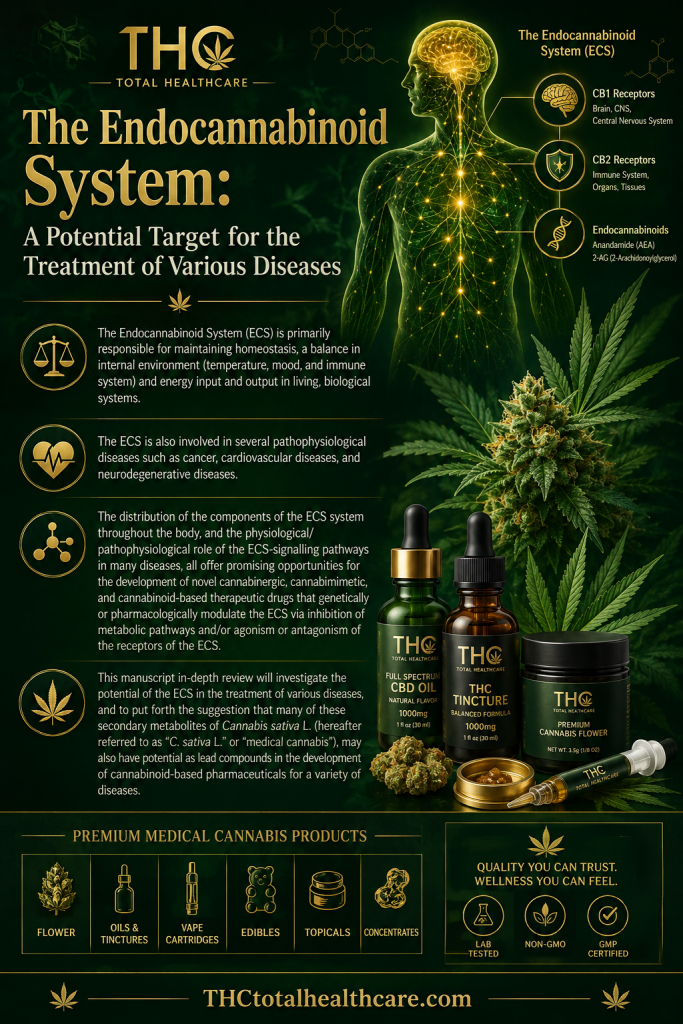
 “The Endocannabinoid System (ECS) is primarily responsible for maintaining homeostasis, a balance in internal environment (temperature, mood, and immune system) and energy input and output in living, biological systems.
In addition to regulating physiological processes, the ECS directly influences anxiety, feeding behaviour/appetite, emotional behaviour, depression, nervous functions, neurogenesis, neuroprotection, reward, cognition, learning, memory, pain sensation, fertility, pregnancy, and pre-and post-natal development.
The ECS is also involved in several pathophysiological diseases such as cancer, cardiovascular diseases, and neurodegenerative diseases. In recent years, genetic and pharmacological manipulation of the ECS has gained significant interest in medicine, research, and drug discovery and development.
The distribution of the components of the ECS system throughout the body, and the physiological/pathophysiological role of the ECS-signalling pathways in many diseases, all offer promising opportunities for the development of novel cannabinergic, cannabimimetic, and cannabinoid-based therapeutic drugs that genetically or pharmacologically modulate the ECS via inhibition of metabolic pathways and/or agonism or antagonism of the receptors of the ECS. This modulation results in the differential expression/activity of the components of the ECS that may be beneficial in the treatment of a number of diseases.
This manuscript in-depth review will investigate the potential of the ECS in the treatment of various diseases, and to put forth the suggestion that many of these secondary metabolites of Cannabis sativa L. (hereafter referred to as “C. sativa L.” or “medical cannabis”), may also have potential as lead compounds in the development of cannabinoid-based pharmaceuticals for a variety of diseases.”
https://www.mdpi.com/1422-0067/22/17/9472
 “Cannabidiol (CBD), the major non-psychoactive compound found in cannabis, is frequently used both as a nutraceutical and therapeutic.
 “Clinical and preclinical evidence has indicated that estrogen depletion leads to memory impairments and increases the susceptibility to neural damage.
 “Hemp flour from Dacia Secuieni and Zenit varieties was added to bread in different proportions (5%, 10%, 15% and 20%) to improve its nutritional properties.

 “Persistent inflammation occurs in people with HIV (PWH) and has many downstream adverse effects including myocardial infarction, neurocognitive impairment and death.

 “In the study, we assessed the effect of hemp extract on activities of resistance parameters and the metabolic compound concentration in adult workers’ hemolymph. Bees were divided into the following groups: (1) control group fed with mixture of sugar and water-glycerine solution, (2) experimental group with pure sugar syrup and inside with cotton strips soaked with hemp extract, (3) experimental group with a mixture of sugar syrup with hemp extract. Hemp extracts caused an increase in the protein concentrations and reduced the protease activities regardless of the administration method. The protease inhibitor activities were decreased only in the group that received hemp extract on the strips. The biomarker activities (ALP, ALT, AST) increased from the control group and workers feeding extract in syrup and decreased in workers supplemented with the extract on strips. In young, 2-day-old workers, the glucose concentration was higher in the groups feeding with the extract than in the control. Hemp extract influenced an increase in urea concentrations in workers’ hemolymph in comparison with the control. The hemp supplementation positively influences the immune system of workers, and the appropriate method of administration may be adapted to the health problems of bees.”
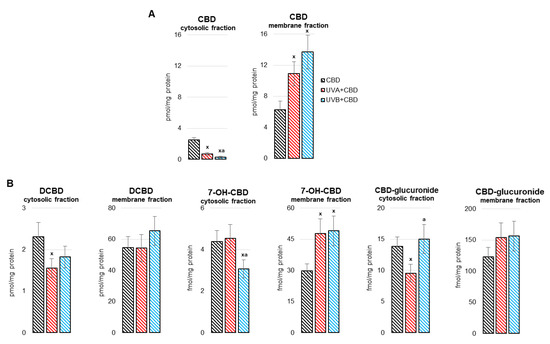
 “The liver is a key metabolic organ that is particularly sensitive to environmental factors, including UV radiation. As UV radiation induces oxidative stress and inflammation, natural compounds are under investigation as one method to counteract these consequences.
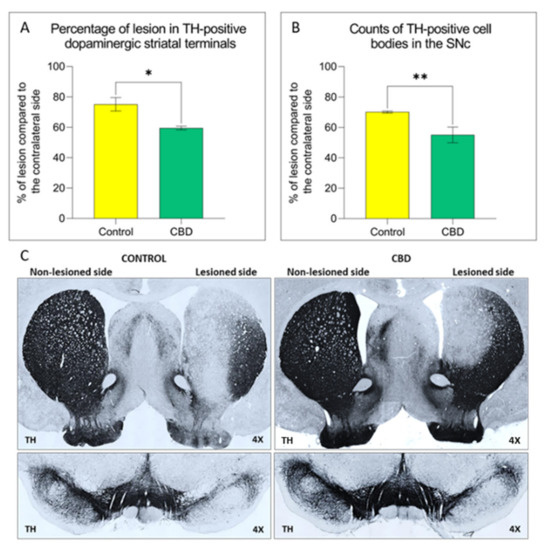
 “Obesity-related insulin resistance (IR) and attenuated brain insulin signaling are significant risk factors for neurodegenerative disorders, e.g., Alzheimer’s disease. IR and type 2 diabetes correlate with an increased concentration of sphingolipids, a class of lipids that play an essential structural role in cellular membranes and cell signaling pathways.