Potential role of cannabidiol for seizure control in a patient with recurrent glioma.

Journal of Clinical Neuroscience Home“Glioma-related epilepsy significantly impact on patients’ quality of life, and can often be difficult to treat. Seizures cause significant morbidity for example neurocognitive deterioration, which may result from seizures themselves or due to adverse effects from antiepileptic drugs. Management of tumour with surgery, radiotherapy and chemotherapy may contribute to seizure control, but tumour related epilepsy is often refractory despite adequate treatment with standard anti-epileptic medications. Given the increasing interest in medicinal cannabis (or cannabidiol or CBD) as an anti-epileptic drug, CBD may help with seizure control in glioma patients with treatment-refractory seizures. Here we present a case of a young lady with recurrent glioma who had refractory seizures despite multiple anti-epileptic agents, who had significant benefit with CBD.”

https://www.ncbi.nlm.nih.gov/pubmed/31848037

“CBD could potentially be a management option in treatment-refractory epilepsy in glioma patients.”

https://www.jocn-journal.com/article/S0967-5868(19)31306-2/fulltext

Beta-caryophyllene enhances wound healing through multiple routes.

 Image result for plos one“Beta-caryophyllene is an odoriferous bicyclic sesquiterpene found in various herbs and spices.

Recently, it was found that beta-caryophyllene is a ligand of the cannabinoid receptor 2 (CB2). Activation of CB2 will decrease pain, a major signal for inflammatory responses.

We hypothesized that beta-caryophyllene can affect wound healing by decreasing inflammation. Here we show that cutaneous wounds of mice treated with beta-caryophyllene had enhanced re-epithelialization.

The treated tissue showed increased cell proliferation and cells treated with beta-caryophyllene showed enhanced cell migration, suggesting that the higher re-epithelialization is due to enhanced cell proliferation and cell migration. The treated tissues also had up-regulated gene expression for hair follicle bulge stem cells. Olfactory receptors were not involved in the enhanced wound healing. Transient Receptor Potential channel genes were up-regulated in the injured skin exposed to beta-caryophyllene. Interestingly, there were sex differences in the impact of beta- caryophyllene as only the injured skin of female mice had enhanced re-epithelialization after exposure to beta-caryophyllene.

Our study suggests that chemical compounds included in essential oils have the capability to improve wound healing, an effect generated by synergetic impacts of multiple pathways.”

https://www.ncbi.nlm.nih.gov/pubmed/31841509

https://journals.plos.org/plosone/article?id=10.1371/journal.pone.0216104

“β-caryophyllene (BCP) is a common constitute of the essential oils of numerous spice, food plants and major component in Cannabis.”   http://www.ncbi.nlm.nih.gov/pubmed/23138934

“Beta-caryophyllene is a dietary cannabinoid.”   https://www.ncbi.nlm.nih.gov/pubmed/18574142

Exploiting cannabinoid and vanilloid mechanisms for epilepsy treatment.

“This review focuses on the possible roles of phytocannabinoids, synthetic cannabinoids, endocannabinoids, and “transient receptor potential cation channel, subfamily V, member 1” (TRPV1) channel blockers in epilepsy treatment.

The phytocannabinoids are compounds produced by the herb Cannabis sativa, from which Δ9-tetrahydrocannabinol (Δ9-THC) is the main active compound. The therapeutic applications of Δ9-THC are limited, whereas cannabidiol (CBD), another phytocannabinoid, induces antiepileptic effects in experimental animals and in patients with refractory epilepsies.

Synthetic CB1 agonists induce mixed effects, which hamper their therapeutic applications. A more promising strategy focuses on compounds that increase the brain levels of anandamide, an endocannabinoid produced on-demand to counteract hyperexcitability. Thus, anandamide hydrolysis inhibitors might represent a future class of antiepileptic drugs. Finally, compounds that block the TRPV1 (“vanilloid”) channel, a possible anandamide target in the brain, have also been investigated.

In conclusion, the therapeutic use of phytocannabinoids (CBD) is already in practice, although its mechanisms of action remain unclear. Endocannabinoid and TRPV1 mechanisms warrant further basic studies to support their potential clinical applications.”

https://www.ncbi.nlm.nih.gov/pubmed/31839498

“Cannabidiol is in clinical use for refractory epilepsies.”

https://www.epilepsybehavior.com/article/S1525-5050(19)30373-7/fulltext

The influence of carboxylesterase 1 polymorphism and cannabidiol on the hepatic metabolism of heroin.

Chemico-Biological Interactions“Heroin (diamorphine) is a highly addictive opioid drug synthesized from morphine. The use of heroin and incidence of heroin associated overdose death has increased sharply in the US.

Heroin is primarily metabolized via deacetylation (hydrolysis) forming the active metabolites 6-monoacetylmorphine (6-MAM) and morphine. A diminution in heroin hydrolysis is likely to cause higher drug effects and toxicities.

In this study, we sought to determine the contribution of the major hepatic hydrolase carboxylesterase 1 (CES1) to heroin metabolism in the liver as well as the potential influence of one of its known genetic variants, G143E (rs71647871).

Furthermore, given the potential therapeutic application of cannabidiol (CBD) for heroin addiction and the frequent co-abuse of cannabis and heroin, we also assessed the effects of CBD on heroin metabolism.

CBD exhibited potent in vitro inhibition toward both heroin and 6-MAM hydrolysis, which may be of potential clinical relevance.”

https://www.ncbi.nlm.nih.gov/pubmed/31837295

“Cannabidiol is a potent in vitro inhibitor of the two-step hydrolysis of heroin.”

https://www.sciencedirect.com/science/article/abs/pii/S0009279719317259?via%3Dihub

A Novel, Tumor-Induced Osteoclastogenesis Pathway Insensitive to Denosumab but Interfered by Cannabidiol.

ijms-logo“Bone metabolism is strictly regulated, and impaired regulation caused by hormonal imbalances induces systemic bone loss. Local bone loss caused by tumor invasion into bone is suggested to be induced by the generation of cytokines, which affect bone metabolism, by tumor cells.

The major cause of systemic and local bone losses is excess bone resorption by osteoclasts, which differentiate from macrophages by receptor activator of nuclear factor kappa-B ligand (RANKL) or tumor necrosis factor-alpha (TNF-α).

We previously found a novel pathway for tumor-induced osteoclastogenesis targeting osteoclast precursor cells (OPCs). Tumor-induced osteoclastogenesis was resistant to RANKL and TNF-α inhibitors. In the present study, we confirmed that exosomes derived from oral squamous cell carcinoma (OSCC) cells induced osteoclasts from OPCs.

We also showed that the depletion of exosomes from culture supernatants of OSCC cells partially interfered with osteoclastogenesis, and cannabidiol, an innoxious cannabinoid without psychotropic effects, almost completely suppressed tumor-induced osteoclastogenesis.

Osteoclastogenesis and its interference by cannabidiol were independent of the expression of nuclear factor of T cell c1 (NFATc1). These results show that osteoclastogenesis induced by OSCC cells targeting OPCs is a novel osteoclastogenic pathway independent of NFATc1 expression that is partially caused by tumor-derived exosomes and suppressed by cannabidiol.”

https://www.ncbi.nlm.nih.gov/pubmed/31835378

https://www.mdpi.com/1422-0067/20/24/6211

Medicinal Use of Cannabis in Children and Pregnant Women.

 Image result for Rambam Maimonides Med J.“The increasing medicinal use of cannabis during recent years has largely overlooked children and pregnant women due to litigious and ethical concerns.

However, over the last few years medicine has observed increasing numbers of children treated with cannabis for autism spectrum disorder (ASD) and fetal alcohol spectrum disorder (FASD), and pregnant women treated for hyperemesis gravidarum (HG).

This review provides an account of major findings discovered through this research.

Specifically, cannabis may offer therapeutic advantages to behavioral symptoms of autism spectrum disorder and fetal alcohol spectrum disorder, and to the severe nausea and vomiting in hyperemesis gravidarum.

The use of medical cannabis in children and pregnant women should be further discussed and researched in this patient population.”

https://www.ncbi.nlm.nih.gov/pubmed/31826800

Management of chronic pain with Jalaprakshalana (water-wash) Shodhita (processed) Bhanga (Cannabis sativa L.) in cancer patients with deprived quality of life: An open-label single arm clinical trial.

Image result for AYU journal“Pain is a common and complex symptom of cancer having physical, social, spiritual and psychological aspects. Approximately 70%-80% of cancer patients experiences pain, as reported in India.

Ayurveda recommends use of Shodhita (Processed) Bhanga (Cannabis) for the management of pain but no research yet carried out on its clinical effectiveness.

OBJECTIVE:

To assess the analgesic potential of Jala-Prakshalana (Water-wash) processed Cannabis sativa L. leaves powder in cancer patients with deprived quality of life (QOL) through openlabel single arm clinical trial.

MATERIALS AND METHODS:

Waterwash processed Cannabis leaves powder filled in capsule, was administered in 24 cancer patients with deprived QOL presenting complaints of pain, anxiety or depression; for a period of 4 weeks; in a dose of 250 mg thrice a day; along with 50 ml of cow’s milk and 4 g of crystal sugar. Primary outcome i.e. pain was measured by Wong-Bakers FACES Pain Scale (FACES), Objective Pain Assessment (OPA) scale and Neuropathic Pain Scale (NPS). Secondary outcome namely anxiety was quantified by Hospital Anxiety and Depression Scale (HADS), QOL by FACT-G scale, performance score by Eastern Cooperative Oncology Group (ECOG) and Karnofsky score.

RESULTS:

Significant reduction in pain was found on FACES Pain Scale (P < 0.05), OPA (P < 0.05), NPS (P < 0.001), HADS (P < 0.001), FACT-G scale (P < 0.001), performance status score like ECOG (P < 0.05) and Karnofsky score (P < 0.01).

CONCLUSION:

Jalaprakshalana Shodhita Bhanga powder in a dose of 250 mg thrice per day; relieves cancer induced pain, anxiety and depression significantly and does not cause any major adverse effect and withdrawal symptoms during trial period.”

https://www.ncbi.nlm.nih.gov/pubmed/31831967

http://www.ayujournal.org/article.asp?issn=0974-8520;year=2019;volume=40;issue=1;spage=34;epage=43;aulast=Tavhare

Cannabinoids and the expanded endocannabinoid system in neurological disorders.

 Related image“Anecdotal evidence that cannabis preparations have medical benefits together with the discovery of the psychotropic plant cannabinoid Δ9-tetrahydrocannabinol (THC) initiated efforts to develop cannabinoid-based therapeutics.

These efforts have been marked by disappointment, especially in relation to the unwanted central effects that result from activation of cannabinoid receptor 1 (CB1), which have limited the therapeutic use of drugs that activate or inactivate this receptor.

The discovery of CB2 and of endogenous cannabinoid receptor ligands (endocannabinoids) raised new possibilities for safe targeting of this endocannabinoid system. However, clinical success has been limited, complicated by the discovery of an expanded endocannabinoid system – known as the endocannabinoidome – that includes several mediators that are biochemically related to the endocannabinoids, and their receptors and metabolic enzymes.

The approvals of nabiximols, a mixture of THC and the non-psychotropic cannabinoid cannabidiol, for the treatment of spasticity and neuropathic pain in multiple sclerosis, and of purified botanical cannabidiol for the treatment of otherwise untreatable forms of paediatric epilepsy, have brought the therapeutic use of cannabinoids and endocannabinoids in neurological diseases into the limelight.

In this Review, we provide an overview of the endocannabinoid system and the endocannabinoidome before discussing their involvement in and clinical relevance to a variety of neurological disorders, including Parkinson disease, Alzheimer disease, Huntington disease, multiple sclerosis, amyotrophic lateral sclerosis, traumatic brain injury, stroke, epilepsy and glioblastoma.”

https://www.ncbi.nlm.nih.gov/pubmed/31831863

“The existence of the endocannabinoidome explains in part why some non-euphoric cannabinoids, which affect several endocannabinoidome proteins, are useful for the treatment of neurological disorders, such as multiple sclerosis and epilepsy.”

https://www.nature.com/articles/s41582-019-0284-z

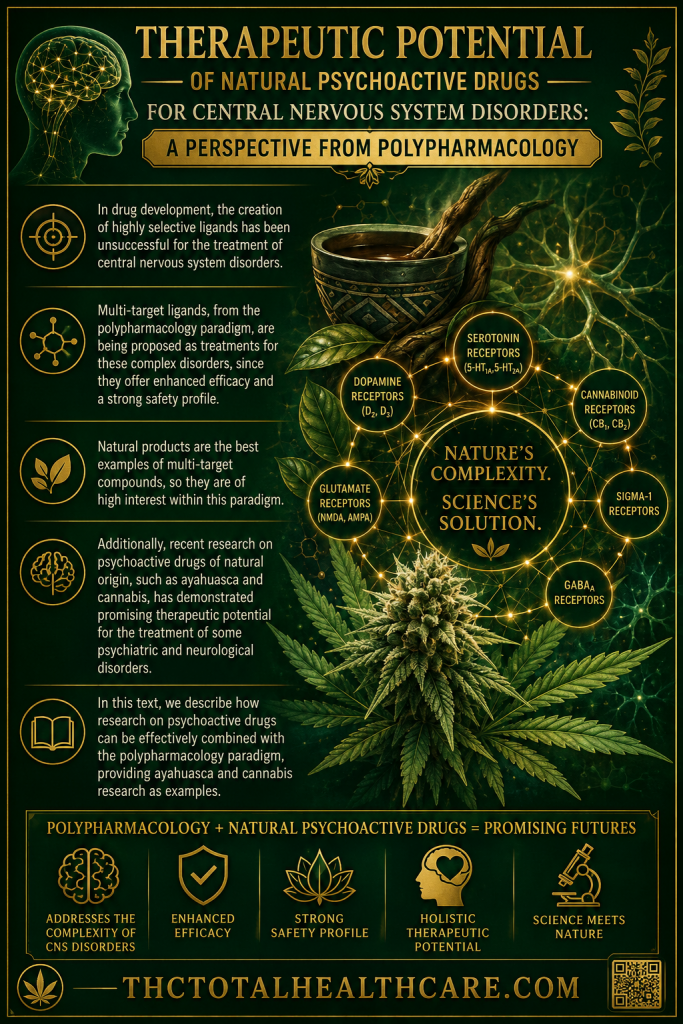
Therapeutic potential of natural psychoactive drugs for central nervous system disorders: A perspective from polypharmacology.

“In drug development, the creation of highly selective ligands has been unsuccessful for the treatment of central nervous system disorders.

Multi-target ligands, from the polypharmacology paradigm, are being proposed as treatments for these complex disorders, since they offer enhanced efficacy and a strong safety profile.

Natural products are the best examples of multi-target compounds, so they are of high interest within this paradigm.

Additionally, recent research on psychoactive drugs of natural origin, such as ayahuasca and cannabis, has demonstrated promising therapeutic potential for the treatment of some psychiatric and neurological disorders.

In this text, we describe how research on psychoactive drugs can be effectively combined with the polypharmacology paradigm, providing ayahuasca and cannabis research as examples.”

https://www.ncbi.nlm.nih.gov/pubmed/31830883

http://www.eurekaselect.com/177382/article

Cannabis-based medicines and the perioperative physician.

Image result for perioperative medicine

“Cannabis use for medicinal purposes was first documented in 2900 BC in China, when Emperor Shen Nong described benefit for rheumatism and malaria and later in Ancient Egyptian texts.

Discussion in medical journals, the mainstream and social media around the use of cannabis for medicinal and non-medicinal purposes has increased recently, especially following the legalisation of cannabis for recreational use in Canada and the UK government’s decision to make cannabis-based medicines (CBMs) available for prescription by doctors on the specialist register.

The actual, social and economic legitimisation of cannabis and its medicinal derivatives makes it likely increasing numbers of patients will present on this class of medicines. Perioperative physicians will require a sound understanding of their pharmacology and evidence base, and may wish to exploit this group of compounds for therapeutic purposes in the perioperative period.

The increasing availability of cannabis for both recreational and medicinal purposes means that anaesthetists will encounter an increasing number of patients taking cannabis-based medications. The existing evidence base is conflicted and incomplete regarding the indications, interactions and long-term effects of these substances.

Globally, most doctors have had little education regarding the pharmacology of cannabis-based medicines, despite the endocannabinoid system being one of the most widespread in the human body.

Much is unknown, and much is to be decided, including clarifying definitions and nomenclature, and therapeutic indications and dosing. Anaesthetists, Intensivists, Pain and Perioperative physicians will want to contribute to this evidence base and attempt to harness such therapeutic benefits in terms of pain relief and opiate-avoidance, anti-emesis and seizure control.

We present a summary of the pharmacology of cannabis-based medicines including anaesthetic interactions and implications, to assist colleagues encountering these medicines in clinical practice.”

https://www.ncbi.nlm.nih.gov/pubmed/31827774

“In summary, cannabinoids may improve pain relief as part of multi-modal approach. As the evidence base increases, CBMs could become part of the perioperative teams’ armamentarium to help provide an opiate sparing multimodal analgesia regime as well as having a role in the management of common post-operative complications such as nausea and vomiting.”

 https://perioperativemedicinejournal.biomedcentral.com/articles/10.1186/s13741-019-0127-x