
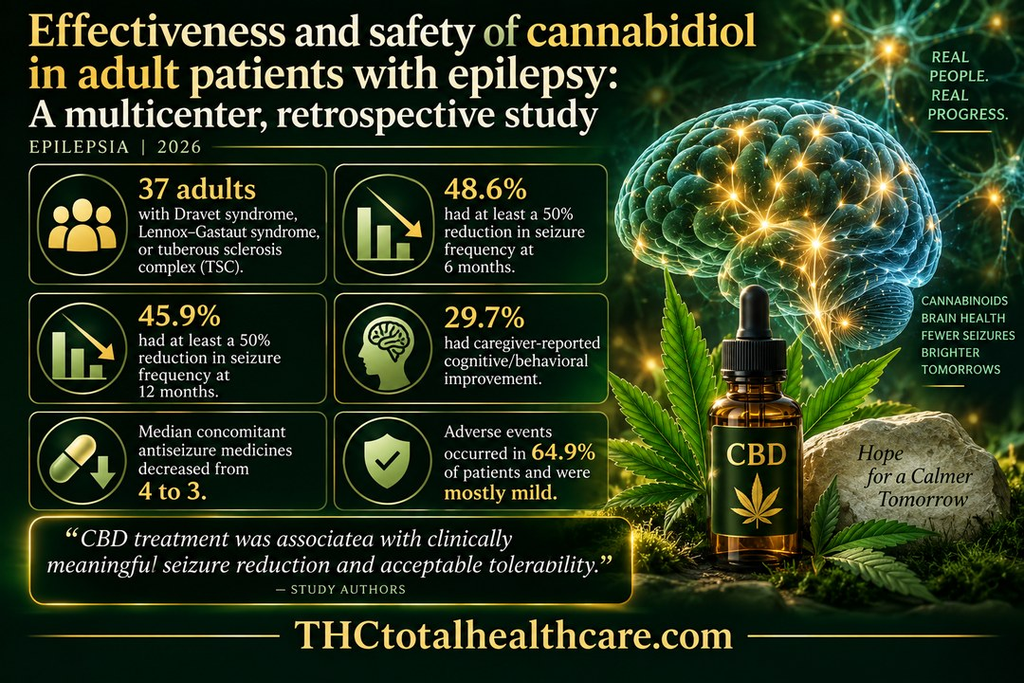
A new multicenter study found that cannabidiol was associated with substantial seizure reductions in adults living with severe, drug-resistant forms of epilepsy. The study followed 37 adults with Dravet syndrome, Lennox–Gastaut syndrome, or tuberous sclerosis complex who received CBD for at least 12 months.
After six months, 48.6% of patients had at least a 50% reduction in seizure frequency; after 12 months, 45.9% still met that threshold. Caregivers also reported improvements in alertness, behavior, interaction, or daily functioning in 29.7% of patients, while the median number of other antiseizure medications fell from four to three.
The authors concluded that CBD was associated with “clinically meaningful seizure reduction and acceptable tolerability” in this real-world adult population. Adverse events occurred in 64.9% of patients but were mostly mild, and 81.1% remained on CBD at 12 months.
“Objective: Cannabidiol (CBD) has demonstrated promising effectiveness and tolerability as adjunctive treatment in patients with severe childhood epilepsies. This study investigated the effectiveness and tolerability of CBD in adults with a history of Dravet syndrome (DS), Lennox-Gastaut syndrome (LGS), or tuberous sclerosis complex (TSC).
Methods: This was a multicenter, retrospective, observational study in adults with diagnosis of DS, LGS or TSC who received at least 12 months of CBD treatment. Medical records were reviewed and baseline characteristics, treatment retention, seizure frequency, cognitive behavioral improvements, concomitant ASM usage, and adverse events were assessed.
Results: Thirty-seven patients (median age 25 years; 67.5% male) with diagnosis of DS, LGS or TSC received CBD for at least 12 months. The CBD median maintenance dose was 10.45 mg/kg/day (IQR 7.455 – 13.975) (median maximum dose 11 mg/kg/day); median follow-up time was 28 months (IQR 22.75-58.25). Seizure frequency was reduced by ≥50% in 48.6% of patients at 6 months and 45.9% at 12 months. No statistically significant differences in median maintenance dose were observed across seizure reduction categories. During CBD treatment, caregivers reported subjective improvements in cognition in 29.7% of patients. Treatment with CBD was significantly associated with a reduction in the median number of concomitant ASMs at the end of follow-up (4 [3, 4]) vs. 3 [3, 4] (p = 0.022). AEs occurred in 64.9% of patients and were mostly mild; 16.2% had AEs leading to treatment discontinuation.
Significance: We present a series of adult patients treated with CBD according to label. The results are similar to those described in children. CBD treatment was associated with clinically meaningful seizure reduction and acceptable tolerability in this real-world cohort of adults with drug-resistant developmental and epileptic encephalopathies. These findings support the potential role of CBD in complex adult DEE populations while highlighting the need for prospective controlled studies to better define its independent treatment effect.
Plain language summary: This study looked at the long-term use of cannabidiol (CBD) in 37 adults with Dravet syndrome, Lennox-Gastaut syndrome, or tuberous sclerosis complex. After 12 months, almost half of the patients had at least a 50% reduction in seizures. Some caregivers also reported improvements in cognition and behavior. Patients were able to reduce the number of other antiseizure medicines they were taking. Side effects were common but mostly mild, although a small number of patients stopped treatment because of them. Overall, CBD appeared effective and reasonably well tolerated, but further controlled studies are needed.”
https://pubmed.ncbi.nlm.nih.gov/42765195
“CBD has demonstrated promising effectiveness and tolerability in adult patients with a history of DS, LGS, or TSC. Treatment with CBD was associated with reductions in seizure frequency and in concomitant ASMs, which could improve treatment retention and reduce AEs. The findings support a growing body of evidence highlighting the efficacy of CBD across age groups and epilepsy etiologies in real-world clinical practice.”