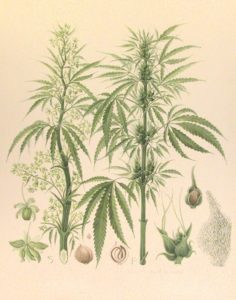
Cannabis Linked To Crohn’s Cure

“Smoking cannabis may be key in treating Crohn’s disease, research suggest.

In a recent trial marijuana was shown to induce ‘complete remission’ for patients suffering from the condition, which is also known as inflammatory bowel disease.

Scientists at Meir Medical Center, Israel, studied 21 people with severe Crohn’s disease who did not respond to various therapies.

They split the patients into two groups: 11 were given a joint to smoke twice a day for eight weeks, while 10 were given a placebo cigarette which contained no trace of cannabinoids.

A ‘complete remission’ of Crohn’s disease was recorded in 5/11 (45%) of the cannabis group and 1/10 in the placebo group.

A total of 10/11 patients in the cannabis group responded to the clinical trial with Crohn’s symptoms (which include pain, diarrhoea, tiredness and weight loss) significantly reduced.

In addition, study authors wrote: “Subjects receiving cannabis reported improved appetite and sleep, with no significant side effects.”

“Further studies, with larger patient groups and a non-smoking mode of intake, are warranted,” they added.”

http://www.huffingtonpost.co.uk/2013/05/21/cannabis-treatment-inflammatory-bowel-disease-crohns_n_3311278.html?utm_hp_ref=uk%3Fncid%3DGEP

Please Note: The title of this article has been changed to “Could Cannabis Cure Crohn’s Disease?”

Now they’re telling us smoking weed will also help fend off diabetes – MSN

Man smoking a joint (©RL/KEYSTONE USA/Rex Features) 

“The magical weed that helps us stay trim, be less crazy, control seizures, cure Crohn’s, rescue the economy and make watching TV game shows more enjoyable is now being credited for possibly reducing the risk of diabetes, too. Analyzing statistics from the Centers for Disease Control and Prevention’s “National Health and Nutrition Examination Survey,” researchers uncovered the good news that current marijuana users had 16 percent lower fasting insulin levels and 17 percent lower levels of insulin resistance than their nonstoner friends.

Bonus: Scientists found that pot users also had slimmer waistlines and higher levels of “good” cholesterol.”

http://now.msn.com/marijuana-may-fight-diabetes-researchers-say 

Skin Cancer Patient Says Oil From Medical Marijuana Is A Cure

“A Ferndale man claims he’s found a cure for his cancer and it’s now legal in Michigan.”

%name Skin Cancer Patient Says Oil From Medical Marijuana Is A Cure.

“WWJ’s Sandra McNeill spoke with Michael McShane who claims he’s been using a topical oil made from medical marijuana on the skin cancer on his forehead and in just over two months it’s nearly gone.

“I’ve got biopsies, chart notes, photographs … in about three weeks I’m going to go back  and really wrap this part of the case up,” said McShane. “It’s made the same way a lot of the fragrances and perfumes are made, and the oil is applied, in my case, directly to the skin, and within 10 weeks my cancer is gone.

“From a topical standpoint I don’t experience any euphoria,” said McShane.

McShane freely admits that he has smoked marijuana since he was in his teens, “It went from a party to a cure for cancer,” he said.”

Read more: http://detroit.cbslocal.com/2011/08/29/skin-cancer-patient-says-oil-from-medical-marijuana-is-a-cure/

The association of N-palmitoylethanolamine with the FAAH inhibitor URB597 impairs melanoma growth through a supra-additive action.

“The incidence of melanoma is considerably increasing worldwide. Frequent failing of classical treatments led to development of novel therapeutic strategies aiming at managing advanced forms of this skin cancer. Additionally, the implication of the endocannabinoid system in malignancy is actively investigated…

CONCLUSIONS:

This study suggests the interest of targeting the endocannabinoid system in the management of skin cancer and underlines the advantage of associating endocannabinoids with enzymatic hydrolysis inhibitors.

This may contribute to the improvement of long-term palliation or cure of melanoma.”

Full text: http://www.ncbi.nlm.nih.gov/pmc/articles/PMC3364151/

The trypanocidal effect of Cannabis sativa constituents in experimental animal trypanosomiasis.

Image result for cannabis sativa

“The effect of Cannabis sativa on trypanosome-infected rats was examined. An aqueous extract of the seeds administered at a dose of 50 mg/kg/d cured animals infected with Trypanosome brucei brucei of blood stream parasites.

Six fractions eluted from the crude extract by column chromatography were assessed for trypanocidal properties. Of these, only 2 fractions retained trypanocidal activity by curing mice infected with T brucei brucei.”

http://www.ncbi.nlm.nih.gov/pubmed/7900270

Related image

“Trypanosoma brucei is a species of parasitic kinetoplastid belonging to the genus Trypanosoma. The parasite is the cause of a vector-borne disease of vertebrate animals, including humans, carried by genera of tsetse fly in sub-Saharan Africa. In humans T. brucei causes African trypanosomiasis, or sleeping sickness.”  https://en.wikipedia.org/wiki/Trypanosoma_brucei

“A trypanocidal agent is an antiprotozoal agent that acts upon trypanosome parasites.”  https://en.wikipedia.org/wiki/Trypanocidal_agent

Cannabis linked to ‘prostate cancer cure’

“Cannabis helps combat prostate cancer, scientists revealed yesterday.

But patients were warned not to use the drug even though active chemicals halted the spread of the disease.

Cannabis also helped reduce the size of tumours when tested on mice, according to researchers at Spain’s University of Alcala.

But Cancer Research UK’s Dr Lesley Walker said: “This opens a new avenue to explore potential drug targets but it is at a very early stage – it absolutely isn’t the case that men might be able to fight prostate cancer by smoking cannabis.

“Research suggests that prostate cancer cells might stop growing if they are treated with chemicals found in cannabis but more work needs to be done to explore the potential of these cannabinoids in treatment.”

Prostate cancer affects more than 35,000 UK men each year and kills around 10,000.”

http://www.mirror.co.uk/news/uk-news/cannabis-linked-to-prostate-cancer-cure-413459

The NFL’s Campaign Against Breast Cancer Is a Total Scam


The NFL's Campaign Against Breast Cancer Is a Total Scam“Have you noticed that during the month of October, the NFL suddenly becomes intensely concerned with making sure you’re aware of breast cancer? Pink jerseys! Huge Ass Pink Ribbons at midfield! Pink motherfucking cleats! Fans interested in aware-ing on their own can even click on over to the NFL’s store and purchase ugly pink crap of their own under the assumption that their good intentions will actually contribute to the fight against cancer. Well, I hate to burst your Pepto Bismo Pink bubble, wearers of dangly earrings that contain both ribbons and tiny footballs, but you’ve been had — the NFL’s Breast Cancer Awareness Month campaign does raise itsy bitsy amounts of money for the fight against cancer, but the amount of money it raises pales in comparison to the amount of money it raises for billionaire NFL owners.

The NFL claims that its pink philanthropy efforts “support the fight against breast cancer” by “promoting awareness” and providing funds to the American Cancer Society. But what they’re mostly promoting is, uh, buying NFL gear, the profits from which are overwhelmingly pocketed by the NFL.

According to Business Insider, the NFL’s October Breast Cancer Awareness Month fundraising effort is multi-pronged. There’s the on-field onslaught of pink (AWARENESS), the off-field auction of autographed or otherwise noteworthy NFL paraphernalia (MONEY FOR THE CURE!), and the part of the NFL store that entices shoppers to purchase officially licensed NFL breast cancer gear, a portion of which goes to FINDING A CURE. According to the League, 100% of the proceeds from the specialty auction go to the American Cancer Society, but the total percentage of purchases of officially licensed gear that actually goes to FINDING A CURE is actually kind of pathetic — 5%. If you want to look at this cynically, in a way, the on-field wearin’ o’ the pink serves as an ad to direct consumers to purchase pink fan items.

BUT WAIT, you might say, AT LEAST THEY’RE DOING SOMETHING. And 5% is still something! Well, kind of. As BI pointed out, if NFL products are sold at a 100% markup and only 5% of sale proceeds go to the American Cancer Society, then the NFL is pocketing 90% of sales of Breast Cancer Awareness products, many of which would not be purchased if they didn’t come with a promise that consumers were “helping.” And, more perspective: while the American Cancer Society isn’t, say, Komen, they still don’t use 100% of the money they receive to “fight” breast cancer. Only 70% of donations taken in by the organization go toward cancer research. So, if you spend $10 on pink stink from the NFL, only about 35 cents is going to finding a cure for breast cancer. And $4.50 goes right back to the NFL, where I like to imagine that it’s spent on gas for a Lake Minnetonka pleasure cruise. For the cure.

But what about awareness?! Surely the NFL is helping keep people aware and alert and vigilant that at any moment, breast cancer could be lurking around a corner in a dark alley waiting with a hot pink switchblade to steal your purse and boobs. The thing about awareness is that it’s all but impossible to quantify — and everyone knows about breast cancer. If you asked 100 people if they’re aware that breast cancer is a thing and that it’s almost impossible to predict and most often affects women, I’d bet that most of them would nod before slowly backing away from you. Breast cancer awareness is so ubiquitous that if deadly diseases attended the same high school, breast cancer would probably be voted prom queen. The “awareness” that comes from the NFL’s sales of pink branded items doesn’t justify the extent to which the league is taking advantage of consumers’ good intentions to pad their wallets. Even if no NFL player ever touched another pink thing again, Americans would go right on being aware of the disease. Unless the Buffalo Jills or New Orleans Saintsations cheerleaders are holding up signs that show women how to give themselves breast self-exams or tickets come with 5 page printouts of places low income women can obtain breast health screening for low or no cost, the type of awareness the NFL is providing is useless, vague garbage.

Since the program’s inception four years ago, the NFL has raised $3 million for breast cancer. In 2009, the League made $8.5 billion. Last year, they made $9.5 billion. Commissioner Roger Goodell has set a revenue goal of $25 billion per year by the year 2027. A million per year out of between $8.5 and $9.5 billion in revenues? Pardon me while I don’t slobber all over the NFL’s pink-drenched marketing campaign.

Want to cure breast cancer? Give directly to an organization that cures breast cancer, or to an advocacy group that seeks actual cures, not marketing and corporate profits. Besides, wearing those horrid pink NFL breast cancer rain boots actually causes cancer. Of the eyes.”

http://jezebel.com/5950971/the-nfls-campaign-against-breast-cancer-is-a-total-scam

Is the pink ribbon campaign a scam?

“The pink ribbon has become synonymous with solidarity for women who battle breast cancer. After all, a diagnosis of breast cancer changes the life of the diagnosed and the lives of all those involved — many times for the worse.

But, did you ever stop to think about what the pink ribbon campaign is all about? Is it really meant to bring “awareness” to breast cancer? Hasn’t everyone heard of breast cancer? Some have questioned the motives of those who stand behind those pretty pink ribbons.

Some have suggested that Breast Cancer Awareness month can be seen as a push for women to be corralled into the mammography suite so they can await their breast cancer diagnosis when the mammography is complete.

The science behind mammography is clear. Mammography does more harm than good.

Yes, the concept seems harsh. After all, most people who wear pink ribbons are innocent. They just go along with the rest. It’s a chance to show that they support the cause, whatever that is.

The pink ribbon campaign, however, is not completely innocent. Take for example this questionable involvement in the pink ribbon campaign. In October 2010, KFC filled and sold the “Bucket for the Cure,” donating 50 cents to breast cancer for each bucket sold. If KFC had a real interest for preventing breast cancer or for finding its cure, wouldn’t they close their doors forever? After all, the Physicians Committee for Responsible Medicine (PCRM) sued KFC for not disclosing to its customers that the chicken sold at KFC contained a dangerous carcinogen. “KFC should post warnings because its aggressively marketed new product harbors a chemical that increases the risk of breast cancer, prostate cancer, and other forms of this lethal disease,” commented Dr. Neal Barnard, of PCRM.

While some participants in the pink ribbon campaign do send raised funds to breast cancer charities, such as Komen for the Cure, others do not follow through with contributions. The Better Business Bureau has issued warnings to consumers regarding this shell game.

Pink Ribbons have hope. On the other hand, the entire breast cancer awareness initiative would be worthwhile if we continued to raise money to advertise the information that we already have about breast cancer prevention: diet, exercise, stress management prevent breast cancer. Why is it that people do not know that eating a low-fat whole plant foods diet is the single most important thing you can do to prevent breast cancer? Why don’t breast cancer organizations teach what we already know instead of continuing to look for a cure that comes in an expensive pill, treatment, or surgery?

Who’s benefiting here, anyway?”

Rimonabant: an antagonist drug of the endocannabinoid system for the treatment of obesity.

Abstract

“Obesity, an ever-increasing problem in the industrialized world, has long been a target of research for a cure or, at least, control of its expansion. In the search for treatment, the recently discovered endocannabinoid system has emerged as a new target for controlling obesity and its associated conditions. The endocannabinoid system plays an important role in controlling weight and energy balance in humans. This system is activated to a greater extent in obese patients, and the specific blockage of its receptors is the aim of rimonabant, one of the most recent drugs created for the treatment of obesity. This drug acts as a blockade for endocannabinoid receptors found in the brain and peripheral organs that play an important role on carbohydrate and fat metabolism. Clinical studies have confirmed that, when used in combination with a low calorie diet, rimonabant promotes loss in body weight, loss in abdominal circumference, and improvements in dyslipidemia. Rimonabant is also being tested as a potential anti-smoking treatment since endocannabinoids are related to the pleasurable effect of nicotine. Thus, rimonabant constitutes a new therapeutic approach to obesity and cardiovascular risk factors. Studies show effectiveness in weight loss; however, side effects such as psychiatric alterations have been reported, including depression and anxiety. These side effects have led the FDA (Food and Drug Administration) to not approve this drug in the United States. For a more complete evaluation on the safety of this drug, additional studies are in progress.”

http://www.ncbi.nlm.nih.gov/pubmed/19443932