

Endocannabinoid System Alterations in Posttraumatic Stress Disorder: A Review of Developmental and Accumulative Effects of Trauma.

 Image result for sage journals chronic stress“The role of the endocannabinoid system in stress-related psychiatric symptoms has been investigated in many animal and human studies.

Although most of these studies consistently report long-lasting effects of prolonged stress and trauma on the endocannabinoid system, the nature and direction of these changes are controversial.

We reviewed the available preclinical and clinical studies investigating the endocannabinoid system alterations long after chronic stress and trauma.

We propose that the effects of prolonged stress or trauma on the endocannabinoid system are different based on the developmental age of subjects at the time of experiencing the trauma and its repetitiveness and accumulative effects.

The current literature consistently demonstrates decreased levels of endocannabinoid ligands and receptors if the trauma occurs in childhood, whereas decreased levels of endocannabinoid ligands and increased levels of cannabinoid receptors are reported when trauma has happened in adulthood.

It is important to note that these changes are region-specific in the brain and also there are important sex differences, which are beyond the scope of this review.”

https://www.ncbi.nlm.nih.gov/pubmed/31660473

“More studies are needed to compare the effects of childhood and adulthood trauma, with or without PTSD presentations, on the eCB system. These studies would have important clinical implications, not only for individuals with trauma and PTSD who commonly have comorbid recreational cannabis use, and medical marijuana users with PTSD being one of its main indicators but also for studies investigating the potential therapeutic use of cannabinoids and eCB enhancers in PTSD treatment.”

https://journals.sagepub.com/doi/10.1177/2470547019864096

Roles of the Hepatic Endocannabinoid and Apelin Systems in the Pathogenesis of Liver Fibrosis.

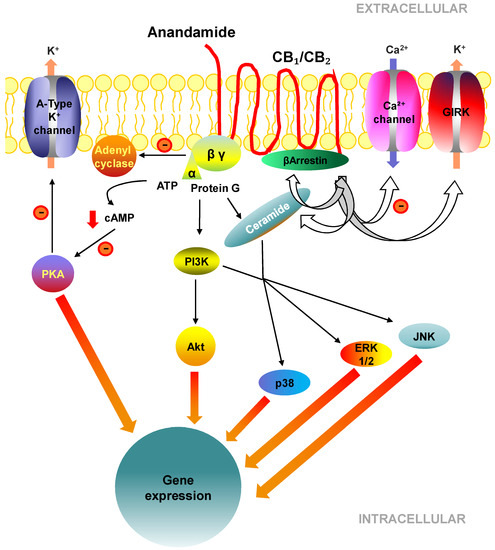
cells-logo“Hepatic fibrosis is the consequence of an unresolved wound healing process in response to chronic liver injury and involves multiple cell types and molecular mechanisms. The hepatic endocannabinoid and apelin systems are two signalling pathways with a substantial role in the liver fibrosis pathophysiology-both are upregulated in patients with advanced liver disease. Endogenous cannabinoids are lipid-signalling molecules derived from arachidonic acid involved in the pathogenesis of cardiovascular dysfunction, portal hypertension, liver fibrosis, and other processes associated with hepatic disease through their interactions with the CB1 and CB2 receptors. Apelin is a peptide that participates in cardiovascular and renal functions, inflammation, angiogenesis, and hepatic fibrosis through its interaction with the APJ receptor. The endocannabinoid and apelin systems are two of the multiple cell-signalling pathways involved in the transformation of quiescent hepatic stellate cells into myofibroblast like cells, the main matrix-producing cells in liver fibrosis. The mechanisms underlying the control of hepatic stellate cell activity are coincident despite the marked dissimilarities between the endocannabinoid and apelin signalling pathways. This review discusses the current understanding of the molecular and cellular mechanisms by which the hepatic endocannabinoid and apelin systems play a significant role in the pathophysiology of liver fibrosis.”
https://www.ncbi.nlm.nih.gov/pubmed/31653030

https://www.mdpi.com/2073-4409/8/11/1311

Medical Marijuana Guidelines for Practice: Health Policy Implications.

Journal of Pediatric Health Care Home“Cannabis use in pediatric health care remains limited, however, there is increasing evidence on the pharmacologic benefits of medical marijuana for chronic conditions in childhood. Realizing the need for guidance in practice, the National Council of State Boards of Nursing (NCSBN) published guidelines to aid in decision making in nursing practice. While focusing primarily on adult use of cannabis, the guidelines do address special populations such as children and adolescents. This article reviews the endocannabinoid system, current state of legislation on medical marijuana, policy considerations, recent FDA approval of a cannabis product for pediatric use, NCSBN National Nursing Guidelines for Medical Marijuana, and pediatric implications for nursing practice.”

https://www.ncbi.nlm.nih.gov/pubmed/31655786

https://www.jpedhc.org/article/S0891-5245(19)30399-2/fulltext

A time-dependent contribution of hippocampal CB1, CB2, and PPARγ receptors to cannabidiol-induced disruption of fear memory consolidation.

Publication cover image“Preclinical studies have shown that cannabidiol (CBD) mitigates fear memories by facilitating their extinction or interfering with their generalization and reconsolidation. The brain regions and mechanisms underlying these effects, and their temporal window, are still poorly understood. The present paper aimed at investigating related questions in the dorsal hippocampus (DH) during contextual fear consolidation.
KEY RESULTS:

CBD impaired memory consolidation when given immediately or 1 h after fear conditioning, but not after 3 h. The DH Arc expression was reduced by systemic CBD treatment in both cases. Immediately after fear conditioning, the CBD effect was abolished by CB1 or CB2 receptor blockade, partly reduced by 5-HT1A or A2A antagonism, and remained unchanged after antagonism of PPARγ receptors. 1 h after fear conditioning, the CBD effect was only prevented by PPARγ receptor antagonism. Besides, the FAAH inhibition impaired memory consolidation when URB597 was infused immediately, but not 1 hour after fear conditioning.

CONCLUSIONS AND IMPLICATIONS:

CBD disrupts memory consolidation up to 1 h after fear conditioning, allowing an extended window of opportunity to mitigate aversive memories after their acquisition. The results suggest time-dependent participation of DH anandamide, CB1, CB2, and PPARγ receptors in this process.”

https://www.ncbi.nlm.nih.gov/pubmed/31648363

https://bpspubs.onlinelibrary.wiley.com/doi/abs/10.1111/bph.14895

Cannabidiol and Cannabinoid Compounds as Potential Strategies for Treating Parkinson’s Disease and L-DOPA-Induced Dyskinesia.

 “Parkinson’s disease (PD) and L-DOPA-induced dyskinesia (LID) are motor disorders with significant impact on the patient’s quality of life. Unfortunately, pharmacological treatments that improve these disorders without causing severe side effects are not yet available. Delay in initiating L-DOPA is no longer recommended as LID development is a function of disease duration rather than cumulative L-DOPA exposure.

Manipulation of the endocannabinoid system could be a promising therapy to control PD and LID symptoms.

In this way, phytocannabinoids and synthetic cannabinoids, such as cannabidiol (CBD), the principal non-psychotomimetic constituent of the Cannabis sativa plant, have received considerable attention in the last decade.

In this review, we present clinical and preclinical evidence suggesting CBD and other cannabinoids have therapeutic effects in PD and LID. Here, we discuss CBD pharmacology, as well as its neuroprotective effects and those of other cannabinoids.

Finally, we discuss the modulation of several pro- or anti-inflammatory factors as possible mechanisms responsible for the therapeutic/neuroprotective potential of Cannabis-derived/cannabinoid synthetic compounds in motor disorders.”

https://www.ncbi.nlm.nih.gov/pubmed/31637586

https://link.springer.com/article/10.1007%2Fs12640-019-00109-8

The endocannabinoid system: Novel targets for treating cancer induced bone pain.

Biomedicine & Pharmacotherapy“Treating Cancer-induced bone pain (CIBP) continues to be a major clinical challenge and underlying mechanisms of CIBP remain unclear.

Recently, emerging body of evidence suggested the endocannabinoid system (ECS) may play essential roles in CIBP. Here, we summarized the current understanding of the antinociceptive mechanisms of endocannabinoids in CIBP and discussed the beneficial effects of endocannabinoid for CIBP treatment.

Targeting non-selective cannabinoid 1 receptors or selective cannabinoid 2 receptors, and modulation of peripheral AEA and 2-AG, as well as the inhibition the function of fatty acid amide hydrolase (FAAH) and monoacylglycerol lipase (MAGL) have produced analgesic effects in animal models of CIBP.

Management of ECS therefore appears to be a promising way for the treatment of CIBP in terms of efficacy and safety. Further clinical studies are encouraged to confirm the possible translation to humans of the very promising results already obtained in the preclinical studies.”

https://www.ncbi.nlm.nih.gov/pubmed/31627091

“Thus, cannabinoids may be clinically useful for treating chronic pain and CIBP.”

https://www.sciencedirect.com/science/article/pii/S075333221933731X?via%3Dihub

Ligands of the CB2 cannabinoid receptors augment activity of the conventional antidepressant drugs in the behavioural tests in mice.

Behavioural Brain Research“Although a lot of information can be found on the specific dual role of the endocannabinoid system in the emotional-related responses, little is known whether stimulation or inhibition of the CB receptors may affect the activity of the frequently prescribed antidepressant drugs.

Our interests have been particularly focused on the potential influence of the CB2 receptors, as the ones whose central effects are relatively poorly documented when compared to the central effects of the CB1 receptors. Therefore, we evaluated the potential interaction between the CB2 receptor ligands (i.e., JWH133 – CB2 receptor agonist and AM630 – CB2 receptor inverse agonist) and several common antidepressant drugs that influence the monoaminergic system (i.e., imipramine, escitalopram, reboxetine).

Summarizing, the results of the present study revealed that both activation and inhibition of the CB2 receptor function have a potential to strengthen the antidepressant activity of drugs targeting the monoaminergic system. Most probably, the described interaction has a pharmacodynamic background.”

https://www.ncbi.nlm.nih.gov/pubmed/31626848

“Interplay between CB2 receptor ligands and antidepressants is pharmacodynamic in nature.”

https://www.sciencedirect.com/science/article/pii/S0166432819311891?via%3Dihub

Systematic Affinity Purification Coupled to Mass Spectrometry Identified p62 as Part of the Cannabinoid Receptor CB2 Interactome.

Image result for frontiers in molecular neuroscience“The endocannabinoid system (ECS) consists particularly of cannabinoid receptors 1 and 2 (CB1 and CB2), their endogenous ligands, and enzymes that synthesize and degrade their ligands. It acts in a variety of organs and disease states ranging from cancer progression over neuropathic pain to neurodegeneration. Protein components engaged in the signaling, trafficking, and homeostasis machinery of the G-protein coupled CB2, are however largely unknown. It is therefore important to identify further interaction partners to better understand CB2 receptor functions in physiology and pathophysiology. For this purpose, we used an affinity purification and mass spectrometry-based proteomics approach of Strep-HA-CB2 receptor in HEK293 cells. After subtraction of background interactions and protein frequency library assessment we could identify 83 proteins that were classified by the identification of minimally 2 unique peptides as highly probable interactors. A functional protein association network analysis obtained an interaction network with a significant enrichment of proteins functionally involved in protein metabolic process, in endoplasmic reticulum, response to stress but also in lipid metabolism and membrane organization. The network especially contains proteins involved in biosynthesis and trafficking like calnexin, Sec61A, tubulin chains TUBA1C and TUBB2B, TMED2, and TMED10. Six proteins that were only expressed in stable CB2 expressing cells were DHC24, DHRS7, GGT7, HECD3, KIAA2013, and PLS1. To exemplify the validity of our approach, we chose a candidate having a relatively low number of edges in the network to increase the likelihood of a direct protein interaction with CB2 and focused on the scaffold/phagosomal protein p62/SQSTM1. Indeed, we independently confirmed the interaction by co-immunoprecipitation and immunocytochemical colocalization studies. 3D reconstruction of confocal images furthermore showed CB2 localization in close proximity to p62 positive vesicles at the cell membrane. In summary, we provide a comprehensive repository of the CB2 interactome in HEK293 cells identified by a systematic unbiased approach, which can be used in future experiments to decipher the signaling and trafficking complex of this cannabinoid receptor. Future studies will have to analyze the exact mechanism of the p62-CB2 interaction as well as its putative role in disease pathophysiology.”

https://www.ncbi.nlm.nih.gov/pubmed/31616248

https://www.frontiersin.org/articles/10.3389/fnmol.2019.00224/full

Cannabinoid Receptor Interacting Protein 1a (CRIP1a): Function and Structure.

molecules-logo“Cannabinoid receptor interacting protein 1a (CRIP1a) is an important CB1 cannabinoid receptor-associated protein, first identified from a yeast two-hybrid screen to modulate CB1-mediated N-type Ca2+ currents. In this paper we review studies of CRIP1a function and structure based upon in vitro experiments and computational chemistry, which elucidate the specific mechanisms for the interaction of CRIP1a with CB1 receptors. N18TG2 neuronal cells overexpressing or silencing CRIP1a highlighted the ability of CRIP1 to regulate cyclic adenosine 3′,5’monophosphate (cAMP) production and extracellular signal-regulated kinase (ERK1/2) phosphorylation. These studies indicated that CRIP1a attenuates the G protein signaling cascade through modulating which Gi/o subtypes interact with the CB1 receptor. CRIP1a also attenuates CB1 receptor internalization via β-arrestin, suggesting that CRIP1a competes for β-arrestin binding to the CB1 receptor. Predictions of CRIP1a secondary structure suggest that residues 34-110 are minimally necessary for association with key amino acids within the distal C-terminus of the CB1 receptor, as well as the mGlu8a metabotropic glutamate receptor. These interactions are disrupted through phosphorylation of serines and threonines in these regions. Through investigations of the function and structure of CRIP1a, new pharmacotherapies based upon the CRIP-CB1 receptor interaction can be designed to treat diseases such as epilepsy, motor dysfunctions and schizophrenia.”

https://www.ncbi.nlm.nih.gov/pubmed/31614728

https://www.mdpi.com/1420-3049/24/20/3672

The Endocannabinoid System as a Window Into Microglial Biology and Its Relationship to Autism.

Image result for frontiers in cellular neuroscience“Microglia are the resident, innate immune cells of the central nervous system (CNS) and are critical in managing CNS injuries and infections. Microglia also maintain CNS homeostasis by influencing neuronal development, viability, and function. However, aberrant microglial activity and phenotypes are associated with CNS pathology, including autism spectrum disorder (ASD). Thus, improving our knowledge of microglial regulation could provide insights into the maintenance of CNS homeostasis as well as the prevention and treatment of ASD.

Control of microglial activity is in part overseen by small, lipid-derived molecules known as endogenous cannabinoids (endocannabinoids). Endocannabinoids are one component of the endocannabinoid system (ECS), which also includes the enzymes that metabolize these ligands, in addition to cannabinoid receptor 1 (CB1) and 2 (CB2).

Interestingly, increased ECS signaling leads to an anti-inflammatory, neuroprotective phenotype in microglia. Here, we review the literature and propose that ECS signaling represents a largely untapped area for understanding microglial biology and its relationship to ASD, with special attention paid to issues surrounding the use of recreational cannabis (marijuana). We also discuss major questions within the field and suggest directions for future research.”

https://www.ncbi.nlm.nih.gov/pubmed/31619967

“Microglial activity can be modulated by eCB signaling, which makes the ECS a potentially forceful tool in the prevention and management of CNS dysfunction.”

https://www.frontiersin.org/articles/10.3389/fncel.2019.00424/full