

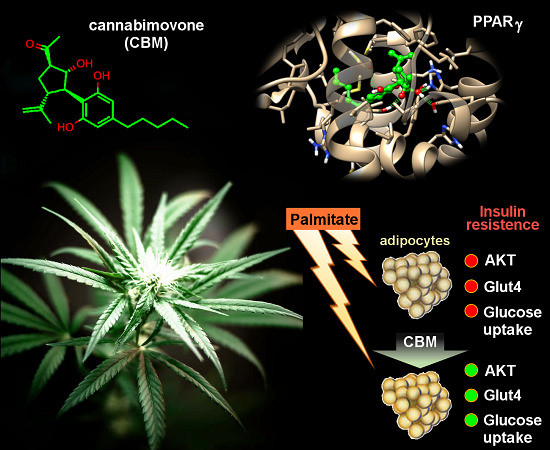
Identification and Characterization of Cannabimovone, a Cannabinoid from Cannabis sativa, as a Novel PPARγ Agonist via a Combined Computational and Functional Study.

 molecules-logo“Phytocannabinoids (pCBs) are a large family of meroterpenoids isolated from the plant Cannabis sativa. Δ9-Tetrahydrocannabinol (THC) and cannabidiol (CBD) are the best investigated phytocannabinoids due to their relative abundance and interesting bioactivity profiles. In addition to various targets, THC and CBD are also well-known agonists of peroxisome proliferator-activated receptor gamma (PPARγ), a nuclear receptor involved in energy homeostasis and lipid metabolism. In the search of new pCBs potentially acting as PPARγ agonists, we identified cannabimovone (CBM), a structurally unique abeo-menthane pCB, as a novel PPARγ modulator via a combined computational and experimental approach. The ability of CBM to act as dual PPARγ/α agonist was also evaluated. Computational studies suggested a different binding mode toward the two isoforms, with the compound able to recapitulate the pattern of H-bonds of a canonical agonist only in the case of PPARγ. Luciferase assays confirmed the computational results, showing a selective activation of PPARγ by CBM in the low micromolar range. CBM promoted the expression of PPARγ target genes regulating the adipocyte differentiation and prevented palmitate-induced insulin signaling impairment. Altogether, these results candidate CBM as a novel bioactive compound potentially useful for the treatment of insulin resistance-related disorders.”

https://www.ncbi.nlm.nih.gov/pubmed/32138197

https://www.mdpi.com/1420-3049/25/5/1119
Safety Assessment of a Hemp Extract using Genotoxicity and Oral Repeat-Dose Toxicity Studies in Sprague-Dawley Rats

Toxicology Reports“Cannabinoids are extracted from Cannabis sativa L. and are used for a variety of medicinal purposes.

Recently, there has been a focus on the cannabinoid Cannabidiol (CBD) and its potential benefits.

This study investigated the safety of a proprietary extract of C. sativa, consisting of 9% hemp extract (of which 6.27% is CBD) and 91% olive oil.

Given the potential of CBD for a variety of human uses and the limited data currently available, these results support that hemp extracts are likely safe human consumption and additional studies should be conducted to validate this conclusion.”

https://www.sciencedirect.com/science/article/pii/S2214750019305207?via%3Dihub

Cannabidiol Effects on Phospholipid Metabolism in Keratinocytes from Patients with Psoriasis Vulgaris

biomolecules-logo“Psoriasis is a chronic inflammatory skin disease characterized by dysregulated keratinocyte differentiation, but oxidative stress also plays an important role in the pathogenesis of this disease.

Here, we examined the effect of cannabidiol (CBD), a phytocannabinoid with antioxidant and anti-inflammatory properties, on the redox balance and phospholipid metabolism in UVA/UVB-irradiated keratinocytes isolated from the skin of psoriatic patients or healthy volunteers.

We conclude that CBD partially reduces oxidative stress in the keratinocytes of healthy individuals, while showing a tendency to increase the oxidative and inflammatory state in the keratinocytes of patients with psoriasis, especially following UV-irradiation.”

https://www.mdpi.com/2218-273X/10/3/367

The effects of acute and sustained cannabidiol dosing for seven days on the haemodynamics in healthy men: A randomised controlled trial.

British Journal of Clinical Pharmacology“In vivo studies show that cannabidiol (CBD) acutely reduces blood pressure (BP) in men.

The aim of this study was to assess the effects of repeated CBD dosing on haemodynamics.

RESULTS:

Compared to placebo, CBD significantly reduced resting mean arterial pressure (P = .04, two-way ANOVA, mean difference (MD) -2 mmHg, 95% CI -3.6 to -0.3) after acute dosing, but not after repeated dosing. In response to stress, volunteers who had taken CBD had lower systolic BP after acute (P = .001, two-way ANOVA, MD -6 mmHg, 95% CI -10 to -1) and repeated (P = .02, two-way ANOVA, MD -5.7 mmHg, 95% CI -10 to -1) dosing. Seven days of CBD increased internal carotid artery diameter (MD +0.55 mm, P = .01). Within the CBD group, repeated dosing reduced arterial stiffness by day 7 (pulse wave velocity; MD -0.44 m/s, P = .05) and improved endothelial function (flow mediation dilatation, MD +3.5%, P = .02, n = 6 per group), compared to day 1.

CONCLUSION:

CBD reduces BP at rest after a single dose but the effect is lost after seven days of treatment (tolerance); however, BP reduction during stress persists. The reduction in arterial stiffness and improvements in endothelial function after repeated CBD dosing are findings that warrant further investigation in populations with vascular diseases.”

https://www.ncbi.nlm.nih.gov/pubmed/32128848

https://bpspubs.onlinelibrary.wiley.com/doi/abs/10.1111/bcp.14225

Hempseed Lignanamides Rich-Fraction: Chemical Investigation and Cytotoxicity towards U-87 Glioblastoma Cells.

molecules-logo “The weak but noteworthy presence of (poly)phenols in hemp seeds has been long overshadowed by the essential polyunsaturated fatty acids and digestible proteins, considered responsible for their high nutritional benefits. Instead, lignanamides and their biosynthetic precursors, phenylamides, seem to display interesting and diverse biological activities only partially clarified in the last decades. Herein, negative mode HR-MS/MS techniques were applied to the chemical investigation of a (poly)phenol-rich fraction, obtained from hemp seeds after extraction/fractionation steps. This extract contained phenylpropanoid amides and their random oxidative coupling derivatives, lignanamides, which were the most abundant compounds and showed a high chemical diversity, deeply unraveled through high resolution tandem mass spectrometry (HR-MS/MS) tools.

The effect of different doses of the lignanamides-rich extract (LnHS) on U-87 glioblastoma cell line and non-tumorigenic human fibroblasts was evaluated. Thus, cell proliferation, genomic DNA damage, colony forming and wound repair capabilities were assessed, as well as LnHS outcome on the expression levels of pro-inflammatory cytokines. LnHS significantly inhibited U-87 cancer cell proliferation, but not that of fibroblasts, and was able to reduce U-87 cell migration, inducing further DNA damage. No modification in cytokines’ expression level was found. Data acquired suggested that LnHS acted in U-87 cells by inducing the apoptosis machinery and suppressing the autophagic cell death.”

https://www.ncbi.nlm.nih.gov/pubmed/32110947

https://www.mdpi.com/1420-3049/25/5/1049

The implications of late-life cannabis use on brain health: A mapping review and implications for future research.

Ageing Research Reviews“While medical and recreational cannabis use is becoming more frequent among older adults, the neurocognitive consequences of cannabis use in this age group are unclear. The aim of this literature review was to synthesize and evaluate the current knowledge on the association of cannabis use during older-adulthood with cognitive function and brain aging.

We reviewed the literature from old animal models and human studies while focusing on the link of middle- and old-age use of cannabis with cognition. The report highlights the gap in knowledge on cannabis use in late-life and cognitive health, and discusses the limited findings in the context of substantial changes in attitudes and policies. Furthermore, we outline possible theoretical mechanisms and propose recommendations for future research.

The limited evidence on this important topic suggests that use in older ages may not be linked with poorer cognitive performance, thus detrimental effects of early-life cannabis use may not translate to use in older ages. Rather, use in old ages may be associated with improved brain health, in accordance with the known neuroprotective properties of several cannabinoids.”

https://www.ncbi.nlm.nih.gov/pubmed/32109605

“Cannabis use in older ages may be associated with improved brain health.”

https://www.sciencedirect.com/science/article/pii/S1568163719303204?via%3Dihub

Dose-Ranging Effect of Adjunctive Oral Cannabidiol vs Placebo on Convulsive Seizure Frequency in Dravet Syndrome: A Randomized Clinical Trial.

Image result for jama neurology“Clinical evidence supports effectiveness of cannabidiol for treatment-resistant seizures in Dravet syndrome, but this trial is the first to evaluate the 10-mg/kg/d dose.
OBJECTIVE:

To evaluate the efficacy and safety of a pharmaceutical formulation of cannabidiol, 10 and 20 mg/kg/d, vs placebo for adjunctive treatment of convulsive seizures in patients with Dravet syndrome.

MAIN OUTCOMES AND MEASURES:

The primary outcome was change from baseline in convulsive seizure frequency during the treatment period. Secondary outcomes included change in all seizure frequency, proportion with at least a 50% reduction in convulsive seizure activity, and change in Caregiver Global Impression of Change score.

RESULTS:

Of 198 eligible patients (mean [SD] age, 9.3 [4.4] years; 104 female [52.5%]), 66 were randomized to the CBD10 group, 67 to the CBD20 group, and 65 to the placebo group, and 190 completed treatment. The percentage reduction from baseline in convulsive seizure frequency was 48.7% for CBD10 group and 45.7% for the CBD20 group vs 26.9% for the placebo group; the percentage reduction from placebo was 29.8% (95% CI, 8.4%-46.2%; P = .01) for CBD10 group and 25.7% (95% CI, 2.9%-43.2%; P = .03) for the CBD20 group. The most common adverse events were decreased appetite, diarrhea, somnolence, pyrexia, and fatigue. Five patients in the CBD20 group discontinued owing to adverse events. Elevated liver transaminase levels occurred more frequently in the CBD20 (n = 13) than the CBD10 (n = 3) group, with all affected patients given concomitant valproate sodium.

CONCLUSIONS AND RELEVANCE:

Adjunctive cannabidiol at doses of 10 and 20 mg/kg/d led to similar clinically relevant reductions in convulsive seizure frequency with a better safety and tolerability profile for the 10-mg/kg/d dose in children with treatment-resistant Dravet syndrome. Dose increases of cannabidiol to greater than 10 mg/kg/d should be tailored to individual efficacy and safety.”

https://www.ncbi.nlm.nih.gov/pubmed/32119035

https://jamanetwork.com/journals/jamaneurology/fullarticle/2762458

Chronic Treatment with 50 mg/kg Cannabidiol Improves Cognition and Moderately Reduces Aβ42 Levels in 12-Month-Old Male AβPPswe/PS1ΔE9 Transgenic Mice.

Image result for j alzheimers dis“Alzheimer’s disease (AD) is characterized by progressive cognitive decline and pathologically by the accumulation of amyloid-β (Aβ) and tau hyperphosphorylation causing neurodegeneration and neuroinflammation. Current AD treatments do not stop or reverse the disease progression, highlighting the need for more effective therapeutics.

The phytocannabinoid cannabidiol (CBD) has demonstrated antioxidant, anti-inflammatory, and neuroprotective properties. Furthermore, chronic CBD treatment (20 mg/kg) reverses social and object recognition memory deficits in the AβPPxPS1 transgenic mouse model with only limited effects on AD-relevant brain pathology.

Importantly, studies have indicated that CBD works in a dose-dependent manner. Thus, this study determined the chronic effects of 50 mg/kg CBD in male AβPPxPS1 mice. 12-month-old mice were treated with 50 mg/kg CBD or vehicle via daily intraperitoneal injections for 3 weeks prior to behavioral testing. A variety of cognitive domains including object and social recognition, spatial and fear-associated memory were evaluated. Pathological brain analyses for AD-relevant markers were conducted using ELISA and western blot.

Vehicle-treated male AβPPxPS1 mice demonstrated impaired social recognition memory and reversal spatial learning. These deficits were restored after CBD treatment. Chronic CBD tended to reduce insoluble Aβ40 levels in the hippocampus of AβPPxPS1 mice but had no effect on neuroinflammation, neurodegeneration, or PPARγ markers in the cortex.

This study demonstrates that therapeutic-like effects of 50 mg/kg CBD on social recognition memory and spatial learning deficits in AβPPxPS1 mice are accompanied by moderate brain region-specific reductions in insoluble Aβ40 levels. The findings emphasize the clinical relevance of CBD treatment in AD; however, the underlying mechanisms involved require further investigation.”

Overview of cannabidiol (CBD) and its analogues: Structures, biological activities, and neuroprotective mechanisms in epilepsy and Alzheimer’s disease.

European Journal of Medicinal Chemistry“Herein, 11 general types of natural cannabinoids from Cannabis sativa as well as 50 (-)-CBD analogues with therapeutic potential were described. The underlying molecular mechanisms of CBD as a therapeutic candidate for epilepsy and neurodegenerative diseases were comprehensively clarified. CBD indirectly acts as an endogenous cannabinoid receptor agonist to exert its neuroprotective effects. CBD also promotes neuroprotection through different signal transduction pathways mediated indirectly by cannabinoid receptors. Furthermore, CBD prevents the glycogen synthase kinase 3β (GSK-3β) hyperphosphorylation caused by Aβ and may be developed as a new therapeutic candidate for Alzheimer’s disease.”


https://www.ncbi.nlm.nih.gov/pubmed/32109623

“For AD treatment, CBD can rescue the production of neurofibrillary tangles and inhibit neuronal apoptosis.”

https://www.sciencedirect.com/science/article/abs/pii/S0223523420301306?via%3DihubImage 1

A Review of Scientific Evidence for THC:CBD Oromucosal Spray (Nabiximols) in the Management of Chronic Pain.

“The 20% prevalence of chronic pain in the general population is a major health concern given the often profound associated impairment of daily activities, employment status, and health-related quality of life in sufferers. Resource utilization associated with chronic pain represents an enormous burden for healthcare systems. Although analgesia based on the World Health Organization’s pain ladder continues to be the mainstay of chronic pain management, aside from chronic cancer pain or end-of-life care, prolonged use of non-steroidal anti-inflammatory drugs or opioids to manage chronic pain is rarely sustainable.

As the endocannabinoid system is known to control pain at peripheral, spinal, and supraspinal levels, interest in medical use of cannabis is growing.

A proprietary blend of cannabis plant extracts containing delta-9-tetrahydrocannabinol (THC) and cannabidiol (CBD) as the principal cannabinoids is formulated as an oromucosal spray (USAN name: nabiximols) and standardized to ensure quality, consistency and stability. This review examines evidence for THC:CBD oromucosal spray (nabiximols) in the management of chronic pain conditions.

Cumulative evidence from clinical trials and an exploratory analysis of the German Pain e-Registry suggests that add-on THC:CBD oromucosal spray (nabiximols) may have a role in managing chronic neuropathic pain, although further precise clinical trials are required to draw definitive conclusions.”

https://www.ncbi.nlm.nih.gov/pubmed/32104061

https://www.dovepress.com/a-review-of-scientific-evidence-for-thccbd-oromucosal-spray-nabiximols-peer-reviewed-article-JPR

“Smoked Cannabis Proven Effective In Treating Neuropathic Pain.” https://www.sciencedaily.com/releases/2007/10/071024141745.htm

“Marijuana Relieves Chronic Pain, Research Shows” https://www.webmd.com/pain-management/news/20100830/marijuana-relieves-chronic-pain-research-show#1