Brain-Imaging Study Links Cannabinoid Receptors to Post-Traumatic Stress Disorder: First Pharmaceutical Treatment for PTSD Within Reach

“In a first-of-its-kind effort to illuminate the biochemical impact of trauma, researchers at NYU Langone Medical Center have discovered a connection between the quantity of cannabinoid receptors in the human brain, known as CB1 receptors, and post-traumatic stress disorder, the chronic, disabling condition that can plague trauma victims with flashbacks, nightmares and emotional instability…

CB1 receptors are part of the endocannabinoid system, a diffuse network of chemicals and signaling pathways in the body that plays a role in memory formation, appetite, pain tolerance and mood. Animal studies have shown that psychoactive chemicals such as cannabis, along with certain neurotransmitters produced naturally in the body, can impair memory and reduce anxiety when they activate CB1 receptors in the brain…

“There’s not a single pharmacological treatment out there that has been developed specifically for PTSD,” says Dr. Neumeister. “That’s a problem. There’s a consensus among clinicians that existing pharmaceutical treatments such as antidepressant simple do not work. In fact, we know very well that people with PTSD who use marijuana — a potent cannabinoid — often experience more relief from their symptoms than they do from antidepressants and other psychiatric medications. Clearly, there’s a very urgent need to develop novel evidence-based treatments for PTSD.”

Read more: http://www.sciencedaily.com/releases/2013/05/130514085016.htm

Using medical marijuana to ease pain

“NORWICH, Conn. (WTNH) –The 31-year-old Norwich man was arrested for growing marijuana inside his home, but says he was only trying to ease his pain.

Tuesday, a Norwich man was in court facing drug charges. Wednesday, he felt comfortable enough to show News 8 how he uses medical marijuana to ease his pain.

31-year-old Joseph Tamborra says the effects are immediate.

“What is the difference after you take a hit,” asked News 8’s Tina Detelj.

“Uhhh it just takes my nausea completely away. It’s like night and day,” Tamborra said.

Relief from nausea caused by his Crones Disease and the pain from a hip and back injury after a car accident.

“I don’t have any cartilage in my hip,” Tamborra said.

It was too much to take, so he took matters into his own hands growing pot plants in a second floor bedroom of his Norwich home. However, that’s illegal and he was arrested for possession and operating a drug factory.

While his court case continued he received his medical marijuana card in March. A picture shows him after losing 90 pounds, unable to smoke after his arrest and too nauseous to eat.

“That helped me out like tremendously,” he said. “Once they realized okay there’s a reason for him doing this.”

At New London Superior Court Tamborra was ordered to perform community services and the charges will go away, but he’s still faced with a dilemma. He says because the medical marijuana law is so new there’s no process in place for him to buy the medical marijuana.

“Hopefully mid-summer, by the end of the year, they might have a dispensary or two set up,” Tamborra said. “I’ve also heard they might just limit it to pharmacies, I’m not really sure.”

The state says it is still working on how the medical marijuana will be dispensed and who can be a licensed producer.”

-Tina Detelj

http://www.wtnh.com/dpp/news/new_london_cty/using-medical-marijuana-to-ease-pain#.UYu7Dcp48Qs


Cannabis for Ulcerative Colitis and Crohn’s Disease treatment

“Chemicals found in cannabis could prove an effective treatment for the inflammatory bowel diseases Ulcerative Colitis and Crohn’s Disease, say scientists.

Laboratory tests have shown that two compounds found in the cannabis plant – the cannabinoids THC and cannabidiol – interact with the body’s system that controls gut function.

Crohn’s Disease and Ulcerative Colitis, which affect about one in every 250 people in Northern Europe, are caused by both genetic and environmental factors. The researchers believe that a genetic susceptibility coupled with other triggers, such as diet, stress or bacterial imbalance, leads to a defective immune response.

Dr Karen Wright, Peel Trust Lecturer in Biomedicine at Lancaster University, will be presenting her soon-to-be published work at The British Pharmacological Society’s Winter Meeting in London today (Thursday).

She said: “The lining of the intestines provides a barrier against the contents of the gut but in people with Crohn’s Disease this barrier leaks and bacteria can escape into the intestinal tissue leading to an inappropriate immune response.

“If we could find a way to restore barrier integrity in patients we may be able to curb the inflammatory immune response that causes these chronic conditions.”

Dr Wright, working with colleagues at the School of Graduate Entry Medicine and Health in Derby, has shown that cells that react to cannabinoid compounds play an important role in normal gut function as well as the immune system’s inflammatory response.

“The body produces its own cannabinoid molecules, called endocannabinoids, which we have shown increase the permeability of the epithelium during inflammation, implying that overproduction may be detrimental,” said Dr Wright.

“However, we were able to reverse this process using plant-derived cannabinoids, which appeared to allow the epithelial cells to form tighter bonds with each other and restore the membrane barrier.”

The research was carried out using cell cultures in a dish but, interestingly, when the team attempted to mimic the conditions of the gut by reducing the amount of oxygen in the cells’ environment, much lower concentrations of cannabinoid were needed to produce the same effect.

Dr Wright added: “What is also encouraging is that while THC has psychoactive properties and is responsible for the ‘high’ people experience when using cannabis, cannabidiol, which has also proved effective in restoring membrane integrity, does not possess such properties.”

The British Pharmacological Society (BPS) – the primary UK learned society concerned with research into drugs and the way they work – is hosting its annual Winter Meeting in London, attracting experts from across the world.

The three-day conference, running from 15 to 17 December 2009, will hear presentations on the latest pharmacological developments to tackle a range of conditions and diseases.”

http://www.news-medical.net/news/20091217/Cannabis-for-Ulcerative-Colitis-and-Crohns-Disease-treatment.aspx

Cannabis Induces a Clinical Response in Patients with Crohn’s Disease: a Prospective Placebo-Controlled Study.

“The marijuana plant Cannabis sativa has been reported to produce beneficial effects for patients with inflammatory bowel diseases, but these have not been investigated in controlled trials. We performed a prospective trial to determine whether cannabis can induce remission in patients with Crohn’s disease…

Complete remission was achieved by 5/11 subjects in the cannabis group (45%)… Three patients in the cannabis group were weaned from steroid dependency. Subjects receiving cannabis reported improved appetite and sleep, with no significant side effects.

CONCLUSION:

Although the primary endpoint of the study (induction of remission) was not achieved, a short course (8 week) of THC-rich cannabis produced significant clinical, steroid-free benefits to 11 patients with active CD, compared to placebo, without side effects.

Further studies, with larger patient groups and a non-smoking mode of intake, are warranted. ClinicalTrials.gov NCT01040910.”

http://www.ncbi.nlm.nih.gov/pubmed/23648372

Treatment of Crohn’s Disease with Cannabis: An Observational Study

“The marijuana plant cannabis is known to have therapeutic effects, including improvement of inflammatory processes. However, no report of patients using cannabis for Crohn’s disease (CD) was ever published.

OBJECTIVES:

To describe the effects of cannabis use in patients suffering from CD.

RESULTS:

Of the 30 patients 21 improved significantly after treatment with cannabis… The need for other medication was significantly reduced. Fifteen of the patients had 19 surgeries during an average period of 9 years before cannabis use, but only 2 required surgery during an average period of 3 years of cannabis use.

CONCLUSIONS:

This is the first report of cannabis use in Crohn’s disease in humans. The results indicate that cannabis may have a positive effect on disease activity, as reflected by reduction in disease activity index and in the need for other drugs and surgery. Prospective placebo-controlled studies are warranted to fully evaluate the efficacy and side effects of cannabis in CD.”

Full Text: http://www.ima.org.il/IMAJ/ViewArticle.aspx?year=2011&month=08&page=455

Cannabinoids for gastrointestinal diseases: potential therapeutic applications.

“Delta(9)-Tetrahydrocannabinol (the active ingredient of marijuana), as well as endogenous and synthetic cannabinoids, exert many biological functions by activating two types of cannabinoid receptors, CB(1) and CB(2) receptors. CB(1) receptors have been detected on enteric nerves, and pharmacological effects of their activation include gastroprotection, reduction of gastric and intestinal motility and reduction of intestinal secretion.

 The digestive tract also contains endogenous cannabinoids (i.e., the endocannabinoids anandamide and 2-aracidonylglycerol) and mechanisms for endocannabinoid inactivation (i.e., endocannabinoids uptake and enzymatic degradation). Cannabinoid receptors, endocannabinoids and the proteins involved in endocannabinoids inactivation are collectively referred as the ‘endogenous cannabinoid system’.

 A pharmacological modulation of the endogenous cannabinoid system could provide new therapeutics for the treatment of a number of gastrointestinal diseases, including nausea and vomiting, gastric ulcers, irritable bowel syndrome, Crohn’s disease, secretory diarrhoea, paralytic ileus and gastroesophageal reflux disease. Some cannabinoids are already in use clinically, for example, nabilone and delta(9)-tetrahydrocannabinol are used as antiemetics.”

http://www.ncbi.nlm.nih.gov/pubmed/12517253

Endocannabinoids and the gastrointestinal tract.

“In the past centuries, different preparations of marijuana have been used for the treatment of gastrointestinal (GI) disorders, such as GI pain, gastroenteritis and diarrhea.

 Delta9-tetrahydrocannabinol (THC; the active component of marijuana), as well as endogenous and synthetic cannabinoids, exert their biological functions on the gastrointestinal tract by activating two types of cannabinoid receptors, cannabinoid type 1 receptor (CB1 receptor) and cannabinoid type 2 receptor (CB2 receptor). While CB1 receptors are located in the enteric nervous system and in sensory terminals of vagal and spinal neurons and regulate neurotransmitter release, CB2 receptors are mostly distributed in the immune system, with a role presently still difficult to establish.

Under pathophysiological conditions, the endocannabinoid system conveys protection to the GI tract, eg from inflammation and abnormally high gastric and enteric secretion.

 For such protective activities, the endocannabinoid system may represent a new promising therapeutic target against different GI disorders, including frankly inflammatory bowel diseases (eg, Crohn’s disease), functional bowel diseases (eg, irritable bowel syndrome), and secretion- and motility-related disorders.”

http://www.ncbi.nlm.nih.gov/pubmed/16751708

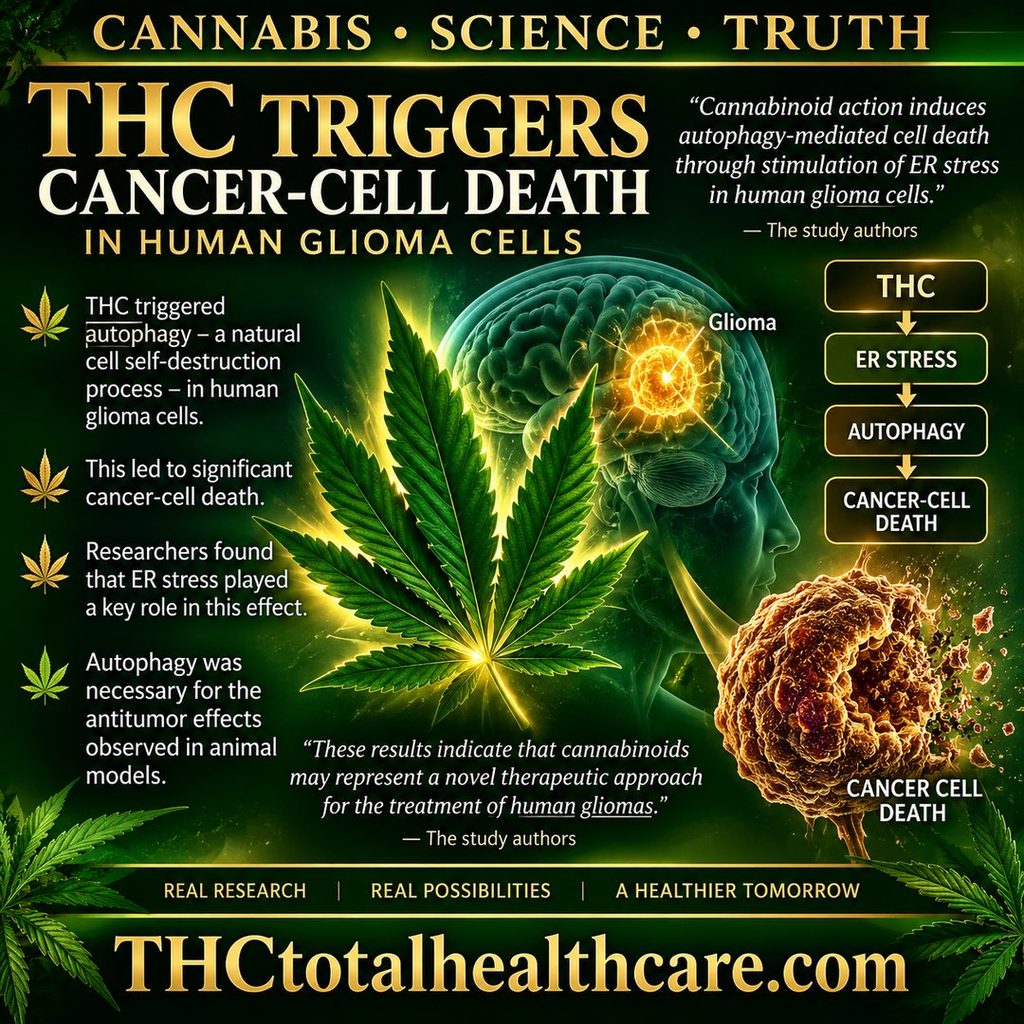
Cannabinoid action induces autophagy-mediated cell death through stimulation of ER stress in human glioma cells

THC triggered a self-destruction process called autophagy in human glioma cells, leading to cancer-cell death. Researchers also found that this pathway was necessary for the antitumor effects of cannabinoids observed in animal models.

“Autophagy can promote cell survival or cell death, but the molecular basis underlying its dual role in cancer remains obscure. Here we demonstrate that Δ9-tetrahydrocannabinol (THC), the main active component of marijuana, induces human glioma cell death through stimulation of autophagy…We also showed that autophagy is upstream of apoptosis in cannabinoid-induced human and mouse cancer cell death and that activation of this pathway was necessary for the antitumor action of cannabinoids in vivo.”

An external file that holds a picture, illustration, etc.<br />
Object name is JCI37948.f8.jpg

“These findings describe a mechanism by which THC can promote the autophagic death of human and mouse cancer cells and provide evidence that cannabinoid administration may be an effective therapeutic strategy for targeting human cancers.

Δ9-Tetrahydrocannabinol (THC), the main active component of marijuana, exerts a wide variety of biological effects by mimicking endogenous substances — the endocannabinoids — that bind to and activate specific cannabinoid receptors. One of the most exciting areas of research in the cannabinoid field is the study of the potential application of cannabinoids as antitumoral agents.

Cannabinoid administration has been found to curb the growth of several types of tumor xenografts in rats and mice…

 Considering that no signs of toxicity were observed in the clinical trial patients or in tumor-bearing animals treated intracranially, peritumorally, or intraperitoneally with THC, and that no overt toxic effects have been reported in other clinical trials of cannabinoid use in cancer patients for various applications (e.g., inhibition of nausea, vomiting, and pain) and using different routes of administration (e.g., oral, oro-mucosal) our findings support that safe, therapeutically efficacious doses of THC may be reached in cancer patients.”

 http://www.ncbi.nlm.nih.gov/pmc/articles/PMC2673842/

Need this THC study explained? thcXplained.com

Active Component Of Marijuana Has Anti-Cancer Effects, Study Suggests

“Guillermo Velasco and colleagues, at Complutense University, Spain, have provided evidence that suggests that cannabinoids such as the main active component of marijuana (THC) have anticancer effects on human brain cancer cells.

In the study, THC was found to induce the death of various human brain cancer cell lines and primary cultured human brain cancer cells by a process known as autophagy.

Consistent with the in vitro data, administration of THC to mice with human tumors decreased tumor growth and induced the tumor cells to undergo autophagy. As analysis of tumors from two patients with recurrent glioblastoma multiforme (a highly aggressive brain tumor) receiving intracranial THC administration showed signs of autophagy, the authors suggest that cannabinoid administration may provide a new approach to targeting human cancers.”  http://www.sciencedaily.com/releases/2009/04/090401181217.htm

“Cannabinoid action induces autophagy-mediated cell death through stimulation of ER stress in human glioma cells” https://www.jci.org/articles/view/37948


Antitumor Effects of THC.

“1-Trans-[delta.sup.9]-tetrahydrocannabinol (THC) the main active component of marijuana, has been shown to exhibit anticancer activity.

Galve-Roperh et al. reported that intratumoral administration of THC induces apoptosis of transformed neural cells in culture, and also induces a considerable regression of malignant gliomas in Wistar rats and in mice… These authors suggest that their “results may provide the basis for a new therapeutic approach for the treatment of malignant gliomas.”

Thus, in our studies, rats and mice that received THC for 2 years exhibited body weight reductions, enhanced survival rates, and decreased tumor incidences in several sites, mainly organs under hormonal control.

These earlier experimental carcinogenesis results on THC clearly lend further validity to the notion that cannabinoids may indeed be anticarcinogenic.”

http://www.thefreelibrary.com/Antitumor+Effects+of+THC.-a068148345

“Antitumor effects of THC.” http://www.ncbi.nlm.nih.gov/pubmed/11097557