Anandamide Is Able to Inhibit Trigeminal Neurons Using an in Vivo Model of Trigeminovascular-Mediated Nociception

Abstract

“Arachidonylethanolamide (anandamide, AEA) is believed to be the endogenous ligand of the cannabinoid CB(1) and CB(2) receptors. CB(1) receptors have been found localized on fibers in the spinal trigeminal tract and spinal trigeminal nucleus caudalis. Known behavioral effects of anandamide are antinociception, catalepsy, hypothermia, and depression of motor activity, similar to Delta(9)-tetrahydocannanbinol, the psychoactive constituent of cannabis. It may be a possible therapeutic target for migraine. In this study, we looked at the possible role of the CB(1) receptor in the trigeminovascular system, using intravital microscopy to study the effects of anandamide against various vasodilator agents. Anandamide was able to inhibit dural blood vessel dilation brought about by electrical stimulation by 50%, calcitonin gene-related peptide (CGRP) by 30%, capsaicin by 45%, and nitric oxide by 40%. CGRP(8-37) was also able to attenuate nitric oxide (NO)-induced dilation by 50%. The anandamide inhibition was reversed by the CB(1) receptor antagonist AM251. Anandamide also reduced the blood pressure changes caused by CGRP injection, this effect was not reversed by AM251. It would seem that anandamide acts both presynaptically, to prevent CGRP release from trigeminal sensory fibers, and postsynaptically to inhibit the CGRP-induced NO release in the smooth muscle of dural arteries. CB(1) receptors seem to be involved in the NO/CGRP relationship that exists in causing headache and dural blood vessel dilation. It also seems that some of the blood pressure changes caused by anandamide are mediated by a noncannabinoid receptor, as AM251 was unable to reverse these effects. It can be suggested that anandamide is tonically released to play some form of modulatory role in the trigeminovascular system.

The known behavioral effects of anandamide are similar to that of Δ9-tetrahydrocannabinol, the psychoactive constituent of cannabis, being antinociception, catalepsy, hypothermia, and depression of motor activity (Dewey, 1986; Adams et al., 1998). Although there is a history of anecdotal evidence suggesting the use of cannabinoids is effective at reducing headache and providing other pain relief, its potential as an acute migraine treatment and even preventive has never been scientifically studied in animal studies or clinical trial (Russo, 1998). However, one anonymous standardized survey found that of those using cannabis medicinally, over 10% were using it to relieve headache or migraine (Schnelle et al., 1999). Although many aspects of the study are open to debate, such as the highly selected nature of patient group, it is nevertheless an interesting observation.”

http://jpet.aspetjournals.org/content/309/1/56.long

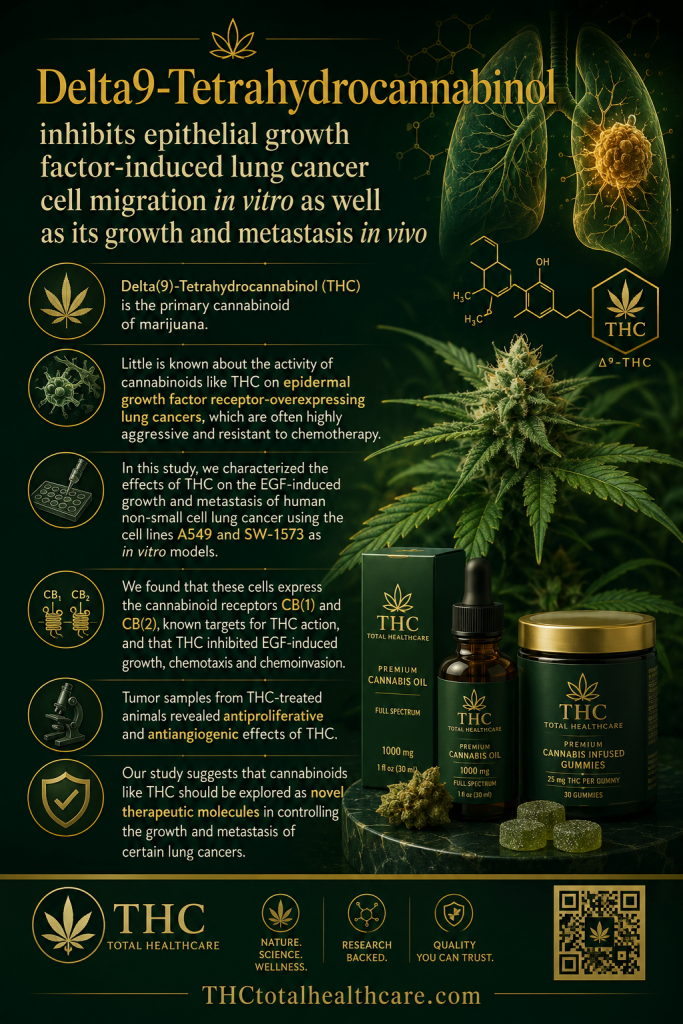
Delta9-Tetrahydrocannabinol inhibits epithelial growth factor-induced lung cancer cell migration in vitro as well as its growth and metastasis in vivo

Researchers investigated whether THC could interfere with the growth and spread of aggressive non-small-cell lung cancer. Using human A549 and SW-1573 lung cancer cells, they found that THC inhibited epidermal growth factor (EGF)-induced cancer-cell growth, migration and invasion. THC also disrupted several signaling pathways involved in cancer survival and movement, including ERK1/2, JNK1/2 and AKT.

The researchers then tested THC in mice implanted with human A549 lung cancer cells. Compared with control animals, THC-treated mice showed significant reductions in tumor growth and lung metastasis. Tumors from the THC-treated animals also showed reduced cell proliferation and blood-vessel formation. The authors concluded that cannabinoids such as THC should be further explored as potential therapeutic molecules for controlling the growth and metastasis of certain lung cancers

“Delta(9)-Tetrahydrocannabinol (THC) is the primary cannabinoid of marijuana and has been shown to either potentiate or inhibit tumor growth, depending on the type of cancer and its pathogenesis. Little is known about the activity of cannabinoids like THC on epidermal growth factor receptor-overexpressing lung cancers, which are often highly aggressive and resistant to chemotherapy.

In this study, we characterized the effects of THC on the EGF-induced growth and metastasis of human non-small cell lung cancer using the cell lines A549 and SW-1573 as in vitro models.

We found that these cells express the cannabinoid receptors CB(1) and CB(2), known targets for THC action, and that THC inhibited EGF-induced growth, chemotaxis and chemoinvasion.

Moreover, signaling studies indicated that THC may act by inhibiting the EGF-induced phosphorylation of ERK1/2, JNK1/2 and AKT. THC also induced the phosphorylation of focal adhesion kinase at tyrosine 397. Additionally, in in vivo studies in severe combined immunodeficient mice, there was significant inhibition of the subcutaneous tumor growth and lung metastasis of A549 cells in THC-treated animals as compared to vehicle-treated controls.

Tumor samples from THC-treated animals revealed antiproliferative and antiangiogenic effects of THC.

Our study suggests that cannabinoids like THC should be explored as novel therapeutic molecules in controlling the growth and metastasis of certain lung cancers.”

http://www.ncbi.nlm.nih.gov/pubmed/17621270

https://www.nature.com/articles/1210641

Need this THC study explained? thcXplained.com

Pot compound seen as tool against cancer

“Marijuana, already shown to reduce pain and nausea in cancer patients, may be promising as a cancer-fighting agent against some of the most aggressive forms of the disease.

A growing body of early research shows a compound found in marijuana – one that does not produce the plant’s psychotropic high – seems to have the ability to “turn off” the activity of a gene responsible for metastasis in breast and other types of cancers.

Two scientists at San Francisco’s California Pacific Medical Center Research Institute first released data five years ago that showed how this compound – called cannabidiol – reduced the aggressiveness of human breast cancer cells in the lab.”

Marijuana’s better known cannabinoid – delta-9 tetrahydrocannabinol, or THC – had already shown some anticancer properties in tumors, but the non-psychotropic cannabidiol had largely gone unstudied. McAllister initial research showed CBD had anticancer potential as well.”

http://www.sfgate.com/health/article/Pot-compound-seen-as-tool-against-cancer-3875562.php

Endocannabinoids in endocrine and related tumours.

“The ‘endocannabinoid system’, comprising the cannabinoid CB1 and CB2 receptors, their endogenous ligands, endocannabinoids and the enzymes that regulate their biosynthesis and degradation, has drawn a great deal of scientist attention during the last two decades. The endocannabinoid system is involved in a broad range of functions and in a growing number of physiopathological conditions. Indeed, recent evidence indicates that endocannabinoids influence the intracellular events controlling the proliferation of numerous types of endocrine and related cancer cells, thereby leading to both in vitro and in vivo antitumour effects. In particular, they are able to inhibit cell growth, invasion and metastasis of thyroid, breast and prostate tumours. The chief events of endocannabinoids in cancer cell proliferation are reported highlighting the correspondent signalling involved in tumour processes: regulation of adenylyl cyclase, cyclic AMP-protein kinase-A pathway and MEK-extracellular signal-regulated kinase signalling cascade.

Up to date since the isolation and characterisation of the psychoactive component of Cannabis sativa, Δ9-tetrahydrocannabinol (Δ9-THC), about 60 different plant terpeno-phenols more or less related to THC have been isolated and defined cannabinoids. They include cannabidiol (CBD), cannabinol, cannabigerol and cannabichromene. The discovery of these principles stimulated the generation of a whole range of synthetic analogues that included not only compounds structurally similar to phytocannabinoids, but also analogues with different chemical structures, including classic and non-classic cannabinoids and aminoalkylindoles (Howlett et al. 2002) as well as the subsequently discovered endogenous arachidonic acid derivatives or endocannabinoids. The discovery of this family of endogenous cannabinoids (Devane et al. 1992, Mechoulam et al. 1995, Sugiura et al. 1995) has focused much attention on cannabinoids and their pharmacological properties during the last few years (Di Marzo et al. 2004).”

http://erc.endocrinology-journals.org/content/15/2/391.long

The endocannabinoid system and cancer: therapeutic implication

Logo of brjpharm

“The endocannabinoid system is implicated in a variety of physiological and pathological conditions (inflammation, immunomodulation, analgesia, cancer and others).

The main active ingredient of cannabis, Δ(9) -tetrahydrocannabinol (Δ(9) -THC), produces its effects through activation of CB(1) and CB(2) receptors. CB(1) receptors are expressed at high levels in the central nervous system (CNS), whereas CB(2) receptors are concentrated predominantly, although not exclusively, in cells of the immune system.

Endocannabinoids are endogenous lipid-signalling molecules that are generated in the cell membrane from phospholipid precursors. The two best characterized endocannabinoids identified to date are anandamide (AEA) and 2-arachidonoylglycerol (2-AG). Here we review the relationship between the endocannabinoid system and anti-tumour actions (inhibition of cell proliferation and migration, induction of apoptosis, reduction of tumour growth) of the cannabinoids in different types of cancer.

This review will focus on examining how activation of the endocannabinoid system impacts breast, prostate and bone cancers in both in vitro and in vivo systems. The therapeutic potential of cannabinoids for cancer, as identified in clinical trials, is also discussed.

Identification of safe and effective treatments to manage and improve cancer therapy is critical to improve quality of life and reduce unnecessary suffering in cancer patients. In this regard, cannabis-like compounds offer therapeutic potential for the treatment of breast, prostate and bone cancer in patients.

Further basic research on anti-cancer properties of cannabinoids as well as clinical trials of cannabinoid therapeutic efficacy in breast, prostate and bone cancer is therefore warranted.” http://www.ncbi.nlm.nih.gov/pubmed/21410463

“The available literature suggests that the endocannabinoid system may be targeted to suppress the evolution and progression of breast, prostate and bone cancer as well as the accompanying pain syndromes. Many in vitro and in vivo studies have shown that cannabinoids are efficacious in reducing cancer progression (i.e. inhibition of tumour growth and metastases as well as induction of apoptosis and other anti-cancer properties) in breast, prostate and bone cancer. Although this review focuses on these three types of cancer, activation of the endocannabinoid signalling system produces anti-cancer effects in other types of cancer.” http://onlinelibrary.wiley.com/doi/10.1111/j.1476-5381.2011.01327.x/full

Cannabinoids and cancer.

“Marijuana has been used in medicine for millennia, but it was not until 1964 that delta9-tetrahydrocannabinol (delta9-THC), its major psychoactive component, was isolated in pure form and its structure was elucidated. Shortly thereafter it was synthesized and became readily available. However, it took another decade until the first report on its antineoplastic activity appeared. In 1975, Munson discovered that cannabinoids suppress Lewis lung carcinoma cell growth. The mechanism of this action was shown to be inhibition of DNA synthesis. Antiproliferative action on some other cancer cells was also found. In spite of the promising results from these early studies, further investigations in this area were not reported until a few years ago, when almost simultaneously two groups initiated research on the antiproliferative effects of cannabinoids on cancer cells: Di Marzo’s group found that cannabinoids inhibit breast cancer cell proliferation, and Guzman’s group found that cannabinoids inhibit the growth of C6 glioma cell. Other groups also started work in this field, and today, a wide array of cancer cell lines that are affected is known, and some mechanisms involved have been elucidated.”

http://www.ncbi.nlm.nih.gov/pubmed/16250836

Delta9-tetrahydrocannabinol inhibits cell cycle progression in human breast cancer cells through Cdc2 regulation.

“It has been proposed that cannabinoids are involved in the control of cell fate. Thus, these compounds can modulate proliferation, differentiation, and survival in different manners depending on the cell type and its physiopathologic context. However, little is known about the effect of cannabinoids on the cell cycle, the main process controlling cell fate. Here, we show that Delta(9)-tetrahydrocannabinol (THC), through activation of CB(2) cannabinoid receptors, reduces human breast cancer cell proliferation by blocking the progression of the cell cycle and by inducing apoptosis. In particular, THC arrests cells in G(2)-M via down-regulation of Cdc2, as suggested by the decreased sensitivity to THC acquired by Cdc2-overexpressing cells. Of interest, the proliferation pattern of normal human mammary epithelial cells was much less affected by THC. We also analyzed by real-time quantitative PCR the expression of CB(1) and CB(2) cannabinoid receptors in a series of human breast tumor and nontumor samples. We found a correlation between CB(2) expression and histologic grade of the tumors. There was also an association between CB(2) expression and other markers of prognostic and predictive value, such as estrogen receptor, progesterone receptor, and ERBB2/HER-2 oncogene. Importantly, no significant CB(2) expression was detected in nontumor breast tissue. Taken together, these data might set the bases for a cannabinoid therapy for the management of breast cancer.

Breast cancer is the most common malignant disease among Western women. Although the rates of mortality of breast cancer patients have decreased as a result of early diagnosis by mammograms, certain breast tumors remain reluctant to conventional therapies, and current treatments have side effects that substantially affect the patient’s quality of life. Our findings might set the basis for new strategies for the management of breast cancer.”

http://cancerres.aacrjournals.org/content/66/13/6615.long

Cannabinoids reduce ErbB2-driven breast cancer progression through Akt inhibition

“BACKGROUND:

ErbB2-positive breast cancer is characterized by highly aggressive phenotypes and reduced responsiveness to standard therapies. Although specific ErbB2-targeted therapies have been designed, only a small percentage of patients respond to these treatments and most of them eventually relapse. The existence of this population of particularly aggressive and non-responding or relapsing patients urges the search for novel therapies. The purpose of this study was to determine whether cannabinoids might constitute a new therapeutic tool for the treatment of ErbB2-positive breast tumors. We analyzed their antitumor potential in a well established and clinically relevant model of ErbB2-driven metastatic breast cancer: the MMTV-neu mouse. We also analyzed the expression of cannabinoid targets in a series of 87 human breast tumors.

RESULTS:

Our results show that both Delta9-tetrahydrocannabinol, the most abundant and potent cannabinoid in marijuana, and JWH-133, a non-psychotropic CB2 receptor-selective agonist, reduce tumor growth, tumor number, and the amount/severity of lung metastases in MMTV-neu mice. Histological analyses of the tumors revealed that cannabinoids inhibit cancer cell proliferation, induce cancer cell apoptosis, and impair tumor angiogenesis. Cannabinoid antitumoral action relies, at least partially, on the inhibition of the pro-tumorigenic Akt pathway. We also found that 91% of ErbB2-positive tumors express the non-psychotropic cannabinoid receptor CB2.

CONCLUSIONS:

Taken together, these results provide a strong preclinical evidence for the use of cannabinoid-based therapies for the management of ErbB2-positive breast cancer.”

Cannabinoids inhibit breast tumor growth in vivo and the number of tumors generated per animal.

Cannabinoids inhibit cancer cell proliferation, induce cancer cell apoptosis, and impair tumor angiogenesis in vivo.

Cannabinoids decrease breast cancer metastases in the lungs

In summary, our results, which were obtained in a clinically relevant animal model of ErbB2-positive breast cancer, suggest that these highly aggressive and low responsive tumors could be efficiently treated with non-psychoactive CB2-selective agonists without affecting the surrounding healthy tissue.”

http://www.ncbi.nlm.nih.gov/pmc/articles/PMC2917429/

JunD is involved in the antiproliferative effect of Delta9-tetrahydrocannabinol on human breast cancer cells.

“It has been recently shown that cannabinoids, the active components of marijuana and their derivatives, inhibit cell cycle progression of human breast cancer cells.

Here we studied the mechanism of Delta(9)-tetrahydrocannabinol (THC) antiproliferative action in these cells, and show that it involves the modulation of JunD, a member of the AP-1 transcription factor family.

THC activates JunD both by upregulating gene expression and by translocating the protein to the nuclear compartment, and these events are accompanied by a decrease in cell proliferation. Of interest, neither JunD activation nor proliferation inhibition was observed in human non-tumour mammary epithelial cells exposed to THC.

We confirmed the importance of JunD in THC action by RNA interference and genetic ablation. Thus, in both JunD-silenced human breast cancer cells and JunD knockout mice-derived immortalized fibroblasts, the antiproliferative effect exerted by THC was significantly diminished. Gene array and siRNA experiments support that the cyclin-dependent kinase inhibitor p27 and the tumour suppressor gene testin are candidate JunD targets in cannabinoid action. In addition, our data suggest that the stress-regulated protein p8 participates in THC antiproliferative action in a JunD-independent manner.

In summary, this is the first report showing not only that cannabinoids regulate JunD but, more generally, that JunD activation reduces the proliferation of cancer cells, which points to a new target to inhibit breast cancer progression.”

http://www.ncbi.nlm.nih.gov/pubmed/18454173

https://www.nature.com/articles/onc2008145

CANNABIDIOL AS POTENTIAL ANTICANCER DRUG.

“Over the past years, several lines of evidence support an antitumorigenic effect of cannabinoids including Δ(9) -tetrahydrocannabinol (Δ(9) -THC), synthetic agonists, endocannabinoids and endocannabinoid transport or degradation inhibitors. Indeed, cannabinoids possess anti-proliferative and pro-apoptotic effects and they are known to interfere with tumour neovascularization, cancer cell migration, adhesion, invasion and metastasization. However, the clinical use of Δ(9) -THC and additional cannabinoid agonists is often limited by their unwanted psychoactive side effects, and for this reason interest in non-psychoactive cannabinoid compounds with structural affinity for Δ(9) -THC, such as cannabidiol (CBD), has substantially increased in recent years. The present review will focus on the efficacy of CBD in the modulation of different steps of tumourigenesis in several types of cancer and highlights the importance of exploring CBD/CBD analogues as alternative therapeutic agents.”

http://www.ncbi.nlm.nih.gov/pubmed/22506672