Hemp (Marijuana) reverted Copper-induced toxic effects on the essential fatty acid profile of Labeo rohita and Cirrhinus mrigala

“Heavy metals pollution affects the nutritive value of fish.

This study examined if the inclusion of dietary hempseed (HS) and hempseed oil (HO) in the diet of the fish could revert the copper-induced toxic effects on muscle fatty acid profile of rohu (Labeo rohita) and mrigal (Cirrhinus mrigala).

Copper exposure showed a significant effect on the fatty acid composition of both species; increased their saturated (SFA) to unsaturated (USFA) and altered their omega-3/omega-6 (ω-3/ω-6) ratios. However, feeding graded levels of hempseed products reverted the toxic effects of copper on the fatty acid profile of both the species, significantly increased muscle total fatty acid contents, improved ω-3/ω-6 ratios, and decreased SFA / USFA ratio in % inclusion dependent manner.

Furthermore, hempseed product showed a species-specific effect on USFA. The ω-3/ω-6 ratios decreased in the muscle of C. mrigala whereas an increasing trend with an increase in hempseed product % inclusion was observed in L. rohita. Moreover, HS showed a higher impact on both species as compared to HO.

With the findings of this study, hempseed product could be recommended as a feed ingredient for enhancing the essential fatty acid contents of fish which in turn can have a good impact on consumer health.”

https://link.springer.com/article/10.1007%2Fs11033-018-4483-2

Endocannabinoids and endocannabinoid-like compounds modulate hypoxia-induced permeability in CaCo-2 cells via CB1, TRPV1, and PPARα.

Biochemical Pharmacology“We have previously reported that endocannabinoids modulate permeability in Caco-2 cells under inflammatory conditions and hypothesised in the present study that endocannabinoids could also modulate permeability in ischemia/reperfusion.
CONCLUSIONS AND IMPLICATIONS:

A variety of endocannabinoids and endocannabinoid-like compounds modulate Caco-2 permeability in hypoxia/reoxygenation, which involves multiple targets, depending on whether the compounds are applied to the basolateral or apical membrane. CB1 antagonism and TRPV1 or PPARα agonism may represent novel therapeutic targets against several intestinal disorders associated with increased permeability.”

https://www.ncbi.nlm.nih.gov/pubmed/31325449

https://www.sciencedirect.com/science/article/abs/pii/S0006295219302722?via%3Dihub

Cannabinoid system involves in the analgesic effect of protocatechuic acid.

 “Protocatechuic acid is an antioxidant which is shown to have analgesic activity in limited studies. However, the mechanisms of action remain unclear.

OBJECTIVES:

It is aimed to investigate the possible contribution of cannabinoid system that supresses the nociceptive process by the activation of CB1 and CB2 receptors in central and peripheral levels of pain pathways, to the analgesic activity of protocatechuic acid.

RESULTS:

It was determined that protocatechuic acid has dose-dependent analgesic effect independently from locomotor activity and is comparable with effects of dipyrone and WIN 55,212-2. Pre-treatment with CB1 receptor antagonist AM251 significantly antagonized the protocatechuic acid-induced analgesia in the tail-immersion and writhing tests, whereas pre-treatment of CB2 receptor antagonist AM630 was found to be effective only in the tail-immersion test.

CONCLUSION:

It is concluded that cannabinoid modulation contributes to the analgesic effect of protocatechuic acid in spinal level rather than peripheral. CB1 receptor stimulation rather than CB2 receptor stimulation mediates the analgesic effect of protocatechuic acid in both levels, especially peripheral. Graphical abstract Protocatechuic acid inhibits pain response via cannabinoidergic system.”

https://www.ncbi.nlm.nih.gov/pubmed/31325037

https://link.springer.com/article/10.1007/s40199-019-00288-x

“Protocatechuic acid (PCA) is a dihydroxybenzoic acid, a type of phenolic acid. It is a major metabolite of antioxidant polyphenols found in green tea.”  https://en.wikipedia.org/wiki/Protocatechuic_acid

Cannabidiol improves vocal learning-dependent recovery from, and reduces magnitude of deficits following, damage to a cortical-like brain region in a songbird pre-clinical animal model.

Neuropharmacology“Cannabidiol (CBD), a non-euphorigenic compound derived from Cannabis, shows promise for improving recovery following cerebral ischemia and has recently been shown effective for the treatment of childhood seizures caused by Dravet and Lennox-Gastaut syndromes.

Given evidence for activity to mitigate effects of CNS insult and dysfunction, we considered the possibility that CBD may also protect and improve functional recovery of a complex learned behavior. To test this hypothesis, we have applied a songbird, the adult male zebra finch, as a novel pre-clinical animal model.

Results indicate 10 and 100 mg/kg CBD effectively reduced the time required to recover vocal phonology and syntax. In the case of phonology, the magnitude of microlesion-related disruptions were also reduced.

These results suggest CBD holds promise to improve functional recovery of complex learned behaviors following brain injury, and represent establishment of an important new animal model to screen drugs for efficacy to improve vocal recovery.”

https://www.ncbi.nlm.nih.gov/pubmed/31325430

https://www.sciencedirect.com/science/article/pii/S0028390818305343?via%3Dihub

Cannabidiol improves behavioural and neurochemical deficits in adult female offspring of the maternal immune activation (poly I:C) model of neurodevelopmental disorders.

Brain, Behavior, and Immunity“Cognitive impairment is a major source of disability in schizophrenia and current antipsychotic drugs (APDs) have minimal efficacy for this symptom domain.

Cannabidiol (CBD), the major non-intoxicating component of Cannabis sativa L., exhibits antipsychotic and neuroprotective properties.

We recently reported the effects of CBD on cognition in male offspring of a maternal immune activation (polyinosinic-polycytidilic acid (poly I:C)) model relevant to the aetiology of schizophrenia; however, the effects of CBD treatment in females are unknown. Sex differences are observed in the onset of schizophrenia symptoms and response to APD treatment.

Furthermore, the endogenous cannabinoid system, a direct target of CBD, is sexually dimorphic in humans and rodents. Therefore, the present work aimed to assess the therapeutic impact of CBD treatment on behaviour and neurochemical signalling markers in female poly I:C offspring.

Overall, the findings of this study support the therapeutic benefits of CBD on recognition memory and sociability in female poly I:C offspring, and provide insight into the neurochemical changes that may underlie the therapeutic benefits of CBD in the poly I:C model.”

https://www.ncbi.nlm.nih.gov/pubmed/31326506

“These findings suggest that CBD is an efficacious treatment for behavioural and neurochemical changes in a female rodent model relevant to schizophrenia.”

https://www.sciencedirect.com/science/article/pii/S0889159119302806?via%3Dihub

Contrasting Roles of Cannabidiol as an Insecticide and Rescuing Agent for Ethanol-induced Death in the Tobacco Hornworm Manduca sexta.

Scientific Reports “Cannabis sativa, also known as marijuana or hemp, produces a non-psychoactive compound cannabidiol (CBD). To investigate the defensive role of CBD, a feeding preference assay was performed with tobacco hornworm Manduca sexta. The larvae clearly show feeding preference towards the Cannabis tissue containing low CBD over high CBD. While the larva avoided the high CBD diet, we investigated detrimental effects of CBD in the insects’ diet. Contrasted to the performance on low CBD-infused artificial diet (AD), larvae reared on the high CBD diet suffer significantly reduced growth and increased mortality. Through testing different carriers, we found that the increase of EtOH in the diet is negatively correlated with insect development and behaviors. Notably, CBD treatment significantly improved ethanol-intoxicated larval survival rate by 40% and also improved diet searching activity, resulting in increased diet consumption. Electrophysiology results revealed that the CBD-treated ganglia had delayed but much larger response with electric stimuli in comparison to the larvae reared on AD only and EtOH-added diet. Our results show CBDs’ defensive role against pest insects, which suggests its possible use as an insecticide. We also provide evidence that CBD alleviates alcohol-induced stress; consequently, improving the performance and viability of M. sexta larvae.”

https://www.ncbi.nlm.nih.gov/pubmed/31324859

https://www.nature.com/articles/s41598-019-47017-7

Acute and short-term administrations of delta-9-tetrahydrocannabinol modulate major gut metabolomic regulatory pathways in C57BL/6 mice.

Scientific Reports “Delta-9-tetrahydrocannabinol (THC) is the primary psychoactive compound in Cannabis, which is studied extensively for its medicinal value. A central gap in the science is the underlying mechanisms surrounding THC’s therapeutic effects and the role of gut metabolite profiles. Using a mass-spectrometry based metabolomics, we show here that intraperitoneal injection of THC in C57BL/6 mice modulates metabolic profiles that have previously been identified as integral to health. Specifically, we investigated the effects of acute (single THC injection denoted here as ‘1X’) and short -term (five THC injections on alternate days denoted as ‘5X’) THC administration on fecal and intestinal tissue metabolite profiles. Results are consistent with the hypothesis that THC administration alters host metabolism by targeting two prominent lipid metabolism pathways: glycerophospholipid metabolism and fatty acid biosynthesis.”

https://www.ncbi.nlm.nih.gov/pubmed/31324830

https://www.nature.com/articles/s41598-019-46478-0

Cannabis Expectancies for Sleep.

Publication Cover

“Up to 35% of adults in the United States suffer from sleep disturbances, which covary with a host of negative mental and physical health outcomes.

Previous research suggests that cannabis‘ sedative effects may be associated with improved sleep. The present study examined the self-reported effect of cannabis use on individual’s sleep-related problems.

Participants included 311 individuals recruited online, who reported both sleep-related problems and cannabis use. Analyses revealed that participants expected cannabis to decrease the incidence of sleep-related problems, including allowing participants to have an earlier bedtime, to fall asleep more quickly, and to have a longer night’s sleep. Moreover, expectancies about the influence of cannabis on sleep negatively covaried with cannabis-related problems.

These findings suggest that individuals believe using cannabis might positively influence their sleep quality and believing so may be protective against cannabis problems. Randomized control trials of cannabis for insomnia appear justified.”

https://www.ncbi.nlm.nih.gov/pubmed/31319769

https://www.tandfonline.com/doi/abs/10.1080/02791072.2019.1643053?journalCode=ujpd20

Probing the antioxidant activity of Δ9-tetrahydrocannabinol and cannabidiol in Cannabis sativa extracts.

“Herein, we report the antioxidant activity of cannabidiol (CBD) and Δ9-tetrahydrocannabinol (THC) in pure and mixed solutions at different ratios, as well as of six different Cannabis sativa extracts containing various proportions of CBD and THC by using spectrophotometric (reducing power assay, 2,2′-azino-bis(3-ethylbenzothiazoline-6-sulphonic acid) (ABTS), 2,2-diphenyl-1-picrylhydrazyl (DPPH), hypochlorous acid (HOCl) scavenging assays) and electrochemical methods (cyclic voltammetry and differential pulse voltammetry).
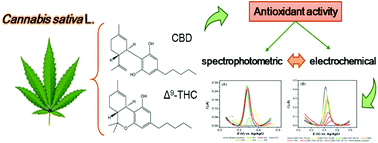
The isolated cannabinoids, the different stoichiometric ratios of CBD and THC, and the natural extracts proved to have remarkable antioxidant properties in all the methods employed in this work.

The antioxidant activity of CBD and THC was compared against that of the well-defined antioxidants such as ascorbic acid (AA), resveratrol (Resv) and (-)-epigallocatechin-3-gallate (EGCG). Clear evidence of the synergistic and antagonistic effects between CBD and THC regarding to their antioxidant activities was observed.

Moreover, a good correlation was obtained between the optical and electrochemical methods, which proved that the reported experimental procedures can easily be adapted to determine the antioxidant activity of extracts from various Cannabis sativa species and related compounds.”

https://www.ncbi.nlm.nih.gov/pubmed/31318364

https://pubs.rsc.org/en/content/articlelanding/2019/AN/C9AN00890J#!divAbstract

Graphical abstract: Probing the antioxidant activity of Δ9-tetrahydrocannabinol and cannabidiol in Cannabis sativa extracts

Cannabidiol Treatment Might Promote Resilience to Cocaine and Methamphetamine Use Disorders: A Review of Possible Mechanisms.

molecules-logo“Currently, there are no approved pharmacotherapies for addiction to cocaine and other psychostimulant drugs. Several studies have proposed that cannabidiol (CBD) could be a promising treatment for substance use disorders.

In the present work, the authors describe the scarce preclinical and human research about the actions of CBD on the effects of stimulant drugs, mainly cocaine and methamphetamine (METH). Additionally, the possible mechanisms underlying the therapeutic potential of CBD on stimulant use disorders are reviewed.

CBD has reversed toxicity and seizures induced by cocaine, behavioural sensitization induced by amphetamines, motivation to self-administer cocaine and METH, context- and stress-induced reinstatement of cocaine and priming-induced reinstatement of METH seeking behaviours. CBD also potentiated the extinction of cocaine- and amphetamine-induced conditioned place preference (CPP), impaired the reconsolidation of cocaine CPP and prevented priming-induced reinstatement of METH CPP.

Observational studies suggest that CBD may reduce problems related with crack-cocaine addiction, such as withdrawal symptoms, craving, impulsivity and paranoia (Fischer et al., 2015). The potential mechanisms involved in the protective effects of CBD on addiction to psychostimulant drugs include the prevention of drug-induced neuroadaptations (neurotransmitter and intracellular signalling pathways changes), the erasure of aberrant drug-memories, the reversion of cognitive deficits induced by psychostimulant drugs and the alleviation of mental disorders comorbid with psychostimulant abuse. Further, preclinical studies and future clinical trials are necessary to fully evaluate the potential of CBD as an intervention for cocaine and methamphetamine addictive disorders.”

https://www.ncbi.nlm.nih.gov/pubmed/31315244

https://www.mdpi.com/1420-3049/24/14/2583