
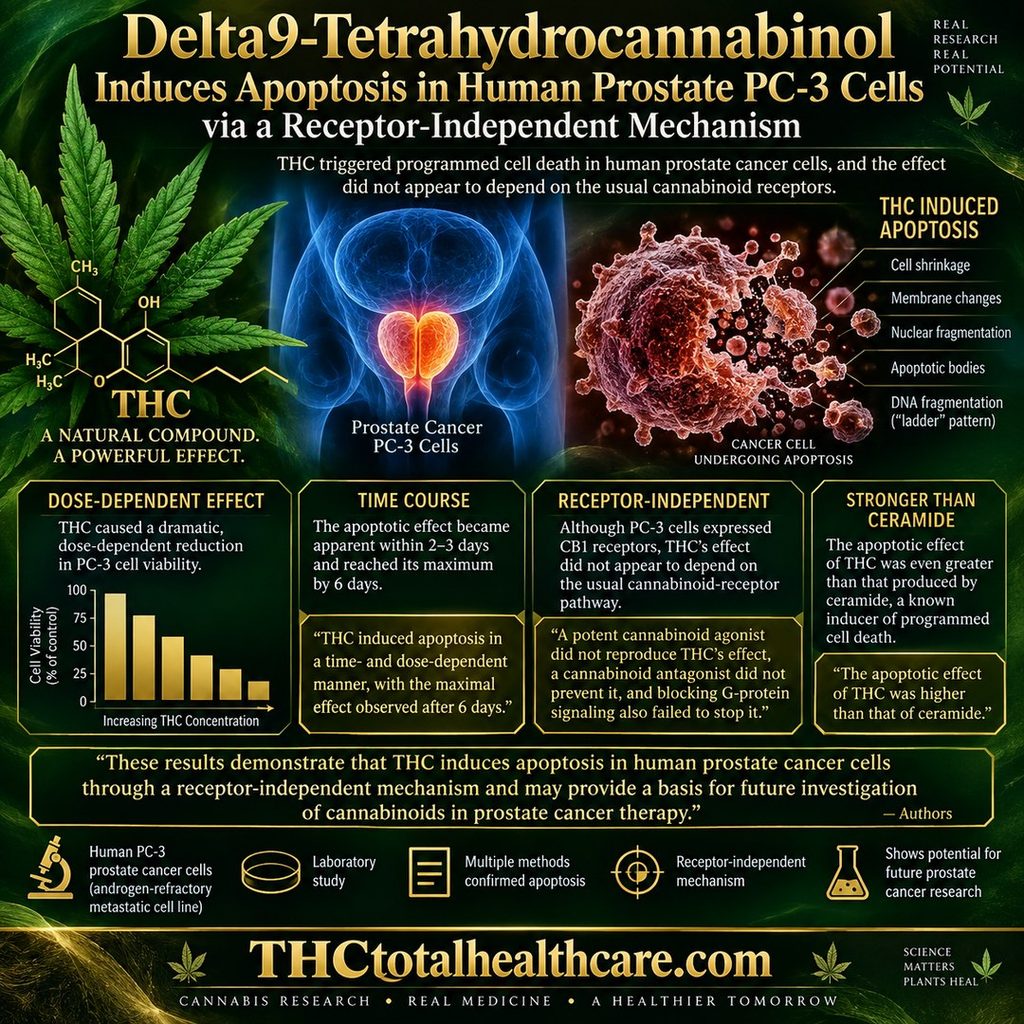
Researchers investigated how delta-9-tetrahydrocannabinol (THC) affects human PC-3 prostate cancer cells, an androgen-refractory cell line derived from a prostate cancer metastasis to bone. THC caused a dramatic, dose-dependent reduction in cell viability and triggered apoptosis, or programmed cell death. The researchers confirmed apoptosis through several independent signs, including changes in the cell membrane, formation of apoptotic bodies, nuclear fragmentation and the characteristic “ladder” pattern of fragmented DNA.
The effect became apparent within two to three days and reached its maximum by six days. THC also produced a dose-dependent increase in apoptotic cells, and the researchers reported that the apoptotic effect was even greater than that produced by ceramide, which they used as a positive control for programmed cell death.
One of the most unusual findings was that THC’s effect did not appear to depend on the conventional cannabinoid-receptor pathway. Although the PC-3 cells expressed CB1 receptors, a potent cannabinoid agonist did not reproduce THC’s effect, a cannabinoid antagonist did not prevent THC-induced cell death, and blocking G-protein signaling with pertussis toxin also failed to stop it. The authors concluded that THC induced apoptosis through a receptor-independent mechanism and suggested that this effect could provide a basis for future investigation of cannabinoids in prostate cancer therapy.
“The effect of delta9-tetrahydrocannabinol (THC), the major psycho-active component of marijuana, in human prostate cancer cells PC-3 was investigated.
THC caused apoptosis in a dose-dependent manner.
Morphological and biochemical changes induced by THC in prostate PC-3 cells shared the characteristics of an apoptotic phenomenon. First, loss of plasma membrane asymmetry determined by fluorescent anexin V binding. Second, presence of apoptotic bodies and nuclear fragmentation observed by DNA staining with 4′,6-diamino-2-phenylindole (DAPI). Third, presence of typical ‘ladder-patterned’ DNA fragmentation. Central cannabinoid receptor expression was observed in PC-3 cells by immunofluorescence studies. However, several results indicated that the apoptotic effect was cannabinoid receptor-independent, such as lack of an effect of the potent cannabinoid agonist WIN 55,212-2, inability of cannabinoid antagonist AM 251 to prevent cellular death caused by THC and absence of an effect of pertussis toxin pre-treatment.”
https://pubmed.ncbi.nlm.nih.gov/10570948
“Results shown here indicate that the cellular death process induced by THC in prostate tumor cells PC-3 shares the biochemical and morphological changes characteristic of apoptotic cells.”
“Thus, in this study, we have shown that the major active component of marijuana, THC, induced prostate PC-3 cell death by an apoptotic process.
The apoptotic death caused by THC treatment was even higher than that produced by ceramide. In spite of the presence of cannabinoid receptor CB1 in prostate PC-3 cells, THC exerts its action via a non-receptor-mediated pathway. Our results are in concordance with previous studies which demonstrate in other cell types, a cannabinoid induction of apoptosis by a receptor-independent mechanism. Cannabinoids also regulate hematopoietic cell growth independently of receptor. Whatever the precise mechanism underlying the non-receptor-mediated effects of cannabinoids, these molecules regulate fundamental cellular functions like proliferation and cell death.
The apoptotic effect of THC described in this study might provide the basis for future therapeutic application of cannabinoids. Further studies will determinate whether cannabinoids exert other effects in prostate cells.”
https://febs.onlinelibrary.wiley.com/doi/10.1016/S0014-5793%2899%2901073-X
Need this THC study explained? thcXplained.com